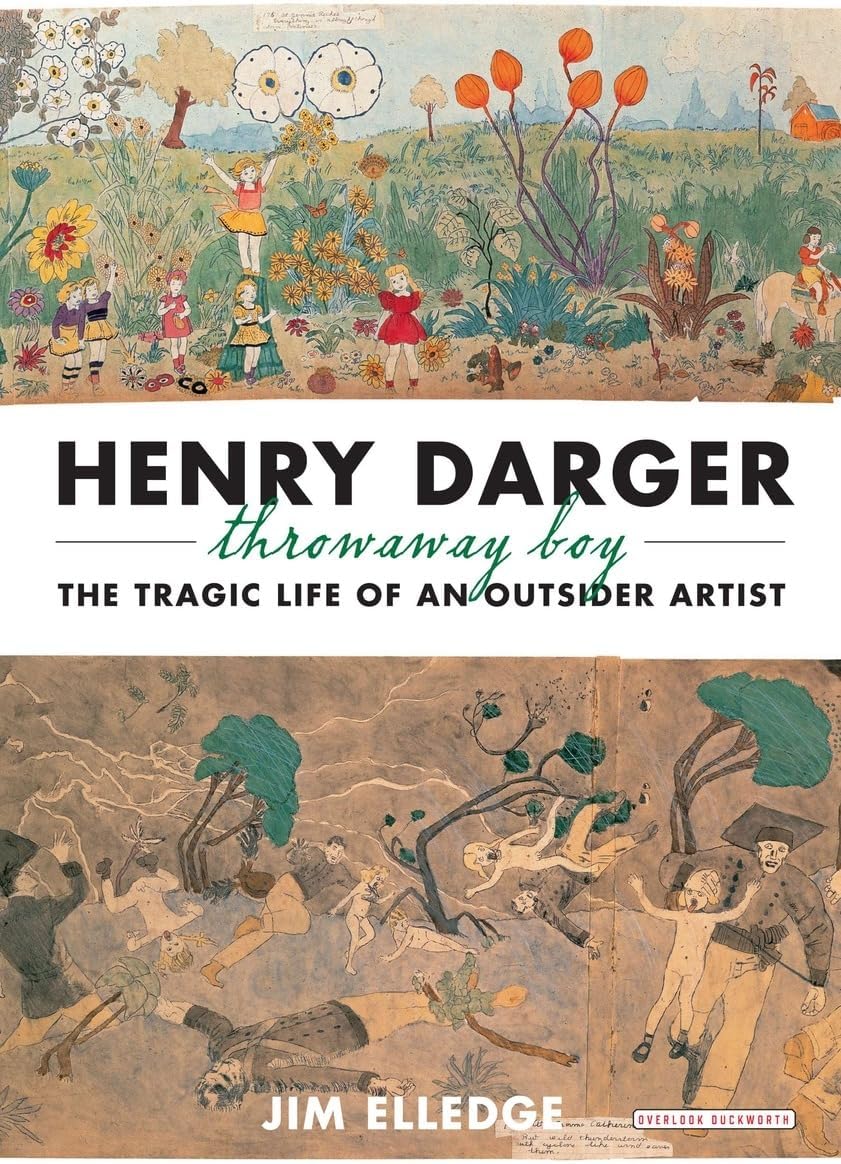
Henry Darger, Throwaway Boy: The Tragic Life of an Outsider Artist
Product ID: 31370080
Buy anything from 5,000+ international stores. One checkout price. No surprise fees. Join 2M+ shoppers on Desertcart.
Desertcart purchases this item on your behalf and handles shipping, customs, and support to Vietnam.
While some art historians tend to dismiss Darger as possibly psychotic, Jim Elledge cuts through the cloud of controversy and rediscovers Darger as a damaged and fearful gay man, raised in a world unaware of the consequences of child abuse or gay shame. This thoughtful, sympathetic biography tells the true story of a tragically misunderstood artist. Drawn from fascinating histories of the vice-ridden districts of 1900s Chicago, tens of thousands of pages of primary source material, and Elledge's own work in queer history, Henry Darger, Throwaway Boy also features a full-color reproduction of a never-before-seen canvas from a private gallery in New York, as well as a previously undiscovered photograph of Darger with his lifelong companion William Schloeder, or "Whillie" as Henry affectionately referred to him. Engaging, arresting, and ultimately illuminating, Henry Darger, Throwaway Boy brings alive a complex, brave, and compelling man whose outsider art is both challenging and a triumph over trauma. Review: Thank You, Jim Elledge, For Setting The Record Straight! - Ever since my recent discovery of Henry Darger, I've wanted to know more about him. Unfortunately, the info out there isn't very helpful, accusing Henry of being "crazy" and a "pedophile" with no concrete evidence whatsoever. This book changes all that by putting the reader in Darger's shoes, uncovering Henry's tragic childhood and heartbreaking adult life. I found myself empathizing with this poor man who was dealt such a sad lot in life. I commend Jim Elledge for his thorough and outstanding job in researching Darger. After reading this book, I can honestly say, I have an understanding of the talented and tortured soul, known as Henry Darger. Review: Not a fantasy world - It's been for a long time one of my favorite tales of a life lived in the Twentieth Century, along with Patti Smith's life and Leonard Cohen's. A boy abused by his relatives and society in the turn of the century 1900s, relegated to a school for Feeble Minded Children who ultimately runs away and finds his future in the harsh, unforgiving underbelly of Chicago. He gains employment as a janitor in a hospital, gains an apartment, and maintains each for the next sixty-plus years, seldom seen by neighbors, a life lived in tragic seclusion. When he dies, his landlord discovers, in the apartment's back room, a nearly 50,000 page manuscript and the walls covered in amazing watercolor illustrations, a rich universe onto itself, an outsider art treasure trove. That's the general story you hear and most of it is true. In these versions, Darger is often portrayed as borderline retarded or naive enough not to know that little girls don't have penises, as he frequently drew them. Or as a psychotic that secretly dreamed of killing children. Jim Elledge dispels many of the lazy generalizations made about this special man and relies on facts as he can find them- school records, rent records, employment records, first hand accounts, ect. He painstakingly goes into the zeitgeist of the times as well- the treatment of homosexuals in the early 1900s, of the mentally ill, the lives lived by those in the stark subcultures of Chicago. In doing so, Elledge is able to come to terms with the controversial artwork and frame the art, and the artist, in a reasonable, factual light. The real history of Henry Darger isn't simple, isn't Herculean, isn't romantic and certainly isn't a modern fantasy. It was a real life lived under difficult circumstances, a life Darger dealt with through his paintings, cut-outs and writings. This book makes Henry Darger truly human.
| Best Sellers Rank | #2,599,112 in Books ( See Top 100 in Books ) #3,555 in Biographies of Artists, Architects & Photographers (Books) #11,665 in Art History (Books) |
| Customer Reviews | 4.3 out of 5 stars 41 Reviews |
B**E
Thank You, Jim Elledge, For Setting The Record Straight!
Ever since my recent discovery of Henry Darger, I've wanted to know more about him. Unfortunately, the info out there isn't very helpful, accusing Henry of being "crazy" and a "pedophile" with no concrete evidence whatsoever. This book changes all that by putting the reader in Darger's shoes, uncovering Henry's tragic childhood and heartbreaking adult life. I found myself empathizing with this poor man who was dealt such a sad lot in life. I commend Jim Elledge for his thorough and outstanding job in researching Darger. After reading this book, I can honestly say, I have an understanding of the talented and tortured soul, known as Henry Darger.
D**L
Not a fantasy world
It's been for a long time one of my favorite tales of a life lived in the Twentieth Century, along with Patti Smith's life and Leonard Cohen's. A boy abused by his relatives and society in the turn of the century 1900s, relegated to a school for Feeble Minded Children who ultimately runs away and finds his future in the harsh, unforgiving underbelly of Chicago. He gains employment as a janitor in a hospital, gains an apartment, and maintains each for the next sixty-plus years, seldom seen by neighbors, a life lived in tragic seclusion. When he dies, his landlord discovers, in the apartment's back room, a nearly 50,000 page manuscript and the walls covered in amazing watercolor illustrations, a rich universe onto itself, an outsider art treasure trove. That's the general story you hear and most of it is true. In these versions, Darger is often portrayed as borderline retarded or naive enough not to know that little girls don't have penises, as he frequently drew them. Or as a psychotic that secretly dreamed of killing children. Jim Elledge dispels many of the lazy generalizations made about this special man and relies on facts as he can find them- school records, rent records, employment records, first hand accounts, ect. He painstakingly goes into the zeitgeist of the times as well- the treatment of homosexuals in the early 1900s, of the mentally ill, the lives lived by those in the stark subcultures of Chicago. In doing so, Elledge is able to come to terms with the controversial artwork and frame the art, and the artist, in a reasonable, factual light. The real history of Henry Darger isn't simple, isn't Herculean, isn't romantic and certainly isn't a modern fantasy. It was a real life lived under difficult circumstances, a life Darger dealt with through his paintings, cut-outs and writings. This book makes Henry Darger truly human.
S**A
Only Half of the Story
Although this is a fine book, it falls short because the illustrations are few and tiny. Darger's paintings were sometimes 10 and 12 feet in length. The book illuminates his deep relationship with William (Sloeder/Schroder?] and the careless abandon with which his father treated him, as well as Darger's tendency to gloss over and even lie about traumatic events in his life. The film shows us his art and how he appeared to others in his daily life but simplifies some things. (For instance, Henry says that his father was a kind and gentle man. Maybe so, but also a selfish drunk. The book tells a deeper and more disturbing story. The book also tries to illuminate Henry's sexual orientation.) Either one on its own falls a bit short of showing us this complicated artist. Together they present a fascinating and (IMHO) comprehensive overview of Henry Darger.
S**A
Justice for Henry Darger
Though some of the author's extrapolations about Mr. Darger's life would cause Sigmund Freud to roll his eyes and remind the reader that "sometimes a cigar is just a cigar, " Mr. Elledge does a credible job in convincing the world that Henry was not a hermit consumed by his own imagination, a pedophile or a sufferer of autism. Instead, the author shows that Mr. Darger's art and literature were motivated by shame over being a gay man and by guilt and anger over being abused as a child and "thrown away" by everyone who could have provided him with happiness and social and economic stability. He was a bitter, impoverished man who could not even afford to adopt a dog to ease his loneliness, and from this train wreck of a life a cultural genius arose. Thank you, Mr. Darger, and thank you, Mr. Elledge.
A**E
A fantastic portrait of the artist, as well as Chicago
Elledge's biography is meticulously researched and compulsively readable. He resists easy and reductive views of Darger as pedophile, and instead investigates his childhood to show the real source of his tortured images-- his heartbreaking early life. At the same time, Elledge's work reminded me of "Devil in the White City" in the way it made Chicago come to life. A fascinating and important book.
R**R
not so sure I like this posthumous invasion of privacy by his landlords...
After reading it, I have no idea if H.D. even wanted his art shown to the world. It seemed very personal and he didn't get anything out of the deal except his personal work shown to everyone without him really being aware. I am not giving his life one star. His courageous life deserves infinite stars in my opinion. It's this mini industry, including this book and others, in which his personal work is the center I wonder about. He wrote he would avenge anyone who stole or took his work so I question it all. He didn't exactly try to draw attention to it when he was younger. Would he be ok with all this? People write he was never an artist yet make more out of his artwork than most other artists. So which is he and if he's an artist, why isn't he involved in any of this after the fact? This Outsider Art framework seems a strange construct in which to place "art" no one else knows what to do with. Well. Art is art. There is no "Outsider Art." If he were around to provide feedback I would feel more comfortable otherwise it's just people taking what he created and profiting from it without him. It's like he's in the asylum all over again, cut off from what is going on, only this time, the asylum is death.
R**S
Amazing research in this book
Amazing research in this book, a beautifully tragic tale. This story made Henry Darger more human and gave me a greater appreciation of his work than I had from all of the films and books that I have come before it. I have recommended this book many times to other artists and non artists.
M**L
In need of serious professional editing
This subject is fascinating, but I can’t but wonder if there was an editor at all. There’s a great deal of supposition and outright fantasy of people’s thoughts and actions from 100 years ago. It was frankly tiresome to wade through all the fluff of this very interesting subject.
Trustpilot
3 weeks ago
1 week ago