⚡ Power up your home network—wired speed, zero compromise!
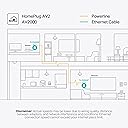
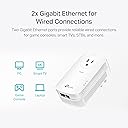
The TP-Link AV2000 Powerline Ethernet Adapter TL-PA9020P KIT transforms your home’s electrical wiring into a high-speed wired network, delivering up to 2 Gbps with 2x2 MIMO and beamforming technology. Featuring dual gigabit ports and an integrated passthrough power socket, it offers effortless plug-and-play setup and power-saving modes, making it ideal for multi-story homes and hard-to-reach spaces where Wi-Fi falls short.


| ASIN | B01H74VKZU |
| Best Sellers Rank | #1 in Powerline Network Adapters |
| Brand | TP-Link |
| Built-In Media | 2-meter RJ-45 Ethernet Cable * 2, AV2000 2-port Gigabit Passthrough Powerline Adapter, TL-PA9020P * 2, Quick Installation Guide |
| Color | White |
| Compatible Devices | Powerline adapters |
| Customer Reviews | 4.1 out of 5 stars 31,618 Reviews |
| Data Link Protocol | Gigabit Ethernet |
| Data Transfer Rate | 2000 Megabits Per Second |
| External Testing Certification | CE |
| Global Trade Identification Number | 00845973094805 |
| Hardware Interface | Ethernet |
| Item Dimensions L x W x H | 2.8"L x 1.7"W x 5.2"H |
| Manufacturer | TP-LINK |
| Product Dimensions | 2.8"L x 1.7"W x 5.2"H |
| UPC | 840460604741 845973094805 |
| Warranty Description | 2-Year Warranty |
B**Y
Great performance and a snap to set up
I purchased these powerline adapters after our development ditched DSL for AT&T Fiber. Now that I had 1 GB of speed, I wanted to improve the throughput of the older TP-Link powerline adapters I'd been using for over 12 years! They worked pretty well, but tose were limited to 200 Mbps (TP-Link AV200) and sometimes had to be reset to regain connectivity. The AV2000 is a major upgrade. They have a maximum speed of 2 Gbps, MIMO, an additional Ethernet port on the bottom of the unit and a passthrough AC in the unit itself. They have never disconnected from each other and provide a fast, stable way to distribute a signal to an area that can't receive wireless or that would benefit from the higher bandwidth of aa wired connection. As an example, I use them to connect a TV to an Apple TV 4K on our patio where wireless isn't strong enough for a reliable connection. The difference in performance over the AV200 is night and day. These are a major upgrade from what I was using, but then again, the ones I had were purchased in 2013. If I have a criticism, it's that they are twice as large as the AV200's I was using. If you plug a device into the AC passthrough, it becomes pretty bulky. It makes hiding the device a bit more challenging and requires at least a few inches of depth to hide it behind a piece of furniture. In exchange for the drawback, the performace of the AV2000 is sensational and makes extending your network a very simple chore!
C**S
Great Alternative to Running Ethernet – High-Speed, Plug-and-Play Simplicity
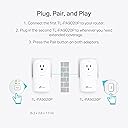
Don’t let the name "AV2000" mislead you—while it implies gigabit or even 2-gigabit speeds, you won’t quite reach those numbers in real-world conditions. However, the Ethernet speeds are still very fast and more than capable of handling streaming, gaming, and general connectivity needs across your home. What makes these powerline adapters shine is their convenience. Running dedicated Ethernet cables through ceilings, floors, or multiple walls is often impractical. These devices let you set up a high-performance wired network without cutting drywall or making permanent changes to your home. It's a clean, non-invasive solution that just works. Setup is completely plug-and-play. You don’t need to install any software or configure settings. Simply plug one unit into a wall outlet near your router and connect it via Ethernet. Then, plug the other unit into an outlet near the device you want to connect—whether that’s a smart TV, game console, or printer—and you’re done. It's that easy. There is a basic utility provided that lets you monitor the adapters, check firmware versions, and update them if needed, but it’s not required for setup or everyday use. Overall, I’m very pleased with the TP-Link AV2000 kit. It’s reliable, fast, and makes extending wired connections in your home incredibly easy. I’d absolutely recommend it to anyone who needs better connectivity without the hassle of physical network cabling.
D**I
Simple & User-Friendly “Finally Fixed My Dead Zone — Works Great, But Not Lightning Fast”
I recently installed the TL-WPA7817 Kit and overall I’m pretty pleased with how it’s improved connectivity in a troublesome spot of my home, though there are a few caveats worth noting. 👍 What I like: Setup was very straightforward: plug one unit near your router, the other wherever you need coverage, press the pair button, and you’re up and running. Because it uses your home’s electrical wiring, it offers awired fallback (via the Gigabit Ethernet port) for devices like a smart TV or game console that benefit from stable connections. In my case, devices that previously struggled with weak WiFi now pull a much better, usable signal. What could be better: While advertised speeds are high, real-world performance depends heavily on your home’s wiring and electrical circuit. As some users point out: “They don’t always work … it heavily relies on how modern electric installation in your building is…” Reddit In my home, I didn’t achieve anywhere near the maximum speed; I’m getting solid improvement over prior WiFi alone, but not the theoretical top numbers. There’s no pass-through power socket on the adapters (on some competing units you don’t lose a wall outlet). The product is best when both adapters are on the same electrical circuit or at least close in wiring terms; if they’re far apart or on different circuits the performance drops significantly.
S**G
Great product!
Had it for a week now, super easy set up and works perfectly! came with everything i need! i connected it to my PC and i can play my games and stream with no lag issue now! perfect alternative to bringing the whole modem upstairs and losing connection to my tv and such
J**E
Wiped out my C9 wifi router
(updated review) 2nd day ownership update: These powerline adaptors completely wiped out my TP-Link Archer C9 router. No joke. I've owned the C9 since Sept 2015 (two months shy of three years), and it has been near perfect. Throughout all of this powerlined adaptor testing I haven't touched my C9 one bit (acting as a simple AP). About an hour after plugging the pair of these powerline adaptors in (one a floor below C9, one a floor above it), slowly but surely all my 2.4, then 5.0G devices drop out. My smart plugs stop responding, Alexa's stop responding, my nest looses its connection... I just noticed my freaking nest rebooted a minute ago for no reason. All the while the powerline adaptors chug along while I perform testing throughout the house. After I unplug the powerline adaptors I have to cold cycle the C9 - it will last anywhere from a few hours to a day at best now before doing the same thing, dropping all my devices. During this if I jack into the ethernet port on the back of the C9 (essentially acting as a switch), I can ping it, get an IP address from my other DHCP server, and connect outbound through my gateway, but NO WIFI. SSIDs are being broadcast, but even if I manually assign an IP I cannot seemingly get any packet movement through the router (have not verified with wireshark). The powerline adaptors seem to directly affect the radios, or power supplies (see below) in this router. I've been setting up and debugging home, corporate and industrial networks as an EE for 15 years, so this is not new to me. If I had messed with the C9's cabling, configuration, power cycled the C9, even moved it prior to testing these adaptors, well I would give these the benefit of doubt and say I inadvertently did something to screw it up. But it was working 100% for months up until now (installed after a move) - and going on three years prior. If it's a coincidence, well I'm sorry to make assumtions, but I'm just putting it out there. I load tested my original C9 12V power adaptor at 3amps for 15-20minutes, and it works as expected. Out of curiousity I plugged a powerline adaptor in and scoped the loaded adaptor 12V output: as expected the powerline adaptors are injecting nearly 800mV of high frequency noise *through* the AC adaptor. This noise shows up at the output of the AC adaptor, every 35mS, for about 400uS in duration and yep, directly into the router. This wasn't even transmitting between adaptors, just an apparent preamble and payload, likely broadcasting for other node discovery. Granted this is the case with any powerline adaptor, however this noise, depending on the frequency, could easily throw switching mode regulator out of whack... If not the AC adaptor itself (I didn't note if this was a linear or switching, but I have to assume switching to get 3.3A@12V), then quite easily any downstream electronics (the C9 no exception) will face issues (with any powerline adaptor). After seeing and experiencing this first hand I am absolutely avoiding powerline adaptors. Do yourself a favor and make due with WiFi. (original review) 1st day ownership: My setup is as follows: 1st floor: internet and gateway/router, NAS. 2nd floor: cat5 from 1st floor to Archer C9 acting as access point. 3rd floor: needed hardwired connection for various office devices (printers, etc). Speed results: 1)with units biggybacked, (one plugged into the other): -TPlinkUtil showed 997Mbps (124MBps). File transfer from NAS 328Mbps (41MBps) -wifi NAS transfer 376Mbps (47MBps) 2)with one unit on 1st floor, the other on 2nd floor at three different sockets (kitchen/dining/living): -TplinkUtil showed 150-229Mbps (19-29MBps). File transfer from NAS 120-146Mbps (15-17MBps) -wifi NAS transfer (5G AC) 528Mbps (66MBps) 3)with one unit on 1st floor, the other on 3rd floor at various sockets (office, bedroom): -TplinkUtil showed 34-79Mbps (4-10MBps). File transfer from NAS up to 96Mbps (12MBps) -wifi NAS transfer 184Mbps (23MBps). Clearly there is very little benefit over a wifi adaptor for using these adaptors, in my setup anyway. A cheap no-name 300N USB adaptor was able to get me the same speeds. Lastly, if browsing the web and doing speedtest tests are all you need, maybe you'll be fine. One note: realize that in most US households the 220 service is broken into two separate 120 "legs". Where the circuit breaker is physically installed inside the electrical panel dictates which leg it's on (often it alternates between one leg and the other when viewing the breakers vertically). To get full performance out of a (any) powerline adapter you *must* be on the same leg as the other adapter(s). Yes they share a neutral and ground but to get the benefit of the "MIMO" you need the other leg also.
D**.
this works great, to get wifi to an out building
i am not good at , internet stuff, wow was this easy just plug it in your router and plug the extender in an outlet , i could not get wifi in my garage , with this iget a strong signal its about 75 ft from my home
A**R
Get Through The Wall
Initial Review, 12/2024 The bulk of this device has caused me to order a bunch of cords and things. It seems good to let others know that the dimensions of the unit should be considered carefully. Big cords do not flex easily. The good part: Despite being on different breaker cicuits of the same breaker box, connection was simple. Performance in initial test was good too. It even claims to have some security. It does not use Wifi or Bluetooth, so it doesn't broadcast over the air. For local point to point, in a house, to perhaps get to the covered deck if its outet is on the same circuit, it might work fine, and then not add another SSID to the neighborhood. It is not very expensive for the pair, and the pair has two RJ45 jacks. So, maybe guest network --> Powerline Adapter --> garage TV, or garage computer type tools, and use it as if it were a public network segment. The questionable part: If somebody gets there hands on it and takes it, they can have a free remote of the same system. They of course can just plug right into the network. The encryption is a black box, and there's no place manage it. Who knows if neighbors can get the signal or not, however the instructions say that it is unlikely. This does not seem so great for an apartment or common wall condo, but maybe... or maybe not! The not so good part: Bulky. Really, really bulky. Prongs are situated so that the thing takes up a whole outlet and more. Tall, and thick, and no side outlet, no side prongs, and loss of other outliets. This is much more of a bummer than one might initially think. Personally, I don't like configuration buttons that people can push, like WPS, or in this case pairing. Outdoor use? Hahaha, well, maybe if you have a weatherproof but ventilated box. If additional use goes well, I will revisit. If things go poorly or if it fails, I will also revisit. Initial tests are promising.
B**E
Amazing, Plug-and-Play as Advertised
if you're having problems with your Wi-Fi, your signal repeater, or your signal extender, or you just don't want so much wi-fi in your life, this is an amazing solution. The two devices do not need to be on the same circuit, notwithstanding the "advisory" in the ad. Mine are not, and it works well, blowing away my previous pathetic Wi-Fi speeds. Now, if the two devices were on the same circuit, my internet speed might improve. I didn't test it, I'm just guessing. However, it's ok, because the speeds I'm getting now with this product is plenty good enough and a great relief. Plus, it's "plug-and-play" as advertised. No need to pour over installation instructions or sweat the small stuff.
Trustpilot
4 days ago
2 months ago