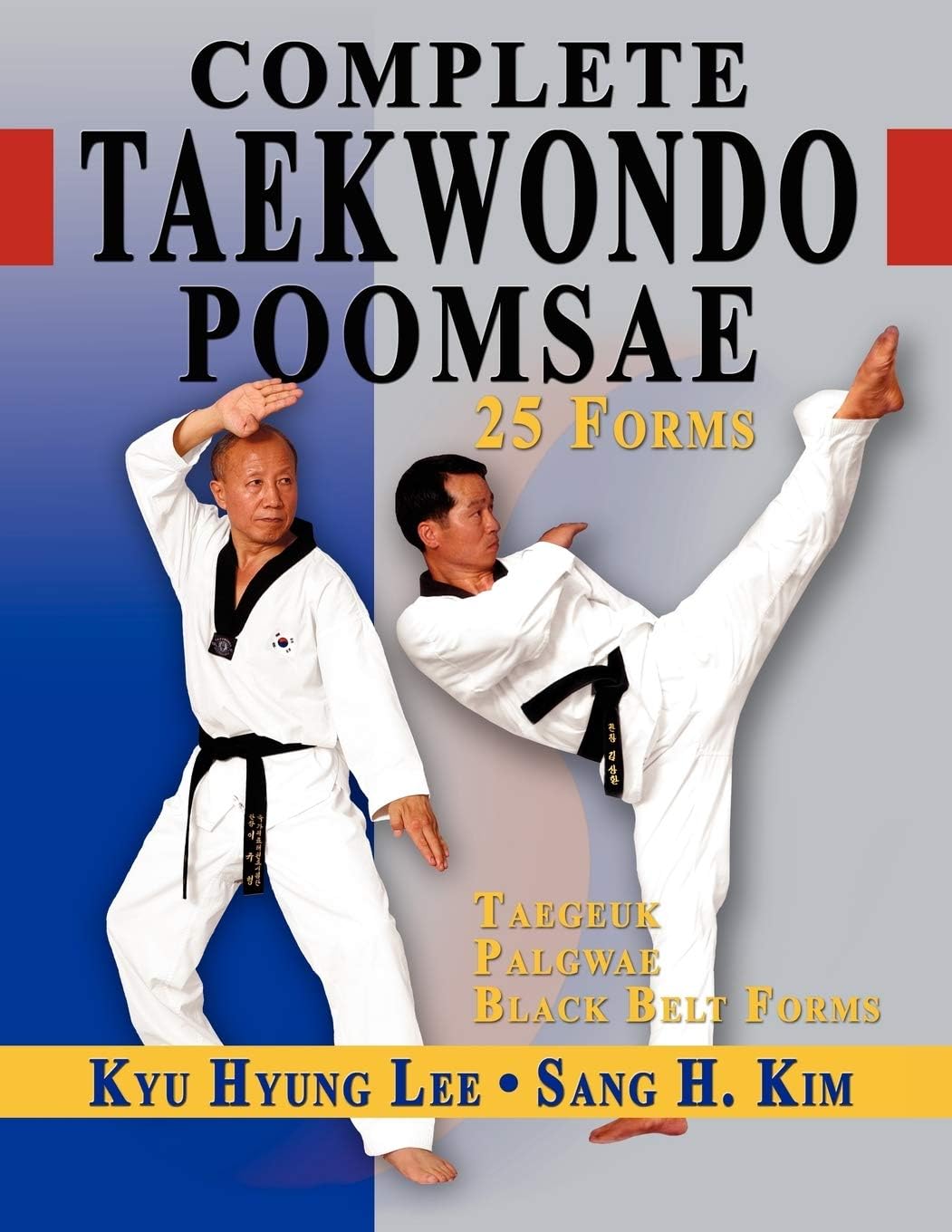
Complete Taekwondo Poomsae: The Official Taegeuk, Palgawe and Black Belt Forms of Taekwondo
Product ID: 3050998
Buy anything from 5,000+ international stores. One checkout price. No surprise fees. Join 2M+ shoppers on Desertcart.
Desertcart purchases this item on your behalf and handles shipping, customs, and support to Vietnam.
The most complete reference book available on the Taegeuk, Palgwae and Black Belt Poomsae of WTF style Taekwondo. Grandmasters Kyu Hung Lee and Sang H. Kim have combined their extensive taekwondo knowledge to teach you not only the 25 official taekwondo poomsae, but also the meaning of the forms, the principles of Poomsae performance and the philosophy that underlies the techniques. Each Poomsae is thoroughly illustrated with clear and technically precise photos. The instructional text is supplemented with information about the meaning, movement line and symbol of each form as well as the correct execution of each new movement introduced in the form. In addition to the 25 official Poomsae, the authors explain Poomsae theory and principles to help you understand the underlying concepts of Poomsae practice. Topics covered include: characteristics of poomsae, 13 fundamental taekwondo techniques, stance, vital targets, bodily weapons, structural principles of poomsae, poomsae creating, movement principles, performance tips, mastery, terminology, origin of Taegeuk and Palgwae, meaning of the trigrams, and complete Korean and English poomsae terminology. Review: THE Taekwondo Textbook!!! - This is THE Taekwondo textbook! The main author was the man who was charged with demonstrating TKD to the world, organizing the TKD demonstration at the 1988 Seoul Olympics. He is now the head coach at the chief headquarters for WTF (the official South Korean) Taekwondo in Seoul, South Korea. You have in your hand THE book of Taekwondo. There is no higher authority! This book actually has the ENTIRE syllabus of Taekwondo in it, not piecemeal. You can study ALL the forms and their contained techniques through this book. The explanations are crystal clear. There is no mystery. Every move's application is clearly explained for you! There are mnemonic diagrams at the start and end of each form so you can check quickly on things you forgot. I've never seen a better organized instructional book before in my life! But the question begs itself - why Taekwondo? Why buy this book and learn this particular martial art? I think knowing what TKD is, through understanding where it comes from is crucial to understanding what you are purchasing: Taekwondo had its birth during the Korean War (1950-53) when the leaders of South Korea's armed forces took notice of the desperate need for their troops to develop strong close quarters combat skills. Unexpectedly, the Korean War developed into a war of close quarters combat and trench fighting, more like World War One than the more recent and highly mobile Second World War. Training had focused on shooting, not on scrapping hand to hand. To remedy this problem, the president, Syngman Rhee, invited ten known martial arts experts to meet and devise a system of training for hand to hand combat to drill the troops in. Apparently these martial arts masters were teachers of variants on Karate, since during the Japanese occupation (1910-45) Koreans were able to travel to Japan to study. In some cases, Karate books read in Korea seem to have been the main inspiration for these masters to initially develop their skills. Karate was developed as the hand to hand combat skill of the royal guards of the king of Okinawa, who were banned from using weapons for hundreds of years by the occupying forces of the Japanese Satsuma clan. They had to arrest and police their own people and visiting sailors from other countries with their bare hands and sticks. Karate, out of necessity, had developed a uniquely effective unarmed fighting method because of this unique situation. The Koreans realized this and learned from it. The Koreans also shared the political situation of the Okinawans of the days of yore, since they too were a disarmed people, colonized by Japan. Traditional martial arts in Korea had focused on weapon forms (for example, sword, spear, flail and halberd patterns/poomse/kata) done by soldiers on foot and horseback; archery was practiced by much of the upper classes as part of their Confucian cultural tradition of the warrior-gentleman. Ssirum, a kind of jacket wrestling, was a major sport, a staple event of fairs and celebrations, and hand to hand fighting method, basically identical to modern judo's standing phase, Kurash and other Eurasian jacket wrestling styles. There was one interesting sport called Taekkyon, popular around the capital city Seoul, which was a form of Ssirum wrestling but also allowed wins by either kicking gently to the head or push kicking so that your opponent had to step back at least three steps to stay up. Kicking someone down to the ground was of course a flat out victory. Korea, a very bookish and intellectual country, had codified many of its martial arts in a book called the Muye Dobo Tongji, which you can purchase in translation through desertcart, and it is a very interesting book too! This book contains a vast array of armed fighting methods, some unarmed ones, and instructions on how to use football games and polo as military training too! I should add that modern Korean soldiers are still made to practice a lot of soccer to develop their fighting skills, including full contact mountainside, in-the-depths-of-the-forest soccer! The South Korean flag depicts a yin-yang (um-yang in Korean) symbol representing perfect balance, surrounded by elemental symbols for earth, fire, water and air. From all these influences, Taekwondo was born. It has the no-nonsense techniques of the weapon-forbidden royal Karate guards of Okinawa, the intentions of the Muye Dobo Tongji for drilling an entire national armed force in hand to hand combat, and the balance and organization of the ying-yang national flag of Korea. It is a powerful, potent and emotional combination, brought about by a desperate situation in the middle of one of the world's most horrific and brutal civil wars, and you can feel it when you practice the forms in the book! I really like some of the common sense and down to earth qualities the authors bring to bear on the subject. They are realistic about the limits of solo training in poomse, and also embrace each individual's personalization of the forms to suit their own needs, physical form and qualities. To explain it simply, poomse practice is excellent low-impact but high-yield exercise; it improves the circulation of the cardio-vascular system; develops a fearless spirit in fighting, since you ALWAYS WIN against your imaginary opponents and you soon begin to expect to always win against real opponents too; and of course, you develop a set of tactical moves to use against real opponents which in most cases either distract, entice or mislead your opponent into leaving an opening for you to exploit. A great many of the moves in this book are illegal in modern TKD competition. I'm actually primarily a judo practitioner, and I see more applications for the book's techniques in jacket wrestling situations (nearly every move involves a pull with the opposite hand to the one striking, on the opponent's sleeve or other part) and street-fighting (all the injury-producing moves) than in a modern TKD ring. The authors point this fact out for us, and let us know that the poomses contain a vastly more complete system of fighting than can sparring, with all its safety considerations. (In the military, however, TKD sparring and full-contact TKD football (soccer) is done full-contact, without safety equipment.) But the poomses cannot teach us distance and timing against real opponents, things that only sparring can teach us, in spite of its limited, watered-down nature. One of the genius things about TKD is that it is designed to be practiced in a very limited space. I imagine the creators of the poomse devising them in their small traditional houses, or little courtyards in their houses, or even in their small apartments. But this is brilliant for a modern martial art. What I love about this book the most is that I can practice and hone my TKD skills in my own home, and not bother anyone or have to go out of doors somewhere to train, like a gym or something. I can do it all right where I live! This is why I think this book is among the very best BOOKS for martial arts. You can learn and do everything yourself, in your own house, in a small or moderately sized room! Get to it! I'm in great shape because of it! My judo fighting has improved tremendously. I'm much more healthy, alert, happy and feeling awake and alive! Also, my memory has improved tenfold from memorizing all the forms and drilling them. My mind is much sharper than it was before too! Review: Clear and helpful - Exactly what I was looking for. Wish I’d found it a few belts ago! Great if you are learning TKD and need reminders of the steps.
| Best Sellers Rank | #983,662 in Books ( See Top 100 in Books ) #743 in Martial Arts (Books) #3,938 in Exercise & Fitness (Books) #71,380 in Arts & Photography (Books) |
| Customer Reviews | 4.7 out of 5 stars 277 Reviews |
P**S
THE Taekwondo Textbook!!!
This is THE Taekwondo textbook! The main author was the man who was charged with demonstrating TKD to the world, organizing the TKD demonstration at the 1988 Seoul Olympics. He is now the head coach at the chief headquarters for WTF (the official South Korean) Taekwondo in Seoul, South Korea. You have in your hand THE book of Taekwondo. There is no higher authority! This book actually has the ENTIRE syllabus of Taekwondo in it, not piecemeal. You can study ALL the forms and their contained techniques through this book. The explanations are crystal clear. There is no mystery. Every move's application is clearly explained for you! There are mnemonic diagrams at the start and end of each form so you can check quickly on things you forgot. I've never seen a better organized instructional book before in my life! But the question begs itself - why Taekwondo? Why buy this book and learn this particular martial art? I think knowing what TKD is, through understanding where it comes from is crucial to understanding what you are purchasing: Taekwondo had its birth during the Korean War (1950-53) when the leaders of South Korea's armed forces took notice of the desperate need for their troops to develop strong close quarters combat skills. Unexpectedly, the Korean War developed into a war of close quarters combat and trench fighting, more like World War One than the more recent and highly mobile Second World War. Training had focused on shooting, not on scrapping hand to hand. To remedy this problem, the president, Syngman Rhee, invited ten known martial arts experts to meet and devise a system of training for hand to hand combat to drill the troops in. Apparently these martial arts masters were teachers of variants on Karate, since during the Japanese occupation (1910-45) Koreans were able to travel to Japan to study. In some cases, Karate books read in Korea seem to have been the main inspiration for these masters to initially develop their skills. Karate was developed as the hand to hand combat skill of the royal guards of the king of Okinawa, who were banned from using weapons for hundreds of years by the occupying forces of the Japanese Satsuma clan. They had to arrest and police their own people and visiting sailors from other countries with their bare hands and sticks. Karate, out of necessity, had developed a uniquely effective unarmed fighting method because of this unique situation. The Koreans realized this and learned from it. The Koreans also shared the political situation of the Okinawans of the days of yore, since they too were a disarmed people, colonized by Japan. Traditional martial arts in Korea had focused on weapon forms (for example, sword, spear, flail and halberd patterns/poomse/kata) done by soldiers on foot and horseback; archery was practiced by much of the upper classes as part of their Confucian cultural tradition of the warrior-gentleman. Ssirum, a kind of jacket wrestling, was a major sport, a staple event of fairs and celebrations, and hand to hand fighting method, basically identical to modern judo's standing phase, Kurash and other Eurasian jacket wrestling styles. There was one interesting sport called Taekkyon, popular around the capital city Seoul, which was a form of Ssirum wrestling but also allowed wins by either kicking gently to the head or push kicking so that your opponent had to step back at least three steps to stay up. Kicking someone down to the ground was of course a flat out victory. Korea, a very bookish and intellectual country, had codified many of its martial arts in a book called the Muye Dobo Tongji, which you can purchase in translation through Amazon, and it is a very interesting book too! This book contains a vast array of armed fighting methods, some unarmed ones, and instructions on how to use football games and polo as military training too! I should add that modern Korean soldiers are still made to practice a lot of soccer to develop their fighting skills, including full contact mountainside, in-the-depths-of-the-forest soccer! The South Korean flag depicts a yin-yang (um-yang in Korean) symbol representing perfect balance, surrounded by elemental symbols for earth, fire, water and air. From all these influences, Taekwondo was born. It has the no-nonsense techniques of the weapon-forbidden royal Karate guards of Okinawa, the intentions of the Muye Dobo Tongji for drilling an entire national armed force in hand to hand combat, and the balance and organization of the ying-yang national flag of Korea. It is a powerful, potent and emotional combination, brought about by a desperate situation in the middle of one of the world's most horrific and brutal civil wars, and you can feel it when you practice the forms in the book! I really like some of the common sense and down to earth qualities the authors bring to bear on the subject. They are realistic about the limits of solo training in poomse, and also embrace each individual's personalization of the forms to suit their own needs, physical form and qualities. To explain it simply, poomse practice is excellent low-impact but high-yield exercise; it improves the circulation of the cardio-vascular system; develops a fearless spirit in fighting, since you ALWAYS WIN against your imaginary opponents and you soon begin to expect to always win against real opponents too; and of course, you develop a set of tactical moves to use against real opponents which in most cases either distract, entice or mislead your opponent into leaving an opening for you to exploit. A great many of the moves in this book are illegal in modern TKD competition. I'm actually primarily a judo practitioner, and I see more applications for the book's techniques in jacket wrestling situations (nearly every move involves a pull with the opposite hand to the one striking, on the opponent's sleeve or other part) and street-fighting (all the injury-producing moves) than in a modern TKD ring. The authors point this fact out for us, and let us know that the poomses contain a vastly more complete system of fighting than can sparring, with all its safety considerations. (In the military, however, TKD sparring and full-contact TKD football (soccer) is done full-contact, without safety equipment.) But the poomses cannot teach us distance and timing against real opponents, things that only sparring can teach us, in spite of its limited, watered-down nature. One of the genius things about TKD is that it is designed to be practiced in a very limited space. I imagine the creators of the poomse devising them in their small traditional houses, or little courtyards in their houses, or even in their small apartments. But this is brilliant for a modern martial art. What I love about this book the most is that I can practice and hone my TKD skills in my own home, and not bother anyone or have to go out of doors somewhere to train, like a gym or something. I can do it all right where I live! This is why I think this book is among the very best BOOKS for martial arts. You can learn and do everything yourself, in your own house, in a small or moderately sized room! Get to it! I'm in great shape because of it! My judo fighting has improved tremendously. I'm much more healthy, alert, happy and feeling awake and alive! Also, my memory has improved tenfold from memorizing all the forms and drilling them. My mind is much sharper than it was before too!
B**M
Clear and helpful
Exactly what I was looking for. Wish I’d found it a few belts ago! Great if you are learning TKD and need reminders of the steps.
J**O
Helpful
My son said it is very helpful as he is learning new poomsaes. Easy to follow.
P**S
The Absolute Best of all Tae Kwon Do books
As my headline says, the book is the best of all the books I have tried. I am a 2nd Dan and I travel a great deal, so I was looking for a book that could be of help to me when I am not able to be at my do jong for a couple of weeks at a time. This book is complete: terms, kicks, warm-up exercises and all the taegeuks, palgwae and Black belt forms. There are photos & diagrams for the progression of the forms and then step by step photos and word descriptions. They are easy to follow and there are more photos to tell what you need to keep in mind to do the action properly. I can't recommend this book highly enough. My only comment to the publisher and author would be: Please make a digital edition of this book so that it can come with me more easily than a printed book. To prospective buyers, if you are looking for a book, buy this one!
L**E
Excellent Resource!
I purchased this book to help me continue my taekwondo journey, since it has detailed instructions on the black belt form(s) I've just begun to learn. The attention to detail in this book is fantastic - Each stance, kick, punch and chop has its own dedicated page with the leg and arm positions clearly described in word and picture, and they even go as far as telling you the degree angles for your appendages, and how to breathe through the movement. I truly wish I had invested in this book at the beginning of my Taekwondo studies, rather than waiting over two years to do so. I highly recommend this book for anyone who wishes to further their understanding of forms.
T**D
Very thorough book
Great book with good photos. Some (but very few) photos are in the wrong place, but the descriptions below the photos are in the correct placements. My guess is the taeguk forms are standard, but I have passed all of my taeguk forms already. I have been looking for a printed version of all the black belt forms which are coming down the pipe for me. There must be a difference with each instructor as to which black belt forms are required. Only a few of the forms in this book are the same as those which I must learn.
C**L
Excellent for preparation or review
This is an excellent book for getting ready for promotion, or to review your prior poomsae. The pictures and descriptions are really helpful. In particular, it first gives you an overview of the form, and then gives you pictures from the front and side of each of the individual movements. There are one or two misplaced pictures, but they didn't at all detract from this great book. All of the students at my dojang liked it so much that I had to buy a second copy for the dojang to use. Our dojang is one of the few I've seen that requires students to learn both Taegeuk and Palgwae forms (which I really like). This book covers them all.
J**O
BUEN PRODUCTO
BUEN PRODUCTO A BUEN PRECIO Y LLEGO A TIEMPO
M**S
Excellent learning aid
An amazing book to assist learning the patterns, a must for all levels
K**N
As desired
No issues with the purchase, product, or delivery.
A**L
The poomsae bible
There is not much to say about this book, except that it is the reference on the poomsaes (taegeuk and palgwae). A precious book for any confirmed practitioner of taekwondo.
D**A
Actual Poomsae Reference Guide with In-Depth Explanation with sufficient Photos
In General, the book provides step-by-step illustrations of 25 Poomsae. We may classify them in three groups. (1) It starts from explaining all the eight Taegeuk poomsae (official requirement to appear for Black-belt exam in WTF), (2) Eight old poomsae of Pagwae series (although they are obsolete now in WTF) as well as, (3) All the nine Black-Belt poomsae (from 1st Dan to 9th) approved by Kukkiwon (WTF). Bonus : This book also provides criteria-wise, in-depth Explanation of most frequently used 13 fundamental representative movements needed to perfectly learn any poomsae at any level. To do so, the authors include sufficient number of Theoretical concepts, Master's Tips, Rules and Photographs. I am 100% sure that the readers will be satisfied and happy with the worth of the book for the value of their money invested. This book is best for both the individual use and/or for the instructors to be used in their Dojo as a Poomsae Reference Guide. Best of Luck, keep reading, learning ... because "Knowledge is the Power".
C**H
Leider überflüssig
Nichts Neues, keine nachvollziehbare Darstellung. Wer Formen laufen möchte, der kann viele bessere Bücher finden. Für Anfänger unbrauchbar, für Fortgeschrittene nutzlos.
Trustpilot
1 month ago
2 weeks ago