We remain fully operational. Our teams are working around the clock to ensure your deliveries continue safely.

DOWNLOAD THE APP


Copyright © 2025 Desertcart Holdings Limited
DOWNLOAD THE APP
Buy anything from 5,000+ international stores. One checkout price. No surprise fees. Join 2M+ shoppers on Desertcart.
Desertcart purchases this item on your behalf and handles shipping, customs, and support to Vietnam.
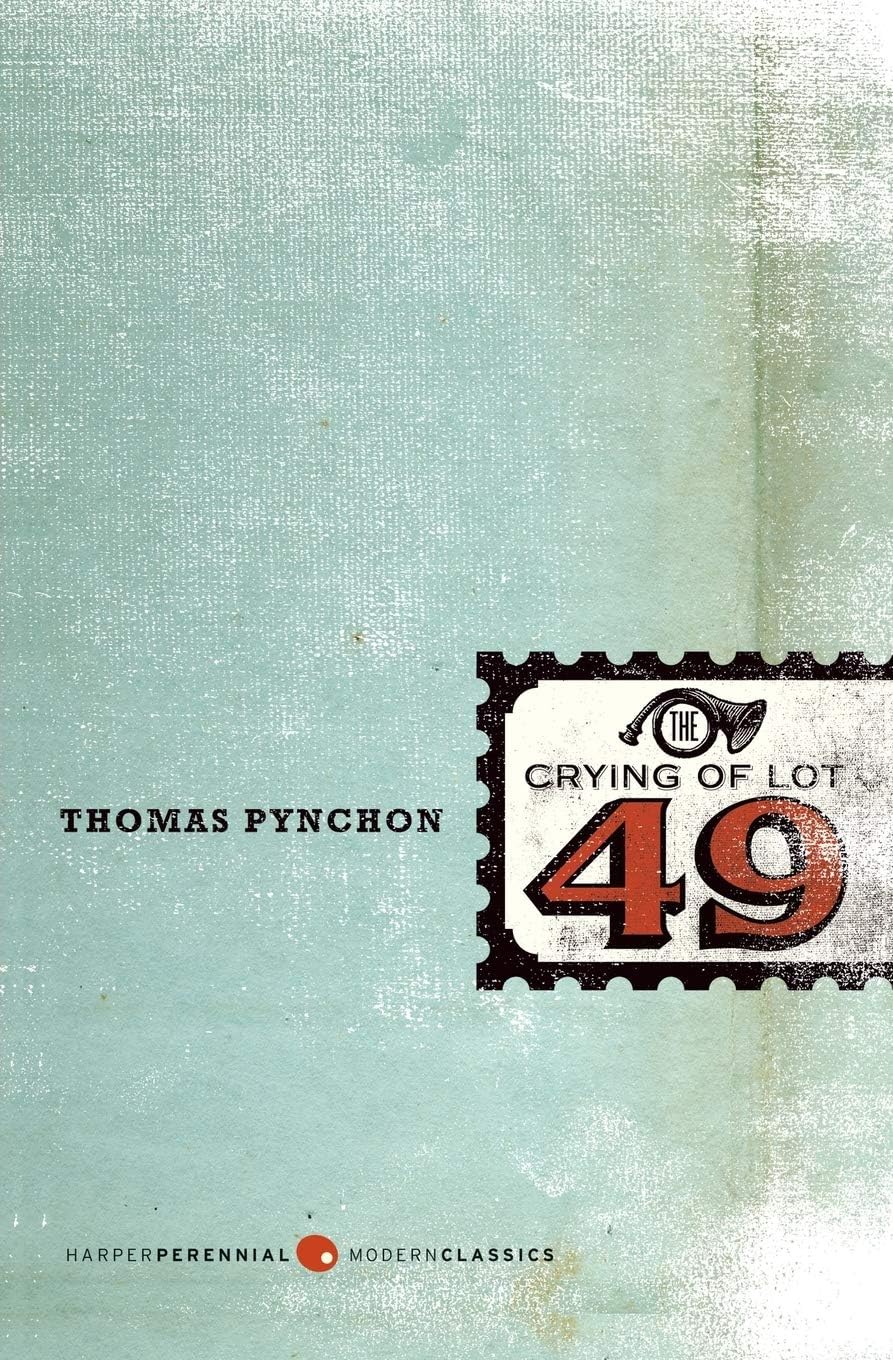
The Crying of Lot 49 (Perennial Fiction Library)
K**R
Perfect Condition
I often browse for books in the stores, and when it comes to purchasing, i prefer Amazon. I like my books in perfect condition. Amazon did not disappoint. The book is high quality.I do not rate the stories themselves, that is a personal...
J**P
A fever dream set afire with a postmodern match.
Pynchon’s novel is dense, surreal and mind-bending. It’s quite a trip and you may need a DIY conspiracy board to make sense of it all.The Crying of Lot 49 intentionally doesn’t aim to fully develop its characters. Pynchon is here to play with form rather than character development, twisting narrative to near disorientation. His prose is playful, almost entirely brilliant, and underscored with pain. It’s a nutrient-dense cocktail of words that’ll mess you up in the best possible way.Pynchon taps into not only a wobbly paranoia, but also a sense of how lost we can feel in a stubborn country of lonely souls pointing fingers at each other.The novel is also about the greater dread that nothing is connected, that everything is random and meaningless. And Pynchon takes not a few shots at 1960s counterculture. Even rebels can trap themselves in their own belief systems.Reality. Just sound and fury, signifying nothing — or perhaps, everything.
A**R
Guide to Being Paranoid
Thomas Pynchon writes the perfect guide to paranoia in The Crying of Lot 49 (published in 1965). His gutsy and self-reliant heroine, Oedipa Maas (more about Pynchon's fabulously funny names later) is named executor of the far-flung estate of an ex-boyfriend. Pierce Inverarity had his fingers in pies of all sorts, including a possible shadow group fighting the monopoly of the US Mail system over mail delivery. The struggle to control the mail dates back centuries (it really does: Pynchon is not making this part up) and the Trystero conspirators are gearing up for an overthrow, offering clandestine methods of getting mail around. Or are they? That's where the paranoia comes in.As Oedipa finds out more and more about seemingly unrelated (but are they?) subjects such as the history of postal subversion (including the philatelical dimensions of forged stamps bearing small, incongruous details in black), and the bones of GIs left at a the bottom of a lake in Italy during World War II and then brought back to the United States to serve as interest for scuba divers in a lake built and outfitted by Inverarity, and the history and performance of Jacobean revenge plays (including one play considered so pornographic and destabilizing that the Vatican keeps it locked up in its library -- another paranoid conspiracy waiting to be written) and resurgent Nazism in San Francisco (not so paranoid, after all), we are as drawn into the twisted story of Inverarity's schemes as she is, and left with the same question: has he created the whole paranoid conspiracy to punish Oedipa or is it a real conspiracy that he was a part of or are all the concurrent acts and facts just coincidences? And if you cannot understand a thing I wrote in this paragraph, don't blame me: read the book.The book was written over forty-four years ago and yet it not dated. The California he writes about is perhaps a bit more innocent and open-spaced than now, but the groundwork for the future is being laid in spiraling real estate developments, spreading smog, and disconnected persons seeking connection, even if it is only the most paranoid grasping for a connection that does not exist.However, there is a noted difference in The Crying of Lot 49 in the 1965 perspective on the Holocaust and World War II, and in today's. In 1965 many survivors and perpetrators of the holocaust were still alive, and WWII was the war people still talked about as a participatory event. It was not an academic discussion of genocide and war, and Pynchon makes the war and the genocide horrible and immediately relevant to his characters. In a way, the characters are seeking to distance themselves from that history, and aligning themselves with an even older history of the struggle against repression while at the same time flying on the balloon of the sixties, trying to get high and find themselves and get laid.I loved how Pynchon uses the 1960s backdrop for his naming of the characters. Pynchon is a timely and sophomoric (but still funny) version of Dickens with his Oedipa Maas (sometimes called "Oed" and sometimes just "Edna"), married to Mucho Maas; we also meet Manni Di Presso, Dr. Hilarius (a Freudian shrink), Stanley Koteks, Mike Fallopian, Genghis Cohen (who calls Oedipa "Miz Maas"), and so on and so on. Pynchon uses silly humor, slapstick, and sly inversions of reality to hold the readers' attention and it all works. The plot of The Crying of Lot 49 is crazy but Oedipa holds it all together, works out all the kinks and twists for me, and makes me a believer.Our Oedipa is an honest and serious girl (she does have some fun in a very funny scene of undressing layers upon layers); she is also an optimist and as dogged as a pit bull. By the end of the book, she accepts paranoia as a necessary state. And she is right, after all. Better to question and wonder, than to be complacent and therefore, unwittingly compliant in the conspiracy. What conspiracy? Take your pick, there are many out there, so keep your eyes open and your brain open, and your options, open. Great good comes from reading great books. For more go to [...]
T**M
Impostures Intellectuelles
Reading this reminded me of an article publishedby Messrs Jean Bricmont and Alan Sokal that argued that "modern French philosophy is a load of old tosh."Then they went on publishing a book on a subject, called"Impostures Intellectuelles"While Pynchon is not a French philosopher, this book could beclassified as a load of tosh. The plot is convoluted asthere is a much of nonsense thrown around without justificationor regard for its relevance within the story line.Among other things we learn that:1. There is a Perpetual Motion Machine built (and operationalapparently) in UC-Berkeley.2. Huge right-wing anti-government conspiracy operates a stealthpostal system, known as WASTE.3. Charcoal for cigarette filters is produced from human bones4. LSD could be an impediment for effective communication5. Etc.Overall, it is a good wholesome summer read, although one wonderswhether the author was under the influence of the said LSD whilecoming up with some of his dense writing.
S**O
El mejor
Soy seguidor y ávido lector de Thomas Pynchon porque tiene un estilo inigualable. Por desgracia, se pueden conseguir pocas de sus novelas en español, por lo que leerlas en inglés es complejo pero genial. Tiene, esta novela en particular, su toque característico: conspiraciones, sátira, personajes profundos. Leer una página de él es como leer una novela entera. Es, en su género, el mejor.
L**E
strange but enjoyable
It’s difficult to know what to make of this. The writing can be fabulous, but puzzling. A strange but fascinating tale, but of what?
C**R
Masterpiece of paranoia and intrigue
Pynchon's 'The Crying of Lot 49' is a labyrinthine journey into paranoia and conspiracy. It's a tightly woven tapestry of intrigue that keeps you guessing until the very end. It's like a rollercoaster ride through a hall of mirrors - thrilling, disorienting, and utterly unforgettable: it even has a bloody full-on play-within-a-play! Unrivalled.
L**S
👍🏻👍🏻
👍🏻👍🏻
R**H
Mind boggling postmodern novel, A salute to Pynchon's artistry
No issues for the quality,but it's a postmodern novel ,if you have not studied detail about what's paranoid self in postmodern time , what's fluid identity then all this meaninglessness in the depiction may seem to u buying worthless.Oedipa's search for truth is meaningless as she feels herself appropriate to be a detective and to collect info about her ex-boy friend she goes trough several steps and on her search she gets nothing even if she's at a moment of reaching the truth somehow it's destructed.The novel also ends with re reality that's misrepresented...
Trustpilot
1 month ago
1 week ago