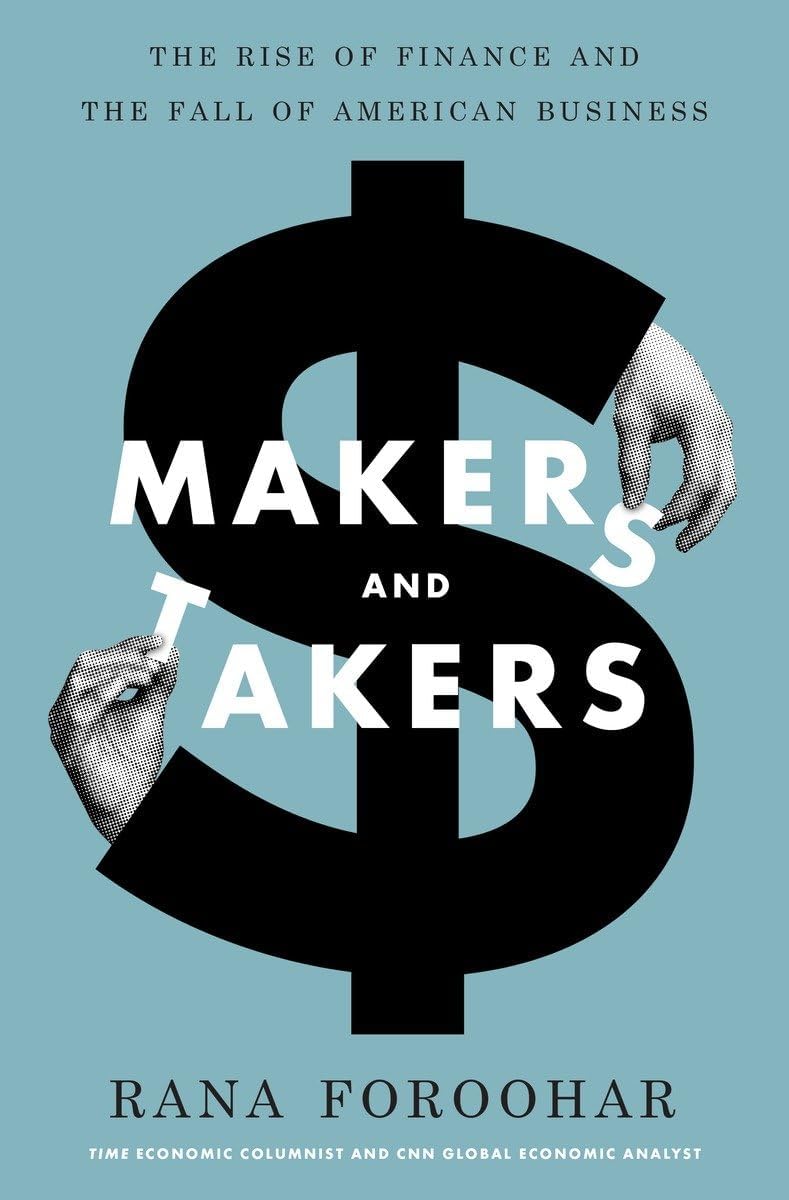
Makers and Takers: The Rise of Finance and the Fall of American Business
Product ID: 28149876
Buy anything from 5,000+ international stores. One checkout price. No surprise fees. Join 2M+ shoppers on Desertcart.
Desertcart purchases this item on your behalf and handles shipping, customs, and support to Vietnam.
Is Wall Street bad for Main Street America? "A well-told exploration of why our current economy is leaving too many behind." — The New York Times In looking at the forces that shaped the 2016 presidential election, one thing is clear: much of the population believes that our economic system is rigged to enrich the privileged elites at the expense of hard-working Americans. This is a belief held equally on both sides of political spectrum, and it seems only to be gaining momentum. A key reason, says Financial Times columnist Rana Foroohar, is the fact that Wall Street is no longer supporting Main Street businesses that create the jobs for the middle and working class. She draws on in-depth reporting and interviews at the highest rungs of business and government to show how the “financialization of America”—the phenomenon by which finance and its way of thinking have come to dominate every corner of business—is threatening the American Dream. Now updated with new material explaining how our corrupted financial system propelled Donald Trump to power, Makers and Takers explores the confluence of forces that has led American businesses to favor balance-sheet engineering over the actual kind, greed over growth, and short-term profits over putting people to work. From the cozy relationship between Wall Street and Washington, to a tax code designed to benefit wealthy individuals and corporations, to forty years of bad policy decisions, she shows why so many Americans have lost trust in the system, and why it matters urgently to us all. Through colorful stories of both “Takers,” those stifling job creation while lining their own pockets, and “Makers,” businesses serving the real economy, Foroohar shows how we can reverse these trends for a better path forward. Review: Incredibly good book, but - I have to give this book five stars because of the depth it goes to on two important subjects - the financialization of American business and its impact on income distribution, and it is good reading. The "but" comes from her beginning and end going back to painting the large commercial banks as the villains when the normal ones had very little to do with the 2008 financial crisis as did the Glass-Steagall Act. Specifically; . Early on she talks about the large increase in financial types among the America's richest people, and in the latest Forbes real-time ranking of billionaires more than 130 of the 1,800 plus billionaires fit this description, but not one was a commercial banker. A 101 year old David Rockefeller might fit that description, but I think his money came from elsewhere. Sandy Weill was at the bottom of the list, but he is more a deal maker and insurance type. Admittedly Jamie Dimon of JPMorgan and Goldman Sachs' Lloyd Blankfein flirt with the bottom of the list but that would be just 2 spots on the 130 plus if they get back into the rankings. .Then the only big bank she talks about in more than passing is Citigroup, which is not a normal universal national bank. Before merging with Travelers and Salomon Brothers, it got two-thirds of its revenue and income from non-American subsidiaries. Then by merging with Salomon Brothers it became one of the big six in investment banking. This merger was the source of its problems, but if Salomon Bothers had been on its own, the Feds would not have been able to rescue it - and it would have been a second Lehman Brothers. The other big banks - JPMorgan, Wells Fargo and Bank of America - had little to do with the pre-2008 problems, albeit Bank of America bought its share with its Countrywide purchase. . At the end she does a good job of suggesting solving the financial problem would be helped greatly by tax reform and several other things - and how difficult this is with a polarized congress and overwhelmed regulators; but she also seemed to feel strongly that a reinstated Glass-Steagall and breaking up the banks were important first steps. Does she really want to see Salomon Brothers, Merrill Lynch, Bear Stearns on their own again, in this polarized world with regulators dealing with things beyond their control? The heavy hand of a JPMorgan, Bank of America and Wells Fargo may be the best thing we have going for us relative to avoiding the next crisis. This is a bit of nitpicking, and it is still an important and much needed book. Review: Best for its breadth (3.7-ish stars) - This is the 200-somethingth review, so cut to the chase: this is a good survey of the impact of the financialization on the US economy. Its main strength is that it highlights many facets of the problem. It’s not a fun book to read; it’s crammed with details and doesn’t necessarily make them all hang together clearly. But if you stick with it you’ll get a good — and unsettling — overview. The author (RF) defines financialization as “the trend by which Wall Street and its way of thinking,” which she terms “short-term [and] risky,” have come to “permeate not just the financial industry but all of American business” (@5). She covers numerous aspects of this problem, including: how firms like Apple spend more on buying back their own shares than on R&D, how investment banks like Goldman Sachs hoard physical commodities like aluminum and drive up prices, how private equity firms now control most of the US rental housing market (that one was new to me), how fund managers are helping themselves to Americans’ retirement savings, as well as how financialization has distorted MBA education, the tax code and Washington regulators. I admit I didn’t pay much attention to her proposed solutions: I lack the faith of most American business journalists that big corporate capitalism can provide solutions. But RF’s diagnosis is valuable because it’s so wide-ranging. While some reviewers found the book easy to read, I found it more average in that regard: passionate, quite serious, with some arresting anecdotes, but otherwise fact-filled and at times very jumpy in its timeline. It doesn’t go into depth on many topics of interest: e.g., it’s not the go-to book to understand the derivatives involved in the 2008 financial meltdown (read some chapters of Janet Tavakoli, instead). There are a few celebrity-journalist touches, such as an awkward passage describing how corporate raider Carl Icahn entertained RF with his voice impressions (@121), but these don’t become overwhelming. Immediately before picking up this book I’d read “And the Weak Suffer What They Must?” by the former finance minister of Greece, Yannis Varoufakis. That book covers a different topic (the evolution of the global financial system, and especially the Euro) but shares some features of this book, such as a choppy timeline and name-dropping personal anecdotes. Nonetheless, Varoufakis is a clearer and more thorough expositor of complicated economic ideas, while inserting a good deal of charm and humor. He is a professor who obviously cares about teaching, while RF is a very busy journalist: that contrast may give you some idea of what to expect from this book. A consequence is that the book omits a few simple explanations that might help readers to fit more pieces of the puzzle together. One is that transactions on the stock market generally don’t bring any money to the company whose shares are being traded — the money just trades hands between buyers and sellers. Despite what textbooks tell you about the important social role of the stock market, less than 1% of the annual value of all exchange-based equity trading around the world goes to companies as new capital to expand their businesses; the rest is gambling. So when RF mentions that "activist investors" don't deserve huge dividends from tech companies because they had no role in helping to create the companies' innovative technology or making their products (@124), the same is true of just about any poor zhlub who bought shares on the market: your money didn't help the company accomplish anything. It also might help readers to know that that the value of financial transactions, including on the stock, bond, derivatives and forex markets, is officially excluded from the definition of GDP, which represents the “real” economy of goods and services. The global annual value of trades on stock exchanges alone is bigger than global GDP, and when you consider the value of all trades in all sorts of financial assets, you get many multiples of global GDP. That, in a nutshell, is why rich people see financial markets as a much better place to make money than the real economy in which most of us work, earn money and spend. Some minor issues: RF omits to mention the role of stock analysts in driving both share prices and executive behavior, and to define such terms as “asset values” and “Chinese walls” (and "eating-club": it's a Princeton thing, apparently). Some of her history, especially in Chapter 3, seemed to me a bit off in a few details, too. Surely systems analysis originated not in finance (@75) but in engineering and military operations research: see S. Optner, ed., “Systems Analysis” (Penguin 1973). RF seems to suggest that managers in the 1950s were focused on stock price (@81); but as I recall from listening to grown-ups as a child in the early 1960s, investors cared most about dividends (and “clipping coupons” if they were bondholders), i.e., about a steady stream of income accruing from holding onto assets, not from making money by trading. Also, by equating the emphasis on the bottom line and accounting that prevailed in that era with “financialization” (@79), RF seems to be using the word in a different sense from her definition at the beginning of the book. Finally, I found at least one significant mistake: RF says that the 1919 Michigan Supreme Court case of Dodge v. Ford “enshrined in law” the notion that “companies ha[ve] a legal obligation to maximize profits for investors, and that their interests trumped those of anyone else” (@70-71). When it comes to the day-to-day operations of a company (as distinguished from sale of the company in certain M&A transactions), this is simply not true in any US state or major country of the world, with the possible exception of Michigan. Plenty of businesspeople do believe there is such a legal duty, which often leads to corporations acting like jerks; so it doesn’t help for this book to encourage that false impression. In sum, this isn't a book to read for its style, nor, aside from a few anecdotes, for its details. But for its big picture of how finance has invaded and destabilized so many areas of our lives, it's worth your time.
| Best Sellers Rank | #1,421,236 in Books ( See Top 100 in Books ) #69 in Economic Policy & Development (Books) #78 in Economic Policy #289 in Economic Conditions (Books) |
| Customer Reviews | 4.4 out of 5 stars 733 Reviews |
A**N
Incredibly good book, but
I have to give this book five stars because of the depth it goes to on two important subjects - the financialization of American business and its impact on income distribution, and it is good reading. The "but" comes from her beginning and end going back to painting the large commercial banks as the villains when the normal ones had very little to do with the 2008 financial crisis as did the Glass-Steagall Act. Specifically; . Early on she talks about the large increase in financial types among the America's richest people, and in the latest Forbes real-time ranking of billionaires more than 130 of the 1,800 plus billionaires fit this description, but not one was a commercial banker. A 101 year old David Rockefeller might fit that description, but I think his money came from elsewhere. Sandy Weill was at the bottom of the list, but he is more a deal maker and insurance type. Admittedly Jamie Dimon of JPMorgan and Goldman Sachs' Lloyd Blankfein flirt with the bottom of the list but that would be just 2 spots on the 130 plus if they get back into the rankings. .Then the only big bank she talks about in more than passing is Citigroup, which is not a normal universal national bank. Before merging with Travelers and Salomon Brothers, it got two-thirds of its revenue and income from non-American subsidiaries. Then by merging with Salomon Brothers it became one of the big six in investment banking. This merger was the source of its problems, but if Salomon Bothers had been on its own, the Feds would not have been able to rescue it - and it would have been a second Lehman Brothers. The other big banks - JPMorgan, Wells Fargo and Bank of America - had little to do with the pre-2008 problems, albeit Bank of America bought its share with its Countrywide purchase. . At the end she does a good job of suggesting solving the financial problem would be helped greatly by tax reform and several other things - and how difficult this is with a polarized congress and overwhelmed regulators; but she also seemed to feel strongly that a reinstated Glass-Steagall and breaking up the banks were important first steps. Does she really want to see Salomon Brothers, Merrill Lynch, Bear Stearns on their own again, in this polarized world with regulators dealing with things beyond their control? The heavy hand of a JPMorgan, Bank of America and Wells Fargo may be the best thing we have going for us relative to avoiding the next crisis. This is a bit of nitpicking, and it is still an important and much needed book.
A**R
Best for its breadth (3.7-ish stars)
This is the 200-somethingth review, so cut to the chase: this is a good survey of the impact of the financialization on the US economy. Its main strength is that it highlights many facets of the problem. It’s not a fun book to read; it’s crammed with details and doesn’t necessarily make them all hang together clearly. But if you stick with it you’ll get a good — and unsettling — overview. The author (RF) defines financialization as “the trend by which Wall Street and its way of thinking,” which she terms “short-term [and] risky,” have come to “permeate not just the financial industry but all of American business” (@5). She covers numerous aspects of this problem, including: how firms like Apple spend more on buying back their own shares than on R&D, how investment banks like Goldman Sachs hoard physical commodities like aluminum and drive up prices, how private equity firms now control most of the US rental housing market (that one was new to me), how fund managers are helping themselves to Americans’ retirement savings, as well as how financialization has distorted MBA education, the tax code and Washington regulators. I admit I didn’t pay much attention to her proposed solutions: I lack the faith of most American business journalists that big corporate capitalism can provide solutions. But RF’s diagnosis is valuable because it’s so wide-ranging. While some reviewers found the book easy to read, I found it more average in that regard: passionate, quite serious, with some arresting anecdotes, but otherwise fact-filled and at times very jumpy in its timeline. It doesn’t go into depth on many topics of interest: e.g., it’s not the go-to book to understand the derivatives involved in the 2008 financial meltdown (read some chapters of Janet Tavakoli, instead). There are a few celebrity-journalist touches, such as an awkward passage describing how corporate raider Carl Icahn entertained RF with his voice impressions (@121), but these don’t become overwhelming. Immediately before picking up this book I’d read “And the Weak Suffer What They Must?” by the former finance minister of Greece, Yannis Varoufakis. That book covers a different topic (the evolution of the global financial system, and especially the Euro) but shares some features of this book, such as a choppy timeline and name-dropping personal anecdotes. Nonetheless, Varoufakis is a clearer and more thorough expositor of complicated economic ideas, while inserting a good deal of charm and humor. He is a professor who obviously cares about teaching, while RF is a very busy journalist: that contrast may give you some idea of what to expect from this book. A consequence is that the book omits a few simple explanations that might help readers to fit more pieces of the puzzle together. One is that transactions on the stock market generally don’t bring any money to the company whose shares are being traded — the money just trades hands between buyers and sellers. Despite what textbooks tell you about the important social role of the stock market, less than 1% of the annual value of all exchange-based equity trading around the world goes to companies as new capital to expand their businesses; the rest is gambling. So when RF mentions that "activist investors" don't deserve huge dividends from tech companies because they had no role in helping to create the companies' innovative technology or making their products (@124), the same is true of just about any poor zhlub who bought shares on the market: your money didn't help the company accomplish anything. It also might help readers to know that that the value of financial transactions, including on the stock, bond, derivatives and forex markets, is officially excluded from the definition of GDP, which represents the “real” economy of goods and services. The global annual value of trades on stock exchanges alone is bigger than global GDP, and when you consider the value of all trades in all sorts of financial assets, you get many multiples of global GDP. That, in a nutshell, is why rich people see financial markets as a much better place to make money than the real economy in which most of us work, earn money and spend. Some minor issues: RF omits to mention the role of stock analysts in driving both share prices and executive behavior, and to define such terms as “asset values” and “Chinese walls” (and "eating-club": it's a Princeton thing, apparently). Some of her history, especially in Chapter 3, seemed to me a bit off in a few details, too. Surely systems analysis originated not in finance (@75) but in engineering and military operations research: see S. Optner, ed., “Systems Analysis” (Penguin 1973). RF seems to suggest that managers in the 1950s were focused on stock price (@81); but as I recall from listening to grown-ups as a child in the early 1960s, investors cared most about dividends (and “clipping coupons” if they were bondholders), i.e., about a steady stream of income accruing from holding onto assets, not from making money by trading. Also, by equating the emphasis on the bottom line and accounting that prevailed in that era with “financialization” (@79), RF seems to be using the word in a different sense from her definition at the beginning of the book. Finally, I found at least one significant mistake: RF says that the 1919 Michigan Supreme Court case of Dodge v. Ford “enshrined in law” the notion that “companies ha[ve] a legal obligation to maximize profits for investors, and that their interests trumped those of anyone else” (@70-71). When it comes to the day-to-day operations of a company (as distinguished from sale of the company in certain M&A transactions), this is simply not true in any US state or major country of the world, with the possible exception of Michigan. Plenty of businesspeople do believe there is such a legal duty, which often leads to corporations acting like jerks; so it doesn’t help for this book to encourage that false impression. In sum, this isn't a book to read for its style, nor, aside from a few anecdotes, for its details. But for its big picture of how finance has invaded and destabilized so many areas of our lives, it's worth your time.
S**S
- - - Best of the Best - - -
If this doesn't win a Pulitzer Prize, I'm scared to imagine what else would. Excluding religious work, this is the best book I have ever read. (The book I read just prior to it was written by a Nobel Prize winner on a similar topic, and doesn’t even compare.) There’s a difference between news (anything new) and information (content that informs). We live in a world flooded with news, but relatively void of clear information. This book is a milestone work that will hopefully help to spark a new genre. Business optimization involves both cost control and value creation. Without sweeping change, the current obsession with the former and comparative abandonment of the latter will “optimize” us right out of being a functional civilization. Finance ultimately reduces to accounting, and if it does not perform as a service to those who are pioneering functional solutions within their individual areas of expertise, then it operates as a tax that progressively corners the world’s wealth for the elite at the cost of the human potential and social wellbeing otherwise promised by the Enlightenment. “Makers and Takers” is an obvious labor of love that is driven by objective logic, informed and materialized by a tour de force of research, and presented with top notch clarity. It is not a political work, but a policy exploration. Politics is opacity. Policies are solutions, grown from seeds of shared understanding. I implore you to read this to help inform your financial future, and empower your influence on government policies. If you’re a teacher, I implore you to make this required reading for your students. If you’re Rana Foroohar- Congratulations on this masterpiece!!! I hope that you are involved in the most crucial policy decisions in Washington. If you’re interested, I’d like see you as President of the United States at some stage in your career.
E**S
Hana Foroobar is pulling back the current on a "dirty ...
Hana Foroobar is pulling back the current on a "dirty little secret" of our so-called senior managers. Finance and Accounting have assumed a role which is commensurate with their ambitions but disproportionate to their training and abilities. In true they know absolutely nothing about how the material world is created or how innovation is actually achieve. The are the penultimate members of the group that Adam Smith considered to be "Unproductive Labour". The create nothing of value and generally their business strategies are purely targeted and wealth extraction and the expense of both employees and future innovation. Interestingly the first monumental failure of the "Finance/Accounting" mindset was the Vietnam War. Able to track every body and widget the war was still lost, in large part because the "Manager" of said war, Robert McNamara may have understood finance very well but knew absolutely nothing about fighting or waging war. This same mindset came to infiltrate and subsume virtually all industries. It has led to the hollowing out of American Manufacturing, $500 billion plus annual trade deficits and the Rise of Trump. Foroohar displays penetrating insight in this work and hopefully it will achieve the recognition it deserves. The new Plantation Overseers sit in corner offices, wear Armani suits and Santoni loafers and have absolutely no idea how to achieve either customer satisfaction or really innovation. Their true intellectual abilities are not up to the task rather their wealth is obtain by devaluing those around them, gaming the system, and co-opting governments to as to hide their pernicious decisions and behaviors.
K**L
great book
I enjoyed every bit of the book. Very well written. Easy language that allows to follow the thoughts of author. Thanks. Recommend!
N**D
You can't regulate cancer
It is great to see an effort to put the term "financialization" into the mainstream, and to have an exploration of its link to economic stagnation and wealth inequality, but ultimately this exploration falls short in connecting the dots. The author, a journalist, has "buried the lead" in my estimation. The rise of the runaway train of our modern financial/banking sector is presented here as a root cause of many problems, and as now being in control of the productive side of the corporate world as opposed to merely serving it (as it originally did). But it could be argued that the financialization of the economy is itself just another symptom of a deeper and more insidious problem: a debt-based global monetary system that's fatal flaw is perpetuated by delusional central bankers. Like addicts, they want to cure too much debt with more debt. The author presents several faces of financializaion, of how the financial sector has run amok in recent decades and how it now pervasively (and adversely) effects the lives of average citizens while further enriching the very wealthy. She writes well and in engaging detail about corporate activism, stock buybacks, derivatives, hedging, deregulation, private equity, retirement plans, regulatory capture, etc. In short, by periodically focusing on the details and stories of specific incidents, companies and personalities, she covers virtually all the bases in a way that doesn't bog down the reader. But the book is much more a description and survey of the "what" than a probing analysis into the "why." The few chapters devoted to the history and the rise of finance concentrate on the evolution of the concept of "shareholder value" and on the evolution of both business schools and of corporate culture to become more cutthroat and bottom-line oriented. The chapters don't fully explain how a greatly financialized economy comes to pass, and the chapter on the misadventures of GM seems to more greatly address the rise of idiotic and insulated corporate bureaucracies than the rise of financialization. Stupid, self-serving and greedy executives and managers have always been with us, and always will. They alone don't bring financialization to dominate an economy. Yet throughout the book, the key to financialization is alluded to even if never fleshed out. The key to it is the unchecked growth of credit/debt, and the key to an unchecked growth of credit/debt is a debt-based monetary system where money IS debt... and where price inflation (whether of goods or assets) is always embraced and the mere threat of deflation, or even a very low rate of inflation, is to be feared and warded off with further expansion of credit/debt by the Fed and the banking sector. By making sure the extractive financial sector ("takers") and its growing levels of debt never contract, we unfortunately make sure growth of the real, productive economy ("makers") DOES contract and stagnate. The takers feed off of and thrive at the expense of the makers, and government policy favoring takers over makers really shifted when the US itself became a "taker" country in 1971, by defaulting on its own promise to redeem IOUs (dollars) for real value (gold). Where the dollar was once a note to be exchanged on demand for something made by makers, a mined and refined shiny metal, it suddenly became a note to be exchanged for... another note. Oil producers, among others, were none too happy. So while the author often brings up the 1970s as a pivotal decade for financialization, she always does so in the context of deregulation or of the debasement of the kinder, gentler corporate culture of old (never mind that businessmen as a rule have ALWAYS sought greater profit, and viewed labor-- quite logically -- as a cost in need of controlling). Not once does she mention the 1970s as a pivotal decade of pervasively high inflation following the collapse of a nominally gold-based global monetary system into one of floating (and manipulated) exchange rates, unlimited credit/debt expansion and "hot money" flows. To talk about deregulating the legal maximum on interest rates without mentioning it in the context of double-digit inflation is indicative of the author's greater failure to approach her subject in a larger historical and global context. The 1970s marked not only overall price inflation, but a vast increase in dollar-denominated oil prices, global shifts in the flow of goods and capital, the rise of neo-mercantilist global competition, and an end to any corporate complacency that just being mediocre "makers" would continue to be business as usual. So it is not surprising that shortly thereafter GM decided making loans was as good or better a business as making cars. With the dollar no longer constrained by gold, the decade also welcomed the new culture of a bottomless pool of federal money for just about anything, including to subsidize business and banking via bailouts. As the 1980s progressed, so did the interrelated rise of trade deficits, budget deficits, public/private debt, and the financialization of the economy. Yes, part of this was due to the perverse incentives created by re-regulation and changes to the tax code. But where was this flood of new money coming from, being channeled through Wall Street? The bulk of spending power is created out of thin air by private sector banks, who don't need to lend out deposits but can create deposits by creating loans, the dual nature of credit/debt. More debt = more credit = more money. Formerly, the creation of dollars was constrained by a "gold cover." But because of the new post-Bretton Woods monetary system, USG deficits helped fund imports of Japanese and European goods, without the same massive loss of US gold reserves that was occurring during the 1960s. The dollars to fund imports largely stay within the US banking system as the exporting country's reserves. So increased debt, whether public or private, helps fuel increased financialization... which in turn helps fuel more debt creation! The monster feeds on everything, and the only way it will die is to let it feed itself to death (and stop giving it the Alka-Seltzer of bailouts). Under the old system, makers had to keep making, because only the productive output of goods and services allows for continued net imports (gold being one of those goods). Under the new system, net-exporting economies chose to accumulate USG debt as a store of wealth. Well, debt is a lot easier to conjure up than gold. The new system is something of a global Ponzi scheme, akin to perpetually using new credit cards to pay off existing debt. The key to this system, unfortunately, is that the new debt isn't simply created and spent by the USG, but rather is channeled by the Federal Reserve through Wall Street monster, which slices, dices, digests and then amplifies the debt through the various modes of financial engineering that are well-discussed in the book. We should stop referring to this system as "capitalism" and, as Richard Duncan has, call it something like "creditism" or "debtism." And Piketty should re-title his book "Credit in the Twenty-First Century" rather than "Capital in the Twenty-First Century." Companies and rich individuals are not so much getting a return on "capital" in the true and non-financialized sense of the word. They are largely getting a return on credit, of credit. As long as credit can be created in infinite amounts, should we expect anything less of the RETURNS on credit? Only when the ability to create credit contracts or collapses, and is then limited in its ability to re-expand, will we see a decline in the returns and a decline in the growth of inequality.. The author, at the end of the book proposes that various reforms by government -- of poorly designed and enforced regulations and tax codes -- may ease the perils and pains of financialization. Surely they are needed and long overdue. But in fact, it is government along WITH the financial/banking sector, via the Fed, that has designed the perpetually-increasing-debt system, and that actively promotes its continued worsening through artificially low interest rates. We can't look to government to end or reform a system that it feeds, endorses and perpetuates. Funny thing is, the author notes the role of the Fed in passing several times, but only in passing. In her final chapter on solutions the Fed is not mentioned at all. Earlier, she has said the Fed's low interest rates were the "kerosene for financialization." She says as long as markets are "genetically modified by the Fed, the economy would look healthier than it actually was." (Well, that has been occurring since the 1980s.) She correctly says the boosting of asset prices results from Fed easy money, and that asset bubbles help increase inequality, even though these policies are "supposed to help the little guy." (Bernie Sanders, take note.) She says as the Fed "pumped money into the economy after the financial crisis, speculators funneled much of it into commodities," helping cause global increases in oil and food prices. Interestingly, she barely mentions the Fed or central banks in general in her entire chapter on how financialized speculators destroy true market signals (of supply and demand). Yes, they profit by creating volatility and artificial paper shortages and high prices of commodities and food, by way of either engineered manipulation or by global flows of surplus credit. But it is central;banking, manipulated interest rates and the global fiat dollar system that precipitate these vast flows of hot money in the first place. Doesn't this journalist want to get to the bottom of the story? Also hard to understand is her defense of bailouts. She has pretty much, and pretty convincingly, spent the entire book making the case that the financial sector has become way to large, has perpetuated vast increases in debt, no longer serves the productive economy but extracts from it, has gone from "too big too fail" to even bigger, serves to create serial financial bubbles that make the rich richer and the poor poorer, has ruined both the retirement system and the housing market for the bulk of current and future Americans. has become so powerful that it basically owns those tasked with regulating it.... yet she thinks "Washington did a great job in saving the banking system." Well, they also did a great job helping create the monstrosity in the first place. Note what has happened in the past few boom/bust cycles with inequality. It rises in the boom, falls in the bust, then rises (as now) in the subsequent Fed-fueled asset bubble. If you really want inequality to fall, Piketty is probably correct: it will take depression, war, or revolution. Consider, a depression is the option with the least violence and with the greatest wealth destruction of all that paper (asset) wealth owned by the rich. In war and revolution, cities burn, factories burn, farms and fields burn, people burn. In the destruction of asset values, only paper burns. Nominal wealth is destroyed. REAL wealth is untouched. Clearly, no one can really know what institutions would have survived or failed without bailouts. Obviously there would have been carnage, and obviously recovery from it would be long. But we know what DID survive WITH the bailouts: the status quo. And we got no return to a more vibrant, productive economy of the type that might come with letting TBTF fail. It's like going to the doctor with a giant malignant tumor, and he gives you the good news: I think we can save it. We'll regulate this tumor, will give it incentives to behave well, we'll make it more benign... even though we've failed in all our other attempts to do so. I say, let it die, before it kills us. Yes, it will be painful, just as it will be the next time the system implodes and gets bailed out again. If we let all this bad debt collapse, and let the debt-mongers die the market-based death they deserve to die, the world will not end. I can tell you exactly what will grow back in its place, if the risk-takers pay their own way rather than being allowed to socialize losses: a smaller, healthier, more functional system.
E**R
Did modern finance kill innovation?
In 1946, over a decade before he became the architect of the Vietnam War, Robert McNamara was hired to rehaul the Ford Motor Company. It was in desperate need of help. The iconic corporation was hemorrhaging about $9 million a month. McNamara, an accountant by training who rose to prominence by applying statistical methods to warfare planning, immediately transformed the culture. Decisions were no longer made from the eye of a designer, or the experience of the line-worker. He immediately developed complex financial metrics to measure a product’s viability. Every penny spent in manufacturing, marketing, design, and engineering had to be justified and rationalized through this analysis. It shifted power from engineers to MBAs. Within three years he doubled the company’s profits. In Makers and Takers, Rana Foroohar argues that this was the end of American global automobile leadership. As crazy as it sounds, the question needs to be asked: Did modern finance destroy innovation? Makers and Takers The book’s central argument is that finance should be a utility. Unlike an electric company, which allocates energy to businesses and people to power the economy, banks allocate capital. Theoretically, in an efficient financial system all an entrepreneur needs to do is have a great idea and a solid business plan. The bank evaluates the plan, loans the money, and makes a profit on the interest. It’s an easy, boring business. If things work out the entrepreneur becomes wealthy, people are employed, and the community receives long term investment. Foroohar presents the case that McNamara spearheaded a revolution that moved finance from a supporter of the economy to the center piece. It no longer allocates capital and gets out of the way; today finance manages nearly all aspects of business. It no longer helps make society; it takes from society. You may be asking yourself, “Didn’t McNamara’s approach double profits in a few years? Didn’t he he bring a company back from the dead?” I think Foroohar’s answer would be: not really. Of course, every firm needs some level of financial structure to succeed, and he should be applauded for his contribution. But during the post-WW2 era, Ford’s growth was driven primarily by societal trends not anything one person did. The U.S. government invested $25 billion to create a 41,000 mile interstate highway system that reduced the time it took to cross the country from about two months to five days. Incomes rose by 2.5 percent a year creating the middle class. In plain English, McNamara’s arrival coincided with both a massive increase in the demand for cars and a budding infrastructure to drive them on. He was born on third base, and everyone thought he hit a triple. From a product perspective, Ford was in such good shape that it took about a decade for McNamara’s impact to be felt. According David Halberstam’s The Reckoning, a 1986 opus on the decline of the American automobile industry, under his system, managers “contrived not to improve but in the most subtle way to weaken each car model, year by year.” This meant “a cheaper metal here, a quicker drying paint there.” Foroohar reports that the system tried to eliminate spare tires in the vehicles, because managers didn’t know anyone who ever had to change a tire (Executives often had company cars—replaced every six months). Eventually the small cutbacks led to huge profits at the expense of quality. During his tenure, Ford debuted two of the most universally loathed cars in the history of the industry: The Pinto and the Edsel. “Accountants were replacing tradesmen,” Foroohar writes. “Making money was slowly but surely replacing the goal of making great products.” The hidden poison: Modern finance destroyed innovation The most damaging legacy of McNamara may have been his impact on labor relations. Labor became a commodified input. It was now something to be managed and squeezed; just a cost of doing business. Never mind that one of the major drivers of innovation is the collaboration of the factory floor and the engineering team. There’s a reason why Bell Labs designed their buildings to house both engineering and manufacturing—a strategy Tesla uses today. While Japanese and German firms were becoming more productive and agile by engraining labor into the strategic decisions of the company—America was building walls and eroding key competencies by outsourcing production. Conclusion Foroohar’s book isn’t perfect–it goes on a bit long and only offers a few solutions—but it’s a well-meaning and well researched book on the modern economy. Not the economy that we hear about on the nightly news or in sound bytes, but the actual structure and incentives driving modern business. She makes a good case that yes, modern the modern financial system has destroyed America’s ability to innovate. The entire system rewards short term gain, over long term investment. The good thing, she notes is that none of this is permanent. “We can remake [the economy] as we see fit to better serve our shared prosperity and economic growth.” This originally appeared on [...] Check it out for more reviews and analysis
K**M
Financiers Take Over - And it Is Not Good For Business
An incredibly thought provoking book about how finance has taken over business. The general theme is that the financiers of the world have taken over business in the sense that people do not run businesses for product development, R&D etc. but rather they run businesses that are driven by financial engineering. Case in point: Apple. Apple has transformed itself from a company that ignored wall street and just focused on incredible R&D and development of innovative products to a company whose stock is driven by financial engineering. They borrow money to pay dividends! As if to prove this point, I was watching CNBC interview a person about what GE will do with the "windfall" now that they are not under the capital rules of "too big to fail". The "smart" person being interviewed said they could do one of three things: 1) Buy back stock 2) pay dividends 3) buy a company. This is exactly the craziness that Rana discussed. None of those three things add value - in fact, they generally extract value to the privileged investor. What about investing in developing new products? That was not even mentioned. It is a fascinating book and really should be read by all. It is the financial take over that is consuming business which is a key reason we have a stagnant economy.
L**G
Why political leaders have to recapture regulation from the private financial sector
There is no other way. The author shows with examples the leaders of the financial organizations and their lobbyists have "captured" many members of the House and the Senate to approve the wrong regulations that are in their financial interests but not of the American citizens. These organizations and the healthcare sector spend the largest amounts on lobbying. Most banks and hedge funds also donate large sums to election campaigns of the members of congress. This combination of the leaders of private financial organizations and lobbyists will obstruct with all their power most if not all the changes the author thinks should be made. The author expresses the hope that the new political leadership will read the book and act on her ideas. Donald Trump has well understood that a large part of the middle class is very dissatisfied with the performance of the government because their income has not increased over the last five to seven years and many "good" jobs have disappeared. The risk, even the probability, is that if he would be elected that instead of capturing again the financial regulation that he will deregulate it even further leading to the next great depression. The other candidate Hillary Clinton has a reputation of being a friend of Wall Street. Elizabeth Warren, is a close collaborator, is referred to in the book may well agree with what the author recommends. There may be way. I found the book very worthwhile to read. The author has done an excellent job in putting together facts that for the most appear to be well documented and a big picture. The total picture is very complex with a very large number of statistics, concepts and ideas. I have read the book three times and only after the third time do I feel confident to rate it five stars and recommend it to others. There is also the revolving door. The author also explains that one of the causes of the problem is the mistaken belief that the freer the market the faster the economy grows. Freedom and the free market are indeed essential. The book "Concrete Economics", "The Hamilton Approach to Economic Growth and Policy'" by S.S. Cohen and J.B Delong, explains very clearly that Government has to create the right frame work that includes the right laws and regulations for competent and ambitious entrepreneurs and businessmen to make the real economy grow. That framework has been deteriorating since 1980 with as a warning signal the subprime disaster from 2008 initiated by the private financial sector and the wrong government policies. The author has made a real contribution in explaining what is wrong with the financial system, the causes and the potential to change it so it becomes an engine of growth for the real economy.
M**R
Muy interesante.
Muy recomendable. Una análisis del daño que los mercados financieros nos están haciendo.
A**R
Speaks of mistakes of finance and gives a great
The book truely lives up to expectations. Speaks of current corporate trends. Speaks of mistakes of finance and gives a great insight
C**E
ottimo
Finalmente qualcuno ai massimi livelli del giornalismo economico ragiona con la propria testa senza preconcetti ideologici e ci offre una diagnosi e delle soluzioni che danno speranza a tutto il mondo occidentale e non solo agli USA
D**G
有价值
非常棒的书,值得购买
Trustpilot
1 day ago
2 months ago