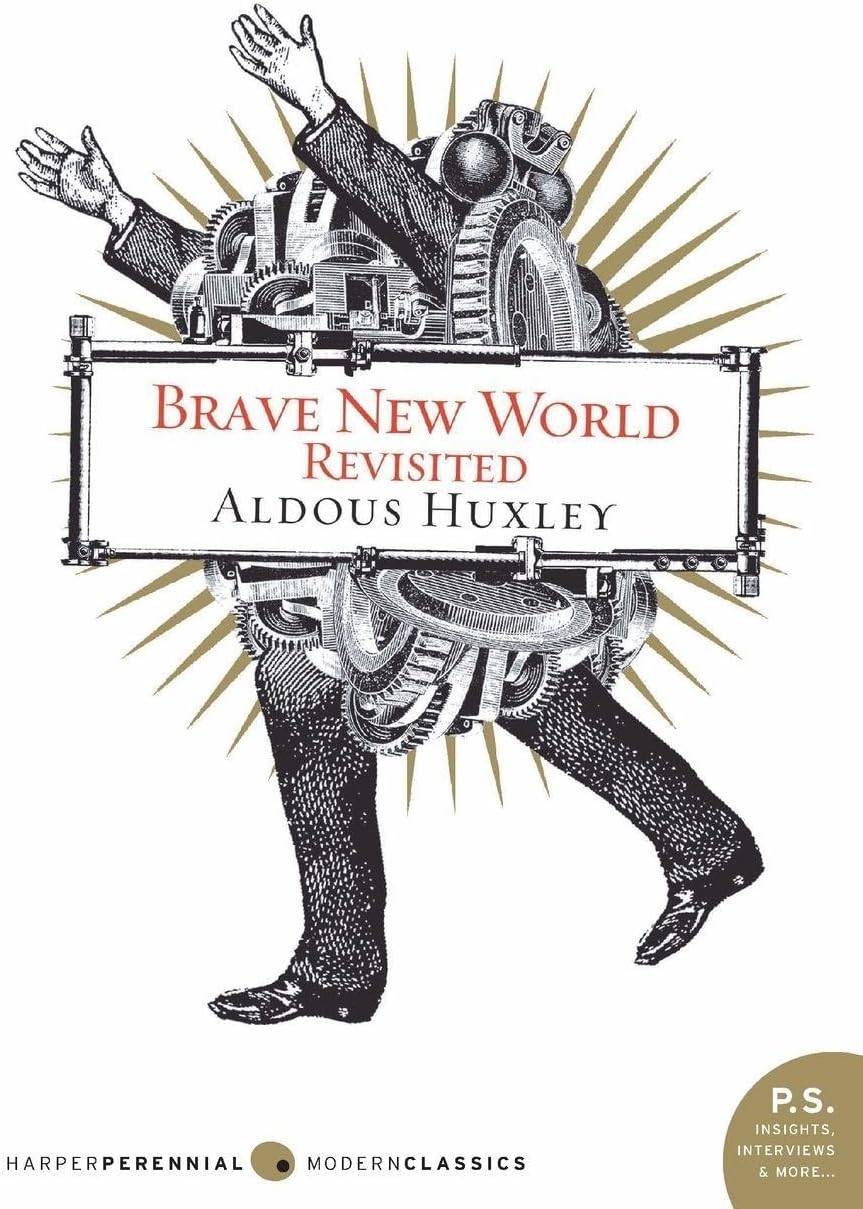
Brave New World Revisited (Harper Perennial Modern Classics)
Product ID: 28145762
Buy anything from 5,000+ international stores. One checkout price. No surprise fees. Join 2M+ shoppers on Desertcart.
Desertcart purchases this item on your behalf and handles shipping, customs, and support to Vietnam.
"Huxley uses his erudite knowledge of human relations to compare our actual world with his prophetic fantasy of 1931. It is a frightening experience, indeed, to discover how much of his satirical prediction of a distant future became reality in so short a time." ― New York Times Book Review When Aldous Huxley wrote his famous novel Brave New World , he did so with the belief that the dystopian world he created was a true possibility given the direction of the social, political and economic world order. Written more than twenty-five years later, Brave New World Revisited is a re-evaluation of his predictions based on the changes he witnessed over that time. In this twelve-part work of social philosophy, one of the most important and fascinating books of his career, Huxley uses his tremendous knowledge of human relations to compare the modern-day world with his prophetic fantasy. He scrutinizes threats to humanity, such as overpopulation, propaganda, and chemical persuasion, and explains why we have found it virtually impossible to avoid them. Brave New World Revisited is a trenchant plea that humankind should educate itself for freedom before it is too late. In this landmark analysis, Huxley explores the chilling accuracy of his vision: Propaganda in a Democracy: An analysis of the methods used by commercial and political propagandists to manipulate the masses in a supposedly free society. Chemical Persuasion: A prescient warning about the use of drugs―both recreational and pharmaceutical―to create an artificial happiness that stifles dissent and critical thought. Overpopulation as a Threat: A clear-eyed look at how excessive human numbers, a problem Huxley once thought centuries away, now strains our resources and personal liberties. Education for Freedom: A powerful argument for an education rooted in critical thinking and the values of liberty as the only true antidote to creeping totalitarian control. Review: A very good/insightful read. Down to earth philosopher/realist - Aldous Huxley is so smart and honest. Does not have an agenda except for the betterment of everyone. The first 1/3 of this book is great. The last 20% is worth the time where he gives his ideas on what it means and how to really be (and stay) a democracy. The middle is pretty much known by everyone these days and can be skipped imho. But it was ahead of its time. Even if you do skip the middle; the rest of the book is insightful and worth reading today. Not an easy read but it is clear and straightforward for anyone making the effort. Review: Great follow up to Brave New World - This is Huxley's appraisal of how things have gone 27 years after he wrote Brave New World. One of the big issues he discusses is overpopulation. The developed world is actually now seeing declining birth rates and some countries are seeing actual population declines. Much of the rest of the world is seeing slowing growth. So, at least one of his points is showing some improvement. However, another point is getting much worse - government and corporate propaganda. He never could have seen social media coming, but it has accelerated the ability to act not only as tightly controlled propaganda, but also as a soma to millions seeking diversion and validation. The book is a short read and not too difficult. I highly recommend it.


| Best Sellers Rank | #28,006 in Books ( See Top 100 in Books ) #116 in Classic American Literature #776 in Classic Literature & Fiction #1,866 in Literary Fiction (Books) |
| Customer Reviews | 4.4 out of 5 stars 1,659 Reviews |
G**E
A very good/insightful read. Down to earth philosopher/realist
Aldous Huxley is so smart and honest. Does not have an agenda except for the betterment of everyone. The first 1/3 of this book is great. The last 20% is worth the time where he gives his ideas on what it means and how to really be (and stay) a democracy. The middle is pretty much known by everyone these days and can be skipped imho. But it was ahead of its time. Even if you do skip the middle; the rest of the book is insightful and worth reading today. Not an easy read but it is clear and straightforward for anyone making the effort.
F**R
Great follow up to Brave New World
This is Huxley's appraisal of how things have gone 27 years after he wrote Brave New World. One of the big issues he discusses is overpopulation. The developed world is actually now seeing declining birth rates and some countries are seeing actual population declines. Much of the rest of the world is seeing slowing growth. So, at least one of his points is showing some improvement. However, another point is getting much worse - government and corporate propaganda. He never could have seen social media coming, but it has accelerated the ability to act not only as tightly controlled propaganda, but also as a soma to millions seeking diversion and validation. The book is a short read and not too difficult. I highly recommend it.
U**R
Frightening to think Huxley's updated critique to Brave New World is over 50 years old...
It is interesting to note that this was written over half a century ago. Huxley critiques his own great work, Brave new World, from the perspective of the technologies and advancements made some 20 or so years later than his original classic. His analysis of psychological methodologies, comparing Orwell's work and critiquing neurological studies from the late 30's through to the 1950's, including the use of subliminal messaging is certainly thought provoking. I wonder what he would have made of modern technology? The apparent reduction in attention span of the media-obsessed population juxtaposed by the the underlying free access of uncensored information that the internet revolution has allowed would have made for an intriguing analysis. This is certainly a good read, at the very least from a historical perspective.
L**D
Must read
Great and prescient book, with a strong historical introduction by Christopher Hitchens.
P**D
Prescient analysis by a great thinker
In 1958 I thought I had read everything Huxley ever wrote and wrote a high school thesis on him entitled “Passion vs. Reason: Self-Division’s Cause. Then I still believed Brave New World was the best of all the book sand essays he wrote. Recently I found Brave New World Revisited also written in 1958 - a treat to read his own review of his dystopian novel written in 1931 and plea for education for freedom.
D**J
He’s much better at novels than essays
“In their propaganda today’s dictators rely for the most part on repetition, suppression and rationalization—the repetition of catchwords which they wish to be accepted as true, the suppression of facts which they wish to be ignored, the arousal and rationalization of passions which may be used in the interests of the Party or the State.” (p.37) The chapters in this book amount to a collection of related essays in which Huxley, writing in 1958 (twenty-six years after writing his masterpiece), reflects on the state of the world. It’s thoughtful and well written. It’s certainly an interesting look into the author’s thinking, and I highlighted many fascinating excerpts. But he does too much pontificating for my tastes; I think he’s much better at novels than essays. Even his well-established and extraordinary prescience reaches its limits here. One forgivable but striking example: he repeatedly ranks DDT alongside penicillin as one of the modern world’s most promising achievements. I found him most compelling when he’s commenting explicitly on his book, and especially so when he’s comparing it to Orwell’s Nineteen Eighty-Four. I would have enjoyed more such commentary. Even more, I wish he’d written a sequel instead of these essays!
M**S
Brilliant
The brilliant mind of Aldous Huxley has pointedly shown us what was afoot in 1958, the year I graduated from high school. One of my favorite classes in University was "Social Control." Here are the salient points from that class. It was a big topic and there were several major books at the time. I don't see that conversation continuing now. Perhaps we have gone diwn that road too far. Sadly, it seems we the people didn't heed his and others' warnings. I wish everyone would read this book and think deeply about what he wrote.
D**O
A sometimes prescient view from the past
It is interesting to see how some problems that were considered intractable at the time of writing (circa 1960) are now ignored, shelved or solved (take your choice). The big two are population and resource depletion. It is now rather passé to worry about these them. Conversely, some problems that are barely mentioned here are now top of mind, namely climate change and pollution. Some have remained constant, such as the struggle to maintain real democracy and political freedom. Who know how Huxley would have felt about latter day developments such as the temptation to well-intentioned censorship and un-personing of dissenters. Perhaps the greatest lesson from rereading this work is “this too will pass”, though one never knows what will pass and for how long.
R**E
Misleading ad.
I did not get the book in the photo. You get the book without the jacket (used look jacket). For a refund only 20%. Ripoff.
A**O
The Future Is Here
A most interesting book. Admittedly, Orwell's 1984 is better and it's sense of doom and oppression compels you to read it again and again. "Brave New World", however, describes a future society that is equally oppressive and terrible, but in a soft form, without torture and secret police. The idea is to convince the people that they are free because there's no better slave than he who doesn't know to be one. In "Brave New World Revisited" Huxley himself reflects about how history and society changed since he wrote his book in the twenties and the early sixties. The shocking conclusion that nowadays is even more true than fifty years ago is that we are slowly but surely drifting into our own version of the Brave New World. Step by step, one little slice after the other our liberty is forgone and lost on the altar of a new society made of security, politically correctness and whatever will be used as an excellent excuse in order to encroach our dwindling spaces of liberty and autonomy. Hence, first read Orwell's 1984, then Huxley's "Brave New World" and finally his "Brave New World Revisited". It's not a comforting view of what lays ahead of us, but knowing the truth may be a good start in order to react.
S**N
Huxley's Future is Now !!!
Author Huxley is a visionary !!! But his visions are scary; written in 1930s he has predicted what's about to happen in the 21st century with alarming accuracy & yet his solutions to overcome the problems seem impossible now... Huxley has broken down into individual chapters the problems plaguing our society & how we are increasingly moving towards a totalitarian regime where people are made to obey not by force but through sheer manipulation of our thoughts. His case studies & historical facts provide indisputable proof for even the naysayers. Almost everything we do, think & act upon are increasingly manipulated by Big Companies & Governments who by & large have shifted to these tactics to maintain stability amidst this chaotic world. Freedom is just a word in theory & Huxley's "Brave New World" exposes this uneasy sham !
T**N
Recommend
Great book, indeed.
T**Y
It is worth to read it
This is an essay about you can read at brave new world . is incredibly to find how near we are of this society. And there you will wind editor's point of view.
Trustpilot
2 months ago
3 weeks ago