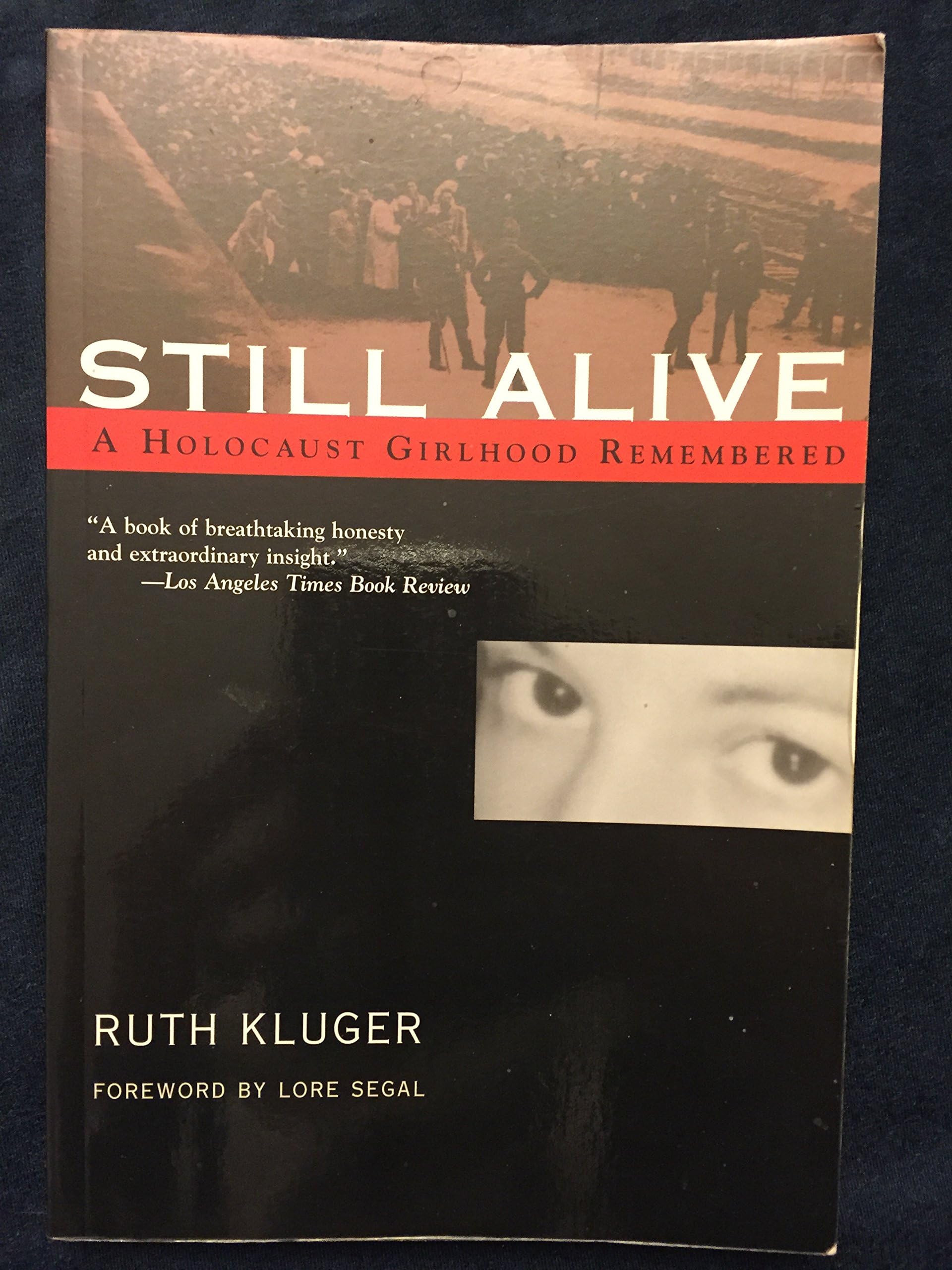

Still Alive: A Holocaust Girlhood Remembered (The Helen Rose Scheuer Jewish Women's Series)
Product ID: 245644
desertcart.com: Still Alive: A Holocaust Girlhood Remembered (The Helen Rose Scheuer Jewish Women's Series): 9781558614369: Ruth Kluger, Lore Segal: Books Review: Almost every page has a memorable phrase - Still Alive: A Holocaust Girlhood Remembered (The Helen Rose Scheuer Jewish Women's Series) by Ruth Kluger Still Alive: A Holocaust Girlhood Remembered (The Helen Rose Scheuer Jewish Women's Series) I loved the frankness of her prose. It seems this is the next generation of holocaust survivors: the children who grew up and led fulfilling lives. Almost every page has something memorable. I went through th 200 quotes I selected on my Kindle and caem up with the top ten or so: Recipes for gefilte fish are no recipe for coping with the Holocaust No great poetry was composed in the concentration camps. If it were not so, one might entertain the idea that the camps were good for something, that they were, for example, a kind of catharsis, producing fine art. In fact, they weren't good for anything The French have only recently begun to remember how they collaborated with the Nazis; it was in France that my father was handed over to the Germans. I would have become an agnostic anyway, but the Nazis added to my disappointment the feeling of having grasped a rotten plank during a shipwreck Even though I despised the law that excluded me, I still felt ashamed to have been found out. For shame doesn't arise from the shameful action, but from discovery and exposure. should be obvious by now that these pages hardly deal with the Nazis. I didn't know any Nazis, but I knew the difficult, neurotic people whom they oppressed, families who hadn't had ideal lives anymore than their Christian neighbors had. Witness the foregoing pages, where I dusted off the ramshackle mementos of my father and brother, enjoying my stay in the attic of memory, my hearers act surprised, assume a stance of virtuous indignation, and tell me that, given the hardships we had to endure during the Hitler period, the victims should have come closer together and formed strong bonds. Particularly young people should have done so, say the elderly. But this is sentimental rubbish and depends on a false concept of suffering as a source of moral education. Only the language was what it had always been, the speech of my childhood with its peculiar inflections and rhythms, a sense of humor that Germans often don't get, and a wealth of malicious half tones that would be obscene in any other tongue; also an intense lyricism that easily degenerates into kitsch. I understand this language, but I don't like it. I speak it, but I wouldn't have chosen it. I am hooked on it, and it's the reason I go back for visits. In our hearts we all know that some aspects of the Shoah have been repeated elsewhere, today and yesterday, and will return in new guise tomorrow; and the camps, too, were only imitations (unique imitations, to be sure) of what had occurred the day before yesterday What did he expect? Auschwitz was no instructional institution, like the University of Göttingen, which he attends. You learned nothing there, and least of all humanity and tolerance. How else are we to tell victims from victimizers? The camp sites hide as much as they communicate. Over the years many people have asked me: "I knew X or Y, who was interned at Theresienstadt. Surely you remember him or her?" Not once have I been able to give a positive answer. Theresienstadt wasn't a village of friendly neighbors and social interaction. It was a transit station. To the Socialists and Communists in the camps, the Jewish prisoners were inferior beings: they had learned this much from the Nazis. in life, nothing offended me more than the generalization that the camps turned us all into brutal egotists, and whoever survived them must be morally defective. Again, the blithe refusal to look closely, to make distinctions, to reflect a little. and it was these unknown details that haunted me. I couldn't talk to my mother about his death. "There is some evidence that they tried to comfort one another, and wouldn't that be better than resistance?" Again the silence. I see the other guy standing before the toilet, waiting for me to come out, no privacy anywhere. Life in a big stable. The owners occasionally show up in their ominous uniforms to make sure that the cattle behave. Makes you feel like the scum of the earth. Only when I had children of my own did I realize that one might well decide to kill them in Auschwitz rather than wait. I now believe that I would have had the same thought and perhaps carried it out more efficiently. Every survivor has his or her "lucky accident"--the turning point to which we owe our lives. Mine is peculiar because of the intervention of the stranger. They exchanged recipes the same way I recited poems. At night a favorite game was to surpass each other with the recital of generous amounts of butter, eggs, and sugar in fantasy baking contests Therefore this is not the story of a Holocaust victim and becomes less and less so as it nears the end I write in their memory, and yet my account unavoidably turns into some kind of triumph of life Because Konrad Lorenz became a Nazi and one of the Party's privileged professors, yet after the war became a reasonable citizen again and was awarded a Nobel Prize. Lorenz himself denied that there was such a thing as evil; there was only "aggression," a normal expression of animal behavior, and fixed action patterns, he wrote. The title of his bestseller, On Aggression, is in the original So-Called Evil (Das sogenannte Böse). A morality derived from science in the service of denial. Martin Walser says, well, hatred of Jews was one of those variants of xenophobia which comes naturally to all men. I think that the Jewish catastrophe can't be explained with abstract arguments taken from ethology or the mice of the veterinary science professor or Konrad Lorenz's views on the strutting rivalry of male animals. And there were, in fact, both men and women with whorehouse fantasies who wanted to know whether I had been raped. I'd explain the concept of Rassenschande, the rule against miscegenation Aryan style, because I found it interesting that a malicious idea could serve as protection (albeit not a foolproof one) against sexual abuse. To make a living and support my two sons, I went back to graduate school and became a professor of German literature. For many years I had refused to have anything to do with the language, the two countries (Austria and Germany), or their people. But I was good at my new job Though the other side persists: belligerent Israelis will say, "Jews don't walk into gas chambers anymore," as they get ready to counter violence with violence. The Jews who were gassed are the inferior Jews in this scenario, which doesn't sit well with me.) What you have been reading is neither a translation nor a new book: it's another version, a parallel book, if you will, for my child ren and my American students. Review: A Remarkable Memoir - Imagine spending your pre-adolescence as a state-sponsored pariah, denied all the normal activities of a healthy active childhood, banned even from movie theaters. Step by step you're stripped of your dignity, sent to live in an overcrowded facility forcibly segregated from normal society, and eventually to a death camp, fully aware that you're marked for extermination. This book captures that personal history, as well the author's lifelong struggle to come to terms with it. It's beautifully written, bitter and disturbing, going deeper into the victims' psychological turmoil than all but a few books on the subject. Written by a woman with an obviously superior, highly analytical intellect, it ranks with Tadeusz Borowski's grimly poetic and cynical writings as among the most illuminating works of Holocaust literature.
| Best Sellers Rank | #239,146 in Books ( See Top 100 in Books ) #141 in Jewish Biographies #1,840 in Women's Biographies #4,931 in Memoirs (Books) |
| Customer Reviews | 4.5 4.5 out of 5 stars (376) |
| Dimensions | 5.98 x 0.59 x 9.02 inches |
| ISBN-10 | 1558614362 |
| ISBN-13 | 978-1558614369 |
| Item Weight | 6.5 ounces |
| Language | English |
| Print length | 216 pages |
| Publication date | April 1, 2003 |
| Publisher | The Feminist Press at CUNY |
J**A
Almost every page has a memorable phrase
Still Alive: A Holocaust Girlhood Remembered (The Helen Rose Scheuer Jewish Women's Series) by Ruth Kluger Still Alive: A Holocaust Girlhood Remembered (The Helen Rose Scheuer Jewish Women's Series) I loved the frankness of her prose. It seems this is the next generation of holocaust survivors: the children who grew up and led fulfilling lives. Almost every page has something memorable. I went through th 200 quotes I selected on my Kindle and caem up with the top ten or so: Recipes for gefilte fish are no recipe for coping with the Holocaust No great poetry was composed in the concentration camps. If it were not so, one might entertain the idea that the camps were good for something, that they were, for example, a kind of catharsis, producing fine art. In fact, they weren't good for anything The French have only recently begun to remember how they collaborated with the Nazis; it was in France that my father was handed over to the Germans. I would have become an agnostic anyway, but the Nazis added to my disappointment the feeling of having grasped a rotten plank during a shipwreck Even though I despised the law that excluded me, I still felt ashamed to have been found out. For shame doesn't arise from the shameful action, but from discovery and exposure. should be obvious by now that these pages hardly deal with the Nazis. I didn't know any Nazis, but I knew the difficult, neurotic people whom they oppressed, families who hadn't had ideal lives anymore than their Christian neighbors had. Witness the foregoing pages, where I dusted off the ramshackle mementos of my father and brother, enjoying my stay in the attic of memory, my hearers act surprised, assume a stance of virtuous indignation, and tell me that, given the hardships we had to endure during the Hitler period, the victims should have come closer together and formed strong bonds. Particularly young people should have done so, say the elderly. But this is sentimental rubbish and depends on a false concept of suffering as a source of moral education. Only the language was what it had always been, the speech of my childhood with its peculiar inflections and rhythms, a sense of humor that Germans often don't get, and a wealth of malicious half tones that would be obscene in any other tongue; also an intense lyricism that easily degenerates into kitsch. I understand this language, but I don't like it. I speak it, but I wouldn't have chosen it. I am hooked on it, and it's the reason I go back for visits. In our hearts we all know that some aspects of the Shoah have been repeated elsewhere, today and yesterday, and will return in new guise tomorrow; and the camps, too, were only imitations (unique imitations, to be sure) of what had occurred the day before yesterday What did he expect? Auschwitz was no instructional institution, like the University of Göttingen, which he attends. You learned nothing there, and least of all humanity and tolerance. How else are we to tell victims from victimizers? The camp sites hide as much as they communicate. Over the years many people have asked me: "I knew X or Y, who was interned at Theresienstadt. Surely you remember him or her?" Not once have I been able to give a positive answer. Theresienstadt wasn't a village of friendly neighbors and social interaction. It was a transit station. To the Socialists and Communists in the camps, the Jewish prisoners were inferior beings: they had learned this much from the Nazis. in life, nothing offended me more than the generalization that the camps turned us all into brutal egotists, and whoever survived them must be morally defective. Again, the blithe refusal to look closely, to make distinctions, to reflect a little. and it was these unknown details that haunted me. I couldn't talk to my mother about his death. "There is some evidence that they tried to comfort one another, and wouldn't that be better than resistance?" Again the silence. I see the other guy standing before the toilet, waiting for me to come out, no privacy anywhere. Life in a big stable. The owners occasionally show up in their ominous uniforms to make sure that the cattle behave. Makes you feel like the scum of the earth. Only when I had children of my own did I realize that one might well decide to kill them in Auschwitz rather than wait. I now believe that I would have had the same thought and perhaps carried it out more efficiently. Every survivor has his or her "lucky accident"--the turning point to which we owe our lives. Mine is peculiar because of the intervention of the stranger. They exchanged recipes the same way I recited poems. At night a favorite game was to surpass each other with the recital of generous amounts of butter, eggs, and sugar in fantasy baking contests Therefore this is not the story of a Holocaust victim and becomes less and less so as it nears the end I write in their memory, and yet my account unavoidably turns into some kind of triumph of life Because Konrad Lorenz became a Nazi and one of the Party's privileged professors, yet after the war became a reasonable citizen again and was awarded a Nobel Prize. Lorenz himself denied that there was such a thing as evil; there was only "aggression," a normal expression of animal behavior, and fixed action patterns, he wrote. The title of his bestseller, On Aggression, is in the original So-Called Evil (Das sogenannte Böse). A morality derived from science in the service of denial. Martin Walser says, well, hatred of Jews was one of those variants of xenophobia which comes naturally to all men. I think that the Jewish catastrophe can't be explained with abstract arguments taken from ethology or the mice of the veterinary science professor or Konrad Lorenz's views on the strutting rivalry of male animals. And there were, in fact, both men and women with whorehouse fantasies who wanted to know whether I had been raped. I'd explain the concept of Rassenschande, the rule against miscegenation Aryan style, because I found it interesting that a malicious idea could serve as protection (albeit not a foolproof one) against sexual abuse. To make a living and support my two sons, I went back to graduate school and became a professor of German literature. For many years I had refused to have anything to do with the language, the two countries (Austria and Germany), or their people. But I was good at my new job Though the other side persists: belligerent Israelis will say, "Jews don't walk into gas chambers anymore," as they get ready to counter violence with violence. The Jews who were gassed are the inferior Jews in this scenario, which doesn't sit well with me.) What you have been reading is neither a translation nor a new book: it's another version, a parallel book, if you will, for my child ren and my American students.
B**S
A Remarkable Memoir
Imagine spending your pre-adolescence as a state-sponsored pariah, denied all the normal activities of a healthy active childhood, banned even from movie theaters. Step by step you're stripped of your dignity, sent to live in an overcrowded facility forcibly segregated from normal society, and eventually to a death camp, fully aware that you're marked for extermination. This book captures that personal history, as well the author's lifelong struggle to come to terms with it. It's beautifully written, bitter and disturbing, going deeper into the victims' psychological turmoil than all but a few books on the subject. Written by a woman with an obviously superior, highly analytical intellect, it ranks with Tadeusz Borowski's grimly poetic and cynical writings as among the most illuminating works of Holocaust literature.
H**Y
The story was overall good and I'm glad I tool the time to read ...
I'm not sure if I would have ever picked this book up on my own to read. I had to read this for a class and the only one so far that I've acctually read out of 3 other books. The story was overall good and I'm glad I tool the time to read it. The only thing I didn't like is that it was jumpy. She talked about different things 8n different chapters from her past, from the present, something else she had already talked about before but added more detail.
B**R
Memoirs of a Feminist Poet
Reading *Still Alive* was like having a conversation with someone I like and admire. A one-sided conversation, one might say, since Kluger was doing all the talking, and I was contributing nothing but my interpretation of her words. But Kluger answered many of the questions I would have asked, had she been sitting across from me. "What was it like after you escaped, when you were thrown in with Germans who were running from the approaching Allies? Did you talk to them?" I would have asked. "For them," she would have said, "it was despair, they were leaving behind everything; while for me, it was joy, because I was gaining everything -- the rest of my life." (I am not quoting the exact words from the book here, but writing the general idea from memory). "Did the culture's attitude toward you as a woman make it more difficult to recover from the humiliation you suffered as a camp inmate?" "What was it like to go from being a very private child, to being crammed into a mass of other humans?" "How was your relationship with your mother after the war, after you grew up?" "What was it like going to a strange place, having to learn a new language, a new culture?" "How could you tolerate life as a U.S. housewife in the 1950's? Of course it was far better than life in the camps, but still ..." Kluger's personality comes across as irrepressible. Her book inspires me rather than depressing me. For example, having described her childhood compulsion to memorize poetry early in the book, Kluger mentions composing poems about the camps with (not so appropriate) catchy rhythms and rhymes, because it made them easier to memorize, and of course she had to commit them to memory since paper and writing implements were scarce, and anyhow, how else could one be sure of holding onto them? I smile as I remember that. Even as she starved for food and water, she found a way to create treasures that no one could take away from her, as long as she lived. I have to confess that I do not read German, so I would not be able to appreciate Dr. Kluger's literary criticism. I am sad that she has not published more poetry and observations of life.
S**N
One of the more discerning books of that time. I felt the events of the holocaust were a part of the whole. The story of a woman's life, the life being the reason for the book not the experiences in the war alone. All in all a very enlightening and deeply satisfying read.
O**R
¡El libro llegó doblado y maltratado!
J**S
Very different memoir. Insightful and haunting. Well worth the read.
T**A
Captivating! I agree with previous reviews that rate this book with the classics written by the likes of Eli Wiesel and Levi Primo!
M**E
Too good to be out of print. Insightful and reflective. This easily ranks with Anne frank and Premo Levi.
Trustpilot
2 weeks ago
1 month ago