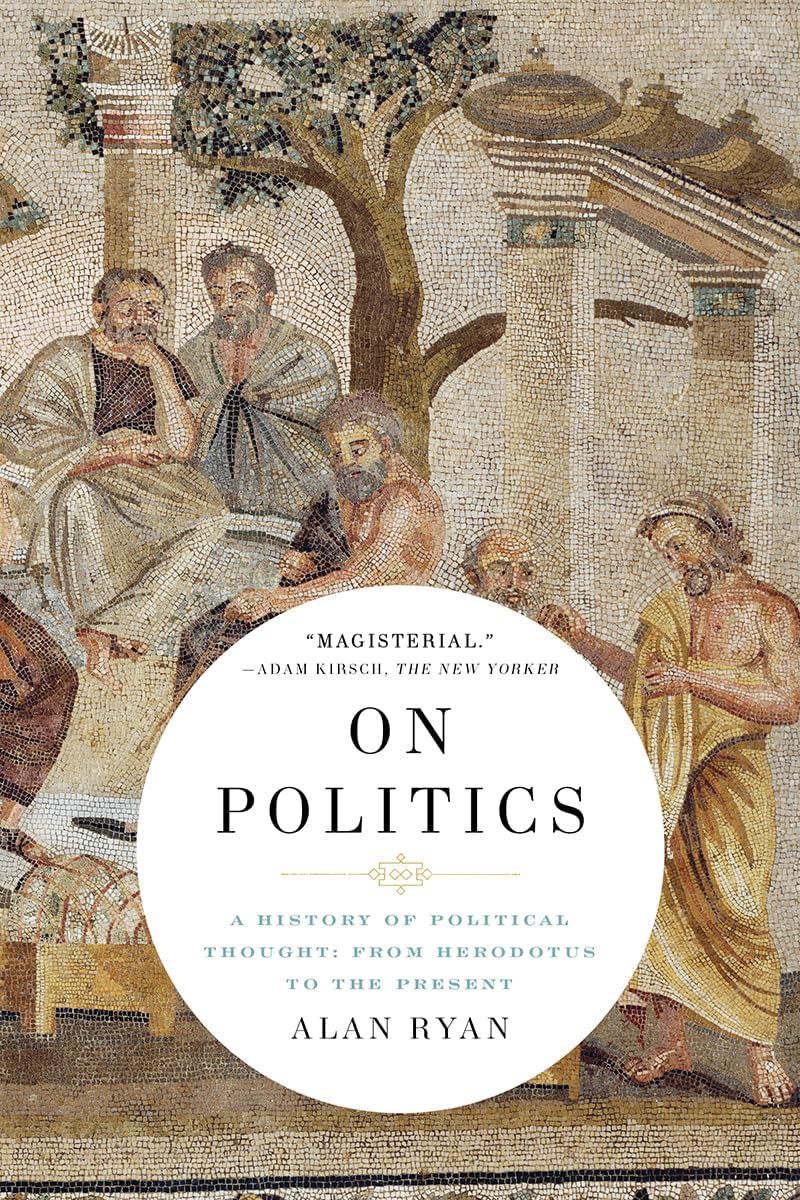
On Politics: A History of Political Thought: From Herodotus to the Present
Product ID: 243728398
Buy anything from 5,000+ international stores. One checkout price. No surprise fees. Join 2M+ shoppers on Desertcart.
Desertcart purchases this item on your behalf and handles shipping, customs, and support to Vietnam.
On Politics: A History of Political Thought: From Herodotus to the Present [Ryan, Alan] on desertcart.com. *FREE* shipping on qualifying offers. On Politics: A History of Political Thought: From Herodotus to the Present Review: Among the 3 ir 4 best narrative surveys of "Western Civ" political thought. - Among the best conventional surveys of "Western" political thinkers' ideas in print. After the introductory chapters, best read selectively as interest leads the reader. Long as it is, it still could use some supplementary surveys that focus more on dissenting and excluded writers still within the framework of the text's project. But this is a good place to start. The book could easily serve as a 2 or 3 term college text ... probably its main target audience. Review: A magisterial history of political philosophy - This is a major work—and a welcome one. Once upon a time, I thought that Sabine’s history of political philosophy was the apogee in this arena. But I think that the author, Alan Ryan, has actually surpassed Sabine. He does a nice job of introducing us to the variety of political thinkers over time. But his analysis of the works—going beyond just description—is the real contribution of this two volume set. Ryan notes that (page xxiii): “This is a book about the answers that historians, philosophers, theologians, practicing politician and would be revolutionaries have given to one question. How can human beings best govern themselves”? For the record, he considers the following subjects/thinkers, among others: Herodotus, Plato, Aristotle, Cicero, Polybius, Augustine, Aquinas, Machiavelli, Hobbes, Locke, Rousseau, Hegel, Bentham, Mill, Tocqueville, and Marx. There are also chapters on more general subjects, such as republicanism after Hobbes and Locke, or the American founding, or democracy in the modern world. It is intriguing that he began the work with Herodotus (and Thucydides). Ryan dissects Plato and Aristotle nicely, exploring some of their major works and making sense of their arguments—while sometimes raising questions about those arguments. There is a lengthy and insightful analysis of Augustine’s political thinking. A key question that this thinker addressed (page 149): “. . .how seriously should a Christian with his eyes on eternity take the politics of his earthly life. . . .” Machiavelli? A diplomat who lost his job as a result of internal politics. Some of his works were efforts to get back in the good graces of the rulers of Florence, such as the Borgias. Much of the chapter explores The Prince, and Machiavelli’s interesting analysis of what it takes to be successful. There is also lucid discussion of Discourses, a follow up to his earlier volume with some interesting twists. There is relevance for the United States in quite a number of chapters. For example, after the chapters on Hobbes and Locke, Ryan considers “republicanism.” Here, he examines the works of John Harrington, Algernon Sidney, and Charles-Louis de Secondat, the Baron de Montesquieu. Each of these thinkers reflected on aspects of republicanism. And each of these was referred to by America’s Founding Fathers during the Constitutional era. The discussion places the discussion of those Founders in a broader context. And so on. A powerfully developed two volume set. If interested in the history of political philosophy, this is an outstanding point of departure.
| Best Sellers Rank | #161,217 in Books ( See Top 100 in Books ) #22 in Historiography (Books) #242 in Political Philosophy (Books) #271 in History & Theory of Politics |
| Customer Reviews | 4.6 4.6 out of 5 stars (263) |
| Dimensions | 6.2 x 2 x 9.3 inches |
| ISBN-10 | 1631498142 |
| ISBN-13 | 978-1631498145 |
| Item Weight | 2.2 pounds |
| Language | English |
| Print length | 1152 pages |
| Publication date | October 27, 2020 |
| Publisher | Liveright |
W**M
Among the 3 ir 4 best narrative surveys of "Western Civ" political thought.
Among the best conventional surveys of "Western" political thinkers' ideas in print. After the introductory chapters, best read selectively as interest leads the reader. Long as it is, it still could use some supplementary surveys that focus more on dissenting and excluded writers still within the framework of the text's project. But this is a good place to start. The book could easily serve as a 2 or 3 term college text ... probably its main target audience.
S**N
A magisterial history of political philosophy
This is a major work—and a welcome one. Once upon a time, I thought that Sabine’s history of political philosophy was the apogee in this arena. But I think that the author, Alan Ryan, has actually surpassed Sabine. He does a nice job of introducing us to the variety of political thinkers over time. But his analysis of the works—going beyond just description—is the real contribution of this two volume set. Ryan notes that (page xxiii): “This is a book about the answers that historians, philosophers, theologians, practicing politician and would be revolutionaries have given to one question. How can human beings best govern themselves”? For the record, he considers the following subjects/thinkers, among others: Herodotus, Plato, Aristotle, Cicero, Polybius, Augustine, Aquinas, Machiavelli, Hobbes, Locke, Rousseau, Hegel, Bentham, Mill, Tocqueville, and Marx. There are also chapters on more general subjects, such as republicanism after Hobbes and Locke, or the American founding, or democracy in the modern world. It is intriguing that he began the work with Herodotus (and Thucydides). Ryan dissects Plato and Aristotle nicely, exploring some of their major works and making sense of their arguments—while sometimes raising questions about those arguments. There is a lengthy and insightful analysis of Augustine’s political thinking. A key question that this thinker addressed (page 149): “. . .how seriously should a Christian with his eyes on eternity take the politics of his earthly life. . . .” Machiavelli? A diplomat who lost his job as a result of internal politics. Some of his works were efforts to get back in the good graces of the rulers of Florence, such as the Borgias. Much of the chapter explores The Prince, and Machiavelli’s interesting analysis of what it takes to be successful. There is also lucid discussion of Discourses, a follow up to his earlier volume with some interesting twists. There is relevance for the United States in quite a number of chapters. For example, after the chapters on Hobbes and Locke, Ryan considers “republicanism.” Here, he examines the works of John Harrington, Algernon Sidney, and Charles-Louis de Secondat, the Baron de Montesquieu. Each of these thinkers reflected on aspects of republicanism. And each of these was referred to by America’s Founding Fathers during the Constitutional era. The discussion places the discussion of those Founders in a broader context. And so on. A powerfully developed two volume set. If interested in the history of political philosophy, this is an outstanding point of departure.
P**G
Excellent overview of politcs!
Good contents & skillfully written. With a good mixture of philosophy, history & political science all rolled into one. Highly recommended for anyone keen on politics as a serious subject matter, from ancient thinkers (Plato, Aristotle etc.) to the modern (Hobbes, JS Mill etc.) & how their thoughts still colored our present day thinking. Detailed analysis of the many thinkers are carefully presented, easily read & understood. I enjoyed the many hours going through the pages! P.S: Quite a bit of typo errors! Think subsequent editions should fix it!
P**J
Politics for the open mind
I just finished reading this two volume tome having started it over a year ago. This book is not about politics as in red versus blue. The book covers political thinking from ancient times to the present. I do not know when this book was published but I wish I could have read it when I was in my 20s or 30s and my mind was readily absorbing ideas. The names of the political thinkers presented by the author were familiar to me from high school history and college courses. (I am over 60 now.) The author's topics are fascinating. His sentence structure can be quite complex but it is worthwhile rereading certain sentences to understand his points. He presents each political thinker in historical perspective while occasionally subjecting such thinker to other times in history. If you enjoy history and complex ideas, give this book a try.
A**S
Tour-de-Force of Political History
If like me you're interested in political history - and especially how we came by our modern forms of government - but don't have the time to read around the subject in depth then this is absolutely the perfect primer. Alan Ryan's very readable yet comprehensive gloss on nearly twenty-five hundred years of political thought is a great introduction to many of the works that shaped later thinking and action. I find books like this to be an invaluable road-map for later reading, so that anyone with interest in learning more knows just where to look. As I also happen to share the author's prejudices regarding Plato, for example, it was pleasant to have some old biases reinforced while having my eyes opened to things I'd not previously known, such as the political implications of Augustine's writings. For anyone who wants to understand how the great adventure of the American republic got its start nearly eighteen hundred years earlier, and why tyrannical systems inevitably implode, this is the place to start.
I**R
Excellent Comprehensive survey of Political Philosophy
Ryan provides a masterful and comprehensive analysis of western political philosophy from the early Greek views to the modern revival of Islamic revanchism and subtle totalitarianism. He has produced a tour de force worth reading and analyzing if you have the time to tackle a thousand pages.
K**I
Good but difficult
Excellent narrative but not for those seeking a light understanding of political thought. A bit tedious. If you liked Mark Levine's Ameritopia, this book is for you several times over.
M**A
A masterpiece, concise and clear.
Any reader of political philosophy is familiar that torturous of getting through a volume on the subject. It is a pleasure to read Alan Ryan's work. Don't waste your money on any other volume of political philosophy. This is it.
I**R
Conseguí este libro como lectura escolar, pero debo admitir que no fué mi estilo. Realmente me conflictuó el lenguaje. La teoría es interesante, pero la lectura no fué mi máximo interés.
T**R
It reads almost like a novel. Essential ideas are skilfully articulated. I can thoroughly recommend it to anyone seeking to grasp the core ideas of western political thought.
A**R
The parcel arrived damaged it was soaking wet
F**D
Politics is a dirty word but we cannot do without it, not in modern societies at any rate. How can we live together in spite of not being in one mind about so many important matters? The United States is struggling to find an answer to this question as we speak. But the question is always with us. Alan Ryan gives a tour from the ancient Greeks to the 20th Century, examining how thinkers from Herodotus to John Rawls have tried to answer how we can live together with our differences. What is the justification for authority? When is it right to force someone to do something that they don't want to do? We all know that humans must live together. But we are fractious, and the incentives for going our own way, even if its against our own interests, are very strong. How can this conundrum be resolved? Thinkers have offered an astonishing range of answers to these questions in the 2500 years since the Ancient Greeks started thinking about them. Some like Marx and Plato deny that these questions will even arise at all in their respective utopian schemes. Some contemporary intellectuals think likewise. As Ryan puts it, in their scheme of things there will be `no economic life to regulate, no crime to suppress, no conflicting interest to balance, no competing policy to reconcile, no conflicts of value to assuage, accommodate or suppress (p. 70). Their optimism seems unfounded. We will always live with these questions. Utopia, the title of Thomas More's eponymous book, means `nowhere'. But does this mean that if we cannot agree, then only brute force can make us live together? No thinker has really thought this - not even Hobbes or St. Augustine, two pessimists about the human condition, if coming from different premises altogether. People can and do live together, in spite of their differences. They can do this without liking one another all that much. The nightly news gives a different impression of course but riots and pogroms make the news in the way that ordinary hustle and bustle of daily life, lived out in a tolerable degree of peace and order, does not. Where we do manage to achieve such a modus vivendi then we can thank politics - even if most journalists won't. In some parts of the world at least, politics does broadly satisfy Aristotle's objective of ensuring that the needs of conflicting groups in society are met, without one achieving dominance over another. Those are by no means the range of questions that this book covers. Does human nature change or is it timeless. Thinkers like Machiavelli thought that human nature does not change and a 16th Century ruler of Florence could look back at Roman history for models of how to behave 1500 years later. He was probably wrong. Maybe human nature does not change but the circumstances we find ourselves in do change. I am also struck by how far the idea of original sin has preoccupied many of thinkers in this book. You do not have to belief in the literal truth of Genesis to see that human beings are flawed creatures, to put it mildly. Yet much of what politics must deal with is not sin as understood in the biblical the mutation of individual human virtues in the context of group identity. Loyalty, courage, sacrifice - virtues we admire in individuals can sustain the most barbarous of collective human endeavours (think of Germany and Japan during the Second World War). It is impossible to do this book the justice it deserves in such a short review. The book itself, weighing in at over a 1,000 pages, though long, manages to summarise so many thinkers, situating them in their historical context, deftly, wrapped in a skilful narrative which seldom fails to hold interest. It is also unashamedly an `old-fashioned book' a term used by one of its reviewers (John Keane In the Financial Times) by way of reproof but which I use as a term of praise. Keane points out that the thinkers are mostly from the Western canon. This is true but so what? Ryan does not have to apologise (indeed he does not offer one) for his failing to bend his knee to contemporary academic fashions. For the plain fact is that a western invention, the state, an entity that claims such rights for itself as `sovereignty' over its territory and its subjects, is now a near-universal form of political organization (save perhaps in a few corners of this world). Many post-colonial states denounce colonialism but ironically owe their existence to colonialism. Post-colonial states have not reverted to pre-colonial forms of rule. Therefore the questions the thinkers address in this book are questions that are pertinent to nearly every inhabitant of this planet. In political practice, there are better and worse answers. But if you want to know what the questions are, then this is an excellent guide.
V**O
Era un libro introvabile nella mia città, ma con Amazon ho risolto il problema. Di più non posso proprio dire.
Trustpilot
2 months ago
2 months ago