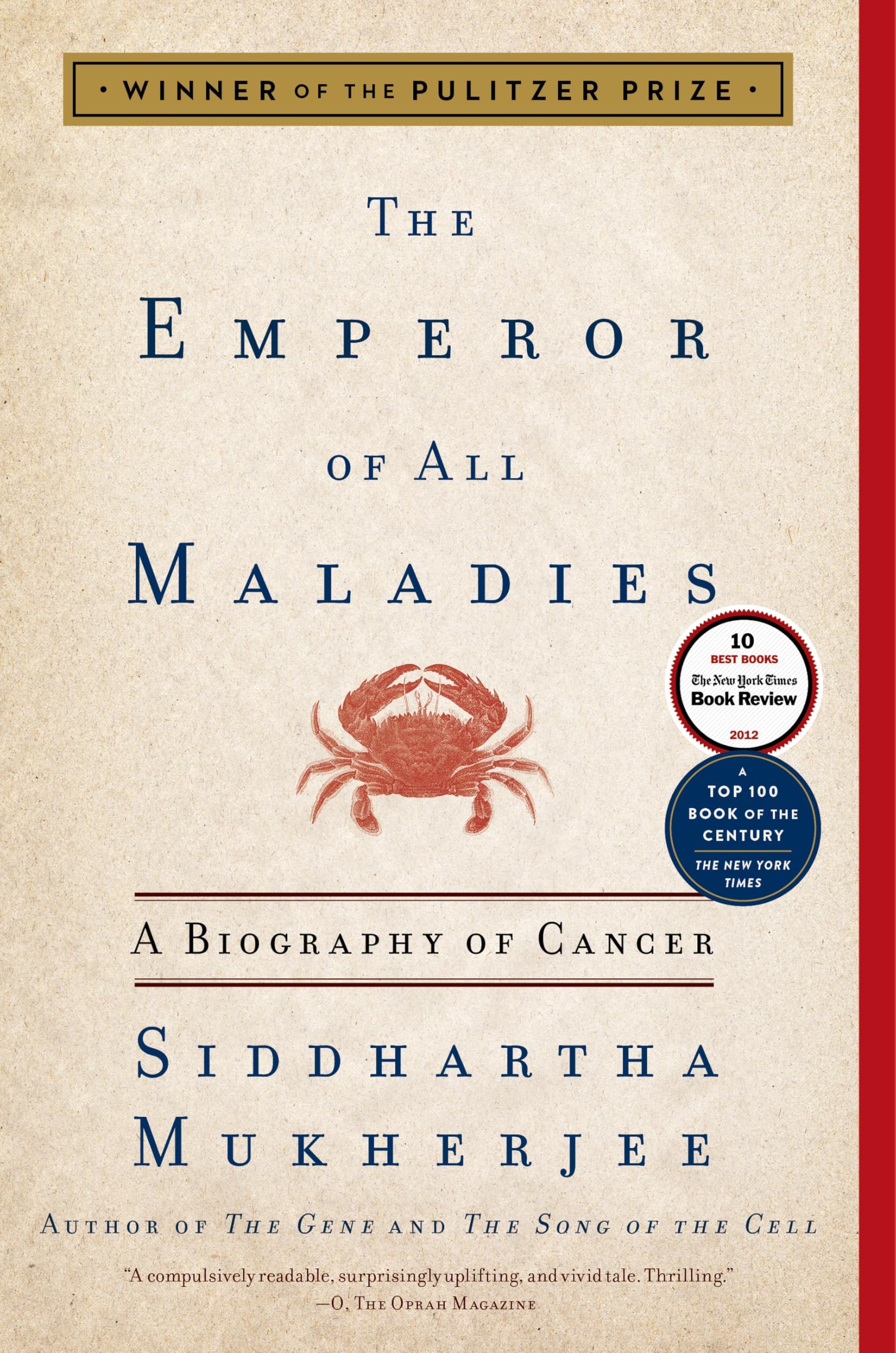

The Emperor of All Maladies: A Biography of Cancer
Product ID: 237771
Selected as One of the Best Books of the 21st Century by The New York Times Winner of the Pulitzer Prize, adapted as a documentary from Ken Burns on PBS, this New York Times bestseller is “an extraordinary achievement” ( The New Yorker )—a magnificent, profoundly humane “biography” of cancer. Physician, researcher, and award-winning science writer, Siddhartha Mukherjee examines cancer with a cellular biologist’s precision, a historian’s perspective, and a biographer’s passion. The result is an astonishingly lucid and eloquent chronicle of a disease humans have lived with—and perished from—for more than five thousand years. The story of cancer is a story of human ingenuity, resilience, and perseverance, but also of hubris, paternalism, and misperception. Mukherjee recounts centuries of discoveries, setbacks, victories, and deaths, told through the eyes of his predecessors and peers, training their wits against an infinitely resourceful adversary that, just three decades ago, was thought to be easily vanquished in an all-out “war against cancer.” The book reads like a literary thriller with cancer as the protagonist. Riveting, urgent, and surprising, The Emperor of All Maladies provides a fascinating glimpse into the future of cancer treatments. It is an illuminating book that provides hope and clarity to those seeking to demystify cancer.



| Dimensions | 6.13 x 1.7 x 9.25 inches |
| Edition | Reprint |
| Isbn 10 | 1439170916 |
| Isbn 13 | 978-1439170915 |
| Item Weight | 2.31 pounds |
| Language | English |
| Print Length | 608 pages |
| Publication Date | August 9, 2011 |
| Publisher | Scribner |
User
A Literary Achievement of Science
The Emperor of All Maladies: A Biography of Cancer by Siddhartha Mukherjee"The Emperor of All Maladies" is a literary achievement of science. It's an enlightening journey through the history of cancer through the eyes of a coming-of-age oncologist. A beautifully written book that treats this complex topic of cancer with the utmost care and respect while providing the reader valuable insights into the scientific quest to eradicate or control this insidious disease. This outstanding 608-page book is broken out into six major parts: 1. "Of blacke cholor, without boyling", 2. An Impatient War, 3. "Will you turn me out if I can't get better?", 4. Prevention is the Cure, 5. "A Distorted Version of our Normal Selves", and 6. The Fruits of Long Endeavors.Positives:1. Outstanding accomplishment of literary science. Extensive research of cancer and conveyed to the masses in an enlightening readable fashion. Kudos!2. Engaging and humane prose.3. What sets this book apart is the author's ability to interweave human stories into the biography of cancer thus achieving a perfect balance of humanity and science.4. Great facts and fascinating scientific tidbits about cancer throughout this book.5. Cancer...what it is, and the never ending scientific quest to eradicate or control it.6. Cancer has many manifestations. This book covers many of them through the eyes of the patients, scientists and doctors. Leukemia and breast cancer, do get special attention.7. Innate ability of Dr. Mukherjee to provide details with panache.8. The history of the drugs developed to combat the many manifestations of cancer. The history of the agencies, and support groups. The scientists behind the design, development and deployment of the drugs.9. Great quotes, "Cancer thus exploits the fundamental logic of evolution unlike any other illness. If we, as a species, are the ultimate product of Darwinian selection, then so, too, is this incredible disease that lurks inside us".10. A look into the history of ancient diseases. The progression (not always in a straight line either) of science as it relates to treating diseases. The key discoveries that were instrumental to progress, anesthesia as an example. The discovery of radium in 1902.11. The history of organizations launched to fund research. Special mention to the tireless efforts of Mary Woodard Lasker and Sidney Farber.12. Conducting clinical research. The trials and tribulations. The various treatments and effects. A lot of focus on chemotherapy. The multidrug concoctions. The reality of the results. The tamoxifen trial.13. The causes of cancer. The various theories. As an example a look into the somatic mutation hypothesis of cancer.14. The quest to understand the biological behavior of cancer before going on an all out attack. Fascinating stuff.15. The quest to prevent diseases. Many examples of historical cases: the "chimney-sweepers' cancer, tobacco, malaria, to name a few. Find out the extreme experiment that put one scientist's own life at risk.16. The history behind screening trials. Pap smears, mammography, the findings, and the lessons learned.17. The insidious disease...AIDS. Retroviruses.18. The link between chromosomal changes and cancer. The causes.19. Proto-oncogenes. "Cancer was intrinsically loaded in our genome, awaiting activation". The first cogent and comprehensive theory of carcinogenesis.20. Understanding the progression of cancer. "Down to their innate molecular core, cancer cells are hyperactive, survival-endowed, scrappy, fecund, inventive copies of ourselves."21. The six rules that explain core behavior of more than a hundred types of tumors.22. The three new Achilles' heels of cancer. The three essential ingredients for a targeted therapy for cancer.23. The current biological and societal challenges of cancer. The pathway disease.24. Excellent links to notes.25. The inclusion of a glossary and bibliography.Negatives:1. At over 600 pages, it does require an investment in time. Thankfully, it's time well invested.2. Lack of charts and illustrations would have added value. Could have been added to appendices to avoid disrupting elegant prose.3. It can be an emotional read sometimes as the reader will find themselves invested in the lives of so many people...let's face it, we are talking about dealing with cancer.4. Some readers will get lost among the many and recurring storylines.5. The photographs would have added more value if they would have been inserted in the context of the narrative instead of a separate appendix.In summary, this is an outstanding and important book. What sets this book apart is Dr. Mukherjee's ability to weave multiple storylines into a fascinating narrative about the history of cancer with just the right touch of humanity. This was an ambitious book and I can only imagine how daunting a quest this was but the author succeeds and as a result we the readers benefit from the knowledge and wisdom. I can't recommend it enough!Further suggestions: "The Immortal Life of Henrietta Lacks" by Rebecca Skloot, "The Secret History of the War on Cancer" by Devra Davis, "One Renegade Cell: How Cancer Begins (Science Masters Series)" by Robert A. Weinberg, "Cancer as a Metabolic Disease: On the Origin, Management, and Prevention of Cancer", "The Violinist's Thumb: And Other Lost Tales of Love, War, and Genius, as Written by Our Genetic Code" by Sam Kean, and "Cancer Ward" by Alexander Isayevich Solzhenitsyn.
User
Simply Fascinating!
"Doctors are men who prescribe medicines of which they know little, to cure diseases of which they know less, in human beings whom they know nothing" --VoltaireThe Emperor of All Maladies: A Biography of Cancer, is a fascinating book about the history of cancer, a disease that would kill 600,000 people in the United States, and 7 million people worldwide in 2010 alone. The author, an Oncologist, researcher, and professor of medicine began this book when he was a resident at Dana Farber Cancer Institute, and an Oncologist at Mass General Hospital in 2005.Most of the information learned about cancer in this novel takes is from the early 1900's to the present, however, in 440bc, a Greek Historian named Herodotus recorded the story of Atossa, Queen of Persia, who has a "bleeding lump in her breast. Her breast was removed, however, it is uncertain as to whether the cancer had returned when she died. There is also on record a 1,000 year old bone cancer preserved in a mummy that was a member of the Chiribaya Tribe. So it appears that cancer was present in the distant past, but that it was somewhat rare, probably because as the author writes. "people didn't live long enough to get cancer". Today since people are living longer and longer, it makes sense that more of us will die of this disease unless a cure is found, as "mutations in cancer genes increase with age".Today however, although significant advances have been made, the war on cancer has not been won by any means. The book is loaded with interesting information, but a difficult book to review, so I thought I would share a combination of statistics, advances in treatment and quotes, that I found interesting:"Killing a cancer cell in a test tube is easy. The trouble lies in finding a selective poison - a drug that will kill cancer without annihilating the patient"* Between 1970-1994, lung cancer was the #1 killer. Lung cancer with women over age 55 increased by 400%.* Between 1990-2005, mortality declined by about 1% each year for, lung, breast, colon and prostate cancer --despite this, a half million Americans died of cancer in 2005 alone.* 1/400 - 39 year old women will develop breast cancer* 1/9 - 70 year old women will develop breast cancer* As of 1981, radical mastectomy is rarely performed today* Prostate cancer and breast cancer are hormone dependent cancers* Breast cancer and ovarian cancer have been found to be connectedIn 1962, the drug Tamoxifen was developed for birth control, but was found to have the reverse effects, actually shutting off the estrogen signal to tissues. In 1973, V. Craig Jordan, a bio-chemist from a little known lab in Central Massachusetts found estrogen receptors were highly responsive to Tamoxifen which choke the cells growth, so a trial drug program was designed for women with advanced metastatic breast cancer, which seemed to cut the cancer's recurrence by 50% in women over 50. It lengthened survival, however, many patients eventually relapsed.The book is full of fascinating insights of the discoveries, advances and outcomes made by cutting edge scientists of the past and present, like the discovery of radium oncology in the early 1900s, mammography, PAP tests, and so much more. From the primitive surgeries of the past to the politics of battling insurance companies who deny treatments here today, this book is never dry or dull. The book is like a medical drama of the past and present. There are interesting photos, advertisements and articles as well. The book was easy to read and understand, even if you are someone who does not have a background in science. Don't let the 590+ pages discourage you from reading this wonderful book, as at least 20% of that are sources used for researching this book. HIGHLY RECOMMENDED
User
Deep, Wide, Interesting, but hard to read.
The subtitle provides a most accurate description of the book: "A biography of cancer". Siddhartha Mukherjee is a cancer doctor who takes us to a compelling journey to the desperate world of cancer, one of the most feared illnesses. The story begins in the first documented historical sightings of what might be cancer, an Egyptian hieroglyph (2500 BC) from the time of Imontap. The next jump in time is to a Persian queen named Atossa (500 BC) who might have suffered from a breast cancer, and we continue to the Greek slaves and eventually to our own time (around 1850- until today), where the story starts to delve into modern time medical reality.The book is almost 500 pages long with the first 100 pages or so looks at its history, and the other 400 provides a detailed description of the research effort in the last 150 years. The research effort is wide and spans many areas, and it is very interesting to see the changes in the perception of the illness and possible treatments as research progresses. It is not far fetch to believe that people living in the year 2050 will look down at the primitive treatment that is currently available (that is in 2013).Cancer is one of the most interesting illness and apparently one of the hardest to cure for two main reasons: The first being that fact that there are many different types. Where even within the same type (e.g. blood cancer), there are different subtypes that are classified by the difference in the mutated genes. The second reason is due to the fact that cancer cells are hard to target without harming the normal cells in the patient body. In other words, we're looking for a "smart" missile that will target only the evil cells.The book provides a very interesting account of the creativity of the researchers in finding ways to deal with cancer. From traumatic operation that digs a large part of the body, to various toxics that kills every cells including the normal ones, and to the most recent advances in the molecular level that study specific genes (often muted) and tries to find a way to suppress their activity.The book is highly interesting, (especially in its early parts) but my main criticism is that it is very *hard* book to read, almost frustratingly hard. Writing to a general audience is a skill that seems to be missing from the author (and editor) of this book. There are many popular science books on topics that are harder to explain (e.g. Quantum Physics), but for some reason this particular book seems to enjoy writing in a complex medical language for no reason. It tends to use complex medical terms that most readers (including me of course) do not fully understand. Moreover, even after encountering a complex medical term and understanding it once following a short internet search, they will probably won't remember it accurately in the next chapter. There is a short glossary at the end of the book, but I kept finding myself going to a nearby Internet connection to look for the meaning of various terms. For examples, "Carcinogenesis" (or Oncogenesis in other places), "Proto-oncogene", "Metastatic", and many others. The problem is getting worst in the last 100 pages, where without a descent knowledge in Biology and a good memory of the medical terms, you won't be able to understand the text in depth. I found myself very frustrated in that part of the book, as the reading became really cumbersome and not very enjoyable.Anyway, for those we are willing to delve into the complex medical jargon, and do want to learn a great deal about Cancer, this book will meet their needs.
User
One of the best written research books ever.
Review of Book and Ken Burns Series:One of the best books and also now one of the best Documentary's out there. This is a 3 episode, three disc, exploration and history of one of the greatest mass murderers of all time, CANCER. This documentary is a thoughtful, moving, emotional journey into everything about cancer and what all the doctors, nurses, researchers and victims have gone through. Possibly one of the best, if not the best research examples ever done in written form, and now film form. I have read the book also which I highly recommend and now I highly recommended the 3 Disc Documentary that Ken Burns has created. I have never been so glued, moved, brought to tears as I have by this documentary. Not only does this book and documentary explore the vast history of this horror, but it also puts a face on this monster. It showcases the pain and suffering of those who are ravaged by this beast. It gives an example of not just a word but a living, breathing human being.Siddhartha Mukherjee is one of the finest human beings to ever grace book form, his book brought to life this horrible reality. He not only brought a face to the monster, but he allowed you to understand the history, and massive exploration for treatment and hopefully one day a cure. In a sense both Siddhartha Mukherjee and Ken Burns has given a voice to this darkness that slowly is causing thousands to die, suffer, or go through.Not only does this book and documentary explore the vast history of this horror, but it also puts a face on this monster. It showcases the pain and suffering of those who are ravaged by this beast. It gives an example of not just a word but a living, breathing human being.Siddhartha Mukherjee is one of the finest human beings to ever grace book form, his book brought to life this horrible reality. He not only brought a face to the monster, but he allowed you to understand the history, and massive exploration for treatment and hopefully one day a cure. In a sense both Siddhartha Mukherjee and Ken Burns has given a voice to this darkness that slowly is causing thousands to die, suffer, or go through.Cancer sadly runs in my family. My sister died of Spinal Cancer. One Aunt died of colon cancer. One Aunt died of Pancreatic Cancer. One Aunt Lung and Brain Cancer. One Uncle Brain Cancer. One Uncle Lung and Brain Cancer. One Uncle Esophagus Cancer. One Uncle Lung Cancer. My Great Grandfather Prostate Cancer. My Dad is a survivor of Prostate Cancer. So I have seen it, experienced its wrath. See the brutality of this beast. I feel the book and Ken Burns Documentary is a prime example of how to look at this Emperor of All Maladies.A perfect book. A perfect film. Both should be owned, read and watched, taught and expressed to others. Wonderful examples of research both in written form and visual form. Perfection.
User
The Enemy lurking within Us all
As human beings we fear most what we cannot see or understand.'The Hound of the Baskervilles' remains an ageless thriller because it is about the family curse that allows an unseen, spectral terror to strike anytime at will on the innocent, young, handsome and brave, with no warning or knowledge on what to do to confront it.The Emperor of Maladies is such a compelling detective story, Perhaps more so, since about 1 in 3 of those reading it will, in their lifetimes, actually make acquaintance with the central villain of the story It is a tale with many heroes, like Sherlock Holmes, who piece together bit by bit, albeit over decades, the puzzles of cancer, and how ultimately to seek out and destroy this formidable foe.Siddhartha Mukherjee describes how Sidney Farber, perhaps the Louis Pasteur of the Cancer, who before anyone had discovered DNA or what it does, did the first heroic experiments to invent chemotherapy, in 1947. Many of his associates and students then spread out to MD Anderson in Houston (the Vegas of Cancer hospitals) and other sites around the US. There lead to many of lone researcher who worked, often against ridicule, to come up with daring experiments finding where the Emperor might be vulnerable. But 'Chemotherapy is like beating a dog with a stick to get rid of its fleas' , and success in the War against Cancer, over the next 4 decades, was limited, at best measured in the few to several additional months that those diagnosed with cancer might be expected to live.This started to change in the late 1980s-early 90s, when researchers discovered the 2 mechanisms of molecular biology at the heart of every cancer - normal genes that go abnormal (oncogenes) by triggering uncontrolled cell division, and normally tumor suppressing genes that lose their ability to suppress runaway tumor growth. Cancer, was at the heart, like Grendel in Beowulf, only a distorted form of ourselves - yes, the enemy was lurking to strike within us, all along in our normal cells, bodies, our fate written in our evolution. But now , at least, with the keyholes had been identified, the right molecular keys had to found to target these errant genes - without, of course, disrupting the complex biochemical pathways that otherwise kept the patient alive.Even as Mukherjee is able to skillfully explain the scientific and medical intricacies of each new challenge, or attempted cure, he seamless bring in the human stories of the patients, the frontline casualities in this War, fought without pity, without sentimentality, on both sides.The fortitude and heroism of the patients, most memorably of 3 year old Robert Sandler, the first recipient of chemotherapy - (the book is dedicated to this boy) - is deftly included in every chapter of the story. We can all identify with these victims.. As Steve Jobs said 'Even if we want to go to Heaven, we dont want to die to get there.'Towards the end of the book, Mukherjee gets more cautiously optimistic that more battles are being won in the War. There is the compelling story of how Dennis Slamon of UCLA drove the first clinical trials of Herceptin curing Barbara Bradfield of breast cancer - this was a drug which Genentech almost never made - a unusual case of an academic showing the way to a for-profit corporation.Throughout the book there are insightful observations on the value of basic research vs. daring experimentation by bold researchers leading to serendipitous cures (for patients who had no other option) . History is apparently replete with examples of very successful cures, even if the underlying mechanism remained mysterious for decades.Read this amazing book, even if we hope against the 1 in 3 chance of personally meeting its subject in our lifetimes.
User
An Astonishing book about Cancer that's a Must Read
Let me get this out of the way right away. Siddhartha Mukherjee's "The Emperor of All Maladies" is probably the most important book you'll read this year, and maybe this decade. Unless you're an oncologist, you will certainly learn an enormous amount about this terrible disease that affects almost everyone on the planet if not directly then indirectly through family, friends, and so on. And what's truly amazing about it is that the book is almost compulsively readable--actually a page turner, despite the fact that it's not easy reading at all and clearly not dumbed down for a popular audience.Mukherjee is a reliable and brilliant guide, taking us through the whole history of the illness, from its first reported manifestations in antiquity, though the latest treatments just now being experimented with. He describes cancer as a kind of doppelganger to our healthy lives, fighting for its own survival as it destroys its host: "Cancer is an expansionist disease; it invades through tissues, sets up colonies in hostile landscapes, seeking'sanctuary' in one organ then immigrating to another. It lives desperately, inventively, fiercely, territorially, cannily, and defensively--at times, as if teaching us how to survive. To confront cancer is to encounter a parallel species, one perhaps more adapted to survival than even we are." Mukherjee escorts us through various phases of the treatment for the disease and demonstrates how are understanding of it has changed very significantly in the past few decades."Cancer, we have discovered," Mukherjee writes, "is stitched into our genome. Oncogenes [genes which allow cancer to flourish] arise from mutations in essential genes that regulate the growth of cells. Mutations accumulate in these genes when DNA is damaged by carcinogens, but also by seemingly random errors in copying genes when cells divide." In the first case, the disease is preventable when we remove ourselves from exposure to carcinogens (as for example, giving up cigarettes) but the random errors are part of our own biology. "We can rid ourselves of cancer, then, onlyu as much as we can rid ourslves of the processes in our physiology that depend on growth--aging, regeneration, healing, reproduction." This sounds like bad news, but scientists have made terrific progress against specific cancers--types of leukemia, prostate cancer, and even certain kinds of breast cancer. In fact, so much progress has been made in the past few decades, that John Watson, the co-discoverer of DNA wrote in 2009, "...an ambitious goal for the next decade [would be] the development of new drugs that will provide lifelong cures for many....Beating cancer now is a realistic ambition because, at long last we largely know its true genetic and chemical characteristics."Mukherjee concludes that future cancer research will expand the kinds of treatments available; no longer will patients have to choose between a poisonous chemotherapy, a disfiguring surgery or the time bomb of radiation. More pinpointed medicines that reverse genetic mutations and treat the very core of the disease are being developed and are actually being used in many specific cancers. Mukherjee is not blindly optimistic. He is aware of the limitations of science against this formidable enemy. But he writes with grace, clarity, and persuasiveness about this very harrowing condition. It's not by any means an easy read, but it is a necessary one.
User
The Burden, The Mass, Onkos
**I am pleased that Dr. Mukherjee has won the Pulitzer prize in general non fiction for this book, 4-18-11In the United States one in three women and one in two men will develop cancer in their lifetime. Dr Siddhartha Mukherjee, a medical oncologist, has written a definitive history of cancer. It may be one of the best medical books I have read. Complex but simple in terms of understanding. A timeline of a disease and those who waged the wars. In 1600 BC the first case of probable breast cancer was documented. In the thousands of years since, the Greek word, 'onkos', meaning mass or burden, has become the disease of our time. Cancer. The title of the book, is "a quote from a 19Th century physician" Dr Mukherjee had found inscribed in a library book that "cancer is the emperor of all maladies, the king of our terrors".As a health care professional and as a woman who is six years post breast cancer, Cancer has played a big part in my life. I used to walk by the Oncology clinic, and quicken my pace. I used to give chemotherapy to my patients, before it was discovered that the chemo was so toxic that it needed to be made under sterile conditions and given by professionals who specialized in Oncology. Dr Mukherjee, wisely discusses cancer in the context of patients, those of us who suffer. After all it is because of the patients, the people who have gone before us, who have contracted some form of cancer, they are the base of this science.Dr Mukherjee started his immersion in cancer medicine at the Dana Farber Cancer Institute in Boston. He relates the beginning of the study of ALL, Acute Lymphocytic Leukemia, by Dr Sidney Farber in 1947. Dr Farber, a pathologist at the time decided to change his focus and start caring for patients. He was given a medication to trial for ALL, and though most of his patients died, some survived to remission. This opened his world and with the help of Mary Lasker, and Charles E Dana, philanthropists, they opened one of the first clinics that specialized in cancer care and research, The Dana Farber Cancer Center. Dr Mukherjee gives us the timeline of ALL and lymphomas and the medications that turned into chemotherapy. The development of specific care for blood cancers and the emergence of AIDS and patient activism. He discusses the surgery for breast cancer. It was thought that the more radical the surgery the better the outcomes. We now know that lumpectomies have an excellent outcome. But, women before me had a radical removal of breast, chest tissue, lymph nodes and sometimes ribs. The lesson learned is that breast cancer is very curable now and all those men and women, the patients who suffered, gave us the answers and cancer care has moved on.The onslaught of chemotherapies changed the face of cancer, and the 1970's served us well. In 1986 the first outcomes of cancer care were measured. Tobacco emerged as an addiction and soon lung cancer was a leading cause of death. Presidential Commissions ensued, politics entered the world of cancer, the war against cancer and the war against smoking. The Pap smear was developed, and prevention came to the fore. The two sides of cancer, the researchers and the physicians at the bedside, who often thought never the twain shall meet, recognized the importance of research to bedside.The story of the boy 'Jimmy' from New Sweden, Maine, became the face of childhood cancer. The Jimmy Fund, a Boston Red Sox charity in Boston, is still going strong today. 'Jimmy' opened the door to the public for the need for money and research, and care for those with cancer. We follow Dr Mukherjee with one of his first patients, Carla, from her diagnosis through her treatment. He has given a face to cancer. We all know someone with cancer, those who survived and those who did not. Cancer prevention is now the wave of the future."Cancer is and may always be part of the burden we carry with us," says Dr Mukherjee. He has now written a "biography of cancer" for us, those without special medical knowledge. However, he does go astray in some discussions such as genetics. I have an excellent medical background, and found I was floundering at times. As I discovered,and Dr. Mukherjee agrees, our patients are our heroes. They/we withstand the horrors of cancer, and the horrific, sometimes deadly treatments. The stories of his patients make us weep, and the complex decision making about their care make him the most caring of physicians.The 'quest for the cure' is the basis of all science and research, and Dr Mukherjee has written a superb tome in language that we can all attempt to understand. The biography of Cancer. Cancer may always be with us,Dr Mukherjee hopes that we outwit this devil and survive.Highly Recommended. prisrob 11-13-10Jimmy Fund of Dana-Farber Cancer Institute, The (MA) (Images of America)Early Detection: Women, Cancer, and Awareness Campaigns in the Twentieth-Century United States
User
Great gift idea, ESPECIALLY Oncologist
A perfec and thoughtful gift for a physician, especially an oncologist. This raised my stock with a family friend I purchased this for. He was impressively surprised and appreciated the attention to his practice.
User
Baskı kalitesi ve kitap orjinal.
Ürün çok güzel ve beklediğim gibi geldi. Kitap kalitesi ve baskısı güzel. Teşekkür ederim.
User
A must read for anyone digging deeper in understanding cancer
I just finished reading it, and I must say it is definitely worthy of its Pulitzer. THe book features very detailed information (the amount of research needed must have been tremendous), but it is conveyed in a very fluid writing.Dr Mukherjee masterfully guides us through seminal moments in the history of cancer discovery and treatment, highlighting the human characters involved in each of those moments. It's very interesting to see characters and concepts come back again in different moments, often in ways to fill in gaps that seemed obvious in retrospect.The only significant aspect lacking in the book is the role of modern pharmaceutical companies and the government (and professional) entities that regulate them. We see a little bit of it with Genentech and Novartis, and the NCI is a major character in the book. However, the whole of the pharmaceutical industry and agencies like the FDA are not there.This is, nonetheless, a must read for anyone interested in digging deeper into the hows and whys of cancer as it is today. Since it was published in 2010, I would love to see an update (a sort of "sequel") covering the stories of the advancements of the last few years; since it's such a dynamic field.
User
An Epic in Elegance: The Literary Power of Mukherjee’s The Emperor of All Maladies
From the very first pages, The Emperor of All Maladies captivates you with a rare blend of scientific clarity, historical sweep, and deeply human narrative. This is not just a medical history — it is a story of hope, suffering, reinvention, and the relentless struggle between life and disease.Beyond its scientific depth and historical scope, the book also shines as a work of literature. The prose is never dull — it is vivid, elegant, and often poetic. Siddhartha Mukherjee transforms what could have been a dense medical chronicle into an engrossing narrative, enriched with imagery and metaphor. His phrasing lingers long after the page is turned. When reflecting on a missed scientific opportunity, he observes: “The two halves of cancer, cause and cure, having feasted and been feted together, sped off in separate taxis into the night.” He defines cancer with striking clarity as “…where cells acquire an autonomous will to increase” and issues the ominous reminder that “Cancer is intrinsically loaded into our genes, waiting for activation.” Lines such as these reveal Mukherjee’s rare gift for making science not only understandable, but luminous and memorable.What Makes It Stand Out1. Brilliant balance of science and storyThe author weaves detailed biomedical content (cell growth, oncogenes, molecular pathways) with gripping human stories of patients, doctors, and researchers. The technical details never overwhelm — they enrich the narrative, letting you see cancer not as abstraction, but as a tragic force that touches lives.2. Immense sweep of historyThe book traces cancer’s battle from early observations through decades of experimentation, innovation, failures, and breakthroughs. You sense how medicine evolved — the shifting paradigms, the false leads, the incremental advances. This gives one a profound appreciation for how fragile and tentative progress often is.3. Philosophical resonanceThe book frames cancer as not merely medical but existential. “Cancer is stitched into our genome… a flaw in our growth, but this flaw is deeply entrenched in ourselves.” Mukherjee makes us ask: can we ever fully eradicate cancer without also eradicating the very processes — aging, repair, regeneration — that sustain life? This questioning elevates the book from a chronicle to a meditation. A key insight: that cancer is, in some way, entangled with our very nature — embedded in processes of growth, aging, repair, mutation.4. Moments of human resilienceBetween the science, there are stories of patients, physicians, and scientists — people who persevere, fail, adjust course, sometimes triumph. These human threads provide an emotional anchor. You care. You cheer. The personal dimension is not an afterthought — it is integral.5. Impressive clarity and structureEven when describing complex processes (oncogenes, chemotherapy, genetic mutation), the author keeps explanations lucid and accessible. “Science embodies the human desire to understand nature; medicine, then, is fundamentally a technological art.” With sentences like this, the book feels like a guided journey, not a lecture.Standout Quotes:“Cancer is stitched into our genome… a flaw in our growth, but this flaw is deeply entrenched in ourselves.”“We can rid ourselves of cancer only as much as we can rid ourselves of the processes in our physiology that depend on growth — aging, regeneration, healing, reproduction.”“Science embodies the human desire to understand nature; medicine, then, is fundamentally a technological art.”“Perhaps cancer defines the inherent outer limit of our survival.”In Short:This book deserves five stars. It is rare to find a work that is at once scientifically ambitious and deeply humane, historically comprehensive and emotionally gripping. If you care about medicine, human suffering, scientific ambition, or just the fragility and resilience of life, this will stay with you long after the last page.
User
A beautiful story narrated by a skilful writer
I was looking for some scientific information about cancer, and I stumbled upon this book. I was expecting a somewhat boring chronology of cancer research; I couldn't have been more wrong.The author makes a wonderful job in selecting stories and "storylines", and telling them in an enjoyable style (a well-deserved Pulitzer). You will travel through history and follow the fall of the humoral theory, the rise (and fall) of radical surgery, the rise (and fall) of radical chemotherapy, and the rise of the genetic theory of cancer.It turns out that following the evolution of the scientific understanding of cancer is the best way to learn about it. In addition to cancer itself, the book teaches much about science going wrong: scientific communities following dogmas and being blind to evidence against them; a premature all in battle against cancer (lacking mechanistic understandings); fabrication of data; politics and corporations hampering scientific research; the loss of connection between doctors and patients.A highly suggested read, although the book is slightly outdated now.
User
Insightful read for both science students and general public
Fantastic book. I read this during my undergraduate university years as a biology student studying health and disease. It was incredibly insightful, both for its historical storytelling and the slightly greater focus on the science of cancer compared to other similar books tailored for a general audience.
Trustpilot
1 month ago
2 weeks ago