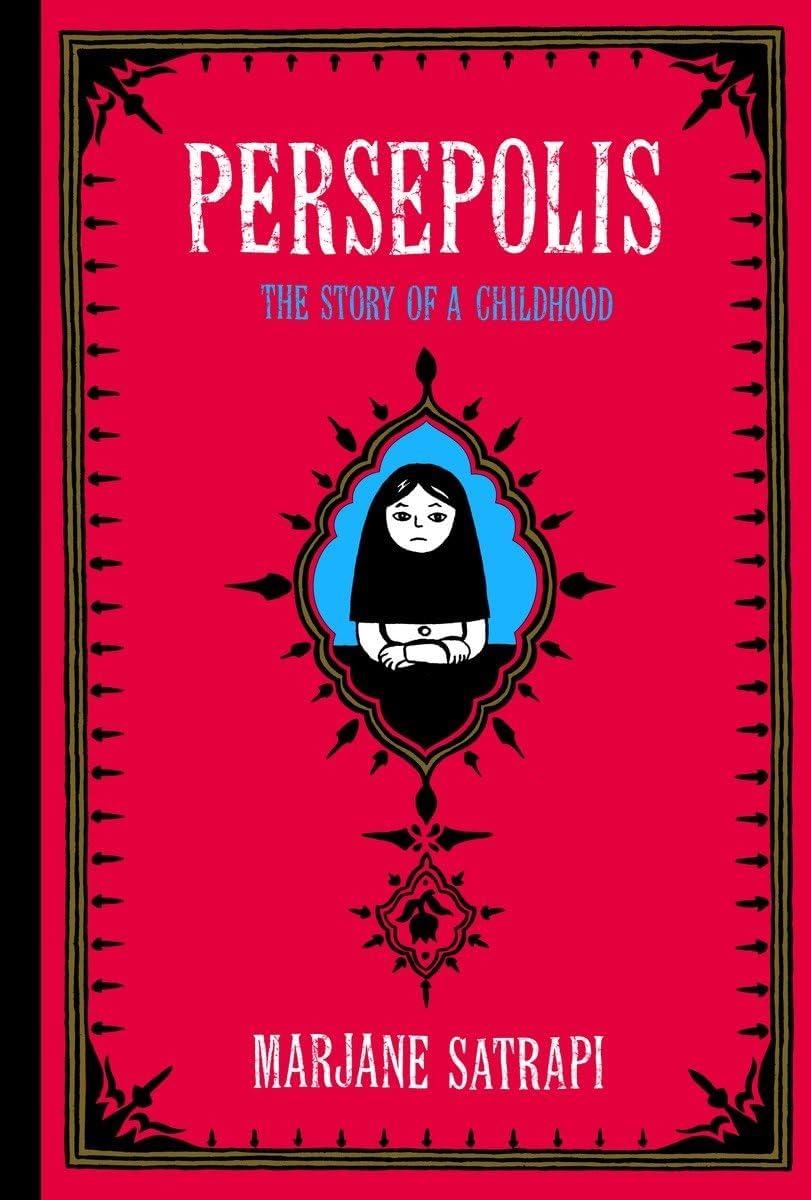
Persepolis: The Story of a Childhood (Pantheon Graphic Library)
Product ID: 222537741
Buy anything from 5,000+ international stores. One checkout price. No surprise fees. Join 2M+ shoppers on Desertcart.
Desertcart purchases this item on your behalf and handles shipping, customs, and support to Vietnam.
NEW YORK TIMES BESTSELLER - Wise, funny, and heartbreaking, Persepolis is Marjane Satrapi's acclaimed graphic memoir of growing up in Iran during the Islamic Revolution. "A wholly original achievement.... Satrapi evokes herself and her schoolmates coming of age in a world of protests and disappearances.... A stark, shocking impact." -- The New York Times: " The 50 Best Memoirs of the Past 50 Years" One of the New York Times 's 100 Best Books of the 21st Century In powerful black-and-white comic strip images, Satrapi tells the coming-of-age story of her life in Tehran from ages six to fourteen, years that saw the overthrow of the Shah's regime, the triumph of the Islamic Revolution, and the devastating effects of war with Iraq. The intelligent and outspoken only child of committed Marxists and the great-granddaughter of one of Iran's last emperors, Marjane bears witness to a childhood uniquely entwined with the history of her country. Persepolis paints an unforgettable portrait of daily life in Iran and of the bewildering contradictions between home life and public life. Marjane's child's-eye view of dethroned emperors, state-sanctioned whippings, and heroes of the revolution allows us to learn as she does the history of this fascinating country and of her own extraordinary family. Intensely personal, profoundly political, and wholly original, Persepolis is at once a story of growing up and a reminder of the human cost of war and political repression. It shows how we carry on, with laughter and tears, in the face of absurdity. And, finally, it introduces us to an irresistible little girl with whom we cannot help but fall in love. Review: Excellent - Publisher: vintage books Genre: autobiography/graphic ISBN: 978-0-099-52399-4 This book is written as a storyboard and the style suits it perfectly. I have never read a book written using this method but I found it to be a very enjoyable experience. For this particular book it works extremely well as it carries the volume of dialogue, if this had been written in straight prose it would have resembled a play rather than a novel. Marjanes general writing style is warm and inviting. As she narrates her story you can hear her voice and it brings the action to life. She captures the horrors of war and the difficulties of love in a style which makes all the subjects in this book seem very real to the reader. I have never been to Iran but I could connect with Satrapi and understood he point of view because it was explained so well and so easily. This book gave me a totally new perspective of muslim women and what they may have been thinking while living under oppressive regimes. Young Iranian girls are not so different to European girls once stripped down to just their thoughts and emotions. A very cleverly written book on a subject which I normally would not read, excellent. Personal read 5/5 Group read 4/5 Plenty to discuss but not everybody's choice of subject. Review: Very powerful comic style novel with a wide range of powerful themes and topics. - Great quality book, with very detailed comic style pictures. It's a great book to read with very powerful themes and topics, that gives a wide range of perspectives and ideas for English A-Level.


| Best Sellers Rank | 7,836 in Books ( See Top 100 in Books ) 1 in Middle Eastern Historical Biographies 127 in Women's Biographies 159 in Comics & Graphic Novels (Books) |
| Customer Reviews | 4.7 out of 5 stars 6,350 Reviews |
A**E
Excellent
Publisher: vintage books Genre: autobiography/graphic ISBN: 978-0-099-52399-4 This book is written as a storyboard and the style suits it perfectly. I have never read a book written using this method but I found it to be a very enjoyable experience. For this particular book it works extremely well as it carries the volume of dialogue, if this had been written in straight prose it would have resembled a play rather than a novel. Marjanes general writing style is warm and inviting. As she narrates her story you can hear her voice and it brings the action to life. She captures the horrors of war and the difficulties of love in a style which makes all the subjects in this book seem very real to the reader. I have never been to Iran but I could connect with Satrapi and understood he point of view because it was explained so well and so easily. This book gave me a totally new perspective of muslim women and what they may have been thinking while living under oppressive regimes. Young Iranian girls are not so different to European girls once stripped down to just their thoughts and emotions. A very cleverly written book on a subject which I normally would not read, excellent. Personal read 5/5 Group read 4/5 Plenty to discuss but not everybody's choice of subject.
G**A
Very powerful comic style novel with a wide range of powerful themes and topics.
Great quality book, with very detailed comic style pictures. It's a great book to read with very powerful themes and topics, that gives a wide range of perspectives and ideas for English A-Level.
M**N
A personal political history from times of freedom to suppression, told from a child's then woman'spoint of view.
"Persepolis" by Marjane Satrapi, is a personal and historical graphic novel of a time in Iran, a country which was called Persia for thousands of years; revealing the events from a clever child and then a young woman's point of view, as she grows up with the political situation expanding and evolving, & she was sophisticated beyond her years because of the good education, and also because of her families' multi involvement and input, experienced by so many of her family. It is a brilliant novel because of the multi-faceted approach, revealing the whole story of Iran in the 20th century and the upheavals and horror of political fundamentalist power and complete suppression and control on members of the whole family, but at first seen through the eyes of a child with her own childish ego, as she want to put the whole world to rights as a prophet: something that many a clever child of imagination has dreamed of doing- "putting the world of stupid adults to rights", suffering mentally and physically under this power, and eventually growing up and learning to live with things as they are, until they gradually change again.
D**.
Heartbreaking and thought-provoking
Great narrative about an Iranian girl through the turbulent years of the Islamic revolution from the mid-1970’s and the war with Iraq. I must say I loved it. However I initially bought it for our literature-devoted daughter who collects books and more recently has developed an interest in graphic novels of which she is building a small precious library as well. The challenge with her new interest is that there are not that that many graphic novels for people of her age that are of high quality and that are engaging. I thought Persepolis was an interesting modern history topic about social events that would open up a new world to her about. However she seemed quite dismissive about the book given that it lay around, untouched for months. Turned out she didn’t think much of the scribbly, childish style of art in black and white, printed on cheap paper. Which I can understand. I then started to read it to her, providing explanation, giving additional background information and answering her questions. This turned out to be really good fun and lead to valuable little debates. The book is somewhat witty and funny, but the narrative is very impressive and bound to leave an impression. The whole presentation can’t match some of the other hard-cover super beautifully illustrated graphic novels we have, but it certainly stands out as a story.
V**N
Insightfull
This is a fascinating view of life pre and post the Islamic Revolution in Iran as viewed by a child from a very left-wing family related to the last emperor or Iran. Her bewilderment, anger and rebellion at being told she had to wear the veil ; the imprisonment and tragic death of her favourite uncle for opposing the regime, and her exile in Austria without her family all paint a vivid picture of the upheaval the Islamic Revolution brought about in this young girl's life and that of her family. This is not a sad story, there are many uproariously funny episodes witnessed through the eyes of this child on her way to adulthood and her return to Iran. I highly recommend this beautiful, honest story, that will make you feel intimately acquainted with Marjane and her family.
E**A
Thank you!
I suppose that of the many praising words written for this book, which deserves them all, very little has been said about the beneficial effect it can have on a reluctant-to-read grumpy teenager. I had personally read it years ago and I cannot praise it enough, a daring genius important novel!!! But i bought it again in my pursue to convince my daughter to read (she had stopped all of a sudden months ago) and it worked wonders. She was totally taken by the very clever story telling and the deeply emotional history scenario. As a young woman she felt connected and touched by the female protagonists and their struggle. She has not stopped reading other books since, similar format or subject. Thank you Mrs. Satrapi for having helped a young lady to reconnect with a reality which is not filtered by utube/instagram/facebook viewers, but much vaster and more profound.
L**R
If you haven't already read this you really should.
This is a stupendous book. I was recommended it by a friend who knew of my interest in black and white sequential art and it blew me away. Its deceptively simply drawn and scripted panels are the autobiography of an Iranian woman whose story imparts far more about life in and the history of Iran than I already knew. This poignant, tragic and frequently funny book could - and should- be read by everyone from a teenager to a mature reader. Highly recommended.
L**D
Important, and thought provoking
An interesting introduction to an area of history that’s not always understood; definitely one of my favourite reads of the year.
D**E
An Important Memoir
So many countries have had their share of war – both, internal and external war. Iran has certainly had their share of emporers, kings, and political oppression. In the introduction of this book, Satrapi gives us a brief two-page synopsis of Iran, its beginnings, its wars, and what happened in 1979 when the last Shah of Iran fled the Islamic revolution. And this is where the author begins her story. Satrapi was six when the revolution began. Her coming of age story begins when she was aged ten. She was an intelligent child from an upper-middle class family who wanted to understand why her world as she knew it, was turned upside by revolution. Satrapi shares with us about all the changes that took place in her country during the revolution, and the year it became mandatory to ‘wear the veil’. She hated it. She could no longer go to school with a mix of boys and girls either. Her privileged and modern life as she knew it, was no longer. Marjane was an only child, and a deeply spiritual girl. In her very young life, she thought she wanted to grow up to be a prophet, but as her world was changing, this would no longer be possible. At a very young age, she began reading books on empires and autocratic world leaders. She wanted to understand why the demonstrations in her country were so violent, horrible crimes against humanity. Marjane repeatedly asked her parents if she could join them in the daily protests they attended on the street from morning till night, but they wouldn’t allow her to participate. She was tired of protesting alone in her own backyard. But her father told her they could get shot at a demonstration, and refused to bring her along. But Marjane believed that if a revolution was to succeed, the entire population should support it. The revolution was a fight against social classes. Politics overwhelmed Marja. She was tired of the people in her life ‘disappearing’, and she was tired of same answers from her parents – ‘they went on a trip’. When her Uncle Anoosh reappeared after fleeing political persecution, he told Marja, “In a country where half the population is illiterate, you cannot unite the people around Marx, the only thing that can really unite them is Nationalism or a religious ethic . . . but the religious leaders didn’t know how to govern,” he called it a fake election takeover – many fled Iran while others thought it wouldn’t last. Uncle Anoosh was found and executed. And Marja became angry with God. The bombings began and the fundamentalists took down the U.S. Embassy – no longer viable to get a visa to flee. The universities closed for two years in order to rewrite new religious curriculum. The middle and upper class feared they’d be forced to wear the veil and perhaps ‘no more cars, back to camels’. Marja found her young world crashing as she feared she wouldn’t get to go to university and become a scholar. Marja’s parents protested daily, and her mother was threatened for refusing to wear the veil or acknowledging the new fundamentalist government – she ultimately succumbed. It was declared that ‘to protect women from all potential rapists’, they declared wearing the veil was mandatory. There became two types of women and two types of men – the fundamentalists and the modern man/woman. Apparently, the modern woman no longer had a choice but to wear the veil, but in protest, they allowed some of their hair to stick out. To distinguish the two types of men – fundamentalists didn’t shave and grew long beards, and didn’tuck their shirts in, vs. the clean shaven men (mustaches optional) who tucked in their shirts and wore neck ties – a fashion from ‘the west’, frowned upon. New Islamic religion stated that women’s hair ’emanates rays that excite men’. It sure feels to me that women had to tone down their looks so as not to excite men. So sad. It doesn’t surprise me how many Iranians fled the revolution. Marja tells us that not just the government changed, but many of the people she knew. Marja was told by her parents that if anyone asks, she prays five times a day. Her mother was a staunch fighter for women’s rights. One year after the protests began, Marja’s parents brought her to one, and Marja shares the violence she witnessed that one and only day she went to protest. And when they began beating women with bats because they weren’t wearing the veil, Marja and her parents scurried home. In September 1980, Marja’s parents took her on a three-week vacation to Europe, they came back to another war, with Iraq – that was on top of the already civil war going on in Iran. When the Iraqis began dropping bombs in Tehran, Marja writes, “The Arabs never liked the Persians . . . they attacked us 1400 years ago, they forced their religion on us.” Her father concurred, but added that the real invasion had already come from their own government. Everything was changing daily as war was both internal and external in Iran. Their Iranian National Anthem was replaced by the new government’s hymn. Marja’s father had given up on listening to news in Iran that he knew was lies. He’d tune in nightly to his old radio and listen to the BBC. Once border town oil refineries were bombed, village people fled to the main city of Tehran, food shortages began in supermarkets, and gas was limited. Marja had to get used to new school protocols, like beating her chest to war cries on the loudspeaker, and celebrating Revolution Day. Her parents along with many others rebelled the teachers. There were strict rules about wearing the veil with NO hair showing – to that statement, and some comic relief, Marja’s dad responded to that teacher, “If hair is as stimulating as you say, then you need to shave your mustache.” The young boys were handed out golden keys in school, and told if they went to war and died, the key would get them into heaven and they’d be offered a better life in paradise. As young as fourteen years old, they were lured to war. Soon enough, the family had to keep dark drapes drawn, and had to bomb-proof their house. The enemy was anywhere and everywhere among their own as citizens were swayed to the fundamentalist’s side, devoted to the new regime. There were strict rules: no parties, no card games, no gambling, no alcohol, and of course, the dress code. And one never knew if their neighbor had flipped and become an extremist who would happily rat out anyone disobeying. Marja tells us about one night in particular when her family was out at a newborn baby celebration, with alcohol, and they were stopped on the way home by extremist police spot-check. They smelled the alcohol on her father’s breath and saw he wore a necktie. He was told to get back in the car and they would follow him home to search his house for alcohol, but that one time they were lucky that money still talked and Marja’s dad bought them off. The persecutions got worse in Iran as the wars progressed. Besides wearing the veil in school, no nail polish or jewelry was permitted either. But food was becoming more available from the black markets – if you had the money. Marja shares another scary story with us. She tells about the day she went out wearing her new American Nike shoes and a Michael Jackson badge she wore on her jacket. These were items no longer available in Iran, but her parents had taken a short trip to Turkey and bought some items for her that Iran saw as Western apparel. There was now a new extreme women’s branch called, The Guardians of the Revolution. Marja was stopped on the street by some of those women, they told her ‘decadence is forbidden’. Marja considered that her lucky day when she was let off with a warning instead of being taken to headquarters where ‘people have been known to disappear for days’. At fourteen years old, Marja was wise beyond her years and a self-proclaimed rebel. If she chose to wear jewelry, the teachers would take it off her, never to be returned. And one day, Marja lost her constraint – the day the principal tried to take her bracelet from her, Marja whacked her so hard, she fell. Marja was expelled. Through connections, her parents got her into another school. But that didn’t last long before Marja called out the teacher for her lies. At that point, Marja’s parents arranged to have her sent to school in Austria, where they had relatives. They were petrified that their daughter’s brevity would land her in jail or killed. Her parents told Marja they would follow in a few months. But would they? With breaking hearts, her parents took Marja to the airport so that she could live in freedom and get the education she deserved, and to allow her to be the child she needed to be. I shall look forward to reading the second book, Persepolis 2, where Marjane returns to Iran as a young adult after fleeing the oppression.
M**T
Good quality and fast delivery
Good quality and fast delivery
B**M
Charming
Good book
F**M
Molto bello
Un modo leggero di raccontare eventi impegnativi
N**R
A Necessary Dose of Perspective on the Middle East
I have taught this book to my tenth grade English students for the past five years, and I believe it has helped to send my former students into society as informed adults with enough perspective to see Iranian people as fellow global citizens, not Middle Eastern enemies. Satrapi wrote the book to inform people about the Islamic Revolution and to give readers an insider perspective. I know that the book was originally written in French, and then later translated to English, which are the main languages of the Western world. This points to her intended audience - Westerners. Satrapi was trying to show the Western world what Iranian people are really like -- not extremists, not radical Muslims - but mostly peace-loving, creative, independently thinking people who value their Persian culture and lifestyle and have suffered greatly for remaining in their homeland in spite of the challenges. Throughout the book, she paints herself as religiously moderate and politically involved, even as a child, and not at all negative towards the West. With images of the Iranian hostage crisis in the back of our minds, it is easy for Americans to assume that all Iranians hate Americans, but this is far from true. Satrapi shows her love for Western culture and music and books with Michael Jackson and Kim Wilde and Iron Maiden. She mostly clearly demonstrates the impact of their suffering with how drastically the loss of her Uncle Anoosh impacted her. She also wants people to have the facts about the revolution as well, which we see in the wealth of historical information integrated into her memoir. I personally believe that Satrapi was very effective in helping society see Iranians differently, mostly from my personal experience. Before reading this book six years ago, I assumed that if the theocracy remains in power, that must mean that the majority of people in Iran must be really religious and anti-West, or else why wouldn't they overthrow their government? This book helped me see that they are really suffering under a different kind of tyranny, and also helped me understand why it happened. She shows why they overthrew the Shah - for freedom from an oppressive government, a government in which she knew that the difference between the social classes caused many people pain, but then she also shows throughout the rest of the book how the Iranian people were manipulated into becoming faithful to an Islamic regime. The serious re-structuring of schools caused great suffering and contributed to the difficulty with changing mindsets. If the religious government controls the schools, then the children are inculcated with the religious ideas, much like how Marjane was initially inculcated with the thought that the Shah was chosen by God. In addition, the Islamic regime ultimately secured their power by uniting the Iranian people in war against a foreign enemy and carrying on the war until the society was so completely devastated, they would not have the energy or desire to cause further revolt of any kind. I think this is an important topic for the Western world to see, as Western relations with Iran affect us in many ways. Our government currently has strict economic sanctions on Iran, which causes our gas prices to go up and impacts us where we feel it the most, our wallets; however, most people do not see the reason behind this, and why the world needs to take note of the tyranny in Iran. In addition, many people here in the United States lump together all of the people in the Middle East under the label of "Arabs" and then furthermore, see them all as extreme Muslims and terrorists, particularly since 9/11. As a student pointed out in class today, the book was published shortly after 9/11, which is likely not a coincidence. In the days after this event, many Americans viewed any Middle Eastern man with a beard or any Middle Eastern woman with a hijab as a terrorist, a threat; yet Marjane paints us a much needed picture of a world so many Americans do not realize exists - a world in which many free spirited Iranian people endure a forced dress code that represents far more oppression than we here in America could ever imagine.
Trustpilot
3 weeks ago
2 months ago