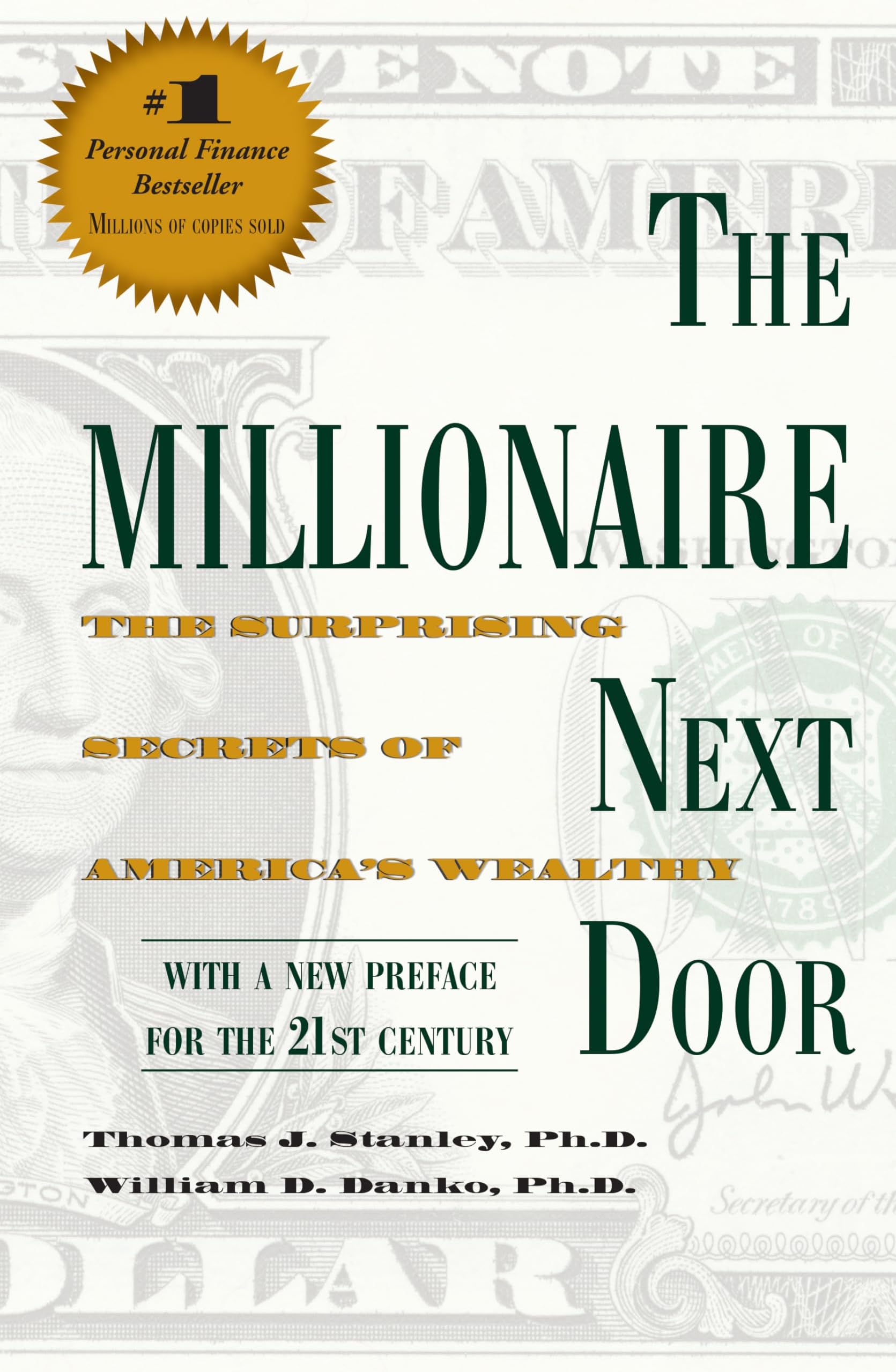
The Millionaire Next Door: The Surprising Secrets of America's Wealthy
Product ID: 221581
📅Timeless insights since 2010
📈Top #5 in Introduction to Investing
📚272 pages of wealth wisdom
Buy anything from 5,000+ international stores. One checkout price. No surprise fees. Join 2M+ shoppers on Desertcart.
Desertcart purchases this item on your behalf and handles shipping, customs, and support to Vietnam.
💼 Unlock the millionaire mindset hiding next door — your wealth journey starts here!
The Millionaire Next Door is a bestselling hardcover book offering 272 pages of data-backed insights into the true habits and mindsets of America's self-made millionaires. Launched in 2010, it challenges common wealth stereotypes by highlighting frugality, smart investing, and disciplined saving as keys to financial success. Highly rated and ranked top in investing and business motivation categories, it’s a must-read for aspiring professionals aiming to join the ranks of the financially savvy elite.


| Best Sellers Rank | #792 in Books ( See Top 100 in Books ) #4 in Introduction to Investing #5 in Wealth Management (Books) #9 in Motivational Management & Leadership |
| Customer Reviews | 4.6 out of 5 stars 15,790 Reviews |
Z**K
Sears, Not Brooks Brothers
This is an excellent, data-backed look at what the wealthy look like in the United States. Contrary to popular belief, most wealthy people do not drive Teslas and eat caviar. They are not tech CEOs or Wall Street financiers. They are small business owners and self-employed professionals who probably drive a 3-year old BMW or a Ford pickup truck or SUV. They probably wear a Seiko watch, not a Rolex. They probably wear a suit bought from Men's Wearhouse, not Brooks Brothers. They probably have a run-of-the-mill Visa credit card, not something from Sak's Fifth Ave. Some of the many useful insights and takeaways from this book: A Useful Definition of Wealth -- Wealth is much more than how much money you pull in every year and how much your house costs. It's more a reflection of your investments and how much money you save. Not how much you spend. There are a lot of people who pull in a ton of money every year but live paycheck-to-paycheck. Wealth and income are not the same thing -- Not all wealthy people pull in a hefty income. In fact, many purposely pull in relatively low incomes in order to reduce their tax obligations. Ross Perot is a great example of this (when the book is written). Perot pays millions in taxes, but is worth billions. Even your neighbor next door might be a millionaire, but maybe the household only brings in $79,000 a year. Most Millionaires Are Self-Made -- While children of millionaires are more likely to become millionaires, very few millionaires (less than 20%) are not self-made millionaires. In fact, regular handouts from parents make it less likely that an individual will become a millionaire someday. Most millionaires worked for their money and were not constantly given Economic Outpatient Care (EOC) from their parents. Frugality Reigns Supreme -- The authors give a great analogy about building wealth. You can play a great offensive (i.e. pulling in money) and you can make a great defensive (i.e. saving your money and preserving your wealth). Playing a great offensive is wonderful, but it is really only useful for building wealth if you don't play a great defensive too (some people are capable of playing such a great offensive that the defensive really isn't important, but this is very few people). They buy discount suits, discounted new cars or used cars, they rely on very, very little credit, and status symbols aren't all that important to them. Mindset Matters -- Most millionaires are not worry-warts. The only things they really worry about are government policies that will destroy their livelihoods, but even then, they know that they can't really control the outcome of these issues directly, so they only give so much effort and so much weight to these decisions. My only quasi-criticism of this book is that the data are from 1992-1996 and the book was written in 1996. This obviously isn't the fault of the authors, and some of the conclusions are reinforced in a 2010 preface, but just take some of the data with a grain of salt. Take inflation and general industrial changes into account. Well worth the read, especially if you are looking to join the ranks of the Prodigious Accumulators of Wealth or work with them.
M**R
Outstanding Financial and Life Lessons
This review is for the Kindle edition of the book. I first read this when it came out 15 years ago while still being fairly early in my professional career, saddled with a lot of debt from graduate school and really trying to figure out where I was going to be several years down the road, and what I wanted to do when I grew up (many people would argue I still don't know). When I saw this available one day for a discount in the Kindle format, I picked it up and just completed re-reading it. This review reflects my attempt over the last 10-15 years of trying to implement the lessons and observations discussed in this book. No matter what age you might be when you read this book, I guarantee you will recognize people from your walk of life - you might even say the names are the only things that are different; you will also recognize a picture of yourself (good and bad), and if you do an honest assessment you will recognize some areas you can improve upon with your own life. That's true for me when I first read it in the 90's as well as today. While it has been 15 years since this book was published, and many of the statistics in terms of current incomes may be dated, the principles remain the same: follow these principles, implement a plan - and stick to it, and you will be well on your way to a better picture financially. While I will not call myself a millionaire, after trying to follow a lot of the guidelines of this book for a decade, my financial picture is one heck of a lot better, and I am almost at the "multiply your annual income by age, then divide by 10" calculation for optimal net worth. The information in this book is not rocket science, but good practical advice on how you can consume less, save more, fund the kids' college education, and still maintain a great standard of living. These lessons should be given by every parent and handed out to every kid growing up. As a CPA in real life with 20 years of professional experience, I would hope I know what I'm talking about - if you follow the advice given in this book on a consistent basis over a period of time, you should also be in one heck of a lot better position financially not only for you, but most likely for your kids and grandkids, too.
C**E
Informative but needs updating
Good book with many examples. However, it’s based on very old data. It needs to be updated for current inflation and income levels. The updates they do have are not many and don’t really seem relevant to modern day.
J**D
Full of wonderful wealth building life lessons.
This has always been a good read. There are two types of millionaire: the flashy and the mundane. This book is the lessons learned of decades of studying the mundane. If you're interested in the behaviors of the stealthy wealthy that lead to their wealth creation, then this book is full of helpful lessons to aid you on your journey to joining them.
O**W
Very Sound Advice
Although this book is outdated in many ways and there has been much criticism about the authors' research methods, it is still well worth reading. I certainly wish I had read it back when I was in high school or college. The title may give the impression that the book is geared toward materialistic people who are obsessed with getting rich and living the high life, but that's not at all what it's about. In fact, the authors' main point is that most people who accumulate a lot of wealth are not at all interested in living the high life. Rather, they are thrifty and live below their means, with the result that they often don't appear wealthy at all. For example, your next door neighbor who manages a maid service -- not a very glamorous-sounding occupation -- could be surprisingly rich. By contrast, a large percentage of people who appear to be rich -- people living in fancy houses, driving expensive cars, wearing designer clothes -- don't actually have much saved up at all. The authors were surprised to make this discovery, and that is what inspired them to write the book. For years, they have compared the behavior of people who are successful at building or maintaining wealth with those who are not successful. Using elementary statistical analysis, they identify key habits and attitudes that enable people to accumulate wealth -- even if they don't have a particularly high salary. Thus, even if you earn a teacher's salary (as I do), you can still hope to retire comfortably and be a relatively wealthy teacher if you manage your spending and investments well. It does help, of course, to have a large salary, but with bad spending habits you can still end up accumulating nothing. (The authors do recommend choosing your occupation wisely.) The habits that they recommend are very practical. For example, you should keep track of all your expenses so that you know how much you spend each month and year on housing, food, entertainment, etc. Then make a budget and stick to it (or create a false sense of scarcity by stowing away a big percentage of your earnings before you even think about spending anything). Invest time and money in financial planning and research. And very importantly, invest your savings in stocks or other equity, making it your goal to have more of your financial growth come from growth of investments than from taxable wages. Overall, the authors present sound principles for building wealth, and they offer compelling evidence for the effectiveness of those principles. They provide a lot of interesting anecdotes that make the book fun to read most of the time, as well as basic statistical analysis of survey results. Again, although their methods may not be "scientifically rigorous," the main ideas are basically sound. I highly recommend the book, especially to young people who are just getting started in their careers -- regardless of how much money they expect to make.
T**G
THIS BOOK IS AN EYE-OPENER -- I WOULD RECOMMEND IT TO ANYONE!
This book could seriously change your life. These guys did a lot of research that I think would surprise -- yet, ultimately encourage -- most folks. Three key findings: 1) Most people who are millionaires don't live the flashy lifestyle 2) Most people who live the flashy lifestyle aren't millionaires 3) YOU can adopt a few simple lifestyle changes and mentalities that will make it MUCH EASIER for you to achieve financial security by simply realizing where your money goes each month! By starting to play better financial 'defense' you can become much more financially secure. The authors present interesting and compelling facts in a persuasive and interesting manner. This is a quick read. It could turn most of your assumptions about wealth accumulation and financial security on their heads! I borrowed and read this book years ago, but wanted to read it again. I bought it used and finished it in two days; it is all still relevant. I highlighted only the parts I thought were gems, and used up a whole highlighter. These principles WORK (suffice to say, they did in my case)! The self-made wealthy already abide by most of these concepts; they drive used cars, shop for bargains, and usually don't buy fancy homes! The high-earners with little to show for their years of high income will find practical advice to stop the bleeding and start building wealth; they will recognize their dumb habits immediately! Those with a low income will benefit by the encouragement and practical tips to begin growing wealth -- it can be done, and there are plenty of examples of it! If you want a book packed with a lot of just plain 'uncommon' common sense, get this one. It will make it easier for you to do the right things for your financial future. You will have less desire to live a "BIG HAT, NO CATTLE" lifestyle once you realize you could have financial independence instead -- an even bigger luxury. This is a book I think that should be recommended reading for every high school student; if people realized all the wisdom packed into these pages, we would see far more sensible life choices being made by American households. We wouldn't have so many families buying stuff they don't need -- with money they don't have -- to impress people they don't like! In summary: You're buying a lot of valuable wisdom in a very inexpensive book. Make this book your first investment. I can't recommend it strongly enough.
U**L
Not What I Was Expecting, Some Good Points Nonetheless
This book was not at all what I was expecting, but contains some good advice that many would benefit from. For some background, my wife and I are relatively young and have career jobs. I bought this book for information on making the most of any extra income, learning more about investing strategies, options for generating passive income, and improving my personal finances. I did learn a few things, but not on these topics (maybe a bit on the last point). The book primarily focuses on interesting finds and anecdotes from the authors' years of research on millionaires in America. The book is divided into eight chapters: 1. Meet the Millionaire Next Door 2. Frugal Frugal Frugal 3. Time, Energy, and Money 4. You Aren't What You Drive 5. Economic Outpatient Care 6. Affirmative Action, Family Style 7. Find Your Niche 8. Jobs: Millionaire vs. Heirs The author essentially splits everyone into two categories: Underaccumulators of Wealth (UAWs) and Prodigious Accumulators of Wealth (PAWs). UAWs have a low net worth relative to income, and the opposite for PAWs and uses these terms throughout the book. His primary argument is that PAWs get to be wealthy by living well below their means - these are people who do not look like millionaires, they live in modest neighborhoods, drive domestic sedans, wear a Timex, and usually have a blue-collar job that does not come with an expensive lifestyle associated and as a result can accumulate a sizeable nest egg. On the other hand, UAWs are typically well-educated professionals with high paying and high profile jobs (doctors, attorneys), but due to societal pressures associated with their social standing are forced to squander all their money living in luxury neighborhoods, driving German cars, and sending their kids to private schools. Their expensive lifestyle means that they spend most of their income and as a result have a low net worth, despite outward appearances. I agree that this is good advice for just about anyone: live below your means and prioritize financial security over social standing. Growing up in a single-income family living in a modest middle class neighborhood, I'm quite used to the live-below-your-means philosophy and I think it gave me at least some sense of good financial discipline. If my parents are any indication, it works great. Where the authors really lost my interest is that the rest of the book is chock full of anecdotes and some rather uninformative statistics to drive a few other points home. While some of these are good points and undoubtedly useful, they always seem to come with caveats or don't draw any real conclusion, which I found frustrating. Most of the points could have been made succinctly in about 1/10 the amount of page space the authors dedicate to them. These include: - Most millionaires in America are self employed business owners, because they run their personal finances like their business finances. However, going into business for yourself is very risky so we don't really recommend that as a viable way to get rich. - Very few millionaires have ever spent much money on a nice suit, pair of shoes, or luxury watch. They usually live in modest neighborhoods or rural areas where the cost of living and social pressures of consumerism are lower. - First generation millionaires (often immigrants) tend to be succeeded by children with financial struggles, since the parent's desire to "give them a better life" pushes them into careers where they become UAWs, and their upbringing in our consumerist culture impedes their ability to live frugally. But even if it turns them into UAWs, encourage them to go to college and aspire to a while-collar professional job. - Parents giving money to their children develops and reinforces poor financial habits. This money is almost always immediately spent, and these children generally have no savings since they are looking to their parents as their safety net and counting on an inheritance. Doing things like buying children a house in an upscale neighborhood or sending grandkids to a private school actually makes the children worse off, since they have to spend more to maintain the associated lifestyle. - The authors spend an inordinate amount of time and space comparing different careers, which I found next to useless since I'm very happy with my chosen career (Engineer) and have no intention of changing. They continually deride pretty much every professional job you can think of, and simultaneously praises how great working for yourself or owning a business is while going on about how difficult and risky it is to actually own a successful business. The author does not recommend changing careers, but again, this is more of a discussion of what their research has shown than any sort of "how to" advice. - Car buyers fall into four categories: whether you buy new or used, and whether you buy from the same place or shop around. The authors devote an entire chapter to this while only coming to the following conclusions: no method of buying a car is the clear winner, but if you own a business you may benefit from your connections with the owners of car dealerships; and most millionaires drive unassuming domestic (and to a lesser extent, Japanese) cars purchased new or lightly used. A final note - curiously, I found no mention of anything real-estate related, which to me is highly unusual in any sort of book about building wealth. The only investment advice found here is in the final chapter and could be summarized as "invest in what you know." That is, if you work in a certain sector, your knowledge of the industry will help you make good investment decisions. Not sure how I feel about this one. For example: not working in technology doesn't mean blue-chip tech stocks are a bad investment. Take it with a grain of salt. One last complaint: most of the financial figures are presented in mid-1990s dollars. I found it frustrating to have to mentally convert to today's dollars to get a relative sense. The authors took the time to update the preface in 2010, it would have been nice to see a revision to the figures quoted throughout the book. (For reference, one 1996 dollar is worth about 1.6 dollars in 2017). In summary, I was surprised about the amount of praise heaped on this book. I would hardly categorize it as a self-help book, it's more a retrospective on the authors' research and a collection of anecdotes and interesting conclusions about the countless Americans leading unglamorous lives while accumulating appreciable amounts of wealth. It's a quick read and I made it through the whole book on a 5-hour flight with time to spare. I would only recommend this book as an interesting overview of some good financial habits, or as an eye-opener for those with luxurious financial tendencies who struggle to save money despite their income level. However, for those who have already developed some discipline and are looking for detailed strategies and advice on personal finance and building wealth via investments and generating passive income, look elsewhere.
B**S
Great book highly recommend
Great book highly recommend
J**W
As expected
Good as expected
K**L
Excellent book.
This book is easy to read and to the point. I have found myself more often than not laughing & chuckling to myself. After reading this book, many things that I have observed over the years around me, it finally makes sense. The authors are of course 100% correct. However, it tells a truth and reality that most people aren't ready or willing to hear. I purchased this book as a gift but I ended up reading it myself. Totally recommended!! The book was written in the 90's but the principles on which is based on remain the same.
P**A
Just do it ,read it action it
Brilliant book shows you how easy it is. Sounds simple but just action it.consistent pays off
L**J
Fantastic guide to financial stability
Yes, read 141 out of 250 pages so far but I am so impressed with the financial advise. Great book. Recommended to everyone with any sort of income.
R**A
Recomendo totalmente a leitura desse livro
Atualmente comprar um livro com material de qualidade é difícil, esse possui capa dura verdadeira, folhas e impressão de qualidade. Certamente o que mais importa é o conteúdo e ele foi muito bem elaborado, traz muitas sugestões e experiências reais de pessoas bem sucedidas, detalhado o que fazer e não fazer de acordo com o histórico de diversas pessoas. Não é preciso ser ou querer ser um milionário para que esse livro seja de grande valor para você, ele pode te ajudar a ser ter uma vida mais tranquila financeiramente ou apenas te ajudar a ser uma pessoa melhor, o que já valeria a leitura.
Trustpilot
2 days ago
3 weeks ago