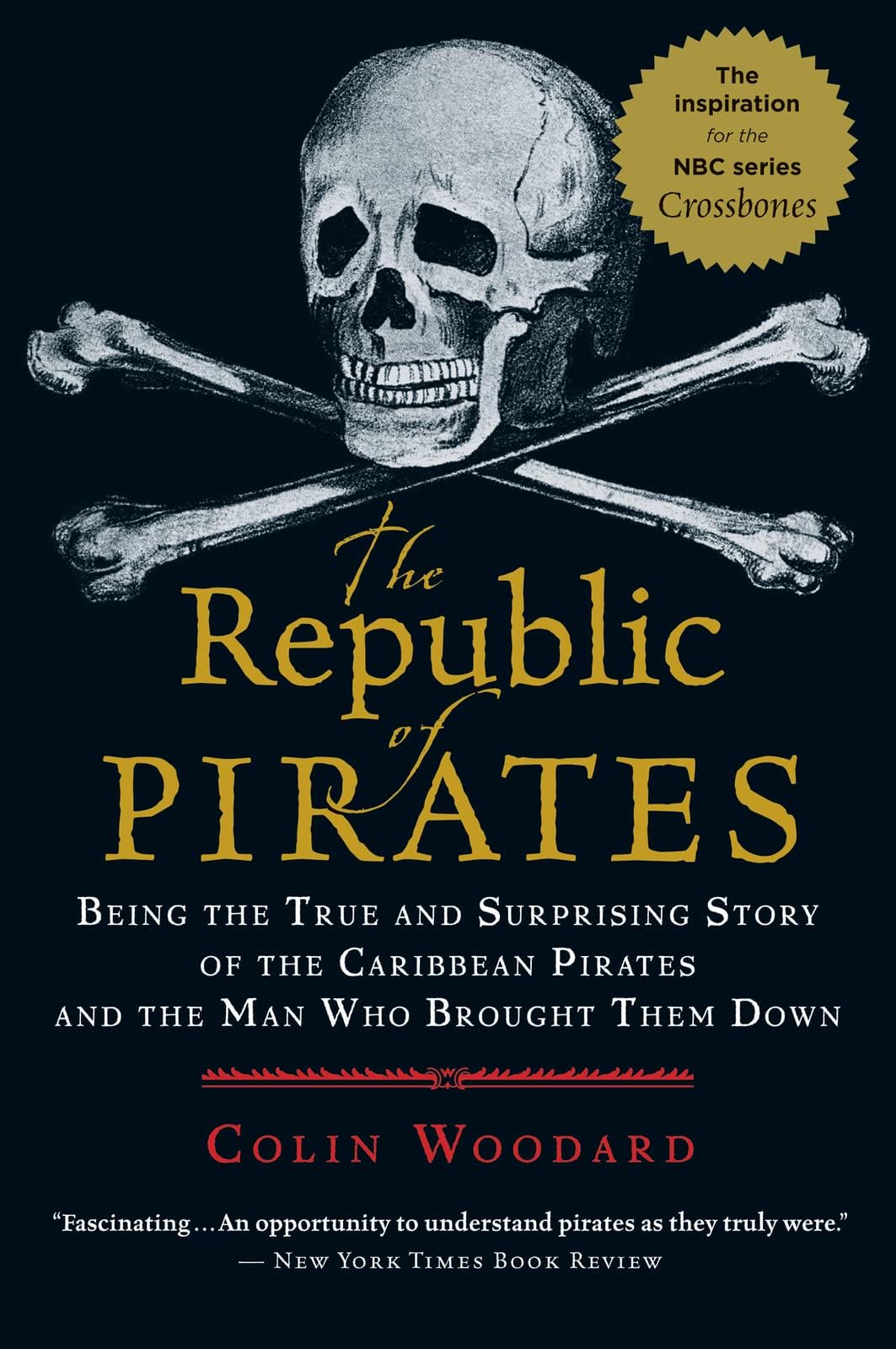
The Republic of Pirates: Being the True and Surprising Story of the Caribbean Pirates and the Man Who Brought Them Down
Product ID: 219461
Buy anything from 5,000+ international stores. One checkout price. No surprise fees. Join 2M+ shoppers on Desertcart.
Desertcart purchases this item on your behalf and handles shipping, customs, and support to Vietnam.
An entrancing tale of piracy colored with gold, treachery and double-dealing (Portland Press Herald), Pulitzer Prize-finalist Colin Woodward's The Republic of Pirates is the historical biography of the exploits of infamous Caribbean buccaneers during the Golden Age of Piracy. In the early eighteenth century, the Pirate Republic was home to some of the great pirate captains, including Edward "Blackbeard" Teach, "Black Sam" Bellamy, and Charles Vane. Along with their fellow pirates — former sailors, indentured servants, and runaway slaves — this "Flying Gang" established a crude but distinctive democracy in the Bahamas, carving out their own zone of freedom in which servants were free, blacks could be equal citizens, and leaders were chosen or deposed by a vote. They cut off trade routes, sacked slave ships, and severed Europe from its New World empires. For a brief, glorious period this true story of pirates reveals a success story as they became heroes in the eyes of the people. Drawing on extensive research in the archives of Britain and the Americas, award-winning author Colin Woodard tells the dramatic untold story of the Pirate Republic that shook the very foundations of the British and Spanish Empires and fanned the democratic sentiments that would one day drive the American revolution. This definitive work of maritime history reveals the real story behind the legends: The Golden Age of Piracy: Go beyond the myths to discover the true, ten-year maritime revolt that brought the British Empire to its knees and disrupted transatlantic commerce. Legendary Pirate Captains: Follow the dramatic exploits of Edward “Blackbeard” Teach, “Black Sam” Bellamy, and the notorious Charles Vane as they rise from common sailors to feared commanders. A Pirate Democracy: Learn about the “Flying Gang” and the crude but distinctive republic they established in the Bahamas, a zone of freedom where leaders were chosen by vote and all men were equal. Authoritative Research: Based on extensive investigation in the archives of Britain and the Americas, this untold story shakes the foundations of our understanding of the era. Review: History at Its Most Dangerous and Fascinating - “Pirates were the rock stars of their age.” The Republic of Pirates is a riveting blend of historical scholarship and cinematic storytelling that resurrects the brutal, lawless world of the Caribbean with extraordinary depth and energy. Rich in political intrigue, naval warfare, and larger-than-life figures, the narrative reads less like a history lesson and more like an epic adventure unfolding in real time. A brilliantly immersive account of rebellion, ambition, and survival on the high seas. Review: Interesting Book about Pirates - The book is interesting, it has a great chart based on the salaries of certain British possessions. The pirates started out as buccaneers or privateers. They had very interesting patterns and analysis. I would say’s it a decent to pretty good book with solid research.


| Best Sellers Rank | #22,225 in Books ( See Top 100 in Books ) #7 in Maritime History & Piracy (Books) #11 in Naval Military History #17 in Crime & Criminal Biographies |
| Customer Reviews | 4.5 out of 5 stars 3,171 Reviews |
S**R
History at Its Most Dangerous and Fascinating
“Pirates were the rock stars of their age.” The Republic of Pirates is a riveting blend of historical scholarship and cinematic storytelling that resurrects the brutal, lawless world of the Caribbean with extraordinary depth and energy. Rich in political intrigue, naval warfare, and larger-than-life figures, the narrative reads less like a history lesson and more like an epic adventure unfolding in real time. A brilliantly immersive account of rebellion, ambition, and survival on the high seas.
J**S
Interesting Book about Pirates
The book is interesting, it has a great chart based on the salaries of certain British possessions. The pirates started out as buccaneers or privateers. They had very interesting patterns and analysis. I would say’s it a decent to pretty good book with solid research.
J**G
The Golden Age of Piracy: crime and adventure in its context
The Golden Age of Piracy, roughly a 30 year period at the beginning of the 18th century, has taken on such a romantic notion in the modern mind, that when you actually discover the true events of the period, that the true story becomes much larger than the caricature that has been painted by Disney or other children's' stories. What Woodard, a native Maine journalist, attempts to do in this book is explain who the pirates actually were, what their motivation was, and why their heyday ended so rapidly. What makes this book so readable, is that not only does Woodard recount the hazards of early 18th century sailing so well, but he places it in its economic, social and political context. What made the pirates of the age so different from previous pirates, for piracy has been around as long as men have taken to the sea, was that these pirates were considered outlaws by every nation, and quite a large percentage of the few thousand who made up the Golden Age, were political dissenters, and hopeful insurgents against the new House of Hanover of Britain, and supporters of the deposed House of Stuart. Woodard inserts several things into his narrative that make this book worthwhile. His description of the extremely harsh social and economic conditions that sailors of the day had to serve under goes a long way to describe why a sailor with an otherwise spotless record would choose to leave legitimate merchant or military service for the high risk life of a Caribbean pirate. The author also makes the at time arcane world of 18th century sailing understandable and real. The reader, by the end of the book, should know the difference and significance between sloops, various rates of line ships, and frigates for example. The book focuses on the personalities of the era especially well. The rise pirate "republic" of the failed British colony of the Bahamas is shown to be personality driven by pirates like Vane and Hornigold. The public persona of Blackbeard, as well as the bumbling of Stede Bonnet illustrates how pirates used or misused their personal gifts to advance their high risk/ high reward profession. Put into context, the reader, besides learning about a fascination time period that was as exciting and really as short lived as the outlaw period of the American west or the gangster rule of Chicago, can see how a pattern of the rule of law and social convention breaks down in all sorts of time periods and circumstances. The British government solution, led by the Bahamian Governor, Woodes Rogers, was to aggressively assert authority over the center of the insurgence and then to alternate between warnings of mercy and systematic hunting of the lawbreakers by getting them to use their natural suspicion to turn on each other. This is a fascinating book for the general reader. There are sufficient maps of the 18th century Caribbean and the North American coast, and the writing not only puts the events into context, but tells the story well, by describing the motivations and personalities of the Golden Age of Piracy so that they make sense within their time period.
O**A
Amazing detail on the true origins of Caribbean piracy.
Movies and other fiction have portrayed quite a distorted view of piracy emphasizing the sensational elements; e.g. pitched ship to ship battles, swashbuckling fighters swinging from ropes, walking the plank. However, this book tells the real story of how pirates operated and it dispels the exaggerations of Hollywood. One would think this would make for a dull dry accounting of the dreary life of a pirate but it turns out the truth is so much stranger and more interesting than the fictional accounts. Early in the book it details the rather harried haunted existence of a typical English mariner. This horrifying setting provides the background for why piracy became an attractive option for colonists and English sailors. It then describes the weird evolution of how pirates made their initial heists and graduated to bigger and more potent ships, the impact of the use of those ships and strange facts about pirate government and their interactions with legitimate colonial governors and the fascinatingly bizarre elements of ship maintenance not normally discussed in any glib fictional account. All of this along with the description of the lives of those tasked with ending piracy and those that committed it presented a rich textured description of life in the early 1700's. The bewildering array of ship classifications is clearly described and then used throughout the text. The book chronicles the start, evolution and decline of Caribbean piracy. If you are considering writing a story set in the golden age of piracy I would consider this a vital starting resource.
Q**O
Probably the best book written about the pirates who raised havoc in ...
Probably the best book written about the pirates who raised havoc in the Caribbean and the Eastern Coast of North America from Charleston to Maine. They're all here. Samuel Bellamy, Edward Thatch (Teach), the infamous 'Blackbeard', Charles Vane and the 'gentleman pirate' Stede Bonnet whose despite a total lack of maritime skills enters into piracy and is rewarded with failure after failure in his miserable attempts at the trade. There are many more men (and women) who engage in piracy and the culmination of their demise by the efforts of Woodes Rogers, the Governor of the Bahamas, himself a tragic figure in the long run. Colin Woodward has gone to great lengths to detail the short careers of these people and their successes as well as failures with their pillages and subsequent 'booty' taken in these raids. What surprised me is most anything was 'treasure' to the pirates. Forget the gold, silver and pieces of eight stories you've heard. Sure that was the stuff to have but cloth, silk, flour, wine, bread, livestock and even barrels of nails and wood were taken as well. Pirate captains were elected by their crews. Do well and manage to raid commerce vessels whose holds contained marketable goods and you kept your position as leader of the crew. Have repeated failures (life Stede Bonnet) and you could find yourself either voted out and back as a regular crew member or worse, contest your ouster and have the crew dump you on the nearest sandbar or uninhabited island as you stood watching your ship and former comrades sail off in the distance. I also never knew that pirates slaughtering crew members of ships they raided was a rarity. Most pirates would attempt to get these sailors to join their ranks (piracy was much more lucrative than being a sailor on a merchant vessel) or some were impressed into it because of a needed skill like a surgeon, carpenter or seasoned deck hand. After cleaning out the hold of a ship sometimes the captain was given a token payment for the cargo or he and his crew were set ashore somewhere desolate. Usually a place they would be found long after the pirates were gone. In most cases their ship was either seized and added to the pirate fleet, burned to the waterline or in many cases kept by the pirates and the captain and crew given a smaller vessels from the pirate fleet that had been seized earlier and sent on their way. This book is a terrific read and chock full of details. Well worth the money spent.
F**O
This book helped me strip the eye patch and introduced me to the real people behind the legend
"They vilify us, the scoundrels do, when there is only this difference [between us]: they rob the poor under the cover of law . . . and we plunder the rich under the cover of our own courage.” - Black Sam Through the use of court documents, testimonies, and scribes Collin Woodard strips the eye patch and not only explains the chain of events that spawned the pirate republic but also humanized the people behind the legends. An extraordinary tale about extraordinarily lives. I almost ran out of pages on my notebook and learned more than I expected. Fascinating stuff. I regard this book with mixed emotions. On one hand I loved the information and was impressed with the level of detail. On the other I couldn't help but think that the book needed a more efficient approach. Reading this book is laborious due in lart to the dry writing style and it also contains unneeded material that's best fitted in the footnote section. Except from my notes: This book helped me strip the eye patch and introduced me to the real people behind the legends. Captains like Sam Bellamy (Black Sam) believed that their deeds were justified and even fancied himself a Robin Hood. Edward Thatch aka Blackbeard was the stereotypical pirate. He embraced the rugged appearance to the point of having fire and smoke emanate from his hat in order to scare his rivals into submission.
J**E
Robin Hoods of the Seas
Of the major works dedicated to Caribbean piracy, this one favors the Romantic interpretation. Neither great national heroes, nor psychopathic dictators, the men we today call the "pirates" were outlaw, adventure-seeking republicans in search of a tolerable life outside the miserable conditions of the Royal Navy or merchant marine. The pirates became outlaws because the "law" was so ruthless and arbitrary, particularly in how it was applied on board a ship. This is the basic thesis of the book. Sounds just like a story out of the Wild West, doesn't it? That's because it really is. It's a story that we can easily translate to England's Wild West. The metaphor works. Believable? At first glance, maybe not, but then the author begins to lay out the evidence, from primary sources. Here, in the Caribbean of the early 18th century, are a group of men with grandiose aspirations living on the edge of civilization, where laws are vague and life is rough hewn. A group of these enterprising fellows established their own stable and independent quasi-state in the British Bahamas, for themselves and other deserters and outcasts of society, before their constant economic harassment attracted the attention of the colonial governors of Virginia, South Carolina, New Providence (Bahamas) and, eventually, King George I. They were gone by 1730, killed, lost, imprisoned or dispersed, just as the western gunslingers were gone by 1890. It's this type of romanticizing that keeps our interest. While the author really has a story to tell, this is good maritime history as well. The book gives us a good overview of colonial conditions, culture and economics as they existed in the Caribbean during the period. The author's language is colorful enough to immerse the reader in the setting, perhaps not as well as a novelist, but with some flair that leaves us entertained. It's a good story and keeps your attention. There are some editorial errors in the books. Misspellings, grammatical, etc... They're never really bothersome, but they do reveal a less professional copy editing effort.
T**B
Thrilling truth about the Caribbean pirate era
The Republic of Pirates: Being the True and Surprising Story of the Caribbean Pirates and the Man Who Brought Them Down I saw this book recommended on Dr. Albert Mohler's summer reading list. Dr. Mohler is president of the Southern Baptist Seminary, and known to be an avid reader of good nonfiction. I have always been interested in the pirate era and decided to read this book. It is amazing how well the author is able to tell the story of the Caribbean pirates. The book reads like fiction in that my interest was intently held and it was hard to put it down. He had me sometimes routing for the "good pirates". Good, of course, is relative. They were all rogues and scoundrels, robbing and plundering. But they were not all murderers. Many, in fact, including Blackbeard and Sam Bellamy held to a code of ethics that prevented them from abusing captives. They most often released them with their plundered ship, or kept the ship and put them ashore unmolested on an island where they were likely to be soon rescued. The author did extensive research of documents such as trial transcripts, diaries, and letters sent by governors and captives to Britain, which detailed events in the pirates' lives. The story of Woodes Rogers, the man who brought them down is riveting. I also learned much about the slave trade and how it was carried out in this book, a topic I've been fairly ignorant of til now, and that that most pirates were British, Irish, or Scottish, mostly rebelling against the Hanoverian king, and wanting James Stuart to be on the throne. I think you will find this book an informative and entertaining read.
K**N
Really Great Book!
I was not expecting that I was going to love this book as much as I did, but honestly I could not put this down. I really liked how even though it was written from a historical perspective, it felt almost like a novel at times due to way the author wrote it, which I really enjoyed. There is a lot of detailed description about daily life during this era that was super interesting to read about as well - it really painted a visual picture about how brutal of an era this was. Definite must-read for anyone interested in the Golden Age of Piracy!
G**G
Very good
This is a wonderful book. It's the very real story of the real pirates of the Caribbean based on archives and their story is better than fiction. Read it.
A**R
A brilliant account of the 'real history' of pirates.
An informative and thrilling read. Colin Woodward does a fantastic job of accounting the amazing adventures and legends of the Pirates of The Carribean. Thoughout the years, the legends of pirates have been romanticized and fantisized, but, as this book accounts, the real life stories of these rebellious bandits is equally (if not more) fantastical and tragic.
P**A
Bra
Syskonbarn älskade den
J**R
Obligatory holiday reading
Great read, would like to see a second volume on Madagascar, Sweden and the Barbary pirates. Very good.
Trustpilot
1 month ago
2 weeks ago