We remain fully operational. Our teams are working around the clock to ensure your deliveries continue safely.

DOWNLOAD THE APP


Copyright © 2025 Desertcart Holdings Limited
DOWNLOAD THE APP
Buy anything from 5,000+ international stores. One checkout price. No surprise fees. Join 2M+ shoppers on Desertcart.
Desertcart purchases this item on your behalf and handles shipping, customs, and support to Vietnam.
🎤 Elevate your voice with vintage tube luxury—because your sound deserves the spotlight.
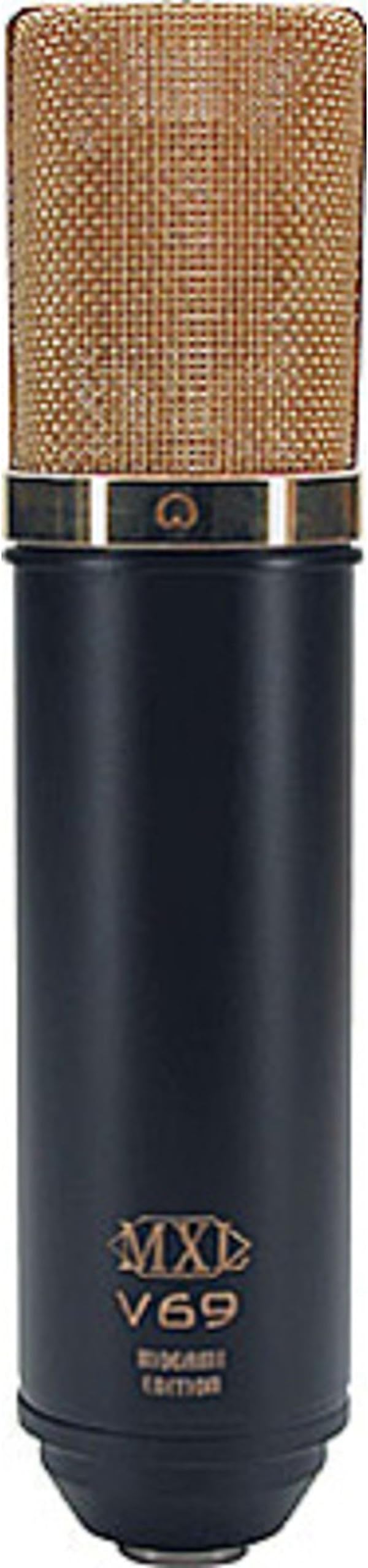
The MXL V69M EDT Mogami Edition is a large diaphragm tube condenser microphone featuring a 47mm gold-plated capsule and a 24-carat gold grill. Designed for professional vocal recording, it delivers warm vintage tube tones with low noise and high sensitivity. The package includes premium Mogami XLR and tube cables, ensuring a complete, ready-to-use microphone system favored by top-tier musicians and producers.
| ASIN | B000HQXT3C |
| Antenna Location | Singing, Streaming |
| Audible Noise | 22 Decibels |
| Audio Sensitivity | 54 Decibels |
| Best Sellers Rank | #53,045 in Musical Instruments ( See Top 100 in Musical Instruments ) #513 in Multipurpose Condenser Microphones |
| Brand | MXL |
| Built-In Media | Microphone |
| Color | Black with Gold Accents |
| Compatible Devices | XLR |
| Connectivity Technology | XLR |
| Connector Type | XLR |
| Customer Reviews | 4.2 4.2 out of 5 stars (75) |
| Enclosure Material | gold |
| Frequency Response | 15 KHz |
| Global Trade Identification Number | 00801813081190 |
| Impedance | 200 Ohms |
| Item Dimensions | 16 x 12.5 x 5.5 inches |
| Item Type Name | Tube Microphone |
| Item Weight | 10.3 Pounds |
| Manufacturer | Marshall Electronics |
| Mfr Part Number | V69 MEDT |
| Microphone Form Factor | Microphone System |
| Model Name | Mics MXL V69M EDT MOGAMI Edition Large Diaphragm Tube Condenser Microphone |
| Model Number | MXLV69MEDT |
| Number of Channels | 1 |
| Polar Pattern | Unidirectional |
| Power Source | External Power Supply |
| Signal-to-Noise Ratio | 72 dB |
| Special Feature | XLR |
| UPC | 801813081190 |
| Unit Count | 1.00 Count |
| Warranty Description | 1 year from date of purchase. |
F**O
One Of The Best Mics I Own
I own 28 mics. This is one of the best. I mostly have condenser mics and a few dynamic mics. This is my only tube mic and the only mic I have with it's own power supply. The difference is both noticeable and significant. The mic has a boost in the high end and adds gentle harmonics. I've used it mostly for live shows through outboard gear (preamp, EQ, and compressor), and it sounds amazing. I place the XML in my top 3.
B**R
Tube microphone
Very nice microphone performs way above this price point if you are looking for a tube mic this is the one to try.
M**M
big n clean
these are what they are. BIG lookin and clean sounding.
T**Y
I got used instead of new by mistake :(
I'm only rating all 3's because I received a used bundle. Was missing the power supply. The shock absorber is the "most used" looking piece I received. The mic looks beautiful. But I can't use it without the dedicated power supply. I may be missing a wire but i'm unsure. In talks with the seller now, will update my review once I can actually use the microphone.
J**Y
MXL MICROPHONE
Microphone is super will buy again
W**N
If you're looking into a tube vocal mic - this one will do the trick
If you like the sound of close vocal mic-ing, if you want detail and presence, this mic will do it. Here are the warnings you've probably read about tube mics: 1) They're noisy 2) Tend to overhead and must be mounted upside down 3) Tend to favor higher voice and not so good if you're a baritone. Well, I live in a studio with poor wiring and lots of gizmos running at once - I've had no noise problems. I've had no overheating issues, and I sing kinda low, and I still get that crisp presence that everyone wants from tube mics.
L**E
Poor quality control
The item arrived and upon opening the package 2 screws fell out completely from the xlr jack and the polish cloth was not included. Upon opening the unit and replacing the washers and screws it seems to function as expected. I will keep this product as it seems to work well, But am going to be very cautious on buying an mxl product in the future.
A**T
WOW !!
This is the most awesome microphone I've ever owned. It sounds and performs better than excellent. I am super happy and I know if anyone else decides to add this to their studio, they will feel the same.
T**T
A tube mic might be considered a luxury today. There are few of them about, most of them designed to provide young engineers/artists with a taste of a bygone era. Mind you, those tube mics weren't a luxury for Geoff Emerick and George Martin when recording the Beatles. Tube mics were one of their primary tools in creating sounds that would endure the passing decades with bite, presence, and dignity. Look at the old photos (not mine but of The Beatles in the studio) and you'll see several U47s and C12s, hanging from booms like Christmas tree ornaments. Nowadays to purchase three or four Neumann U47s in good condition you'd be spending over $50,000. You'd have to take out a mortgage. Or sell your car. And your spouse's to generate a sufficient down payment. It's like I was a kid, still heavy with acne, starting to record. At age-11 a friend's dad was a Neumann rep and we cut our first record direct-to-disc on a Neumann machine using that brand and Telefunken gear. When I began doing demos in small studio, I became familiar with the Neumann first-series U87. It's got a large diaphragm, meaning one that's at least 1” in diameter. It's somewhat similar to the Chinese capsule that we find in the MXL V69ME but perhaps not made with attention to the best materials and adherence to exacting tolerances. One aspect, a sort of “secret weapon” of the MXL V69ME is the “self-attenuating” circuit that cuts harsh, unwanted overtones at source. It's not something like a filter or pad you switch on. It there working quietly to rid the mic of harshness. Not all mics have this. The Neumann U87 does, however. It's a nice and seemingly necessary touch. So back when I started in studios, the old, now sanctified Neumann U47s , U67s, and AKG C12s, all tube mics, were par for the course. Any bigger studio stocked them in additon to non-tube mics like AKG D19s, first series Sennheiser MD-421s, and another example would be the 1950s ribbon mic, once used in a TV studio, an RCA BK-5B. All these cost a fortune today. As they should. I've got an old half-track master of the music that my band made to secure an LA deal. I remember a Sennheiser on one tom and two Neumann U47s, one for each floor tom. The results, even when the drum track was bounced onto the same track as the bass in this four-track set-up, it retained huge, round sounding toms. I believe that the MXL V67ME will furnish you with more than a taste of this action. While the mic may vary in quality in terms of components and design, it stands well in a mix. The tube does its work just like the old ones did. It is NOT one of those so-called tube preamps where you could take away the tube and still get the job done. Such devices add tubes for “warmth and vintage tone”. They're really solid state with tubes as decoration. The MXL V69 ME architecture is like its forefathers. The mic, which you hold or more commonly place on a shockmount on a stand, is much like the mics of the sixties. There's a glass vacuum tube inside each mic. If you take it out, the mic doesn't work. It's integral, just as much as the external power supply, a lump like a brick on the floor that plugs into the wall. On some modern tube mics, there is a dial on the external power supply you turn to switch pickup patterns. Not the MXL V69. It keeps everything simple (and therefore less costly) by staying with a cardioid pickup pattern. Devoid of switches, it is left to the engineer to pad the input 10dB give or take, or set up a high-pass filter on the console. Tubes improve the quality of tone the hotter they get. That's why MXL in its instructions accompanying the V69ME tell you to wait a spell after turning on the power supply. The warmer the better. Incidentally the mic is connected to the power supply with elite Mogamy cable (at this point, with a multi-pin, not XLR, cable); indeed, all wiring is with Mogami. Wiring can make or break a signal chain, so to speak. MXL also advises to suspend the mic, in its shockmount, upside down. You see Frank Sinatra in Capitol Music at Hollywood and Vine singing through an old U47 or Telefunken and it's upside down. The reasons, beside looking cool, include the fact that heat rises and if it penetrates the diaphragm, you screw up the mic, period. Therefore, you turn it upside down and heat rises to the rear end of the mic and dissipates. And for demonstrative vocalists it leaves more room for hand motions and turning pages of sheet music. On the website recording hacks.com, there are hundreds of mic profiles. In addition, there are “mic shootouts”, including one in which the MXL V69ME is pitted against mics costing twice as much or more. At the end of the day, many judges voted the V69 first or second. Some even mentioned similarity with the old U47. Now, this is not to say it's a perfect mic. There may be small production and component cost-saving initiatives and the mics may not be totally consistent. But choosing a matched pair of mics is always a challenge and if this mic can fool experts on more than one occasion into thinking they're listen to some upscale Neumann or Telefunken, I rest my case. I own three Apex mics, two which I bought privately, one from Amazon. They're funky looking, heavy, long and slender in a C12 sense and they deliver the goods in a variety of pickup patterns. But I prefer the MXL V69. Does the V69 have faults? Somewhere down the road, you'll probably want to replace the generic tube with something premium. That'll cost you $30 or so. Some people replace the capsule/diaphragm. I don't think it's a necessity with this mic. There's not much more to say. I thought the shock mount at first was fragile. But there was an occasion in which I left the then brand new V69 for a total of 14-hours set pointing downwards. There was no safety net. At the outset I used a small pair of pliars to tighten the shock mount wing screw and nothing budged, I kid you not. And when I removed the mic from the jaws, it was a bit of a tussle at first. This is good. If you can rely on a mic hanging upside down for over half a day and not dropping on its head, you've tapped into something good. The same goes for the wiring. Someone at recording hacks reported that there's something like $150 worth of Mogami wiring/cabling in this package! This is a really good, solid, affordable mic. Watch Amazon until the V69E drops in price. I can tell you that in Canadian dollars it can hover at $400-plus. But eventually it dips down, so keep a close watch. Amazon doesn't usually reduce the price by more than $100 so follow your gut feeling and you'll save a a whack of cash. When it starts to dip in price, keep a close watch for another week or so. Amazon doesn't usually discount more than $100 so trust your hunches and swoop down when things look good. In conclusion I have to say that I'm negligent. I have not tested this mic, the MXL V69MEZ on its strong suit: vocals. Given I just got the mic from Amazon, and I'm putting the finishing touches on my basement studio, and I've done one legit session with ukuleles (!) and I've recorded various drums in my collection. I set up the V69 as a “blend” mic, such as you used to see in three-track recording, for eg at Stax, between two Apex 460s (see photo). The MXL works well in that sort of company but stands more proud in the mix, somehow. It seems to exhibit more presence. While I haven't close-miked vocalists, I've done lots of drums from six to fifteen-feet distant and the sound I can get is like Ringo's on the track “In My Life”. If you've read this far today, you're seriously interested in tube mics and my strongest advice is buy the MXL V69 ME . It's surprisingly quiet; it's self noise clocks in lower than that of the U47! The sound-pressure handling is good for just about anything but I'd advise you not to place it in the inner sanctum of the bass drum 2” from the batter. Aside from that cautionary note, you will gain the feeling that you're walking in the steps of the late Geoff Emerick. It's up to you now. With this mic, you should be prepared for heightened sensitivity, so it seems, and serious bite that stems from a cushion of warm tones. Phew, who wrote that? Tbw.
A**A
I bought this mic to record soprano-range vocals that are centered around mid-rage frequencies with a fair bit of high-range frequencies. I was looking for a mic that would have a good amount of presence in the mid-range without over-accentuating the harsher and more nasal mid-range frequencies. I also wanted something that would bring warmth to my vocals, since they can be a tad too bright for my tastes. And I wanted something that would provide a lot of detail and clarity to the high-range frequencies. Man, this mic really is everything I hoped it would be. Even while being super congested with the flu, this mic adds warmth and body to the mid-range without making me sound nasal or shrill. Actually, if anything it probably made me sound a bit less nasal than most mics would. I don't normally sound nasal when I sing, but some microphones can make me sound just a bit nasal if they exaggerate certain frequencies around 1-2khz too much. The higher frequencies are just perfectly emphasized with this mic and the combination sounds just wonderful. I already had the V67G. That microphone was nice, but still had a slight bump in the high-mid range frequencies that could over-emphasize some characteristics of my vocals. It also didn't have quite as much clarity in the higher frequencies as I wanted. This microphone came in a really sturdy hard case, which I was not expecting! It also came with a tube-mic phantom power supply, two cables, a shock-mount, and a wind-screen. The power supply is super sturdy and supplies very clean power. This might be the lowest noise condenser microphone I have tried (not that I've tried a lot of the more expensive ones than this). If you have noise issues, you should look into getting a power conditioner. Even a cheap one will do wonders for your audio equipment and any noise issues. It's really incredible and likely a great all-around vocal mic, but it really shines for soprano voices that have tonal characteristics similar to Amy Lee (not saying I sing as well as her, just that there are similar characteristics in tone and frequency).
Trustpilot
2 weeks ago
2 months ago