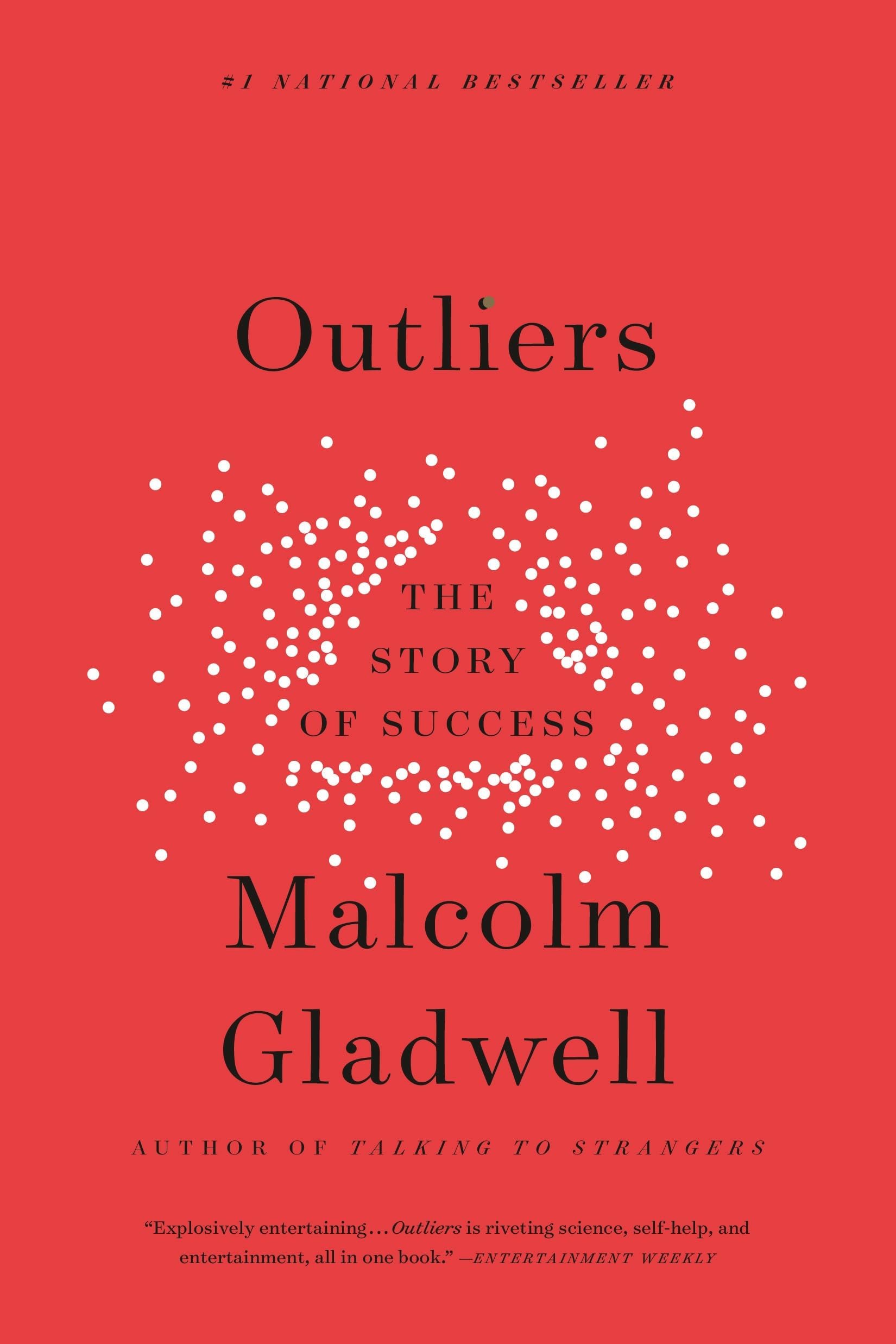
Outliers: The Story of Success
Product ID: 199730
⏳10,000-hour mastery rule
📊Top 10 in Decision-Making & Psychology
📚Bestseller #2,153 in Books
Buy anything from 5,000+ international stores. One checkout price. No surprise fees. Join 2M+ shoppers on Desertcart.
Desertcart purchases this item on your behalf and handles shipping, customs, and support to Vietnam.
🚀 Decode success secrets before your peers do!
Malcolm Gladwell’s 'Outliers' reveals the hidden patterns behind exceptional success, blending compelling stories with scientific research. Ranked top in business and psychology categories, this bestseller equips ambitious professionals with insights on practice, culture, and opportunity that redefine achievement.


| Best Sellers Rank | #2,192 in Books ( See Top 100 in Books ) #5 in Business Decision Making #7 in Decision-Making & Problem Solving #13 in Popular Social Psychology & Interactions |
| Customer Reviews | 4.6 out of 5 stars 39,139 Reviews |
J**H
Another terrific book from Gladwell
"Outliers", like other Gladwell books, is very enjoyable. It offers some interesting perspectives about what makes some people more successful than others, with particular emphasis on those who far exceed expectations. Many of the book's criticisms focus on what the book is not. I think that is a mistake. This is simply a fine book, a very thoughtful and easy read. The book goes into how one's ethnic roots and specific opportunities set the stage for dramatic success, then working hard takes over. For example: 1. An ancestral emphasis on community involvement can lead to health results which beat the odds. 2. The date of one's birth can affect athletic and academic success, as the oldest in a group of youth, will lead to the 'Matthew Effect', better coaching/teaching, more games/practice, etc. There is an accumulative advantage. On a list of the wealthiest people of all-time, besides opportunity showing up with so many from America, among that group, being born around 1835 and around 1955 stand out, to take advantage of when railroads and Wall Street emerged and when computer time-sharing emerged, respectively. 3. The 10,000 hour rule. Gladwell thinks about 10,000 hours of concentrating at a skill is necessary to excel at something. 4. Whether it is height in basketball or IQ, just being tall enough or intelligent enough is all that really matters, same with colleges as long as they are good enough. Practical intelligence, knowledge and savvy are what really counts and family background is the key to having those. Parents should be involved with their children, with lots of negotiating and expectations of child talk-back, necessary to cause a child to develop a sense of entitlement, maybe not the most moral approach, but extreme success madates that. 5. Jewish immigrants had advantage of occupational skills, like in the garment industry - enterpreneurial skills versus other immigrants like peasant farmers. Work was more meaningful. Their offspring saw this, plus NYC public schools were probably the best in the world at the time. 6. Harlan, Kentucky is an example of herdsmen settlers, with a culture of honor from Scotch-Irish ancestors, influenced descendants, Gladwell saying that crime in the South more influenced more by personal than economic reasons. Certain 'insult' words have bigger effect. 7. Plane crashes are more from human errors in teamwork and communication. Cultural respect for authority a big factor; can keep a subordinate from directing a superior in an emergency. Plus, 'mitigated speech' can be a problem. Can be remedied by training in 'Aviation English'. 8. Asians being better in Math, likely related to ancestral tradition of rice paddies, which are complicated and require hard work throughout the year. Western farming is more mechanical with usually an off-season with little work. Here again, more meaningful and hard work. Plus, Asians learn to count faster because of language differences for numbers. 9. K.I.P.P. Academy in the Bronx, charter middle school, is successful because it has long school days and short summer vacations, with students who commit to work hard. Studies have shown schools generally do well when they are in session, the problem are kids losing ground without good parental involvement during summer vacation. So, it is possible to make up for poor childhood family situations. Makes school meaningful. Incentives, rewards, fun and discipline is the formula. A terrific book.
S**E
We all know or have heard of one of these. Why are they so interesting?
There is little doubt that Malcolm Gladwell is an engaging story teller, clearly a result of his his background as a journalist. His style is both easy to read and informative. The individuals whose lives and stories he uses to illustrate his points are at once interesting and at the same time well chosen to illuminate the issues under his social microscope. These are stories told with enough detail, often gleaned from personal interviews with the people at whom he chooses to look in intimate detail. He avoids in large measure the narrow vision that such inspection may yield by also investigating the social sciences that have searched out the details of such difficult concepts. Everyone has some idea who "makes it" and who does not. That is often easy to see because life rewards those who make great effort in general. The difficult part is understanding why some succeed so well and others who may be even more gifted do not, at least in terms of the world's way of rewarding the star performers. It is often the grist of of rumor and innuendo as to why or how some people make it to the top of the "food chain." But to analyze the reasons carefully and then apply the scientific data of real studies to those stories brings this clearly into the realm of reality, if we ever really know that that is. As one who has spent a lifetime trying to apply the results of scientific study to the real world I found his approach noteworthy because of its practical applicability. I have read many dry textbooks, articles and studies and sometimes had difficulty seeing their real world application. But these stories are very illustrative of the points Mr. Gladwell is attempting to help us see with clarity. I enjoyed very much reading this work and wondering if it would have made some difference in the way I lived my own life and what I may have accomplished had I applied the message of its pages. I think that this can help everyone with ambition and ability to achieve more and those who may not have as much of a gift do well with what they have inasmuch as he clearly points out that achievement of greatness is often the result of great effort and application of what natural ability one has. I liked the "10,000 hours" as a real world application of what it takes to do it well. There is just enough science to give the work credibility, but not make it dry or over the heads of most. This and all the others of Gladwell's work that I have read have that same engaging style, enough to help one understand and believe it and enough of the stories of real people to make it interesting and applicable. I have recommended this book to my friends and family, especially those who are in the fields of childhood education or influence and who are either children growing up in this competitive society or raising children themselves. Everyone has something to learn from this either about themselves, those they may seek to help and those whom they may choose to emulate. I liked this book. I read it on my kindle, standing in line, sitting waiting or just absorbed by its message. It was hard to put down. This was the first of Mr. Gladwell's works I read, but then quickly read others which seem to have the same merit.
R**A
Worth the Investment
Outliers made it to the #1 spot as a national bestseller, and it's well deserved. It is interesting, clearly written, and the argument is logically presented and, for the most part, well supported. The book's central ideas are 1) that brain power, character, and motivation are overrated; 2) other factors—often not easily recognized or not given enough significance—such as where and when a person was born, his or her family history, and the particular twists of fate and coincidences in a life story, are integral to the success (or failure) of an individual. While his second premise makes sense to most of us, it is frequently downplayed in favor of intelligence, desire, ambition, and other character traits when analyzing the achievements of the famous and highly successful. No one, no matter how smart and driven, can do it alone, says Gladwell. And he insists that enough favorable factors must come together to clear the path and propel the individual to become a winner. For example, Bill Gates was born at the right time (computers coming into their own), to wealthy parents, and through various fortuitous events ended up in a situation that gave him unprecedented access to computers in the late 1960's when he was only an eighth grader. Various individuals acted as facilitators to make it possible for him to continue his programming work through high school and into college. In Gates words, "I was very lucky." Gladwell recognizes that Gates was brilliant and driven, and those faculties no doubt played in his favor, but the author maintains that the right circumstances—the precise state of technology when he was just the right age, the financial means, the mentors and coincidences—had to be there. He supports the argument by using contrast, including examples of extremely intelligent individuals, geniuses in fact, who were also highly motivated, but whose life circumstances did not favor them, and thus failed to achieve their enormous potential. In fact, he shows that high intelligence is an advantageous factor in achieving success only to a point beyond which it does not matter how many more IQ points you register. Curiously, Gladwell misses an opportunity to advance more of his basic premises when analyzing the success of the Beatles, instead narrowing his focus on the break the band got by accepting a gig in Hamburg, Germany, which forced them to play a variety of music genres many hours daily, seven days a week before they took America by storm. His emphasis here is the number of hours the Beatles played during that time, which made them much better musicians, but he does not highlight that the turbulent 1960's were ripe for radical change in various areas of society, music being one. One of the author's main points in other parts of the book is that the period in which a person happens to be alive has an enormous influence on his or her personal life outcome, and the Beatles are a perfect example of that. And yet, Gladwell does not seize the opportunity to emphasize this. Quite odd, really. The influence of culture in determining success or failure in specific fields is interestingly illustrated in Gladwell's analysis of airplane crashes. Until recently, Korean Air had a relatively high number of accidents, and it was discovered that this was largely due to their culture, which frowns upon the questioning of authority. It was found that Korean co-pilots and flight engineers were extremely hesitant to question the Captain's actions and decisions, much less clearly convey their concerns, when they detected potential problems. A similar situation resulted in an Avianca (a Colombian airline) crash in New York in January 1990. In that incident, the factors of bad weather, a very tired flight captain, and a malfunctioning auto-pilot were exacerbated by their being on a holding pattern over the city while running out of fuel and the first officer's reluctance to convey the gravity of the situation forcefully enough to the very busy and commanding New York air traffic controllers. He did not want to anger the "authorities," so the exchanges via radio maintained a business-as-usual tone until the plane eventually ran out of fuel and crashed. Gladwell offers many other fascinating and surprising facts in Outliers, such as the odd relationship between successful hockey players and their birth month, why the 1930's was the perfect time for New York Jewish lawyers to be born, why the 1950's residents of Roseto, Pennsylvania seemed immune to heart disease even though their diet was loaded with fat, few were committed to exercise, and many smoked heavily and struggled with obesity. If you find these extraordinary social phenomena interesting, you will like this book.
G**G
Outliers is a superb book of practical application, and I regret not reading it earlier!
Outliers: The Story of Success, by Malcolm Gladwell, is a #1 National Bestseller for good reason— superb book—and I regret not reading it earlier. In wonderfully engaging storytelling, the author reveals the surprising reasons why some people, including Canadian hockey players, star lawyers, and technology business founders, achieve such remarkable success. The bottom line is that success does not originate in innate intellectual brilliance or athletic ability. Instead, it is seen in those who take advantage of extraordinary opportunities, such as being born in the right month of the year (and therefore stronger and faster than others in their year group), or in a place and time when computer programming is in its infancy. This is the book that publicized the “10,000 hour rule,” the observation that those who achieve world-class excellence simply put in the hours required to prepare them to take advantage of exceptional opportunities. This is a book that is well worth pondering, and one that encourages you to not begrudge putting in the hours needed to become world-class in any endeavor.
E**S
Engaging and Insightful Look at Success
Engaging and Insightful Look at Success Malcolm Gladwell has a gift for taking big, sometimes abstract ideas and turning them into stories that stick with you. Outliers dives into the question of why some people achieve extraordinary success while others with similar talents do not. What I really enjoyed about this book is the way it blends research with real-life examples—whether it’s the “10,000 hours rule” of practice, the role of cultural legacies, or how timing and opportunity shape careers. The book is easy to read, and Gladwell’s storytelling makes the psychology and sociology of success feel both approachable and meaningful. I found myself reflecting on my own path and how circumstances—some within my control and many not—have influenced outcomes. This isn’t a self-help manual with step-by-step advice, but rather a thought-provoking exploration that makes you reframe how you view talent, effort, and opportunity. If there’s a caution, it’s that some of Gladwell’s conclusions can feel a bit too neat, as if the complexity of success is boiled down to a single narrative. But that doesn’t take away from how stimulating and conversation-starting the book is. Bottom line: A fascinating and highly readable book that challenges the myth of the “self-made” success and shows how hidden advantages, culture, and sheer timing play a massive role in achievement.
A**Z
Great read
Why and how companies become successful
M**I
Success arises out of the steady accumulation of advantages.
Outliers is a book about successors. Malcolm Gladwell analyzes success follows a predictable course. Success is a gift, he asserts, not simply the sum of the decisions and efforts we make on our own behalf, nor given to the brightest. Outliers are who have had the strength and presence of mind to seize opportunities given to them. From this perspective, Matthew’s words, “For unto everyone that hath shall be given, and he shall have abundance. But from him that hath not shall be taken away even that which he hath,” makes sense to us. Success is the result of accumulative advantage. Past successors were born at the right time with the right parents and the right ethnicity. Gladwell claims we need to replace the patchwork of lucky breaks and arbitrary advantages that today determine success, the fortunate birth dates and the happy accidents of history, with a society that provides opportunities for all to build a better world. Gladwell verifies existence of skewed birth months among pro sports players. He, then, inspects the 10,000-hour rule for success, and concludes the brain takes 10,000 hours to assimilate all that it needs to know to achieve true mastery. Success, he says, is a function of persistence and doggedness and the willingness to work hard. Not all geniuses grab success during their lifetimes. Almost none of the genius children from the lower social and economic class ended up making a name for themselves. He stresses the importance of practical intelligence, which helps you read situations correctly and get what you want, like knowing what to say to whom, knowing when to say it, and knowing how to say it for maximum effect. We get these kinds of attitudes and skills from our families. Middle-class parenting style, “concerted cultivation,” attempts to actively foster and assess a child’s talents, opinions and skills, while poor parents tending to follow a strategy of accomplishment of natural growth, by contrast, letting them grow and develop on their own. Gladwell illustrates constraints of cultural legacy by an example of “Scotch-Irish” and past plane crushes. Success arises out of the steady accumulation of advantages. When and where we are born, what our parents do for a living, and what the circumstances of our upbringing are make a significant difference in how well we do in the world. Cultural legacy, the traditions and attitudes we inherit from our forebears, can play the same role. Community around us prepares us properly for the world. We are handed down tendencies and assumptions and reflexes by the history of the community we grew up in. He shows us the Power Distance Index differs greatly among cultures. Also he points out the exact opposite communication styles between the East and the West. Western communication has a transmitter orientation, while many Asian countries are receiver oriented. Working really hard is what successful people do. He finds a clear relationship in rice farming between effort and reward. Autonomy, complexity, and connection between effort and reward are what work has to have if it is to be satisfying. The genius of the culture formed in the rice paddies is that hard work gave those in the fields a way to find meaning in the midst of great uncertainty and poverty. Outliers are also those people who are given the opportunity to escape the constraints of their cultural legacy. Gladwell’s suggestion to make up classes with school kids of similar birth dates is worth to consider.
B**W
Entertaining and provides some food for thought, but don't take it too seriously
Some of the reviews here are as if not more interesting than the book itself! Mr Gladwell's Outliers is an interesting read to be sure. It is my first Kindle purchase and I read it in one night, so it is neither long nor difficult to digest in a short amount of time. One of the major complaints here is that the author seems to rely too heavily on data picking to justify his own preconceived notions. To this point I concur. This is ok for experimenting with formulating hypthoses and thought experiments, but not acceptable for writing a book of this nature. As to the other somewhat disturbing accusation that Mr. Gladwell does not have his facts correct - such as in the case of the Guam traffic accident and the number of hours the Beatles played at Hamburg, it would be somewhat upsetting if this was true. But to this point I try to give Mr. Gladwell the benefit of the doubt, and take in the larger points of the book. My biggest issue with Mr. Gladwell is his definition of what it means to be an outlier and to be successful. I would argue that someone who is highly intelligent and has decided to live a moderate yet supremely comfortable and happy life , may have been more successful in the game of life in the end. In spite of these criticisms, I think the author still manages to pull off a decent book. There was an interesting article in the NY Times many years ago that talked about the effects of Nature vs. Nuture by studying a number of identical twins that were separated at birth. Their conclusion was that we are both a product of our genes and our environment, with a pretty equal weighting given to both. Outliers attempts to teach the same, that what we are born with is just as important as the environment we are born to: the things our parents will do, the society we grow up in, cultural and family traditions and beliefs, and whether the time that we are born in will help open up extraordinary opportunities. Finally, I would like to say a few things about the Asian references throughout the book. Growing up in a Chinese immigrant family myself and knowing many similar families, I would like to note the following: 1) It is absolutely true that it is much easier to remember longer numerical sequences in Chinese. However, I have some doubt as to whether that makes us better mathematicians in any way. 2) I was advanced in math at an early age. However, I attribute that to the many hours my dad spent educating us at home in this subject, not due to any magical power of memory or genetics. There are plenty of Asians in the United States who are unimpressive in this area which should provide ample proof to the contrary. 3) It is absolutely true that the small advantages one receives early in life provides a springboard from which to progress against his or her peers. When I was in kindergarten, I was able to answer questions that the teacher would occassionally ask the class, due to the extra effort my dad spent at home with educating us. This in turn ended up placing me into a special gifted class for the rest of my grade school years. Not many were accepted into this program, and we received better teachers and resources than our peers. Many of those classmates went on to great schools and are in professional careers. 4) Many immigrant families stress pure academics (maths and sciences) and do not pay enough attention to language and soft skills (social skills and what the author likes to deem emotional intelligence.) As a result, the cost often ends up being a trade off - gaining in one area at the cost of another. Academia demands the former, but real life demands the latter.
S**N
A Brilliant book, which bundle the art of living with greatness.
This amazing books gives some hints "Why you should challenge odds. How you should raise childs". "10000 hours, self-discipline, environment and the luck and time "
A**R
Recommend
Like other Gladwell’s books this is very insightful and interesting, inspiring and fun account of success. Recommended!
K**A
الكتاب صغير حجمه
احب الكتب المتوسطه ماتناسبني القراءة بكتاب صغير خصوصا بلغة اخرى - النسخة سليمة لكن الحجم صغير
J**O
amazing book!
one of the least books i read till the end
G**3
excellent book
Malcolm Gladwell is an excellent writer. Once I started reading I have not been able to put this book down. It is telling the succes story of different people : from hockeyplayers to lawyers, Bill Gates, children from poor families in NY suburbs and explains why airplane crashes happen. Everybody can be an outlier if life 's opportunities are lined up in the right way.
Trustpilot
1 day ago
2 months ago