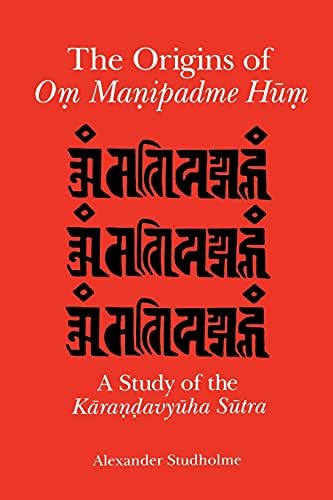


The Origins of Om Manipadme Hum: A Study of the Karandavyuha Sutra
Product ID: 1903895
Buy anything from 5,000+ international stores. One checkout price. No surprise fees. Join 2M+ shoppers on Desertcart.
Desertcart purchases this item on your behalf and handles shipping, customs, and support to Vietnam.
Full description not available
B**S
Great Addition to Our Understanding of Mantra
The Origins of Om Manipadme Hum makes several significant contributions to our understanding of the historical circumstances and narrative developments that engendered the present-day omnipresence of the mani mantra throughout the Himalayan Buddhist world. While it relies principally on an Indian text, the Karandhavyuha Sutra, Origins nonetheless points forward, as well, toward the emergent cult of Avalokitesvara that was to become the lynchpin of the Tibetan theocratic state and a core ethical teaching for Mahayana Buddhist social cohesion across the Himalayan range.The author makes the trenchant observation that the "literal" meaning of the mantra IS indeed important; by rendering the Sanskrit compound manipadme as a locative, Studholme makes the convincing argument that the principal translation of the mantra ought to be "[May I take rebirth] within the jeweled lotus!" a classic reference to the means of rebirth into Amitabha Buddha's Pure Land of Sukhavati/Dewachen. Thus we can understand the Tibetan practice of the mani mantra and the widespread cult of Avalokitesvara as an indigenous variant of similar, contemporaneous Pure Land Buddhist movements in China and Japan.This is a critical book for anyone with an interest in Indo-Tibetan tantric history, Pure Land forms of Buddhism, or mantra & toning practices.You can find my complete review for the Journal of the International Association of Tibetan Studies at its online home, the Tibetan & Himalayan Library.
D**N
Where did the most popular Buddhist Mantra come from?
This book researches the development area of the popular Buddhist mantra "Om Mani Padma Hum". It is a study into a Buddhist Sutra called the Karandavyuha Sutra; this means the casket containg the magnificent array of the manifestation and works of Avalokitesvara.The book starts with an introduction into the little known world of Hindu Puranas and its relationship to Mahayana Buddhism. We have to remember that there are no writings in existence today from India two thousand years ago,so historic research can only develop through interpretation of the myths for an insight into the social/religious world at that time. Starting by reading Puranas of the Hindu God Shiva, Studholme embarks on a journey of fascinating investigation through an area of comparative study. He leads us on an endeavour that proves well worth reading.He then concentrates on comparisons between the famous ancient Hindu mantra of Shiva "Namah Shiva" and "Om Mani Padme Hum" which is without doubt the most famous Buddhist mantra. Still following the theme of Buddhist/Hindu comparison he then investigates the development of Mahayana Buddhism in relation ship to the "Mani" mantra.In speaking about the meaning of the Mantra "Om Mani Pamde Hum" Studholme starts by engaging us with the motion of the difficulty of understanding the meaning of a mantra. He says on page 105:-"Thus the srotum, or "ear", is the instrument of hearing and jnatram, or intellect, is the instrument of knowing Mantra, similarly, is an instrument (tra) of the mind (Man-), being derived from the same root as manas-, denoting "mind" in the very broadest sense, encompassing the activity, not only of thought, but also of the emotions, the imagination, and the spiritual faculty of a human being. What is really importent, therefore, about phenomena such as "Om Mani Padme Hum" is not their meaning but their function".Studholme then concludes his book with a chapter which is a an overview of the themes in the Karandavyuha Sutra.All in all this book is a fascinating study into the origins and the meaning of Avalokitesvara the Bodhisattva of compasion. It is also a book that is quite lucid for a lay reader to read. Its a door into the intricate world of Mahayana Buddhism that though reading like a mystery plot is easy to follow.Dave Benn
A**O
Excellente étude d'un sujet qui intéresse de plus en plus de lecteurs - pratiquants bouddhistes ou autres.
Un livre clair, précis, bourré d'informations, qui effectue une excellente mise en contexte culturelle et historique du sutra du Karandavyuha, l'un des premiers sutra à être introduits au Tibet, et sans doute l'un des plus méconnus. Bien écrit, facile à suivre et convaincant, l'auteur fait ressortir la nature syncrétique et les origines yogiques du Bouddhisme tibétain. Un "must" pour tous ceux qui s'intéressent à cette branche du Bouddhisme.
Trustpilot
3 weeks ago
2 weeks ago