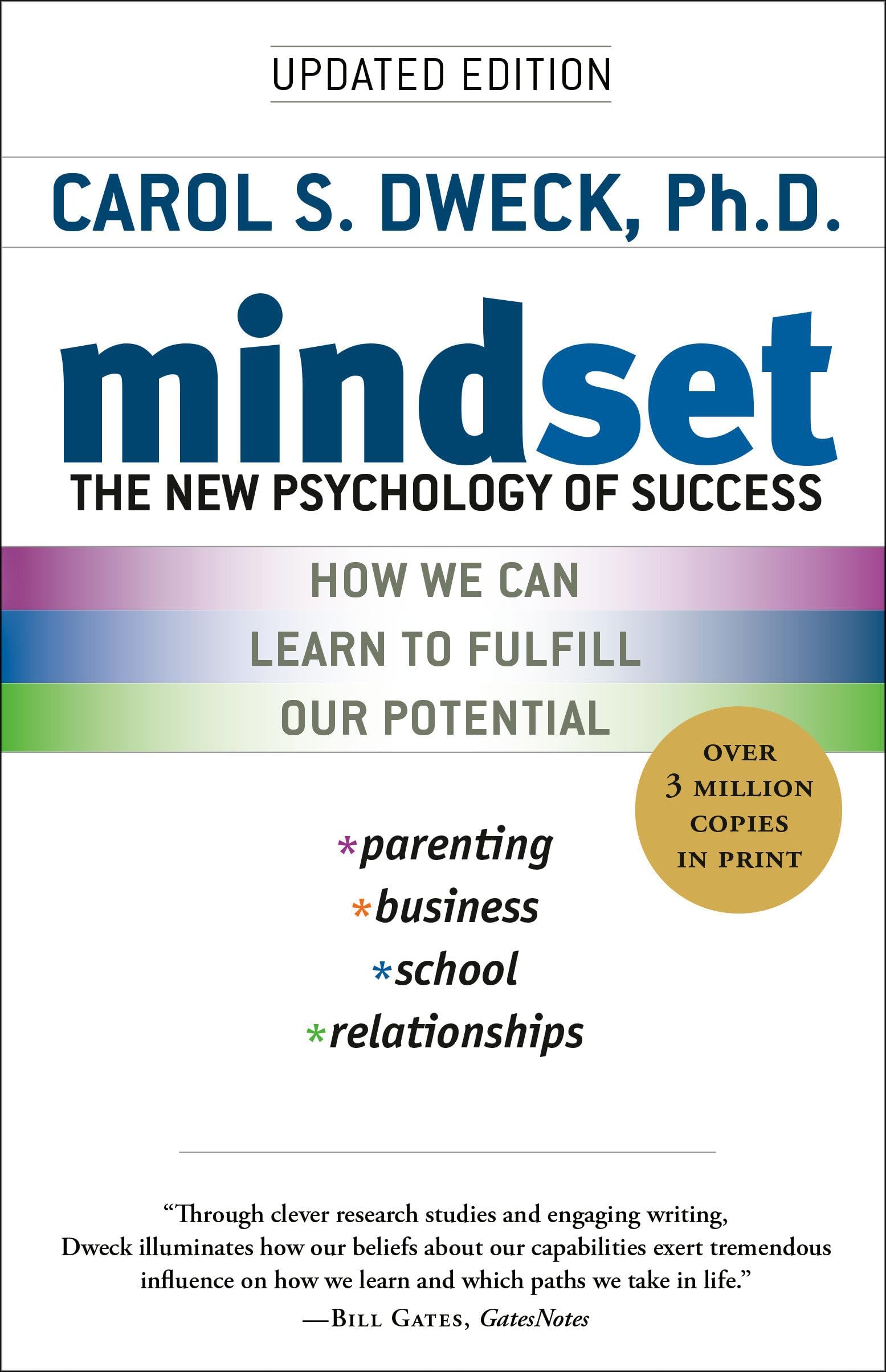
Mindset: The New Psychology of Success
Product ID: 188684166
Buy anything from 5,000+ international stores. One checkout price. No surprise fees. Join 2M+ shoppers on Desertcart.
Desertcart purchases this item on your behalf and handles shipping, customs, and support to Vietnam.
World-renowned Stanford University psychologist Carol Dweck, in decades of research on achievement and success, has discovered a truly groundbreaking idea–the power of our mindset. Dweck explains why it’s not just our abilities and talent that bring us success–but whether we approach them with a fixed or growth mindset. She makes clear why praising intelligence and ability doesn’t foster self-esteem and lead to accomplishment, but may actually jeopardize success. With the right mindset, we can motivate our kids and help them to raise their grades, as well as reach our own goals–personal and professional. Dweck reveals what all great parents, teachers, CEOs, and athletes already know: how a simple idea about the brain can create a love of learning and a resilience that is the basis of great accomplishment in every area. Review: Loved this - A really motivating and practical read. The book does a great job of explaining the difference between a fixed and growth mindset, and it gives clear examples of how to apply the concepts in everyday life. The advice feels actionable rather than just theoretical, which makes it easy to start making changes straight away. It’s inspiring without being overbearing, and it genuinely makes you think about how you approach challenges and learning. Definitely a book that can help you unlock your potential if you take the lessons to heart. Review: The book we should all read. - It's tough to imagine a book that could have a more profound impact upon a person's self-perception than Mindset, it is a truly phenomenal work that is both easy to read and packed with in-depth research and justifications for the author's hypothesis on learning and development. The book shelf for self-help/useful psychology is incredibly bloated and it always seems like the next book has more ringing praise than the last and, whilst I've read some excellent books on clinical psychology that are peerless, this will always be the book that I remember most fondly for changing my *own* mindset to one where failure was a necessary bump in the road to success, and not an irreversible breakdown. Bear in mind, this isn't a book that will simply inform you, it's a book that will actively change you. The core concept that Dweck puts across is that humans generally fall into two types of mindset when it comes to achievement, success, learning and ability; the growth mindset and the fixed mindset. Quintessentially the growth mindset is the "Practice makes perfect"/"Try, try and try again"/"Back in the saddle" school of thought whereas the fixed mindset is typically the "I've either got a knack for it or I haven't"/"Talent is born, not developed"/"If I need to practice then I can't be that good". Needless to say in the pages within Dweck tries to detach people from a fixed mindset and steer them towards the growth version, giving plenty of real life and 'laboratory' examples of her conceptions and why they do, and should, matter to us. This is not just a book aimed at children either, we should never stop growing as people and everyone from students to seasoned academics or established athletes to those just joining an MMA club will find much to mull after reading this. The only gripe I had when reading was the author's irritating habit of stuffing politics, particularly gender politics, into her extrapolations about different peoples attitudes to learning and the impact this has on the academic, corporate and political world. With this being Dweck's life's work as a psychologist I would have preferred she keep her political conjugating to herself to instead focus on the fascinating subject matter, she is free of course to release numerous other books covering such other topics as she so wishes. In summary, if you want to be convinced (within reason) that 'Effort is what creates success' then buy this book immediately.


| Best Sellers Rank | 12,477 in Books ( See Top 100 in Books ) 255 in Applied Psychology (Books) 594 in Practical & Motivational Self Help |
| Customer Reviews | 4.5 out of 5 stars 22,589 Reviews |
M**K
Loved this
A really motivating and practical read. The book does a great job of explaining the difference between a fixed and growth mindset, and it gives clear examples of how to apply the concepts in everyday life. The advice feels actionable rather than just theoretical, which makes it easy to start making changes straight away. It’s inspiring without being overbearing, and it genuinely makes you think about how you approach challenges and learning. Definitely a book that can help you unlock your potential if you take the lessons to heart.
A**N
The book we should all read.
It's tough to imagine a book that could have a more profound impact upon a person's self-perception than Mindset, it is a truly phenomenal work that is both easy to read and packed with in-depth research and justifications for the author's hypothesis on learning and development. The book shelf for self-help/useful psychology is incredibly bloated and it always seems like the next book has more ringing praise than the last and, whilst I've read some excellent books on clinical psychology that are peerless, this will always be the book that I remember most fondly for changing my *own* mindset to one where failure was a necessary bump in the road to success, and not an irreversible breakdown. Bear in mind, this isn't a book that will simply inform you, it's a book that will actively change you. The core concept that Dweck puts across is that humans generally fall into two types of mindset when it comes to achievement, success, learning and ability; the growth mindset and the fixed mindset. Quintessentially the growth mindset is the "Practice makes perfect"/"Try, try and try again"/"Back in the saddle" school of thought whereas the fixed mindset is typically the "I've either got a knack for it or I haven't"/"Talent is born, not developed"/"If I need to practice then I can't be that good". Needless to say in the pages within Dweck tries to detach people from a fixed mindset and steer them towards the growth version, giving plenty of real life and 'laboratory' examples of her conceptions and why they do, and should, matter to us. This is not just a book aimed at children either, we should never stop growing as people and everyone from students to seasoned academics or established athletes to those just joining an MMA club will find much to mull after reading this. The only gripe I had when reading was the author's irritating habit of stuffing politics, particularly gender politics, into her extrapolations about different peoples attitudes to learning and the impact this has on the academic, corporate and political world. With this being Dweck's life's work as a psychologist I would have preferred she keep her political conjugating to herself to instead focus on the fascinating subject matter, she is free of course to release numerous other books covering such other topics as she so wishes. In summary, if you want to be convinced (within reason) that 'Effort is what creates success' then buy this book immediately.
M**Y
A flawed masterpiece!
Sometimes one reads a book that is so convincing that all the arguements against it seem trivial in the extreme. 'Mindset', in my opinion, is a typical example of this, although it has imperfections. Not only is it a powerful thesis backed by overwhelming evidence and persuasive power, it has the extraordinary ability to linger memorably in the mind long after the last chapter; a true measure of an influential reading experience. Dweck's passion for teaching and learning is evident throughout, producing a layer of academic acumen that strengthens her case. Also, there is a compassion towards her learners, particularly the children , that says a great deal about her and her feelings towards her subjects. It's heartbreaking to think that there are teachers out there- many of them that have been teaching and lecturing for years - that do not share her views- or her caring attitude- about the 'growth mindset.' of her learners. In fact, it is disturbing to think they might be hindered in their lifes by out-dated views. I wish every class in the world was aware about the views and opinions expressed in this book. The world would be a richer place for it. For example, chapter 3- exploring the truth about ability and accomplishment- is simply a wonderful exposition about the flexibility of the human mind. (It should be shown to every child who mistakenly believes that he/she is not artistic.) Limiting beliefs can be shattered by this level of research. On the downside, Dweck really does hammer the message home about the ability of the mind to grow and expand it's skill base. Sometimes it's too much and repetitive. Since she's so strong with her case, it can be like she's preaching to the converted after the first 3 chapters. (Chapter 5 on Business is far too long-winded and dull). In addition, I am not too keen on branding people in this fashion. I mean, is really ethical to put someone in a box labelled 'Fixed-mindset'- is this not a generalisation and de-humanising? If so, maybe fans of John McEnroe should steer well clear of this as he gets a rough ride in this book. By the way, hasn't he grown his skills as a tennis commentator over the years? In summary, an excellent book on the psychology of success; if a little dry and repetitive for my tastes.
P**S
Another of my favourite self help/psychology books
As usual I'll start my review by mentioning that as a standard rule I don't review these types of books without first reading through them fully and attempting to apply the advice that they propose. By doing so I can't therefore be accused of reviewing a book I haven't actually read. I won't write an unnecessarily long review for this book since I don't think it really needs it but I will make a few points which I think need addressing for anyone interested in this book. The gist of Dr Dweck's message is that there are two different types of mindset and that people more or less fit into one or the other. The `fixed mindset' which is a defeatist, `know your place', `genes determine everything', `I'll never amount to much' mentality. She also presents what she calls a `growth mindset' in which learning, challenge and development become the key mentalities. For example instead of using failure as proof of incompetence you learn to treat it as a challenge to do better. One could of course debate the validity of her message; it's not academic and doesn't amount to proven science. It is however a remarkably useful way of looking at things and one that has been very beneficial for me personally. It isn't as easy to implement as she alludes to and the vast majority of people will note elements of their own character in both mindsets, no one will fit 100% into either category. Regardless I think everyone could benefit from adopting a growth mindset and would happily encourage potential readers to try. Also in response to comments from a few negative reviews criticising the large number of examples she's added for growth mindsets in everyday life. Actually I think they are necessary since the more examples we have the easier it'll be to apply a growth mindset to our everyday lives and it demonstrates the large spectrum that growth mindsets can apply to. I don't think a shorter book would have driven the message home. In a nutshell I highly recommend this book to anyone looking at personal development.
K**Z
An important book
This is a book that covers an important subject, how to be more successful in learning and in relationships. The content of "Mindset" is based on solid psychological research by an experienced and eminent professor of psychology. Carol Dweck employs the concept of mindset. In simple terms, there are two mindsets. In the "fixed mindset", you are likely to give up early when confronted with a challenge in learning or in a relationship. You avoid challenges because you want to avoid the pain that comes from failure. In the "growth mindset", you expect to learn and grow, embrace challenge, overcome setbacks and failure and achieve more. The book gives clear explanations of how fixed mindsets are created. In children, they are created by what their parents and teachers say. In the fields of sport and music they are created by incorrect words and actions from coaches and teachers. She describes what the costly results of such mindsets are, and how to create growth mindsets to help people achieve more. With a growth mindset, you are praised for your effort so that you persist to overcome challenges and problems, do not give up early, and achieve more. The book is not difficult to read, and I think it is one that should be re-read regularly. It is a book that provides a valuable insight to anyone in education, teachers, coaches, parents, students, and anyone involved in a personal relationship.
A**D
Brilliant in conception, underwhelming in execution
Despite the three star evaluation, do not underestimate the quality of the central thesis of this book. The idea that there are two mindsets - fixed and growth - and that these mindsets are basic in determining many things about success and happiness in life, is incontrovertible, radical, and perception shifting. Dweck has based the book on a bedrock of sound, academic research. She has applied it to several key spheres of life. She has witnessed its power to change lives. What's the problem then? The problem is this book and how it is written; specifically, Dweck underestimates her audience's ability to handle the strong stuff. Instead of explication and application, we are treated to story after story, anecdote upon anecdote, and imaginary dialogues with non-existent people. I'm by nature a careful reader but I found myself flicking, scanning and otherwise anxious to get it finished. That's what I usually do when I read the psychology section of a magazine. And the worst about it is, Dweck has so much of depth and detail to say. I suspect that she has said it in her more academic book on the same subject, 'Self-Theories: Their Role in Motivation, Personality and Development'. I suspect, further, that someone convinced her of the need to write a popular account of findings, dumbed down for us plebs. Perhaps this is slightly unfair; Dweck's passion for facilitating positive change in people's lives does shine through. But I needed less motivational patter, more on her theory of motivation. I'm a big boy, I can take it. What frustrated me the most were the hints in her book of the workshops and training sessions she has supervised in order to help people grow a growth mindset (140-141 and 218-220). I wanted details, details, details. Instead, there were brief overviews, references to techniques without the possibility of follow-up, and dead ends. But surely this should be the very hub of the book. The concept of 'how to' might seem beneath the purview of lofty academics but for the average buyer of this book I'm guessing this is almost all of what is required. A large chunk of other reviewers seem to agree. As well as more detail on use and how-to, I'd have appreciated some thought from the other end of the spectrum. What I mean is, if true, I think Dweck's theory constitutes a deep interpretation of human nature. She does recognise that mindsets run at a more basic level than the techniques and approaches of therapies such as CBT or REBT (216). Maybe I'm over-doing it, but I kept thinking of the debates in pre-Socratic philosophy between the worldviews of being and becoming, Parmenides versus Heraclitus. It also minded me of debates about personal identity and persistence over time i.e. whether personality is fixed, in flux or a fiction. One reason why I rate Mihaly Csikszentmihalyi`s 'flow' concept so highly is because he interacts with it on all these levels. A few other little points niggled me. Dweck's excursus into business ethics was an exercise in naivety (esp. 118). Her habit of taking every businessperson, every sports star, every relationship issue, and using it to illustrate her fixed/growth dichotomy seemed stretched to me. And an academic writer who feels the need to quote Malcolm Gladwell as one of her prime sources is surely getting things the wrong way round (40, 90, 108-9). Dweck's fundamental thesis will stay with me. Her stories will not. Her method lies elsewhere. So, probably, should your money.
S**L
An insightful exploration into the power of mindset in shaping success and fulfilment.
Dweck introduces the concept of fixed and growth mindsets, illustrating how individuals' beliefs about their abilities profoundly impact their approach to challenges, setbacks, and learning. Through compelling anecdotes and research findings, Dweck demonstrates how cultivating a growth mindset can lead to greater resilience, achievement, and personal development. Her book provides practical strategies for fostering a growth mindset in various aspects of life, making it a valuable resource for individuals, educators, and leaders alike. Overall, "Mindset" offers a compelling argument for the transformative potential of adopting a growth-oriented perspective.
G**E
Mindset is a truly remarkable book.
Mindset is a truly remarkable book. It is so instructive for all ages. Even for me as a grandfather of seven teenage grand children, it shows me the well-meaning error of my ways in praising children too much for their intelligence and talent, rather than praising and encouraging them for their time, persistence and effort spent on their achievements. I would urge any parent or grandparent to read it and to buy it for their children or grandchildren. Equally I would encourage any teacher or tutor to do the same. Its relevance to sporting achievement, to commercial and professional success, to healthier and fulfilling relationships, to teaching others are all covered in great and well researched detail by Doctor Dweck. In the whole field of self-discovery, this has made a huge contribution to our understanding of human behaviour around achievement. I recommend it unreservedly. Sir Gerry Neale
M**A
Great book full of growth/fixed mindset examples
I think the book was really good explaining when the growth/fixed mindset appears on people. It was great how the book explained the different mindsets in every possible way: business, sports, education, childhood... every person can benefit from the different stories. At the end it was addressed how to be more aware of the fixed mindset, I would love to have more tips on how to overcome the fixed mindset. Recommended for everyone
F**X
Absolut lebensverändernd! Ein Muss für jeden, der wachsen möchte.
Ich habe "Mindset: The New Psychology of Success" (im Deutschen oft als "Mindset: Wie Sie Ihr Denken verändern und Ihr Potenzial entfalten" bekannt) von Carol Dweck gelesen, und ich kann mit voller Überzeugung sagen, dass es eines der prägendsten Bücher ist, die ich je in den Händen hatte. Dieses Buch ist kein einfacher Ratgeber, sondern ein tiefgründiges Werk, das unser Verständnis von Erfolg, Lernen und persönlicher Entwicklung auf den Kopf stellt. Dweck präsentiert darin ihre bahnbrechende Forschung zu den Konzepten des "Fixed Mindset" (starres Denken) und des "Growth Mindset" (Wachstumsdenken). Sie erklärt überzeugend, wie diese grundlegenden Überzeugungen über unsere Fähigkeiten und Intelligenz unser gesamtes Leben beeinflussen – von unseren Beziehungen über unsere Karriere bis hin zu unserer Erziehung und unserem Umgang mit Herausforderungen. Besonders beeindruckend fand ich: Die Klarheit und Zugänglichkeit: Dweck schafft es, komplexe psychologische Konzepte auf eine verständliche und nachvollziehbare Weise zu vermitteln. Keine Spur von trockenem Universitäts-Jargon! Die Fülle an Beispielen: Ob aus dem Sport, der Wirtschaft, der Kunst oder dem Elternhaus – die zahlreichen Fallstudien und Anekdoten illustrieren die Theorie perfekt und machen das Buch lebendig. Man erkennt sich oder Menschen aus seinem Umfeld immer wieder in den Beschreibungen. Das war echt ein Augenöffner. Die praktische Anwendbarkeit: Das Buch gibt nicht nur Einblicke, sondern auch konkrete Ansätze, wie man ein Wachstumsdenken entwickeln und fördern kann, sowohl bei sich selbst als auch bei anderen. Das ist besonders wertvoll für Eltern und Lehrende. Die hoffnungsvolle Botschaft: Die Quintessenz, dass wir unsere Fähigkeiten und Intelligenz durch Anstrengung und Hingabe entwickeln können, ist unglaublich ermutigend und befreiend. Es nimmt den Druck des Perfektionismus und öffnet Türen für kontinuierliches Lernen und Verbesserung. Ich habe das Buch bereits mehrfach verschenkt und empfehle es jedem, der: Sich persönlich weiterentwickeln möchte. Herausforderungen nicht als Sackgasse, sondern als Chance sehen will. Eltern oder Pädagoge ist und Kinder zu widerstandsfähigen und lernfreudigen Menschen erziehen möchte. Verantwortung für Teams oder Mitarbeiter trägt und deren Potenzial voll ausschöpfen will. Kurz gesagt: "Mindset" ist ein Game-Changer. Es hat meine Sichtweise auf Erfolg und Misserfolg grundlegend verändert und mir geholfen, mein eigenes Potenzial besser zu erkennen und zu nutzen. Absolute Leseempfehlung!
J**N
Mindset is belangrijk
Een vlot geschreven boek die je wegwijs maakt in de wereld van mindset
A**R
Mindset
Great insights are written. I have just started reading it but I could recommend it to anyone who is looking for life detour inorder to live a meaning and purposeful life!
D**D
Parfait
C'est un livre absolument génial, que vous soyez familier du concept ou que vous découvrez totalement le principe du mindset de croissance il est à lire :)
Trustpilot
2 weeks ago
5 days ago