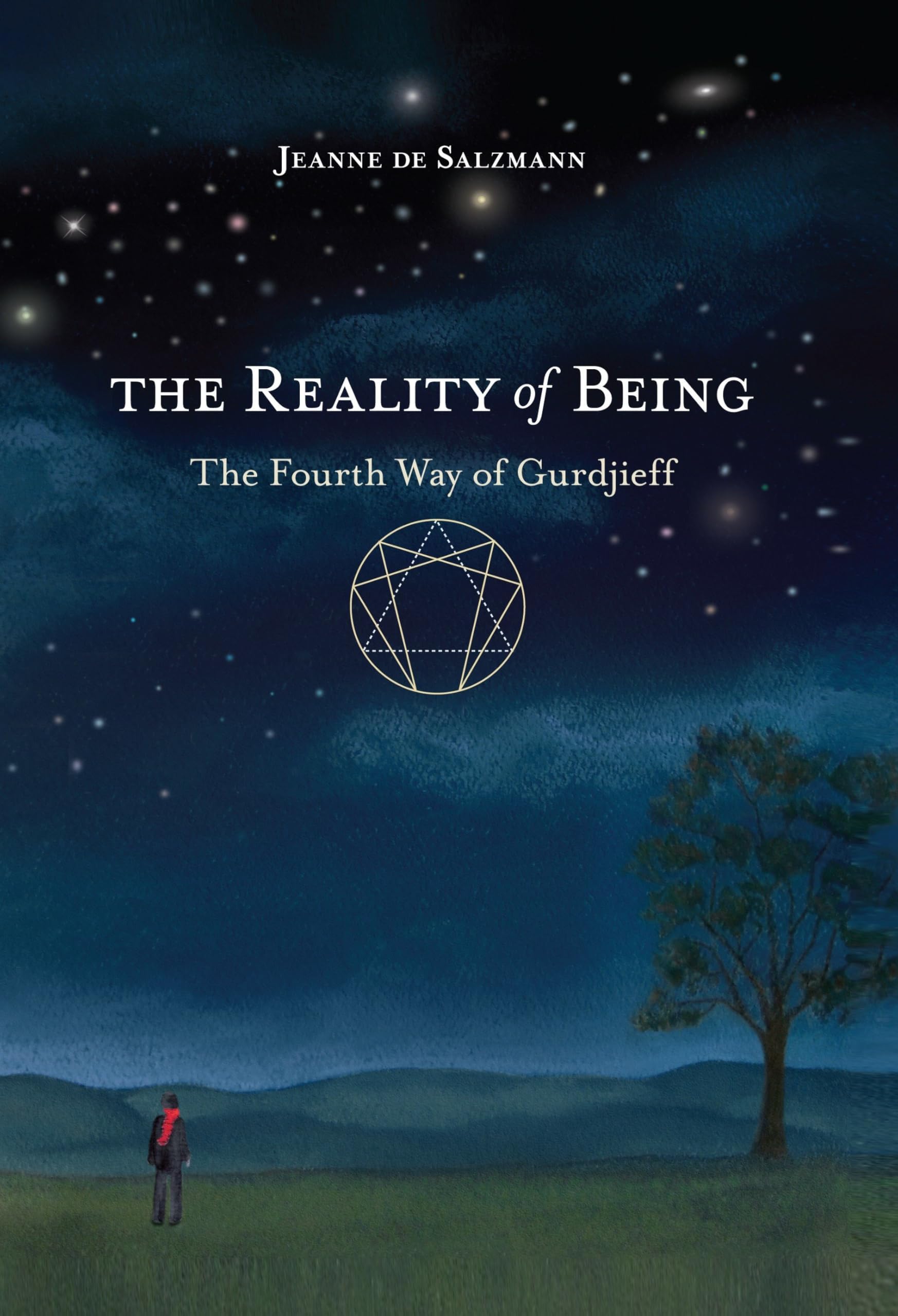
The Reality of Being: The Fourth Way of Gurdjieff (The Fourth Way of Gurdjieff: Toward a New Being)
Product ID: 17208177
Buy anything from 5,000+ international stores. One checkout price. No surprise fees. Join 2M+ shoppers on Desertcart.
Desertcart purchases this item on your behalf and handles shipping, customs, and support to Vietnam.
An important book on liberating ourselves from the state of “waking sleep” in which we live our lives, as taught by one of the most influential spiritual teachers of the 20th century As the closest pupil of the charismatic spiritual master G. I. Gurdjieff (1866–1949), Jeanne de Salzmann was charged with carrying on his teachings of spiritual transformation. Known as the Fourth Way or “The Work,” Gurdjieff’s system was based on teachings of the East that he adapted for modern life in the West. Now, some twenty years after de Salzmann's death, the notebooks that she filled with her insights over a forty-year period (and intended to publish) have been translated and edited by a small group of her family and followers. The result is this long-awaited guide to Gurdjieff's teaching, describing the routes to be traveled and the landmarks encountered along the way. Organized according to themes, the chapters touch on all the important concepts and practices of the Work, including: • Awakening from the sleep of identification with the ordinary level of being • Self-observation and self-remembering • Conscious effort and voluntary suffering • Understanding symbolic concepts like the Enneagram • The Gurdjieff Movements, bodily exercises that provide training in Presence and the awareness of subtle energies • The necessity of a "school," meaning the collective practice of the teaching in a group Madame de Salzmann brings to the Work her own strong, direct language and personal journey in learning to live that knowledge of a higher level of being, which, she insists, “you have to see for yourself” on a level beyond theory and concept. De Salzmann consistently refused to discuss the teaching in terms of ideas, for this Fourth Way is to be experienced, not simply thought or believed. Review: a great companion for spiritual seekers! - I was not familiar with Mme. De Salzmann nor Guedjieff’s work, but as is said, when one is ready, the teacher will appear. While not unfamiliar with the types of work she describes, I found reading her reflections to be a compliment and validation for my own sojourn to the Self. I am now going to dive into Gurdjieff’s actual teachings, and am curious how they might enhance my own journey inward. If you are on a path of spiritual awakening and metaphysical exploration this book is a good one to have in your repertoire. Review: An Extraordinary Book Unlike Any Other - This is perhaps one of the most powerful and extraordinary books I've ever read in the field of transformation or the Fourth Way. I was introduced to the Gudjieff Work as a teenager forty some years ago and have read all of the most important published books. My favorites have always been "In Search of the Miraculous" by P.D. Ouspensky and "Beelzebub's Tales" and "Meetings with Remarkable Men" by Gurdjieff. A few months ago I read "Heart without Measure" by Ravi Ravindra about his several-years work with Madame de Salzmann. I found it especially profound and moving. So when I heard about the publication of "The Reality of Being" I ordered it immediately. I am almost finished reading it (the first time). I notice that I am reading rather quickly so I can get a gist of the content but plan to start re-reading it again much more slowly to let in sink in deeper. I expect this is will be a book I'll be re-reading for the rest of my life. The essence of the book is actually very similar to Ekhart Tolle's "The Power of Now." It is about presence, being in the now, seeing one's "ordinary I" from a higher perspective and tapping into higher energies. Tolle's book is excellent. However, "The Reality of Being" goes ten times deeper. Every sentence, every paragraph, every chapter is permeated with profound substance. The Power of Now is a good primer. This is the the advanced course. Of course, no book can, by itself, give you the depth of experience and understanding that working directly with "a teacher who knows" can. But in every single part of the book Madame de Salzmann calls on us to do the inner work necessary to awaken. And her instructions are in no way vague or ambiguous. However they are so deep that it may take a good degree of attention and focus to grasp their meaning. This book is quite like any other I've read in my life. It has more transformative power packed into a single page than the average library of self-help or spiritual books. If you are a follower of the Fourth Way or seriously interested in personal transformation, this book is a must.
| Best Sellers Rank | #234,707 in Books ( See Top 100 in Books ) #554 in Spiritualism #1,895 in Spiritual Self-Help (Books) #4,865 in Personal Transformation Self-Help |
| Customer Reviews | 4.7 out of 5 stars 294 Reviews |
E**.
a great companion for spiritual seekers!
I was not familiar with Mme. De Salzmann nor Guedjieff’s work, but as is said, when one is ready, the teacher will appear. While not unfamiliar with the types of work she describes, I found reading her reflections to be a compliment and validation for my own sojourn to the Self. I am now going to dive into Gurdjieff’s actual teachings, and am curious how they might enhance my own journey inward. If you are on a path of spiritual awakening and metaphysical exploration this book is a good one to have in your repertoire.
R**N
An Extraordinary Book Unlike Any Other
This is perhaps one of the most powerful and extraordinary books I've ever read in the field of transformation or the Fourth Way. I was introduced to the Gudjieff Work as a teenager forty some years ago and have read all of the most important published books. My favorites have always been "In Search of the Miraculous" by P.D. Ouspensky and "Beelzebub's Tales" and "Meetings with Remarkable Men" by Gurdjieff. A few months ago I read "Heart without Measure" by Ravi Ravindra about his several-years work with Madame de Salzmann. I found it especially profound and moving. So when I heard about the publication of "The Reality of Being" I ordered it immediately. I am almost finished reading it (the first time). I notice that I am reading rather quickly so I can get a gist of the content but plan to start re-reading it again much more slowly to let in sink in deeper. I expect this is will be a book I'll be re-reading for the rest of my life. The essence of the book is actually very similar to Ekhart Tolle's "The Power of Now." It is about presence, being in the now, seeing one's "ordinary I" from a higher perspective and tapping into higher energies. Tolle's book is excellent. However, "The Reality of Being" goes ten times deeper. Every sentence, every paragraph, every chapter is permeated with profound substance. The Power of Now is a good primer. This is the the advanced course. Of course, no book can, by itself, give you the depth of experience and understanding that working directly with "a teacher who knows" can. But in every single part of the book Madame de Salzmann calls on us to do the inner work necessary to awaken. And her instructions are in no way vague or ambiguous. However they are so deep that it may take a good degree of attention and focus to grasp their meaning. This book is quite like any other I've read in my life. It has more transformative power packed into a single page than the average library of self-help or spiritual books. If you are a follower of the Fourth Way or seriously interested in personal transformation, this book is a must.
W**K
Practical Account of the Gurdjieff Inner Work
This book, published in 2011, contains decades of personal writings of Jeanne de Salzmann (1889-1990), Gurdjieff's principal student and the guardian and proponent of his work after his death. Students of the Gurdjieff work completed the task of compilation and shaped the book in such a way that it reads like a progression of de Salzmann's personal development. The book starts off with a challenging aspect of the Gurdjieff work, which is the need to see how I am asleep, how I am lacking the strength and will to truly do, how I fall short of living like a true, complete human being. It is easy to skip over this Work foundation and move on to exercises and esoteric ideas of energies and transformation, but throughout the book it becomes clear how often de Salzmann herself went back to this notion of her lack, and staying on front of that lack without looking away. The book is permeated with a palpable force that seems to radiate off the pages. Jeanne de Salzmann was a tireless, uncompromising seeker after Truth, and her writings transmit some of this intense dedication to living a conscious Life. A true example of the Gurdjieff Work as it is practiced today, she not only preserved it as a Path towards embodying such a Life more and more fully, she also personally demonstrated its efficacy through her living and in this book. An excellent accompanying book to this one is Ravi Ravindra's Heart without Measure, in which the author describes in a most touching way his personal interactions with Jeanne de Salzmann in her role as teacher of the Gurdjief Work during the last years of her life.
M**W
yes
one of the best spiritual books ever
R**3
This is a Fourth Way Master's Class Reference Manual.
A brilliant articulation of important ideas and accounting of corresponding efforts. This book resonates with De Salzman's deep personal sincerity in describing what it is like to commit all, or as much as of one's attention and energy as one can connect with and control, in a moment to moment 70 year pursuit of one's own highest cognitive and spiritual possibilities. ("Who am I - Who am I in this world?) This is no introductory overview of The Fourth Way, nothing casual about this book - De Salzmann's, THE REALITY OF BEING. Better first to have read "IN SEARCH OF THE MIRACULOUS", by P.D. Ouspensky. But as De Salzmann's account makes clear, The Fourth Way is not about books and intellectual exchange anymore than such may be necessary as trailmarkers for those on mission to answer the aforementioned questions. She makes clear that The Fourth Way is about effort, the effort to observe oneself over and over again, in a very special and different way, in the context of everyday life. Nothing I have read, nor anyone I have spoken to during 40 years of fitful dabbling in The Fourth Way, has provided such insight into the efforts and quality thereof to first verify and then implement Gurdjieff's teachings better than Jeanne De Salzmann in this book. This is a reference manual not a trophy book. Time's a wast'n. Good luck!
M**N
Best writing on Gurdjieff philosophy and practice
Have bought several books about the practices Gurdjieff taught his pupils and the objectives of such practices, along with the different experiences of different students in following the practices. I had a hard time getting into the book, but then I read a paragraph by the author where she said it didn't matter if one just opened it at random or started from the beginning or whatever. I had tried starting from the beginning and failed totally, but in fact seemed to very often pick it up at random and then, about half of the time I did that, I would get totally absorbed, miss a meal, be late for work, and so on. So on this account I deemed this book my find of the year. And so it has proved to be. I came to it through reading another book, by Ravi Ravindra, which I found helpful but more of a personal writeup of his own experience with this teaching. This book is more from the viewpoint of one trying to provide information that will throw some light on the practices, including the dances, that Gurdjieff advised and taught, and what kind of results one might fairly expect, thus guidelines. To talk about being isn't easy - just try it sometime! So to talk about any kind of increase in awareness of being, well, either the reader is absorbed in 2 seconds or it remains opaque. If the latter, do come back later; if the former you're gone anyway, call us when you come back!
G**Y
Perhaps More Questions Than Answers
The Reality of Being is an unanticipated, and unusual, addition to the growing number of books that attempt to speak of the Gurdjieff Work. It is unanticipated because the author, Jeanne de Salzmann, passed on some 21 years ago and during her entire life published very little. The book is of interest for many reasons, not the least of which is Mme de Salzmann's long and close relationship with Mr. Gurdjieff that began in Tiflis in 1919. Of their first meeting, she said, "The impression of Gurdjieff was very strong, unforgettable. He had an expression I had never seen, and an intelligence, a force, that was different...a vision that could see everything." When asked his impression of her, Gurdjieff said, "She--is intelligent." As he would later explain, "Intelligent means he who directs his body. If the body directs, you are a nullity, a peasant--if you direct your body you are intelligent." Having studied and taught forms of music and dancing, including that of Jacques Dalcroze, it was natural for her to become one of the leading dancers in Gurdjieff's Movements. For the next 30 years, from their first meeting in Tiflis, through Constantinople and Europe, to the establishment of the Prieuré, to his last years in Paris where she assisted at his meetings, she was a devoted student. According to the editors, "Before Gurdjieff died, he charged de Salzmann to live to be `over 100' in order to establish his teaching. He left her all his rights with respect to his writings and the Movements, as well as the music..." In the years after Gurdjieff's death, de Salzmann was an indefatigable and instrumental force in creating the framework of institutions that made available the ancient, esoteric teaching of The Fourth Way. From the beginning, the unusual nature of The Reality of Being becomes apparent. It primarily consists of extracts from de Salzmann's journals. These give a flavor quite unlike any other Work book. The material is organized primarily by "themes," and not chronologically ordered--though it is stated that the beginning chapters are generally from the 1950's. (Some hint of the chronology would have given important insight into what she was facing after Gurdjieff's death, and reasons for her visits to Guénon, Graf Druckheim, and Krishnamurti.) The exact origin of the material presented is not entirely clear, but her writings apparently have come out of her personal experiences and ponderings of the Work. There is not the sense that these are Gurdjieff's teachings in her words, but rather her inner experience of the teaching. The extracts have been edited by "a small group of [her] friends and followers." As the original journals--with the exception of one snippet--are unpublished, the extent of editing cannot be known. The sense is that the editing may have added at times an awkwardness to what will be for many an already difficult text. The writing is often quite detailed and perhaps of considerable density for those with no experience of the Work. A typical example: 15 Hypnotized by my Mind: An inattentive mind is filled with thoughts. In a passive state it is constantly creating images and applying them to what I observe. The images provoke pleasure or pain, which is recorded in my memory, and illusions form around desires for satisfaction. In observing from a fixed vantage point, this mind creates a kind of separation, an opposition, a judge that reacts to everything with a preconception based on what has been learned. [end] The level of detail can become difficult to follow. There may be a mental glazing-over if much of this material is read at one sitting. Though the book in places may seem a bit "wordy" and repetitive of subject matter, some of the monographs are rich and beautiful in their subtlety and depth of understanding. They penetrate subjects, such as sensation, that have been presented only in limited ways outside of oral transmission. One wonders if there could well be a more serious issue with giving such detailed descriptions. The Work is a work of self-exploration and self-transformation. Clearly Mme de Salzmann did a tremendous amount of work on herself and gained a great deal of knowledge--self-knowledge. Is it advantageous to make such material available to all levels of students in the Work, much less the general public? Gurdjieff gave us the basic ideas, such as the function of the formatory mind--"can't count beyond two" and "sees everything in black-and-white." It is a student's work to verify this. In this way, the teaching comes alive, and understanding in its true sense, that is, the resultant of being and self-knowledge, come to be. Personal journals, and particularly Work journals, typically represent what is experienced and understood at a particular point in time. It would seem far better that students not be given such detailed descriptions based upon another's personal experience. Self-exploration should be just that--one's individual work experienced and reported in conjunction with a teacher and group. The editors write, "Like every experiential account, the inner journey Mme. de Salzmann describes can really be understood only to the extent the reader himself can live the experience..." But one doesn't live the experience through another's words. All of this brings up what is really the essential question: was this material intended by de Salzmann to be published? The editors' answer is that they believe so. They quote her at age 91, "I am writing a book on how to be in life, on a path to take in order to live on two levels." The editors go on to say "When she died 10 years later, she left her note books intact, carefully preserved. To those closest to her, this was a clear sign of the legacy she intended for this material: to help complete Gurdjieff's writings on a clear vision of reality..." Thus, on the basis of a remark that could well be taken either metaphorically or was referring to completely different material, the material is published "to complete Gurdjieff's writings." The word complete is questionable. Yes, some believe that because Life is Real, Only Then When `I Am' ends with a colon and not a period, Gurdjieff did not complete the teaching. But he finished the book in 1935 and had 14 years left to complete it. Rather than incompletion, isn't it more reasonable to interpret the colon as a charge to the reader to now--having been given the teaching and its practices--to complete the teaching in himself by understanding what follows the colon? While one may argue that some of the decisions taken by de Salzmann in the course of 40 years following Gurdjieff's death are open to question (the edited version of the First Series published in 1992 comes to mind), there is no question that she worked diligently on all three lines of the Work, mandated that all the Movements be filmed so as not to be lost, was highly respected by Gurdjieff's direct senior students, particularly Lord John Pentland, and came to a very high level of understanding. That said, the material in the book does not appear to be written in a way that was intended to be presented to the general public or to present the Work as a teacher's record of personal experience for future students. The editors' claim that Mme de Salzmann intended that this material be published and used as an extension and completion of Gurdjieff's writings is questionable. Can it be accepted that the person responsible for the publication of Gurdjieff's writings couldn't publish her own writings or, at the least, give instructions in this regard? Shall there now be a "skipping over" of Gurdjieff's legominism, All and Everything, and Ouspensky's In Search of the Miraculous to begin the study of a new book containing complex writings and material that may never have been intended for publication or teaching? As to the value of this material as part of the teaching and to further complete the written record, does this material simplify or complexify the Work? C. S. Nott asked Gurdjieff, "What about people who have never met you... How will they be able to understand Beelzebub's Tales?" Gurdjieff's reply must have shocked Nott, "Perhaps will understand better than many always around me... I not wish people to be identified with me, I wish them identified with my ideas. Many who never meet me, simple people, will understand my book." --Dick Myers, The Gurdjieff Journal, #54
R**N
Relaunch of the Gurdjieff Work
In reading this remarkable book I understood for the first time the reaction of a friend (who was interviewed in GIG) on his first reading of Beelzebub - he threw the book away in anger! This also remains me of a Movements class about five years ago in which a man of my age, then 63, taking part first time in a Movements seminar, in the middle of the class took his clothes (which were on the floor) and started throwing them furiously around the studio. I managed to abstain from throwing the book and could later go on reading without any such nonsense. I am not sure of the others, but my "reaction that happened only in imagination" seems to have been to the continuous repetitive form that the book has. I agree also to the advice in another review to read slowly, in small pieces, as the ideas are concentrated and not easily digested. Having written all that, I will hasten to claim that this book really is "The Relaunch of the Gurdjieff Work" for our time! It does have hardly any of the "toys" that were given to us by Gurdjieff and Ouspensky. Instead, it is about being, "I am", Reality, the two states (higher and lower), consciousness, sleep etc. So one may ask: what is new? There really is nothing new under the sun! However, some things in this book are repeated so many times, on and on, that they actually get through! To take some sentences out of their context would not give the right picture of the book. It is a whole, and in my view should be treated and read as a whole.
S**E
Fabulous, thank you!
Excellent product :-)
N**D
Beautiful book
Must read for 4th Way practitioners. Edition is good - good size text and good print. We use it in the groups all the time
F**O
Just Wonderful
For those with some knowledge of the Fourth Way, this is an exquisite piece of art. Highly recommend to read this and let it sink into yourself. It creates an atmosphere far away from the more technical issues addressed by other authors. In a very real way, the book seems to be alive, much like Eckhart's Tolle the Power of Now.
J**.
The Reality of Being
This is a very special book which , in my opinion, can only be useful to the people who are serious in the study and the living of Mr Gurdjieff's proposal called <The Work> . It is not a book which can be read lightly and commented upon as if ..one could! It is Madame de Salzman 's multi layered testimony of this inner continuous struggle towards the transformation of ones' being,.. which words may summarise as an <Awakening> to what we are and what the World is...In fact this book can only remain a closed book to anyone who never had the need to ponder and wonder about Reality and our place in it..but may be it is also a book which might suddenly intrigue some unprepared readers through the taste of what is True, attracting in them this unknown something burried in us which thirsts for understanding about why we are here and what we are living for.Madame de Salzman's book might be.. a unique, intimate, practical yet extraordinary description in action of a multi dimensional Reality which wants to be revealed to the traveller if he or she searches and works for it. It is never <read>... but according to the moment of need,like a magical <garde- a -manger> ,the food it contains may suddenly appear, may be recognised, may be eaten in silence, then digested...From then on understanding grows.
A**R
The child wants to have, the adult wants to be.
電子サンプルで読めるところまでだけでも、これがとてつもない本だとお分かりになるのでは。 美しくて大きな本で、大きくても持ち運びたくもなるんですが、Kindleでも買ってしまいました。
Trustpilot
1 month ago
1 month ago