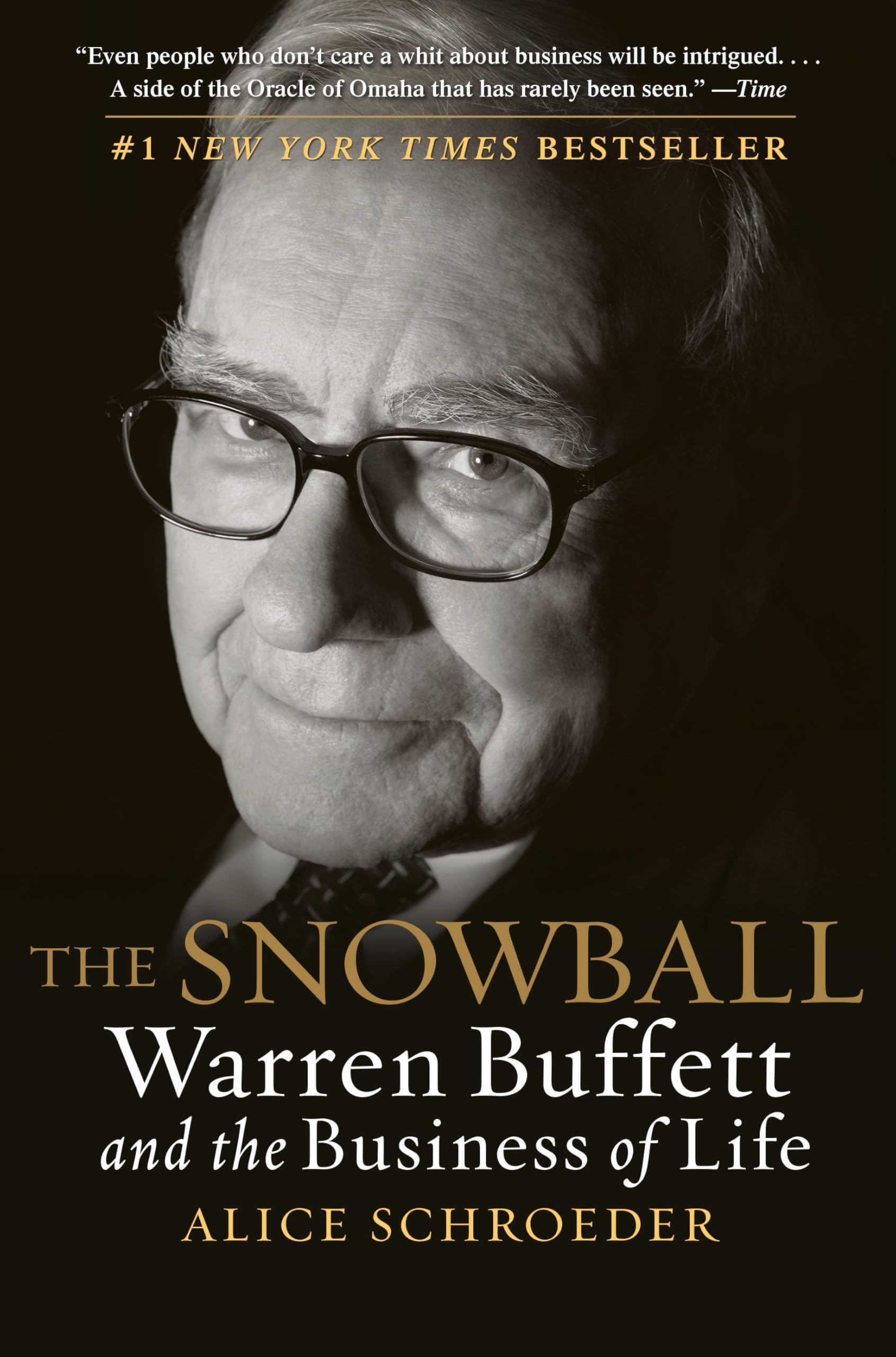
The Snowball: Warren Buffett and the Business of Life
Product ID: 1705156
Buy anything from 5,000+ international stores. One checkout price. No surprise fees. Join 2M+ shoppers on Desertcart.
Desertcart purchases this item on your behalf and handles shipping, customs, and support to Vietnam.
#1 NEW YORK TIMES BESTSELLER • “The most authoritative portrait of one of the most important American investors of our time.”— Los Angeles Times “Even people who don’t care a whit about business will be intrigued. . . . A side of the Oracle of Omaha that has rarely been seen.”— Time (Five Best Nonfiction Books of the Year) A BEST BOOK OF THE YEAR: The Washington Post; People; Financial Times; Businessweek; Janet Maslin, The New York Times; Publishers Weekly Warren Buffett is one of the most respected men in the world. But the legendary Omaha investor has never written a memoir or offered a glimpse into his intensely private life. Here, at last, he gives unprecedented access to his work, opinions, struggles, triumphs, follies, and wisdom. This complete biography of the man known everywhere as “the Oracle of Omaha” was written by highly respected former financial analyst and business writer Alice Schroeder with the cooperation of Buffett himself, who gave her thousands of hours of his own time as well as complete access to his wife, children, friends, and business associates—and his files. The result is the fullest exploration of his philosophy of life we will ever have. Here are the principles and ideas that made Buffett astoundingly wealthy, enriched the lives (and bank accounts) of those who adopted them, and created the most fascinating American success story of our time. Review: Feet of Clay - Alice Schroeder has accomplished an impressive feat. The poor lady must have spent many hours at Gorat's watching Buffett devour his strict Colon Cancer diet. This beautifully written 940 page biography reveals aspects of the Buffett personality which alternately shocked and repelled me. For example, I had no idea that Buffett the teenager was an habitual shoplifter. If I had known this many years ago I might never have started collecting Berkshire shares. His emotional neglect of his son Howie caused Howie to act up in order to gain his father's attention. Buffett gave neither money nor his personal time to his children. He spent his hours in his study and the children effectively had no father. It was as if he regarded them as a costly overhead expense that he tolerated to please his wife. Years later, when Howie ran for public office, Buffett refused to donate to his son's campaign. Although he could be tough, heartless and greedy where money was concerned, he was a complete wuss in interpersonal relationships. His mother's criticisms of him as a child made him weep and he was terrified of her even as an adult. One wonders if his uncontrolled greed for cash was his way of building a moat around himself that his mother could not breach. As his fame grew, he started spending time with his Yiddish princess, Kay. He stayed in her many luxurious residences while his wife lived alone in their small Omaha home now bereft of children. Naturally Susie, his wife, found this to be a lonely life and she started to look around for something to fill in the hours. She sang professionally and gave generously of her time to acquaintances who were needy. She is the true heroine of this book. Her generosity and innate goodness contrast sharply with the shallow greediness of the husband she was pressured into marrying. When Susie, on several occasions, had to enter hospital Buffett refused each time to visit his wife. Apparently the Miser of Omaha is terrified of hospitals and doctors. When his friend Kay lay near death it was his daughter Susie Jr who, after much effort, persuaded him to visit the bedside of his dying friend. His entire life is based on the dictum: take but never give. The time eventually came when his wife Susie had had enough. She moved out to San Francisco and started enjoying herself. Buffett wept for days when he realized that his wife had left him. He begged her to return but to no avail. Susie asked a friend to look in on him & to cook him an occasional meal. Eventually the friend moved into the house. Buffett, the book clearly shows, is always on the lookout for a 'mommy' - a female who will shelter him, coddle him and make him feel 'safe'. He knows several such persons. It wasn't until Susie died that Buffett started to have a real relationship with his children. He stopped regarding them as unnecessary expenses but started relating to them & giving them his time & his love which he had always denied them in childhood. He became aware of their feelings rather than being totally preoccupied with his own. He started to consider his children as being important in his life. For the first time he took an interest in what they were doing. His son Howie missed his father's companionship during his childhood very much. He appeared to ignore his son Peter pretty well completely until he became an adult. After Susie died, Buffett started to give Peter some attention and to treat him as a human being. The author says that Howie had yearned for a close connection to his father all his life & had never received it. Howie & his wife moved to Omaha so that he could be near his father. Buffett has now started giving his children big checks on their birthdays which he had never done before. He is trying to buy their love after depriving them of the most precious gift he could have given them in childhood - his personal time and personal attention. The book describes how Buffett showed a real coldness to the adopted daughters of his son Peter. He told Peter they would receive nothing in his will. He wrote a cruel letter to Nicole Buffett, his son Peter's adopted daughter. The book doesn't really explain the meanness that Buffett displayed toward this girl. The book errs in one respect. The author did not get it quite right about the issuance of Class "B" shares. They were issued because Katz, a Philadelphia mayoral candidate, was going to subdivide the "A" shares & issue a "B" share of his own. Buffett had Charlie Munster call Katz and try to bully him into withdrawing his plan but Katz would not budge. So Buffett, much against his wishes, had to bring out the "B" shares himself. The book describes his difficulty in understanding and using computers which clearly shows that his success is not due to his IQ but rather to his phenomenal memory. His ability to remember countless past business scenarios and their outcomes allows him to make good business decisions. As this marvelous book nears the end, it makes clear that it is so difficult & painful for Buffett to give away money, or bottle caps, or golf balls that he passed the job to the Gates Foundation. The Gates Foundation is actively supporting planetary overpopulation by distributing the money to Africa and the Africans, rather than returning it to the American citizens who made it possible for Buffett and Gates to accumulate this money in the first place. Buffett has passed up an opportunity to be truly creative with his wealth. One can only wonder at the incredible advances in medicine that could be made if a large amount of this money were devoted to stem cell research. By giving it away Buffett looks ridiculous. After working all his life to accumulate something and then discarding it we must conclude he worked all his life for nothing. Unlike Andrew Carnegie, he leaves nothing behind for which he would be remembered. He will be quickly forgotten. Some years after his wife Susie died, Buffett married his companion changing her status from a lowly live-in servant girl to a wife. One wonders if she had to sign a Pre-Nup. Review: “Wall Street is the only place people ride to in a Rolls-Royce to get advice from people who take the subway” - Warren Buffett is world-famous for his success at investing. A native of Omaha, Nebraska, the son of a stock broker who served several terms in Congress, he began in business very young selling candy to neighbors and delivering newspapers but his real passion was reading everything he could get his hands on about investing in stocks and bonds, learning about businesses, and investing according to a carefully thought-out investing philosophy derived from the authors of several books he read who became his mentors at Columbia Business School-Benjamin Graham and David Dodd. This biography, written with the cooperation of Buffett by Alice Schroeder, an author with a Wall Street background, is a thoroughly-researched account of his life and career, beginning with his childhood in Omaha and following him through his education and his career as an investor and money-manager who, through the vehicle of his firm Berkshire Hathaway, made himself and many of his investors very wealthy. Indeed, in 2008 he was named the richest man on earth. The book chronicles his philosophy of business and many of his quirks - he favours Coke over wine and burgers and steaks over almost any other type of food - and delves into numerous accounts of his investments which have spanned cocoa-beans, textile mills, Wall Street investment banks, and railroads, among many others. Buffett comes across as an almost asocial machine constantly sifting through businesses to find the best bargains to invest in. With family and friends he seems remote and absent-minded, uninterested in things that fall outside the world of business. He seems never to have read a novel, for instance, or a poem. When one of his friends points out a Picasso sketch on the wall at his friend’s house he says he hasn’t noticed it even though he’s been going there for 30 years. He’s also kind of funny about money, which I suppose is not surprising given who he is. That said, he does change over the course of his life in some respects and the book does a good job of describing it, showing, for example, how he was persuaded to be more generous towards his children, and describing the way he went from believing that his greatest service to humanity was through amassing a huge fortune to believing that giving money away sooner was preferable. If this book has a limitation it is that it shies away from offering a more definitive interpretation of its subject that would aid the reader in coming to a deeper understanding of the real Warren Buffett. The book offers an account of the complete Buffett mythology: his folksy, Midwestern values, his common-sense voice, his sage wisdom about business. It reinforces his philosophy of investing in undervalued companies with excellent long-term prospects, his injunction, via Graham, to “be fearful when others are greedy, and greedy when others are fearful.” It charts his growing fame, his circus-like shareholder meetings, his numerous appearances in the business press and on business TV networks, his love for Cherry Coke and Gorat’s steakhouse. And while the mythology is probed and dissected in some ways - yes, he’s lived in the same house since 1958 but Schroeder points out that he has remodeled it since then - I don’t think the reader will come away from this book with a true understanding of what’s driving him, at least not with a view or interpretation of this that has the endorsement and exposition of the author. If I had to take a guess, the primary influence on Buffett seems to be his father, Howard Buffett, a stock broker from Omaha whose civic values led him to Washington D.C. where he served in Congress during Warren’s youth. His mix of patriotism and business seems to have greatly influenced his son whom he took on a visit to the New York Stock Exchange in 1940 at the age of ten. Buffett says he wanted money so he could be “independent” and didn’t like to do manual labor but so do lots of us and he didn’t stop making money once he’d become independent so there is clearly more to it than that. It’s this sort of reading of Buffett I wish there was more of in this book. The book is nonetheless filled with as much superficial detail as you could want about Buffett. At 816 pages there’s tons of information about his whole life and world, it perfectly captures Buffett’s voice, as well as separate accounts of many important times in his life from the perspective of his family and friends. Schroeder has written a good valuation report style biography of the man and I suppose in many ways that’s the type of biography most suited to this life.


| Best Sellers Rank | #15,042 in Books ( See Top 100 in Books ) #27 in Biographies of Business & Industrial Professionals #31 in Rich & Famous Biographies #219 in Memoirs (Books) |
| Customer Reviews | 4.6 out of 5 stars 4,945 Reviews |
S**S
Feet of Clay
Alice Schroeder has accomplished an impressive feat. The poor lady must have spent many hours at Gorat's watching Buffett devour his strict Colon Cancer diet. This beautifully written 940 page biography reveals aspects of the Buffett personality which alternately shocked and repelled me. For example, I had no idea that Buffett the teenager was an habitual shoplifter. If I had known this many years ago I might never have started collecting Berkshire shares. His emotional neglect of his son Howie caused Howie to act up in order to gain his father's attention. Buffett gave neither money nor his personal time to his children. He spent his hours in his study and the children effectively had no father. It was as if he regarded them as a costly overhead expense that he tolerated to please his wife. Years later, when Howie ran for public office, Buffett refused to donate to his son's campaign. Although he could be tough, heartless and greedy where money was concerned, he was a complete wuss in interpersonal relationships. His mother's criticisms of him as a child made him weep and he was terrified of her even as an adult. One wonders if his uncontrolled greed for cash was his way of building a moat around himself that his mother could not breach. As his fame grew, he started spending time with his Yiddish princess, Kay. He stayed in her many luxurious residences while his wife lived alone in their small Omaha home now bereft of children. Naturally Susie, his wife, found this to be a lonely life and she started to look around for something to fill in the hours. She sang professionally and gave generously of her time to acquaintances who were needy. She is the true heroine of this book. Her generosity and innate goodness contrast sharply with the shallow greediness of the husband she was pressured into marrying. When Susie, on several occasions, had to enter hospital Buffett refused each time to visit his wife. Apparently the Miser of Omaha is terrified of hospitals and doctors. When his friend Kay lay near death it was his daughter Susie Jr who, after much effort, persuaded him to visit the bedside of his dying friend. His entire life is based on the dictum: take but never give. The time eventually came when his wife Susie had had enough. She moved out to San Francisco and started enjoying herself. Buffett wept for days when he realized that his wife had left him. He begged her to return but to no avail. Susie asked a friend to look in on him & to cook him an occasional meal. Eventually the friend moved into the house. Buffett, the book clearly shows, is always on the lookout for a 'mommy' - a female who will shelter him, coddle him and make him feel 'safe'. He knows several such persons. It wasn't until Susie died that Buffett started to have a real relationship with his children. He stopped regarding them as unnecessary expenses but started relating to them & giving them his time & his love which he had always denied them in childhood. He became aware of their feelings rather than being totally preoccupied with his own. He started to consider his children as being important in his life. For the first time he took an interest in what they were doing. His son Howie missed his father's companionship during his childhood very much. He appeared to ignore his son Peter pretty well completely until he became an adult. After Susie died, Buffett started to give Peter some attention and to treat him as a human being. The author says that Howie had yearned for a close connection to his father all his life & had never received it. Howie & his wife moved to Omaha so that he could be near his father. Buffett has now started giving his children big checks on their birthdays which he had never done before. He is trying to buy their love after depriving them of the most precious gift he could have given them in childhood - his personal time and personal attention. The book describes how Buffett showed a real coldness to the adopted daughters of his son Peter. He told Peter they would receive nothing in his will. He wrote a cruel letter to Nicole Buffett, his son Peter's adopted daughter. The book doesn't really explain the meanness that Buffett displayed toward this girl. The book errs in one respect. The author did not get it quite right about the issuance of Class "B" shares. They were issued because Katz, a Philadelphia mayoral candidate, was going to subdivide the "A" shares & issue a "B" share of his own. Buffett had Charlie Munster call Katz and try to bully him into withdrawing his plan but Katz would not budge. So Buffett, much against his wishes, had to bring out the "B" shares himself. The book describes his difficulty in understanding and using computers which clearly shows that his success is not due to his IQ but rather to his phenomenal memory. His ability to remember countless past business scenarios and their outcomes allows him to make good business decisions. As this marvelous book nears the end, it makes clear that it is so difficult & painful for Buffett to give away money, or bottle caps, or golf balls that he passed the job to the Gates Foundation. The Gates Foundation is actively supporting planetary overpopulation by distributing the money to Africa and the Africans, rather than returning it to the American citizens who made it possible for Buffett and Gates to accumulate this money in the first place. Buffett has passed up an opportunity to be truly creative with his wealth. One can only wonder at the incredible advances in medicine that could be made if a large amount of this money were devoted to stem cell research. By giving it away Buffett looks ridiculous. After working all his life to accumulate something and then discarding it we must conclude he worked all his life for nothing. Unlike Andrew Carnegie, he leaves nothing behind for which he would be remembered. He will be quickly forgotten. Some years after his wife Susie died, Buffett married his companion changing her status from a lowly live-in servant girl to a wife. One wonders if she had to sign a Pre-Nup.
D**R
“Wall Street is the only place people ride to in a Rolls-Royce to get advice from people who take the subway”
Warren Buffett is world-famous for his success at investing. A native of Omaha, Nebraska, the son of a stock broker who served several terms in Congress, he began in business very young selling candy to neighbors and delivering newspapers but his real passion was reading everything he could get his hands on about investing in stocks and bonds, learning about businesses, and investing according to a carefully thought-out investing philosophy derived from the authors of several books he read who became his mentors at Columbia Business School-Benjamin Graham and David Dodd. This biography, written with the cooperation of Buffett by Alice Schroeder, an author with a Wall Street background, is a thoroughly-researched account of his life and career, beginning with his childhood in Omaha and following him through his education and his career as an investor and money-manager who, through the vehicle of his firm Berkshire Hathaway, made himself and many of his investors very wealthy. Indeed, in 2008 he was named the richest man on earth. The book chronicles his philosophy of business and many of his quirks - he favours Coke over wine and burgers and steaks over almost any other type of food - and delves into numerous accounts of his investments which have spanned cocoa-beans, textile mills, Wall Street investment banks, and railroads, among many others. Buffett comes across as an almost asocial machine constantly sifting through businesses to find the best bargains to invest in. With family and friends he seems remote and absent-minded, uninterested in things that fall outside the world of business. He seems never to have read a novel, for instance, or a poem. When one of his friends points out a Picasso sketch on the wall at his friend’s house he says he hasn’t noticed it even though he’s been going there for 30 years. He’s also kind of funny about money, which I suppose is not surprising given who he is. That said, he does change over the course of his life in some respects and the book does a good job of describing it, showing, for example, how he was persuaded to be more generous towards his children, and describing the way he went from believing that his greatest service to humanity was through amassing a huge fortune to believing that giving money away sooner was preferable. If this book has a limitation it is that it shies away from offering a more definitive interpretation of its subject that would aid the reader in coming to a deeper understanding of the real Warren Buffett. The book offers an account of the complete Buffett mythology: his folksy, Midwestern values, his common-sense voice, his sage wisdom about business. It reinforces his philosophy of investing in undervalued companies with excellent long-term prospects, his injunction, via Graham, to “be fearful when others are greedy, and greedy when others are fearful.” It charts his growing fame, his circus-like shareholder meetings, his numerous appearances in the business press and on business TV networks, his love for Cherry Coke and Gorat’s steakhouse. And while the mythology is probed and dissected in some ways - yes, he’s lived in the same house since 1958 but Schroeder points out that he has remodeled it since then - I don’t think the reader will come away from this book with a true understanding of what’s driving him, at least not with a view or interpretation of this that has the endorsement and exposition of the author. If I had to take a guess, the primary influence on Buffett seems to be his father, Howard Buffett, a stock broker from Omaha whose civic values led him to Washington D.C. where he served in Congress during Warren’s youth. His mix of patriotism and business seems to have greatly influenced his son whom he took on a visit to the New York Stock Exchange in 1940 at the age of ten. Buffett says he wanted money so he could be “independent” and didn’t like to do manual labor but so do lots of us and he didn’t stop making money once he’d become independent so there is clearly more to it than that. It’s this sort of reading of Buffett I wish there was more of in this book. The book is nonetheless filled with as much superficial detail as you could want about Buffett. At 816 pages there’s tons of information about his whole life and world, it perfectly captures Buffett’s voice, as well as separate accounts of many important times in his life from the perspective of his family and friends. Schroeder has written a good valuation report style biography of the man and I suppose in many ways that’s the type of biography most suited to this life.
R**L
It Is As It Is
This is a complete re-tale of the story of Warren Buffet from beginning to almost end. If you are fascinated by him or consider him a wonderful American treasure, read it. I did and I enjoyed it. BUT it is a commitment bordering 900 pages so if you process information quickly and can't make a full time commitment, take a pass. Rather than recount the book, let me just add facts I found of interest that I did not know. First, we all know his extreme belief in value investing. But what's interesting is that initially his money comes as a stock picker who is getting a percentage of the increase, think hedge fund type sharing. This "leverage" exponentially allowed his wealth to build greatly. Don't get me wrong, he did a great job for his investors of which I wish I were one. But the fallacy that a great stock picker can build great wealth is not totally true. At some point leverage is generally the driver allowing the massive jumps and I was surprised to see that applied to the most basic American capitalist who preaches against debt. A substantial amount of time is spent on his personal life and I enjoyed this as great background. It's like my bartender brother says, "EVERY family is screwed up" and this book does nothing to rebut that statement. Reading further, there are many stories of Buffett's bad picks, newspapers, Coke for a while, Solomon Brothers. You get the feel that he's not the greatest stock picker, and some of his quick decisions seem to bear that out, but that once he was large, he received special deals when capital was needed and has the liquidity to allow companies to grow. In fact that is what is stated by him, we are looking for companies that can grow our equity at 20% plus. NOT necessarily stock picking of value businesses. I would add to this that he has always been more of a market timer which many people preach against. If you enjoy stocks and investing and you want the ultimate bible on a renowned investor, this is the book for you. I thoroughly enjoyed it and recommend it highly. BUT be prepared for the time commitment. This is not what I would call a "beach read" unless you have quite a while and lots of suntan oil.
B**H
The Greatest Investor
Warren Buffett authorized Alice Schroeder, a former insurance analyst with Paine Webber, to pen his biography. He told her if there are 2 versions of a story, use the "less flattering version". This tidbit demonstrates how humble the greatest investor in history is. This book is 838 pages excluding notes. I read this book carefully and I will be reading it again. I admire Buffett. I bought my first BRK share in 1997 and its share price dropped 40% recently and fell below liquidation value. I bought a few more. BRK is my single largest holding, accounting for a third of my portfolio. If the price drops more, I will buy more. The title Snowball refers to the power of compounding (snowflakes become snowballs). Buffett compounded businesses. He began to sell products (chewing gum) at age 6 years. He always had a fascination with numbers and money. He was a precocious child, very intelligent, good in math. By age 10 he visited Wall Street and developed an interest in stocks. Bought stocks shortly afterwards. By the time he was 16, he was worth $5000 (in today's dollars that would amount to $53,000). He was born to intelligent parents who afforded him a good education. He states he won the "ovarian lottery". Had he been born in Bangladesh, for example, to a poor family, his skills in capital allocation would have been useless. As such, he states he was very lucky to be born in the USA. His father was a libertarian Republican congressman whom Buffett admired greatly and mourned his death. He was not close to his verbally abusive mother. Buffett himself is a well known liberal democrat and talks about the need for higher income and capital gains taxes. He says he is a democrat because of the party's stance on civil and reproductive rights. Buffett is an atheist. He has contributed to the democratic party, family planning and "nuke free" organizations. Interestingly, Buffett wanted to attend Harvard but was rejected. He was accepted into Columbia where he fell under the sway of Graham and Dodd. He recommends Grahams' book Intelligent Investor. (He recently gave an interview asking investors to pay particular attention to chapters 8 and 20). He married Susan Thompson, the daughter of a prominent local physician. Susie bore him 3 children. Buffett was distant to his kids, he was busy and focused in his work of compounding money. He adored his wife but she became burned out caring for Buffett that later in life she moved to San Francisco and set up a waitress named Astrid Menks to care for Buffett. After Susie died a few years ago, Buffett married Astrid. Susie, with Warren's blessing, was a social activist. She was very engaged in the civil and gay rights movements. After Susie died, he became very close to his kids. Buffett befriended Kay Graham, the owner of Washington Post Co. Kay was famous for her Washington DC parties. Buffett the country bumpkin from Nebraska, met many famous people at these parties which he called elephant bumping. After initial reticence, he found that he enjoyed elephant bumping very much. Berkshire Hathaway was a textile mill that Buffett bought. It did not make any money, it was a losing business. Buffett sold it many years later but kept the name. He partnered with Charlie Munger and began to acquire more businesses. Their business dealings became so complex that they were investigated by the SEC in 1975. This caused Buffett a lot of lost sleep and anxious moments. The SEC commissioner, Stan Sporkin concluded that Buffett and Munger mistepped, but were not crooks. They got a gentle tap on the wrist. The incident caused Buffett and Munger to simplify their partnership. Another anxious moment for Buffett and Munger was acquiring a stake in Salomon Brothers which became involved in a scandal in buying Treasury bonds. One rogue trader caused so much trouble. Buffett took over as chairman and worked with the federal regulators and paid a massive fine and returned Salomon to health and sold it off. One of the players in this incident was John Merriweather, who later left and founded Long Term Capital Management. In 1999, LTCM nearly imploded and risked causing a global financial meltdown. Buffett offered to buy LTCM only if Merriweather left. Buffett guarded his reputation zealously and Merriweather was considered tainted. The feds, led by Alan Greenspan, saved LTCM, creating a moral hazard. We are still paying the price today because the feds are intervening everywhere these days. Had Buffett taken over LTCM, there would have been no moral hazard. Buffett said he made a mistake in investing in US Air. But he bought Net Jets and liked it so much even though it is not making much money. His purchase of General Re took years to pay off. He warned about derivatives long before they became toxic. He cleaned out bad management at Gen Re. His purchase of a utility company caused consternation at the time but with the recent alternative energy boom, his purchase now appears to be a stroke of genius. He has now created a wonderful collection of businesses that will long outlast him at least by a generation. Like JP Morgan, John Rockefeller, and Sam Walton, Buffett's BRK will live on long after his death. Buffett is giving away his billions to the Gates Foundation. He is giving his children enough money but not too much. As Buffett says, his death with be a "buying opportunity".
M**2
How to be a billionaire like Warren Buffett? No, but a good way to know the man behind the curtain.
If you want some technical tips on how to be the next Warren Buffet, go grab a copy of Ben Graham's Security Analysis from 1934. But if you want a look at the man Warren Buffett, you have come to the right place. Want to know what kind of family man Buffet is? Want to know how a billionaire treats his children? Or how a young millionaire budgets money to his homemaker wife? Fascinating stuff. You can also learn about his early career and how he got started, as well as his father the politician and the impact that had. To many of us Warren Buffet is a billionaire investor who knows the ins and outs of Wall Street way better than most of us. Being a financial celebrity, you would expect to find his whole life online. That though isn’t the case with Warren. Little was known about his personal life until Alice Schroeder wrote this book- The Snowball: Warren Buffet and the Business of Life. Reading through the book you will realize that you don’t have to be successful after everyone else has failed. Warren, commonly known as the “Oracle of Omaha” is a financial investor who also doubles up as a mentor. For only $13.84, you will get to meet Warren in this 832 pages book. He will endow you with timeless financial wisdom and proper business ethics that aren’t taught in school. His practical approach to life will motivate you to kick start your own. The pity party story that one may tend to propagate as reason as to why they aren’t succeeding will diffuse after reading this book. Warren worked to be where he is currently and was never born with a silver spoon. He is a practical inspiration. As you read along, you will learn that no man is an island and that having a strong support system will go a long way in ensuring you succeed. For example, his associate Charles Munger has been his associate since 1959. It doesn’t have to be the perfect system but rather a unit you can count on. The book is full of insights and it is by reading it that one will be able to grasp and even apply some of the insights in his/her life. Unlike some autobiographies that are boring to tears, this one is different. There are hilarious snippets after every other chapter and with no time you will complete reading the autobiography and even probably re-read it. It will feel just like the first time you opened the book to read. Alice has also included notes to help you understand the book better. The title of the book is a metaphor that depicts the ever growing wealth of Warren. The book is lengthy and has a lot of details some of which one may not find necessary but the conversational writing that Alice has employed in penning this book will keep you glued to the book. This is a must read book that walks you through the life of a legend.
M**A
Finest insight into the man and his investments
Alice has written a singularly remarkable book: for the first time we have a historical record of Buffett's career with his cooperation as well as the cooperation of those close to him. The book gives Buffett masterful treatment by placing his saga in its appropriate historical context. For students of the world's greatest investor, this is a godsend and adds tremendously to the existing literature. You'll get so much out of this that for the price of the book, you're being paid to read it. One of the book's best features is the amount of detail it provides on many of Buffett's investments. From a bird's eye view (and from reading the existing histories as well as his letters to investors), you've heard that he bought Washington Post stock and that it turned into a multi-decade multi-bagger for Berkshire. Reality is a lot more complicated than that. Buffett created Kay Graham as an expert capital allocator and had hands-on (literally) involvement with the company. The same is true of GEICO. Buffett's greatest investments, therefore, have been those in which he has invested much more than just his capital. We also learn that Buffett relied much more than previously thought on his network of friends, and encouraged them to "ride the coattails" of great investors (though not his). Whereas the American Express investment during the salad oil crisis had been explained very simplistically, here we learn that Buffett employed friends to dig up large piles of scuttlebutt and reports on the company before committing capital. And so it goes. Alice provides a very balanced, sometimes skeptical, look at Buffett's life. She's no pushover and holds her own by successfully treating her subject objectively (at least much more than I expected). Buffett is the world's greatest simplifier: he lives by simple, crisp rules. And in the end, he notes that the purpose of life is to be loved by as many people as possible among those you want to have love you. If you take one lesson from this book, it's that there are two things that even a mountain of cash can't buy: a sterling reputation, and love. Many anecdotes are poignant, others hilarious, and all are instructive and insightful. At various points I was laughing out loud. The world is much enriched by this history. Is it perfect? No, but neither could it be. Different readers will have different demands. Some won't care about the personal side, and wish the author had provided even more detail on the businesses and investments. But the personal side of this enigmatic personality is essential to an understanding of this puzzle of a man who has, without a doubt, the finest reputation and track record of any juggernaut businessman who ever lived. If Roger Lowenstein's excellent "The Making of an American Capitalist" is the undergraduate course on Buffett, then this is the master's degree -- masterfully written, researched, thought out, and a valuable gift to Buffett aficionados, admirers, and students of life.
C**S
How to invest for life
All you need to know about one of the smartest investors
K**S
Honesty abounds
Warren tells Alice: "if my account of events conflicts with other versions, pick the least flattering one". Tells you everything you need to know about him. A portrait of Buffett now hangs in my office after reading this book.
E**O
The Snowball: Warren Buffett and the Business of Life
Ho letto il libro in pochi giorni, l'ho trovato molto interessante e scorrevole nonostante non sia proprio corto. Ottimo libro se si vuole iniziare ad investire nel mercato azionario o anche per chi è già piu' esperto e necessita di un supporto per rivedere o diversificare il proprio portfolio.
ス**ス
Amazing Story
原書に挑戦したところ、本文だけで700頁のボリュームに圧倒され、読み終えるのに数ヶ月を要したが、世界一の投資家であるWarren Buffettが生まれてから2008年までの人生を詳細に描き出している本書には、それだけの時間を費やす価値があった。 まず驚いたのが、Buffettのプライベートがここまでと思うほどさらけ出されていることだ。幼い頃に母親から徹底的に罵倒された彼は自分に自信が持てない人格になってしまう。青年になっても人前で話すことができず、それを治すために学校まで通ったというのは現在の彼からは想像もつかない。そんな彼を救ったのが妻となるSusieだ。ここに描かれる彼とのSusieの関係はとても興味深い内容である。Buffettは冷徹な投資家のように見られがちであるが、それと同時に一人の弱い人間であることがよくわかる。 そして何といってもBuffettがいかに世界一の投資家になったかという過程が実に面白い。彼の現在の巨富が幼い頃から始めた新聞配達で貯めた資金が元になっており、それがタイトルのSnowball(雪だるま)のように転がるにつれて加速的に量が増えていく様子は驚異的だ。ただ自分は今までBuffettが株式に長期投資して、それを売り買いすることにより利益を上げてきたと思い込んできたが、それだけではなく、実際はすぐれた経営者がいる会社を買収して、それをグループに取り込み、そこから生まれるキャッシュを次の投資に向けるという手法を取っていたことは初めて知った。 また、彼がプライベートでもビジネスでも正直さ・公正さを重んじ、自分が約束したことをきちんと果たす人間であることもよくわかった。
G**S
Great book
It is a great book not only for business, but for life. Though I think people that don’t know his achievements won’t be patient enough to finish the 700+ pages
N**G
Fascinating ...
Warren Buffet is a household name... even in Australia. This is an interesting and very candid biography of this simple yet complicated man. I enjoyed the personal part just as much as the business parts however his obsession with money from a young age and the fact that he seems to spend so little makes him quite complicated. Alice Shroeder's writing style is excellent and although it is a long book the writing feels both succinct and animated. In a nutshell, Warren proves to be a shrewd businessman, a patient opportunist, yet seems a little disconnected with his own family. And it is clear only later in life when he realised he wanted to give it away do we see the philanthropic side. I also enjoyed the sense of transformation from his midwestern roots to a captain of Wall Street and the many great one liners full of wisdom.
C**U
Amazon Harikasin
Amazon sayesinde yabanci kitaplari daha uygun fiyatlara alabiliyoruz. Tesekkurler Amazon.
Trustpilot
2 weeks ago
2 months ago