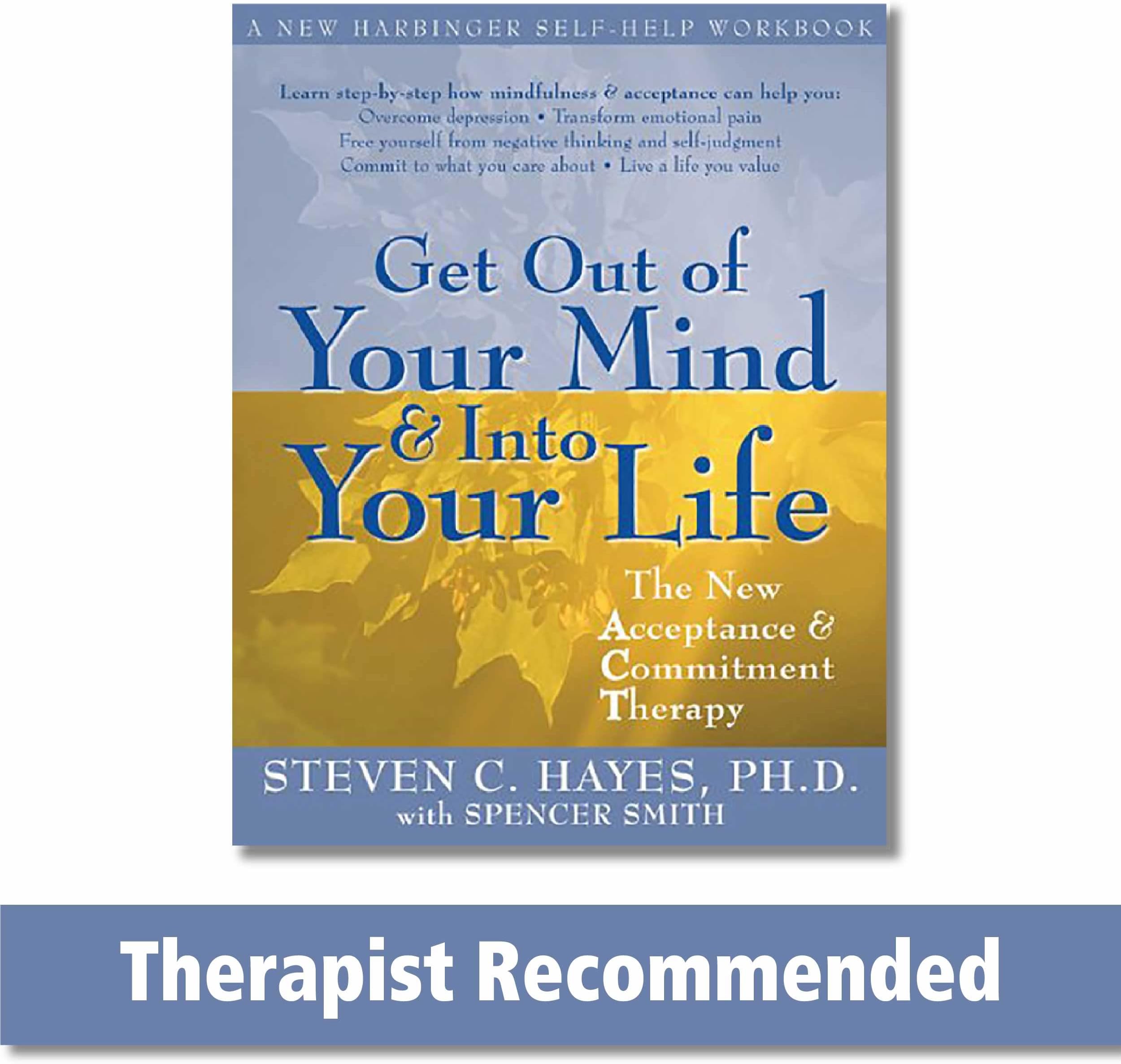
Get Out of Your Mind and Into Your Life: The New Acceptance and Commitment Therapy (A New Harbinger Self-Help Workbook)
Product ID: 1702267
Buy anything from 5,000+ international stores. One checkout price. No surprise fees. Join 2M+ shoppers on Desertcart.
Desertcart purchases this item on your behalf and handles shipping, customs, and support to Vietnam.
Get ready to take a different perspective on your problems and your life―and the way you live it. Acceptance and commitment therapy (ACT) is a new, scientifically based psychotherapy that takes a fresh look at why we suffer and even what it means to be mentally healthy. What if pain were a normal, unavoidable part of the human condition, but avoiding or trying to control painful experience were the cause of suffering and long-term problems that can devastate your quality of life? The ACT process hinges on this distinction between pain and suffering. As you work through this book, you’ll learn to let go of your struggle against pain, assess your values, and then commit to acting in ways that further those values. ACT is not about fighting your pain; it’s about developing a willingness to embrace every experience life has to offer. It’s not about resisting your emotions; it’s about feeling them completely and yet not turning your choices over to them. ACT offers you a path out of suffering by helping you choose to live your life based on what matters to you most. If you’re struggling with anxiety, depression, or problem anger, this book can help―clinical trials suggest that ACT is very effective for a whole range of psychological problems. But this is more than a self-help book for a specific complaint―it is a revolutionary approach to living a richer and more rewarding life. Learn why the very nature of human language can cause suffering Escape the trap of avoidance Foster willingness to accept painful experience Practice mindfulness skills to achieve presence in the moment Discover the things you really value most Commit to living a vital, meaningful life This book has been awarded The Association for Behavioral and Cognitive Therapies Self-Help Seal of Merit ― an award bestowed on outstanding self-help books that are consistent with cognitive behavioral therapy (CBT) principles and that incorporate scientifically tested strategies for overcoming mental health difficulties. Used alone or in conjunction with therapy, our books offer powerful tools readers can use to jump-start changes in their lives. Review: Much more than a self-help book. - The title makes this book sound like yet another "feel better" style self-help narrative, but I was pleasantly surprised. Dr. Hayes wrote this more as a workbook that allows the reader to better highlight negative impacts of anxiety, pain, or anger and then retrain the brain. His teaching style is rather effective; and clearly he wants his reader to engage with their own story in place of superimposing his theory as absolute truth. He doesn't spend pages of introduction grandstanding with false modesty, but delves right into the subject. He doesn't drone on about the efficacy of the therapy, or waste half the content seeking to convince us (the reader) of some newfound truth. Instead he presents a finding, explains how our brains process that information, and provides examples until we can apply it with our own inputs. For a man that was integral to the foundation of this modality of Cognitive Behavior Therapy, is a leader of his field, and wrote a book (this one) that once overtook Harry Potter on the Best Seller's list, it is refreshing to have his focus on the subject at hand in place of himself. If you've read self-help books by many of the talk circuit gurus, this writer will stand in sharp contrast. A joke about Psychologists says that if you go to them with one problem, you'll leave with two. The author demonstrates that often the echoes of negative stimuli carry through and have an even greater impact on how we live our lives. While he might show you the man behind the green curtain he also teaches us to understand those brain pathways, and how to redirect them to a more positive outcome. Whether you were recommended to buy this book, or it is "homework" from your Counselor or Therapist, you will gain far more value from these pages than the price you paid. Review: Spectacular - I suffer of OCD and panic attacks (if Hell exists, and I believe so, I am sure it has to be something like an eternal panic attack). My life had been, for many years -about 15-, all about my obsessions, compulsions and fears. I lived in a continuous reactive mode to my mind. If my mind was over-curious or stressed I felt fear and just followed it. I would be amazed at myself and my continuous, unstopping over-thinking. I started by reading Tolle's "The Power of Now". The book, instead of helping me, caused me panic attacks (well, the book and my personal circumstances too). I was feeling like "Well, my thougts are different from myself and my self-identity, but... if I am not my mind, if I am not my thoughts, then who am I?". Afterwards, I read "Brain Lock". Great book! Still, I was living in continuous reactive mode: if an obsessive thought would come, I would react with the book methodology (Realize one is having a thought, realize one has OCD, find something else to do and, finally, stop giving importance to the obsessions). The book was a breakthrough for me into CBT. But, walking down a library some day, prey of a depression after a panic attack had spoiled a relationship, I came across this book (Get out of our mind...) I bought it with a bunch of other books. What makes this book so great is that it takes you by hand to ACT (a form of CBT) and actually has compassion at yourself. It goes slowly. It repeats the ideas several times and makes amazing analogies. It explains, in plain English, the mind-trap of trying not to think something and how this is a loophole (the less you try to think on an elephant, the more you think of it). It contains plenty of exercises. I did them (Do them! They actually get yourself out of your talkative mind) and started feeling the change. I had lots of fear at the beginning, to confront my fears -yes: fear of my fears), but after some time I learned -or am learning- to accept my thoughts without fighting them... and then... ...and then, there was this chapter which actually was called "If I am not my thoughts, then who am I"!! This chapter opened my eyes to living my life not reactively (like, sadly, most people I know do) but proactively: you don't have to follow every little whim and capricious idea that spots on your mind! You can live according to your values and principles! This book changed my life. God knows it did. And OCD and panic have made disasters in my life (destroyed a relationship with a wonderful woman, swamped myself and made me keep stuck on the same laboral position for years, and a very long etcetera), but I am not going to pay attention to them anymore. No matter how much they "yell" inside myself. I got things more important to do than solving my "OCD/Panic" situation. I have some values to live for and some people to love. 10/10 (I am re-reading the book now, just after I finished it)


| Best Sellers Rank | #94,460 in Books ( See Top 100 in Books ) #5 in Mood Disorders (Books) #10 in Anxieties & Phobias #33 in Anxiety |
| Customer Reviews | 4.5 out of 5 stars 2,367 Reviews |
A**E
Much more than a self-help book.
The title makes this book sound like yet another "feel better" style self-help narrative, but I was pleasantly surprised. Dr. Hayes wrote this more as a workbook that allows the reader to better highlight negative impacts of anxiety, pain, or anger and then retrain the brain. His teaching style is rather effective; and clearly he wants his reader to engage with their own story in place of superimposing his theory as absolute truth. He doesn't spend pages of introduction grandstanding with false modesty, but delves right into the subject. He doesn't drone on about the efficacy of the therapy, or waste half the content seeking to convince us (the reader) of some newfound truth. Instead he presents a finding, explains how our brains process that information, and provides examples until we can apply it with our own inputs. For a man that was integral to the foundation of this modality of Cognitive Behavior Therapy, is a leader of his field, and wrote a book (this one) that once overtook Harry Potter on the Best Seller's list, it is refreshing to have his focus on the subject at hand in place of himself. If you've read self-help books by many of the talk circuit gurus, this writer will stand in sharp contrast. A joke about Psychologists says that if you go to them with one problem, you'll leave with two. The author demonstrates that often the echoes of negative stimuli carry through and have an even greater impact on how we live our lives. While he might show you the man behind the green curtain he also teaches us to understand those brain pathways, and how to redirect them to a more positive outcome. Whether you were recommended to buy this book, or it is "homework" from your Counselor or Therapist, you will gain far more value from these pages than the price you paid.
A**N
Spectacular
I suffer of OCD and panic attacks (if Hell exists, and I believe so, I am sure it has to be something like an eternal panic attack). My life had been, for many years -about 15-, all about my obsessions, compulsions and fears. I lived in a continuous reactive mode to my mind. If my mind was over-curious or stressed I felt fear and just followed it. I would be amazed at myself and my continuous, unstopping over-thinking. I started by reading Tolle's "The Power of Now". The book, instead of helping me, caused me panic attacks (well, the book and my personal circumstances too). I was feeling like "Well, my thougts are different from myself and my self-identity, but... if I am not my mind, if I am not my thoughts, then who am I?". Afterwards, I read "Brain Lock". Great book! Still, I was living in continuous reactive mode: if an obsessive thought would come, I would react with the book methodology (Realize one is having a thought, realize one has OCD, find something else to do and, finally, stop giving importance to the obsessions). The book was a breakthrough for me into CBT. But, walking down a library some day, prey of a depression after a panic attack had spoiled a relationship, I came across this book (Get out of our mind...) I bought it with a bunch of other books. What makes this book so great is that it takes you by hand to ACT (a form of CBT) and actually has compassion at yourself. It goes slowly. It repeats the ideas several times and makes amazing analogies. It explains, in plain English, the mind-trap of trying not to think something and how this is a loophole (the less you try to think on an elephant, the more you think of it). It contains plenty of exercises. I did them (Do them! They actually get yourself out of your talkative mind) and started feeling the change. I had lots of fear at the beginning, to confront my fears -yes: fear of my fears), but after some time I learned -or am learning- to accept my thoughts without fighting them... and then... ...and then, there was this chapter which actually was called "If I am not my thoughts, then who am I"!! This chapter opened my eyes to living my life not reactively (like, sadly, most people I know do) but proactively: you don't have to follow every little whim and capricious idea that spots on your mind! You can live according to your values and principles! This book changed my life. God knows it did. And OCD and panic have made disasters in my life (destroyed a relationship with a wonderful woman, swamped myself and made me keep stuck on the same laboral position for years, and a very long etcetera), but I am not going to pay attention to them anymore. No matter how much they "yell" inside myself. I got things more important to do than solving my "OCD/Panic" situation. I have some values to live for and some people to love. 10/10 (I am re-reading the book now, just after I finished it)
A**R
Are all self-help psychologists copy-cats?
This is not a bad book. It's a pretty good book. What I find incredibly annoying is that the author doesn't acknowledge his huge debt to Gary Emery, who first coined the acronym "ACT." Hayes' ideas are very close to Emery's, in some cases altered just enough so that it isn't outright plagiarism. Instead of acknowledging Emery or the Zen and Stoic thinkers (Epictetus!) whose ideas and methods are also clearly present, Hayes continually makes claims of being "scientific," and quotes his own "scientific" studies. (Is psychology actually a science?) I have no doubt that studies confirm what earlier philosophies first worked out. Emery's books are also syncretistic, and he also doesn't acknowledge his forerunners, but he belongs to an earlier wave of psychologists drawing on Eastern religions and Stoicism, and much of Hayes' book seems derived from his. It seems to be the culture in self-help psychology to pretend you are the very first prophet.
D**Y
Fresh, Novel, Interesting, Controversial and Potentially Life Changing
Psychological treatments, like most forms of therapy, have been developing and adapting for centuries. In recent years the best treatment for depression, as well as a host of other psychiatric disorders, has being centered on a combination of medication and cognitive-behavioral therapy (CBT). The behavior therapies largely replaced psychoanalytic theory. The transition from psychoanalysis was not smooth, and as an attempt to ridicule psychoanalytic ideas, some notorious behavior therapists used to train people with mental illness to perform simple actions and then they would watch with amusement as psychoanalytically trained colleagues concocted creative but often bizarre symbolic interpretations of behaviors that had just been created. We may now be on the cusp another revolution in therapy that could ultimately relegate CBT to the history books, rather in the way that CBT did to psychoanalysis. This new approach has sprung directly from the Buddhist traditions, and revolves around "mindfulness and acceptance". In the Buddhist worldview, each moment is complete by itself, and the world is perfect as it is; That being so, the focus is on acceptance, validation and tolerance, instead of change, and experience rather than experiment as the way to understand the world. For many patients it feels profoundly liberating to be able to see that thoughts are just thoughts and that they are not "you" or "reality." This realization can free an individual from the distorted reality that they often create and allow for more clarity and a greater sense of control in life. This idea that the solution to suffering is to increase acceptance of the here and now, and to decrease the craving and attachment that inevitably keep one clinging to a past that has already changed, is quite different from behavior therapy's emphasis on developing skills for attaining one's goals. But the notion that suffering results from things not being the way one strongly wants them to be, or insists they should be, is very compatible with cognitive-behavioral therapies. The work of Albert Ellis, who is still active in his nineties, is arguably the clearest and most consistent presentation of this point of view. The ideas in this book are fresh, novel, interesting and controversial. Some of the suggestion will be of great help to some people. Yet two problems remain for most people, and these are motivation to change and resistance to change. Without attention to those twin demons, progress can be very difficult. For anyone interested in personal growth and development and an easy introduction to a whole new approach to therapy, this book is highly recommended.
T**N
Don't get caught up in the negative reviews
This is a very insightful book. Very well written and very easy to follow. It goes over many insightful things that you would never even begin to think about that can very much help you with your internal suffering. Reading the many negative reviews on here, made me feel like this book was not going to be helpful, and that I was going to waste my time reading that, but have come to realize that these people probably didn't try very hard to get better and give this book much of a chance. I truly do believe that if you spend time and effort in using the techniques and exercises in this book you will see much improvement. A big thanks to the studies that went into this book, and everybody that helped contribute to this book. This is one of the most helpful books I have come across.
H**S
This isn't really a theory book, it's an actual self-help therapy guide
This is exactly what I was looking for: a guidebook for helping yourself, as opposed to some kind of textbook. The author uses lots of commonsense examples to really illustrate what he's talking about not to professional psychologists, but to everyday people who are suffering. The book is very well organized and the chapters are small enough to read in an afternoon and digest. It is filled with small exercises you can do to either prove some of the points made by the author to yourself, or to gauge your progress in applying what you have read. Highly recommended book; if you want a taste of it, there is a free sample on the Kindle app that will really give you a strong feeling for the content in the book.
A**R
Easy to use.
This is a wonderful workbook. Hayes does a great job with building your foundation in the first two chapters, that you will utilize throughout the workbook. Also, you can find supplemental videos on you tube and his home page that support the concepts that are being taught.
M**N
Not impressed
My therapist recommended this book and wants me to work through the lessons. So far I’m about 25-30% through the book and I’m not crazy about it. The author is too verbose for me and lessons so far aren’t all that helpful to me. So far I think the message/concept is interesting. I’ll update if I feel differently by the time I’m done with the book.
F**T
Useful and clear book
This self-help book has a psychological cognitive basis and it surely gives tools to better approach our life, statess of mind, thoghts and so on. I wld reccomend it to everybody who is daily fighting with his own unpleasant thoughts.
N**Y
Un livre d'auto-thérapie à lire absolument
Pour l'auteur qui est un scientifique en psychologie la solution à nos souffrances c'est l'acceptation et il a fini par me convaincre à travers ce livre. + Le livre explique tous de point de vu scientifique. + Offre des exercices d'autoguérison et des programmes de "vie"(comment identifier ses valeurs entre autres). + Accompagner ce livre avec des méditations de "l'enfant intérieur" résout le problème depuis sa racine et permet de vivre plus en paix✌ (ma propre expérience) Ps: c'est pas un livre qu'on termine dans une semaine.
Y**G
A fantastic book, his first and brilliant self-help book on ACT, very accessible and comprehensive
A fantastic book, his first and brilliant self-help book on ACT, very accessible and comprehensive
D**W
Get Out of Your Mind and into Your Life
"Get Out of Your Mind and into Your Life", one of several SELF-HELP books I have read this year, and the title of the book could not describe its contents any better.! This book goes a step further than Good authors like "Louise Hays" self-help books and "Susan Jeffers" self-help Series, because you will be automatically become engrossed, even by the 1st 3-5 pages in this book, on the grounds you have an open mind, and you are not a negative person... Only those who are motivated to move on, or desperate to get out off their current circumstances will be ready, and this book is both light reading and very down-to-earth Practical medication for the soul. I'm not going to repeat what others who rate this book very highly have already said. All I wish to say this book has been a tremendous help to me, and works better than anything a "Shrink or a GP" can give you in the form of a Pill... Please, AVOID Pills (only if you can), but not an necessity, I as a result of recovering from Severe Depression and PTSD, I can speak with some authority and conviction on the subject.. The Shrink or GP can only do so much "the rest is down to you", also buy some "relaxing music and meditation CDs" here on Amazon, for after every 60 min reading session, which I personally recommend. (don't over do it)... (don't take on to much at anyone time)... Im sure your Adult enough to know whats best for you anyway. - thanks for reading. If you think my review was at all helpful, I would be grateful if you would kindly CLICK Yes,! - cheers, David.
J**O
Wonderful
It is a very interesting book.you can read it easily it is quite good and you can read it without any problems
Trustpilot
5 days ago
2 days ago