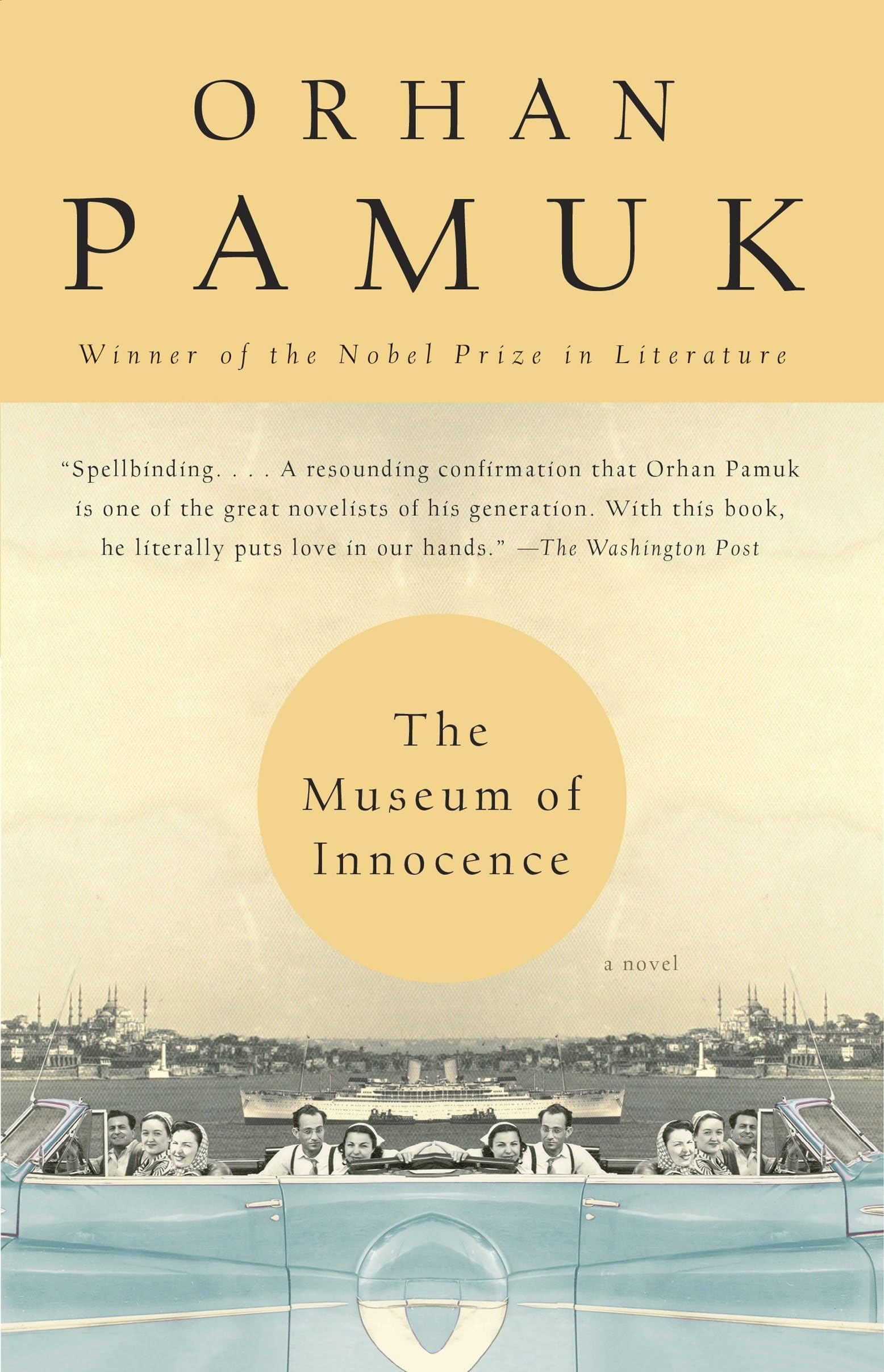
The Museum of Innocence (Vintage International)
Product ID: 16719440
Buy anything from 5,000+ international stores. One checkout price. No surprise fees. Join 2M+ shoppers on Desertcart.
Desertcart purchases this item on your behalf and handles shipping, customs, and support to Vietnam.
Now a Netflix series • From the Nobel Prize winner and "one of the great novelists" ( The Washington Post) comes a stirring exploration of the nature of romance in late 1970s Istanbul. It is 1975, a perfect spring in Istanbul. Kemal and Sibel, children of two prominent families, are about to become engaged. But when Kemal encounters Füsun, a beautiful shopgirl and a distant relation, he becomes enthralled. And once they violate the code of virginity, a rift begins to open between Kemal and the world of the Westernized Istanbul bourgeoisie. In his pursuit of Füsun over the next eight years, Kemal becomes a compulsive collector of objects that chronicle his lovelorn progress—amassing a museum that is both a map of a society and of his heart. Review: A somewhat biased review - Let me preface my review by admitting that I am a huge sucker for well written romance stories, even ones that may lack the literary genius that define masterpieces. This potentially contributed to the mesmerizing experience I had from reading this book. That said, Orhan Pamuk is a great writer who demonstrates an uncanny ability to put out beautiful and poignant literatures, as evident in all his previous work. I had the pleasure to listen to his talk at the New Yorker Festival last year where he talked about the experience of writing his book. As fascinating and hilarious as his speech was, I don't think he was able to convey what readers should be expecting in Museum of Innocence. Museum of Innocence is a love story that alludes to much more. It is said that this is Pamuk's first novel about love (I disagree). The story is centered on Kemal's experience of encountering his love Fusun, as an almost married man, losing her and trying to win her back. Almost the entire story is told from his perspective because he represents multiple oppressive forces that existed in Turkish society in the 70s and 80s, despite his own resentment of these forces. The story is divided into short chapters with titles that convey metaphysical inquiries about love and happiness in the most colloquial and at times cliché language. The writing itself is rather poetic but contains a greater dose of realism than Snow. The storyline is punctuated with breathtaking imageries. Kemal's obsession with Fusun, manifested through his fetish of collecting the objects with associations with Fusun, is absurd by nature but made real and even what somewhat sensible by Pamuk. (The actual museum, which Pamuk has been organization is scheduled to open this year in Istanbul and all objects mentioned in the book will be on display) When reading this book, I cannot help but be reminded of three other novels - Lolita, Anna Karenina, The English Patient. One of the major theme found in Museum of Innocence is the exactly the central theme in Lolita - the objectification of the object of desire. HH's lust of Lo and Kemal's persistence pursuit of Fusun are so similar in that they are both characterized by fetishism. The Istanbul society, the setting of Museum Innocence is not much different from the one Tolstoy described in painstaking details in of St. Petersburg society in Anna Karenina. Pamuk gave the same level of attention to detail to the inanimate objects in Museum of Innocence as Tolstoy did in AK. But writing in a more modern and tender prose, reading Museum of Innocence is more similar to reading the English Patient than to the tediousness of reading Tolstoy. I read the Museum of Innocence after having gone a long period without reading much fiction. It is a tremendous pleasure and I was completely immersed in the story that by the time I got off the train and arrived at work, I cannot stop thinking about the story. It is a long book but Pamuk will pull you through quickly. I cannot claim this as a literary masterpiece at this point but it is definitely a great read. Review: Powerful Start and Then a Slow Burn - I do enjoy Mr. Pamuk’s work. He has a unique style, and his plots are generally engaging. The idea that drives this novel—a bereaved man who collects objects that connect him to his lost love and puts them in a museum—is intriguing. Though I don’t think it quite lives up to the potential of the idea, I did like this. The early part of this novel is spectacular. Our narrator, Kemal, a rather spoiled rich man, becomes enamored of a beautiful, young, distant relative named Fusan even as he prepares to celebrate his engagement with another spoiled rich girl named Sibel. His powerful lovemaking scenes with Fusan in the first pages color the rest of the novel. The extended scene of the engagement party is a tour de force. After the party, however, the novel becomes something of a slog. Pamuk does have a tendency to go for the slow burn in his novels which can be trying. Kemal becomes such a sad sack and his actions seem so ridiculous that it becomes difficult to sustain any sympathy for him. There are some good moments as he tried to keep his relationship with Sibel going and the end, though predictable, has some energy. On the other hand, there are hundreds of pages of boring dinners with Fusan’s family (and husband) where he apparently steals thousands of small items from their house and no one mentions it. Apparently, Mr. Pamuk has created a real Museum of Innocence in Istanbul because of the popularity of this novel there. I do think the picture he paints of a country in transition from traditional to more modern values is a fascinating one and maybe resonates very strongly in Turkey. On the other hand, for this reader, there were challenges along with the successes.


| Best Sellers Rank | #53,954 in Books ( See Top 100 in Books ) #174 in Cultural Heritage Fiction #251 in 20th Century Historical Romance (Books) #2,577 in Literary Fiction (Books) |
| Customer Reviews | 4.0 out of 5 stars 1,449 Reviews |
Y**O
A somewhat biased review
Let me preface my review by admitting that I am a huge sucker for well written romance stories, even ones that may lack the literary genius that define masterpieces. This potentially contributed to the mesmerizing experience I had from reading this book. That said, Orhan Pamuk is a great writer who demonstrates an uncanny ability to put out beautiful and poignant literatures, as evident in all his previous work. I had the pleasure to listen to his talk at the New Yorker Festival last year where he talked about the experience of writing his book. As fascinating and hilarious as his speech was, I don't think he was able to convey what readers should be expecting in Museum of Innocence. Museum of Innocence is a love story that alludes to much more. It is said that this is Pamuk's first novel about love (I disagree). The story is centered on Kemal's experience of encountering his love Fusun, as an almost married man, losing her and trying to win her back. Almost the entire story is told from his perspective because he represents multiple oppressive forces that existed in Turkish society in the 70s and 80s, despite his own resentment of these forces. The story is divided into short chapters with titles that convey metaphysical inquiries about love and happiness in the most colloquial and at times cliché language. The writing itself is rather poetic but contains a greater dose of realism than Snow. The storyline is punctuated with breathtaking imageries. Kemal's obsession with Fusun, manifested through his fetish of collecting the objects with associations with Fusun, is absurd by nature but made real and even what somewhat sensible by Pamuk. (The actual museum, which Pamuk has been organization is scheduled to open this year in Istanbul and all objects mentioned in the book will be on display) When reading this book, I cannot help but be reminded of three other novels - Lolita, Anna Karenina, The English Patient. One of the major theme found in Museum of Innocence is the exactly the central theme in Lolita - the objectification of the object of desire. HH's lust of Lo and Kemal's persistence pursuit of Fusun are so similar in that they are both characterized by fetishism. The Istanbul society, the setting of Museum Innocence is not much different from the one Tolstoy described in painstaking details in of St. Petersburg society in Anna Karenina. Pamuk gave the same level of attention to detail to the inanimate objects in Museum of Innocence as Tolstoy did in AK. But writing in a more modern and tender prose, reading Museum of Innocence is more similar to reading the English Patient than to the tediousness of reading Tolstoy. I read the Museum of Innocence after having gone a long period without reading much fiction. It is a tremendous pleasure and I was completely immersed in the story that by the time I got off the train and arrived at work, I cannot stop thinking about the story. It is a long book but Pamuk will pull you through quickly. I cannot claim this as a literary masterpiece at this point but it is definitely a great read.
T**H
Powerful Start and Then a Slow Burn
I do enjoy Mr. Pamuk’s work. He has a unique style, and his plots are generally engaging. The idea that drives this novel—a bereaved man who collects objects that connect him to his lost love and puts them in a museum—is intriguing. Though I don’t think it quite lives up to the potential of the idea, I did like this. The early part of this novel is spectacular. Our narrator, Kemal, a rather spoiled rich man, becomes enamored of a beautiful, young, distant relative named Fusan even as he prepares to celebrate his engagement with another spoiled rich girl named Sibel. His powerful lovemaking scenes with Fusan in the first pages color the rest of the novel. The extended scene of the engagement party is a tour de force. After the party, however, the novel becomes something of a slog. Pamuk does have a tendency to go for the slow burn in his novels which can be trying. Kemal becomes such a sad sack and his actions seem so ridiculous that it becomes difficult to sustain any sympathy for him. There are some good moments as he tried to keep his relationship with Sibel going and the end, though predictable, has some energy. On the other hand, there are hundreds of pages of boring dinners with Fusan’s family (and husband) where he apparently steals thousands of small items from their house and no one mentions it. Apparently, Mr. Pamuk has created a real Museum of Innocence in Istanbul because of the popularity of this novel there. I do think the picture he paints of a country in transition from traditional to more modern values is a fascinating one and maybe resonates very strongly in Turkey. On the other hand, for this reader, there were challenges along with the successes.
G**Y
A Case of Time And Waiting
It takes a certain emotional discipline to read European Literature. No, change that - it takes a certain unique discipline to read any literature other than that of these United States. We here in the colonies go for hidden tawdriness, spelled out from page one with the page-turner style of dime westerns (more like five-spot westerns these days). The "other" requires us to stop, smell the cigarette smoke, to inch into the book ever so slowly, in the hope that plot is fructifying, even though we can't yet discern it. That characters are more than poseurs trying to seduce us with their cool, above-it-all aplomb. But as Pamuk makes plain in his somewhat derivative novel, his Turkish characters are as flawed, as human, as we Yanks are. In The Museum Of Innocence, Pamuk gives us the story of Kemal Basmaci, whom we Americans might call one of Turkey's beautiful people coming of age during the `seventies' turbulence there. They party hard, abuse friendships and loves, all without a second thought, reminding me a bit of Gatsby. One of that culture's paradoxes is that even as late as the 1970s, Turks submitted to arranged marriages. So it hardly surprises that one day Kemal finds himself engaged to and in love with the very beautiful and cultured Sibel. And who couldn't love such a person as Sibel? Pamuk seems to ask. But his trick here is that Kemal and his friends are creations of both their culture and their family's aspirations for them. All despite the way they see themselves as culturally European, not Middle Eastern. But Kemal is soon to learn the hard way - and over many anxious years - what real love is to make of him. He falls in love with Füsun, a distant cousin and a child from the, well, less rich side of the family. They immediately enter into a sexual relationship, handled with almost Puritanical tact by Pamuk. And with each copulation, their intimacy and love grows stronger. Kemal at first sees no conflict in his double sex life, but as marriage to Sibel comes closer to reality, internal discord sets in. Füsun, of course, wants to be his one and only, but this doesn't seem to be blessed by the stars, so Kemal and Sibel press on with their marriage plans. Finally, Füsun disappears. Kemal is devastated. His marriage plans soon fall apart, and he sets out on a journey of decades to find Füsun and to reclaim her love - reminding me a bit of Ian McEwan's Atonement. There are other tacit literary references: Victor Hugo and Tolstoy and Henry James and a whisper of Dickens. But Pamuk's vision for this novel seems more philosophically complex than these derivative tacks might lead us to believe; he seems to want to continue to plumbing the Turkish psyche for his readers. More to the point, he toys throughout with the idea of time, how it shapes us and changes us. His eponymous museum is a paean to Füsun - a collection of mementoes gathered from the many years of their relationship, assembled in an attempt to freeze moments of their time together. He perceives from the very first, I think, that their love (and by implication, all human love) is transient, that it will pass, later if not sooner. We humans, he seems to want us to understand, are uncomfortable with the very dynamism of the human condition. There must be something more, his story whispers - a place or a condition in which permanence rules. Pamuk, as he did in Snow, dallies with the techniques of post-modernism, but one turn of that pen near the book's end nettles this reader. He turns the story over to Pamuk (who makes a cameo appearance at Kemal and Sibel's engagement party), ostensibly to free Pamuk from his role as narrator and allow him to present something of Kemal that couldn't be depicted otherwise. Sadly, the technique seems more facade than substance. Still, Pamuk proves himself one of this generation's foremost writers, one who dares to challenge us with philosophic insights cloaked in story.
F**O
Beautiful woman is thwarted by male-dominated Turkish society
This is an enjoyable read that is very smoothly narrated, with an easy-going quality. The story is divided into numerous small segments that serve well as digestible bite-size chunks, each one a temptation to read the next. Structurally it is also flawed, however- it drags on too long and could be improved by the ommission of four or five chapters of extraneous detail that go nowhere and contribute little to the plot. The author documents every detail of Turkish domestic life in the 1970's with the zeal of a curator, but goes slightly overboard. Despite this he manages to hold the tension right through to the final denouement, with his appealing and delightful evocation of romantic feeling. The tragic ending is far too predictable though, and it follows an age-old literary pattern: love is elusive, brief and crowned by death. For once it would have been so much more satisfying to let love continue into old age. Pamuk parodies lovesickness and the cult of virginity to ridiculous levels. We are expected to believe that a wealthy and succesful 30 yr old man would obsess to the point of pursuing his lost love for 8 years without even a hint of reciprocation or encouragement from her; that he is ecstatic to ceremoniously rub himself down in the hint of scent lingering on her discarded cigarette butts; we are asked to accept that she spends 8 years in a marriage that is never consummated. Given that Pamuk humorously chooses to resort to such an unoriginal formula, it strikes me that we are probably being asked to view this tale in light of its wider concepts. The heroine Fusun, while adorable, is essentially a powerless figure. Her charm lies in her non-threatening girlish cuteness, her attractiveness in the somewhat inept lack of threat she presents to the patriarchy. Reliant on her looks and the favours of men to get ahead, she is also continually trapped, hampered and subtly controlled by men. In a male-dominated society still repressed by islamic tradition, she can find no way to self-development, self-expression or self-realisation. Her only escape, therefore, her only means of taking control of her own life, is ultimately suicide, and that becomes the most powerful action she undertakes. Despite the absurd review from the Washington post on the front cover "with this book he literally puts love in our hands!"- this book does not depict love, but selfish obsession. The protagonist, Kemal, lives entirely for his own gratification and never puts the interests of his "beloved" first. A self-absorbed and pampered young man from a priveleged background, he never really gains the readers sympathy and while much of the intimacy is touchingly worded, it still reads like a parody of a sixteenth century chivalric romance. Ultimately Fusun is objectified for her beauty and in the final pages there is a strong sense of her being just another trophy, a prized possesion to be collected and looked at. It is almost as if the author is unaware of having created this final impression.
S**R
How Ugly, How True (This is Not a Slam)
Reading Museum of Innocence is a bit like mounting a docile mare and getting unceremoniously bucked off. The landing is abrupt and hard. Yes, this is an artistic, groundbreaking work. I can't think of when romantic love was so, for lack of a better word, "obsessively" detailed. Obsession is the theme of this book and falling in love is one of the splendid, morose obsessions of our time. Such love is supposed to graduate itself. In the case of Kemal, main character of the book, no graduation takes place. Instead he obsesses (that word again) over the stray bits left in the wake of his love for Fusun. Fusun has been born to the wrong class, the wrong neighborhood, has the wrong ambitions and possesses too egregious a style for an elite Istanbulli like Kemal. None of this prevents him from taking Fusun surreptiously as a teenage mistress, while planning a public announcement of his engagement to another woman. Poor Fusun. Poor Kemal. Poor us. Orhan Pamuk's writing is once again laden with a level of imagery that will keep decades of doctoral candidates busy with interpretative studies. I read the Museum of Innocence as soon as the publishers could release it into my hands. However, the book bucked and kicked, probably because I am a woman. I caution readers that Museum of Innocence strips away all semblance of actual innocence to the point of excruciation, enshrining Kemal's imitation of love. It is a dead love. Fusun's life is a series of survival moves, which no amount of worship from Kemal can remedy or improve, despite his fixation. Kemal seeks a form of possession, collecting the totality of Fusun's life through lost earrings and crumpled cigarette butts. He is also afflicted by a serious lack of real nerve. He has no desire to contradict the social construct that imprisons him, Fusun and his erstwhile fiance. Not that social revolt would actually help them, given Turkey's slide into martial law, also described in the story background. If half the sin be scandal, then Turkey's upheaval in the seventies and eighties never appears to rock Kemal's class beyond tepid fears of lost status and the inconvenience of martial law. Fusun, who begins the book as a Lolitaesque figure may be Kemal's great love, but she begins to look like a mouse trapped in the paws of a moody cat. She is doomed by her poverty and low status, even though she possesses blood ties to Kemal's family. So powerful is Fusun's allure to dopey, depressed Kemal that Fusun's family, includimg her eventual husband, can never quite tell Kemal's apologetically deep pockets to sod off as he becomes an uninvited, daily presence in their lives. Fusun is Turkish Lolita with blither spirit while Kemal is Humbert Humbert with less malignance. At least he believes he genuinely loves, though he is nearly as morbid as the execrable Humbert. The result is an exhaustive examination of ungraduated love and its tiresome foible. Or the book is an examination of halted progress, personal and political. It could be a deep look at the motivations we unwittingly project through our notions of romantic love. Pamuk's glory as a writer is that he plumbs art from this. The end of the book has some amazingly original post-modern turns that are Pamuk's signature as an author. Fusun, it becomes clear, must die. What else to do with her? By the time feminism arrives to her neighborhood she will be a self-destructive mess. Fusun's character is frustratingly remote. Kemal has all the right upper-class props to support his exquisite self-loathing, which unforgivably obscures Fusun's potential to the point of vanishment. After her tragic death, he plans his tribute, the Museum of Innocence. Fusun's possessions, including the discarded cigarette butts, are organized into a collection. All this in the name of abused virginity and social standing. How ugly. How true. Must "true love" be exploitive? Museum of Innocence may be read more easily by men, which leads me to think Pamuk's partial intention was exactly this, literary expose. Maybe I am too wishful. However, Museum of Innocence is a great work. Like Pamuk's other books, a certain level of discomfort is required (in my case, a great deal of it). I had the same reaction when I read Lolita, which in hindsight was an amazingly prescient novel, similarly ugly, but true. I recommend this book and will read it again, just not right now. (By the way, the book also managed to slap me in the face. My name is Bentler, the same name of an Ottoman era forest near Istanbul that Kemal visits early in the book. That is another story).
I**N
A companionship of knowing shared defeat
The Museum of Innocence - in my opinion - is not Orhan Pamuk's best work, but it is still an amazing novel. I have just finished reading it and I am - again - blown away by Pamuk's genius and his ability to grasp and to hold my attention for the whole length of 530 pages of the novel. Plus, I feel a bit melancholic, leaving his extraordinary but fictional world, made of the same ingredients: a man`s quest to find love, his life's gradual but drastic change, and this endless pursuit of happiness...while erring in the streets of Istanbul. The novel started as a love story doomed to fail. But as the time passes (the novel covers more than 32 years) and the obsessive nature of Kemal's mind is revealed, I began to wonder if this love would have ever sustained if these two people had actually gotten married. Since, besides all these objects, gathered and cherishes by Kemal - objects which have been used or possessed by Fusun and her family - does he ever try to understand Fusun's mind, her thoughts, her wants or her dreams. He appears mostly surprised at most of Fusun's responses to him. He gives up his previous life, in the name of his love for a woman, while it is clear that he's only in love with her beauty. Almost as if he is under a maledict spell, he doesn't understand her sadness, or her sorrow. After having spent 8 years at her dinner table, I'm not sure if he still could interpret her gestures, her few words, or her silences in the right way? Besides watching TV together, while she remained in her own bitterness and he lingered at the depth of his own impossible obsession, what else did they share? The more I read, the more I felt that their love story could have had a different path if Kemal wasn't so much in love with the image of a woman he had made in his mind. He wasn't really in love with Fusun, but in love with his own fascination, or in other sense, in love with this obsession. But before I could develop a stronger resentment toward Kemal for his ignorance and selfishness, Pamuk wrote:"Sometimes it occurred to me that ours (our love) was a companionship of knowing shared defeat: This made me even happier than love did." And there, I realized that all along the way, this was the story Pamuk intended to tell. In other words, Fusun's love represents this obsession with the past, this timeless nostalgia, while the character of Sibel represents the modernity. No wonder Fusun's realm ends up in a museum, or as Pamuk writes: "...if objects that bring us shame are displayed in a museum, they are immediately transformed into possessions in which to take pride." The Museum of Innocence is a complex novel, beautifully written, full of intriguing and thought provoking twists and turns, and I would definitely recommend it to every book lover.
S**.
'The heart of my life was elsewhere'
With a tip of his hat to two of his literary heroes - Nabokov and Proust - Orhan Pamuk takes on the themes of erotic obsession and memory in his latest book, written in a lyrical style that is ideally suited to his romantic tale. What makes this novel so memorable and enjoyable to read is Pamuk's wit in telling the story and his affection for the characters. These endearing characters include Fusun, the object of desire for the protagonist (Kemal), as well as virtually the entire cast - which includes the city of Istanbul circa 1970s/80s, a ramshackle but charming place that is integral to the mood of the story. Here's the gist of the plot: Kemal, the privileged son of a wealthy businessman, begins an affair with Fusun, a beautiful shop clerk, at the same time that preparations are under way for his engagement to Sibel, a sophisticated woman of the upper classes. The 40-page chapter on the engagement party, which is a showcase of brilliant social comedy, sets in motion the dissolution of both the planned wedding and Kemal's relationship with Fusun. Kemal withdraws from the world - distancing himself from his family and friends, neglecting his job and sneaking to the apartment where he and Fusun had their affair, where he surrounds himself with various mementos that remind him of Fusun. What happens next is a bit stunning. The reader learns that Kemal re-establishes ties with Fusun by constantly visiting her and her family for "innocent" family dinners, about four times a week over an eight-year period. This lengthy middle portion of the book is told thematically rather than chronologically, and you start to feel a bit disoriented and lost in time as Pamuk devotes entire chapters to various aspects of Kemal's obsession - such as Fusun's facial expressions and 4,213 cigarette stubs that he collects. You get the distinct impression that Kemal is wasting his life and squandering his privileged social position (Kemal guiltily points out that the well-off are a tiny minority in Istanbul). But is he wasting his life? Pamuk anticipates all of our doubts and objections. There's no denying that the middle section of this novel drags badly in spots as Pamuk dissects every aspect of Kemal's feelings for Fusun. But Pamuk's witty approach to his story (the social comedy reminded me of Proust, and the depiction of the Istanbul film industry is hilarious), his beautiful language and his love for his characters ultimately carry the day. The description of the "Museum of Innocence" that Kemal establishes is moving as well. Although I found this challenging book well worth the effort, the slow pace and repetitive nature of the plot will not be for everyone. If you're new to Pamuk, you should probably start with "Istanbul," his wonderful memoir about growing up in that fabulous city on the Bosphorus. One final note: according to the New York Times, Orhan Pamuk plans to open a museum in his home town of Istanbul, featuring items corresponding to each of the book's 83 chapters. Pamuk himself makes an appearance early on and at the end of the novel.
A**L
A Droning Bore
I was initially excited at the subject matter of The Museum of Innocence (obsession), and at the mostly positive glowing reviews I'd read of it (comparing it to Nabokov's brilliant"Lolita"). It began promisingly enough; Pamuk's a good writer and the story seemed compelling. However, it began to bog down at the middle and never recovered. I had to force myself to finish this over-long book, literally counting the number of pages left till the end. A protagonist should have some redeming characteristics that help the reader to feel sympathy and/or interest in his/her story. Kemal, the protagonist of this novel, seems to have none. He's annoying, self-involved and blinded, selfish, ridiculous and more. The object of his obsession, the young woman Fusun, at first touched my sympathy, but later also became pointless and without much to redeem her. I found myself not caring about either of them or their story. The plot barely drones on, with too much space taken to niggling details viewed through the eyes of Kemal. The ending is as pointless as the entire book and its characters, and left me wondering why I bothered to slog through it at all.
I**S
Muy recomendable
Esta es una de esas lecturas que uno quisiera se prolongarán por siempre. Me encanto
J**N
For those who, like me, find it difficult to let go
Pamuk, a brilliant and beautiful writer who is new to me. The first paragraph of “Museum of Innocence” took my breath away with the words that capture the essence of this story.
T**Y
Awesome..
If you haven't read Orhan Pamuk then you haven't read the Literary Geniuses of 20th Century. Pamuk is simply superb... His characters come alive and takes you on a journey not as a spectator but as a Co-commuter.
A**L
Loved it! A great read
Absolutely loved the book- loved being transported back to old Istanbul. Loved the writing which brought the book to life on the pages..,
R**A
Amazing
Amazing book. Actually, everything from Orhan Pamuk is amazing I hardly wait to visit the musem
Trustpilot
5 days ago
2 weeks ago