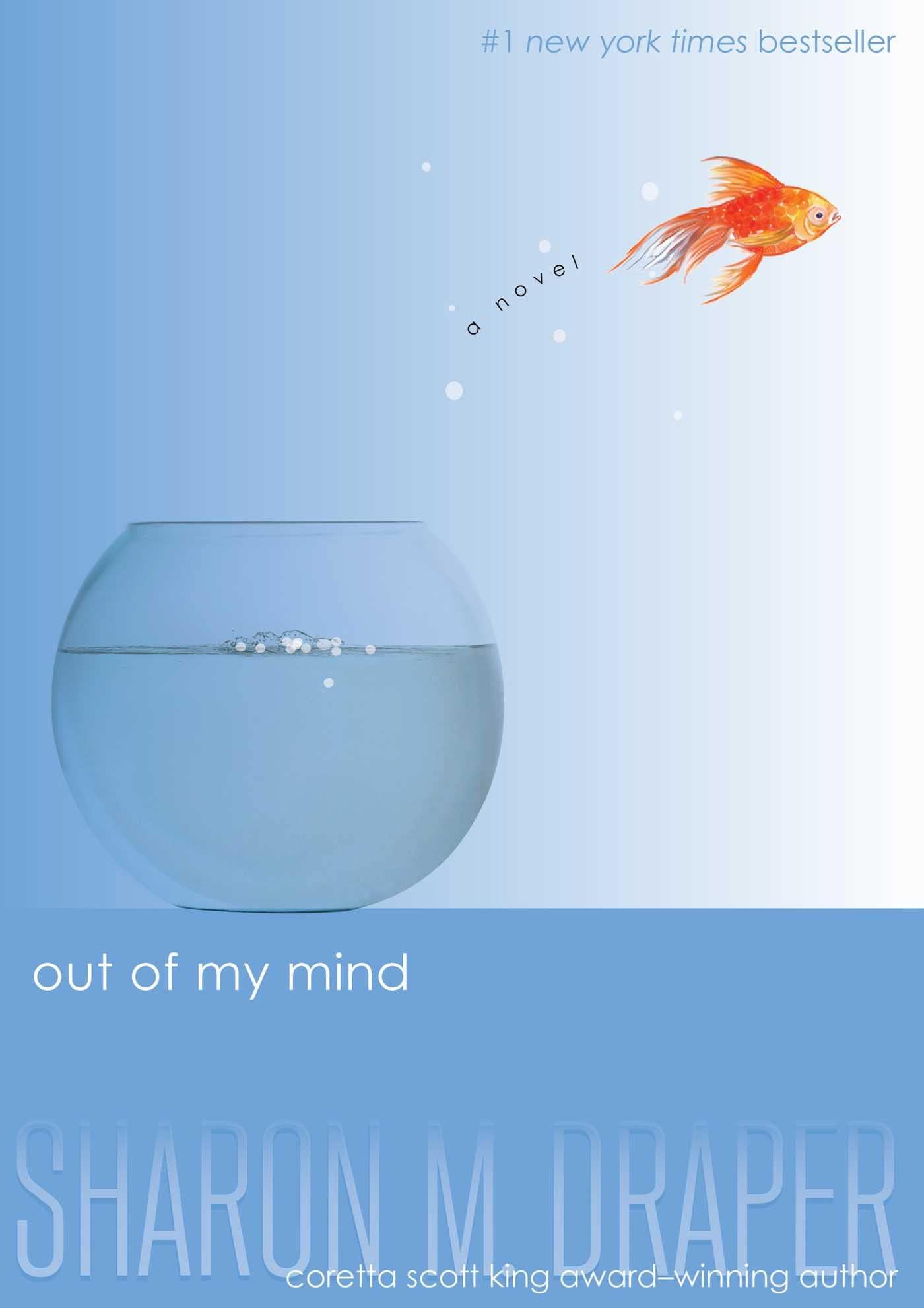
Out of My Mind (The Out of My Mind Series)
Product ID: 164416
✨Award-winning series
📚Engaging narrative
🧠Mind-bending concepts
Buy anything from 5,000+ international stores. One checkout price. No surprise fees. Join 2M+ shoppers on Desertcart.
Desertcart purchases this item on your behalf and handles shipping, customs, and support to Vietnam.
📖 Get lost in a story that speaks to your soul!
Out of My Mind is a captivating installment in The Out of My Mind Series, featuring an award-winning author who masterfully weaves relatable characters and thought-provoking themes into an engaging narrative that resonates with today's readers.


| Best Sellers Rank | #931 in Books ( See Top 100 in Books ) #2 in Children's Books on Disabilities #45 in Children's Family Life Books (Books) |
| Customer Reviews | 4.7 out of 5 stars 18,068 Reviews |
C**.
Listen to the quietest voices
I work as a CNA at a facility for long term acute care of people with traumatic brain and spinal cord injuries. This book was left by the family in the room of a younger patient (teenager) who had to be supervised 1-on-1 at all times due to his injury. I have since heavily suggested it to many of my coworkers in healthcare and child care. It is a very simple read, but very moving and thought provoking even so. "Out of My Mind" is the story of a little girl who just wants to be able to be heard and seen. She has spastic quadriplegia and cerebral palsy, but a photographic memory. She remembers everything that she has ever heard or seen, but is able to say nothing. I would ask you to take a moment and contemplate what it would be like to be in that position. She is treated as a baby, an invalid, someone stupid and incompetent because she looses control of her muscles and can't behave as a "normal" child. Can you imagine having above average intelligence and memory, but everyone treats you as if you have the mental capacity of an 18 month old... and no way to correct them? This is the story of how she was able to develop the skills and be given the tools to make her voice heard. It is also a coming-of-age story. It's the story of her commentary on how people treat her, and her experiences being in "special" education classes, how she is able to see the beauty and wisdom in her classmates that the rest of the school has "thrown away" in the dingiest classrooms in the corner of the school. It's also the story of a 5th grade little girl's desire to be accepted just as she is. As someone who commonly works with TBIs, it's also a reminder of the proverbial "don't judge a book by its cover". I may be working with someone who is completely unresponsive, but it's impossible to know how much is actually being understood and comprehended. I have had coworkers who either treat unresponsive patients like nothing more than dolls or like idiots, and it always offends me. While this is a young adult book, it is definitely a book also important for adults to read. I would read this with an elementary-aged school child, but I would also read it with an adult group. It's a fast read - written as though by a very intelligent 5th grader - but the message is much more complex and powerful.
C**Y
PROBABLY THE BEST BOOK EVER WRITTEN
I am in awe. I found this book on Amazon for my ten year old son, who has Aspergers. He is having a particularly hard time in school these days, and I picked this book because it sounded like a book that I thought he might be able to relate to. He needed a book for a book report. This is so much more than a simple read. I'm disabled. I don't often go out that much. Most of my free time is spent reading. I have read hundreds, if not thousands of books. This book is by far probably one of the best books I have ever read. Because I am not as gifted as this brilliant author, I am having a hard time finding just the right words to describe the journey I took. It profoundly affected me, as a mother with a special needs child. More importantly, it "reached" my son, who eagerly found himself sitting with me way past his bedtime to read. We couldn't get enough. The story wasn't just well written, it didn't just have a plot, or characters. This book became alive. Both my son and I could picture each character, each scene as it played it, and the emotions were so real, we often had to stop. Stop to give each other a high five when things went well. Stop to curse and shake our heads wildly in anger, and mostly stopped to share so MANY MANY tears. Tears for Melody. Tears of frustration. Tears of sympathy. Tears of hope. And tears of gripping pain. I don't know who her target audience was. She had me at the reviews. But this book should be mandatory reading for every parent, whether they have typical kids or not. I am grateful for this author for bringing my son and I together. Not just by reading a book, but by bringing us together in a way that I usually not privy to. My son will typically tune out everyday conversation with talk of video games, iPad apps, scripted conversations taken from clips of a tv show he likes that he repeats over and over. For just once, a very special once, we were actually sharing this together. This book is a gift. It was to me. It was to my son. It stays with you long after the book is read. It is by far, one of the best books ever written. Thank you, Mrs. Draper. Not only for this book, but for what it gave me and my son.
A**R
A Must Read for Everyone
This is a book that should be read by all, young and old! Out of My Mind introduces us to Melody, a 5th grader who has cerebral palsy. Melody is unable to do the things that most of us take for granted and can do for ourselves--bathe, get dressed, hold a fork or spoon, walk, and speak. And speak is something that Melody is bursting to do. Although her body may not cooperate and allow her to do what most other children are able to do, Melody is brighter than most and has thousands of words in her head that she is dying to get out! Melody has been placed in a classroom with other children with special needs where they are treated by their teacher as though each is incapable of learning anything. If Melody could speak, she would tell her teacher exactly what she thinks, but she is unable to do so. Then, three things happen when Melody goes into the fifth grade. First, the students 5H get a new teacher who has actually taken the time read and learn about each of the special needs students in her classroom and utilizes instructional methods that encourage their growth and learning; second, the school implements a program of inclusion where Melody and her classmates are mainstreamed for some of their classes; and third, Melody's parents purchase her a "Medi-Talker," a specially designed computer that allows Melody to "speak" and participate in class as she has never been able to do before. Despite her sharp mind and apptitude, there are those, fellow students and teachers alike, who refuse accept her "smarts" and are unable to see beyond her physical limitations. When Melody astounds her classmates by qualifying for the school's "Whiz Kid" team (with the highest score of those who tried out), she is over the moon. She hopes that her fellow classmates will now accept her as one of them and see that there is more to her as a person than the body that cannot do what she would like for it to do. If her team wins the area competition, they will travel to Washington, D.C. to participate in the National Competition. For Melody, this will be an opportunity unlike any other that she has experienced in her elevens years on this earth. Who wins? Who loses? If I answer these questions I will be spoiling the story for those who want to read this book, and trust me, you WANT to read this book!
D**N
Excellent, well written exploration of a differently abled girl's experience
This is an excellent book, well written, and well worth your time. Its lessons and characters will not be quickly forgotten. Fans of vampires, zombies, and gore should go elsewhere; this one is for someone with a keen intellect and a sense of humor. Someone who'd like to learn what life might be like for a person who simply cannot communicate her higher thoughts and emotions, although they're always boiling away in the percolator of her videocamera mind. You might know or be related to a special needs child or grownup. Then again, perhaps you don't often think about special needs people because they're "invisible" to society in general, or perhaps you look away when they pass because you don't want them to think you are staring, or perhaps you'd rather not think about it at all because you feel all creeped out. Maybe if you knew that they're actually just like anyone else, you'd feel better. Here's an eloquent peek inside just such a life. First, let me say that I concur entirely with the researchers who say that "spoilers" do not spoil a story for most skilled readers, so I'm not going to fret about leaving behind clues to the events in this tale. On the other hand, you can get a good synopsis from just about every other review, so I won't be summarizing the story. I want to address instead the value of what you take away from the tale. From here on, *spoiler alert* for those who worry about such things. The writing is smooth and funny, and the prose is cadenced, so readers who are accustomed to the plod-plod-thump of potboilers may be pleasantly surprised. The story is in intimate first person, and for once the reader is plunked into the mind of someone who is locked into a malfunctioning physical prison. She has no way to show or tell others about her (high) abilities and must endure constant frustration at not even being able to tell someone when something is going wrong. She eventually gets a very rudimentary way (a picture board) to communicate, but it's useless for abstract thoughts and for anything that the pictures don't tell about. Her world opens up when she finally gets a Medi-Talker like Big Steve Hawking's so people realize that there are great thoughts inside her. (Whether they appreciate this is a mixed issue.) I do agree with the quibble that others have brought up: nowadays, when someone needs and can use a "box of words," he or she is generally issued one by the time he or she starts school. It takes an awfully long time in this book for anyone to come up with the idea of giving one to the main character. I would've liked to hear some kind of excuse as to why this couldn't be afforded previously and how someone suddenly found a charity that would pay for it. That would've given us a reason for the long delay. I can't agree with critics who say that the author shouldn't let "bad things" and "mean people" stand unchanged. That's realistic. There have been objections saying that the bullies don't change, and the other characters in the book don't change. I believe that in this type of story, a character arc of redemption doesn't have to happen for everybody. Bullies sometimes stay bullies and often get worse over time. Didn't these readers notice that the teacher had a change of heart from not believing that Melody could have done her own work on the quizzes to knowing that she got every answer right and putting her on the team? He redeemed himself somewhat in that way. But then he fell back into the swamp like a backslider when he didn't insist on holding the flight for her. (This is, alas, typical of people. Because they are not saints. They are but mortal flesh with souls that sometimes go with the most expedient answer instead of the right action.) Bullies like Claire and Molly are out there. We have all come across them. Ditto for Rose, who is a pleaser, a classic "I want everyone to like me" type who is not sincere about her "friendship" pose and reveals her true colors in the end. Melody's reaction of standing up for herself at the end of the novel was totally appropriate, and THAT was the lesson we were to take away--standing up for what's right. Not a pretend lesson of sweetness and light that would lie to us and tell us that all bullies turn into friends and people always repent and are redeemed. Sometimes the apology you get is too little and too late. After seeing the reviews that bemoaned the "awful things at the end of the book," I feared that it meant the dog or a person might die; worry not, however, because everyone lives. I want to tell you that in advance because it SLAYS me when things like that happen, especially for egregious reasons. I like to know going in that no pets or grandparents or children were zapped in the course of the book. Yes, a crisis takes place, but it's ultimately OK. The incident is meant to show that Melody still faces challenges in communication, even though things are much better. And that people who are angry and in a hurry can make awful mistakes. Life is like that. I have defended similar plot choices in more than one of my published novels because even though people in publishing said they wanted YA fiction to always show that there's a second chance, I believe that sometimes there is not, and we must find ways to cope and assign meaning anyway. Sometimes the cookie just crumbles, despite our best efforts. Still, the heroine's dream is crushed because of silly middle school posturing, and she can't communicate with her mother at a critical moment (although WHY her box of words was ever not in her hands I don't know--I know of one student with such a device, and it NEVER leaves her side, even to ride in the car!) This is life. These things happen, and we have to cope and find the meaning in the events and figure out how to do it differently next time, if we can. So for those who claim that it's too difficult an ending to inflict on young readers--hey, this is LIFE and that is the sort of thing that happens. I can totally believe that they "accidentally" left her behind so they wouldn't have "the retard" (a term one of the bullies actually uses! If anyone wants to get outraged, get outraged about that pejorative term!) on their team. The other students were not happy about the extra attention from reporters that focused on Melody. They didn't want her at their breakfast because she couldn't feed herself and they thought it unsightly, no doubt--and when the opportunity arose to leave before planes were grounded, they skipped out on her. I can see this happening. As for the sister being hurt--well, the mother was angry and impatient and having to do something she didn't want to do, and so she wouldn't check out WHY Melody was upset and trying to tell her something. People are just LIKE that. The lesson is that we should avoid this sort of acting in anger. It would be nice if I could learn that myself. People have complained that the book is ageist or too "mean." I think that to invoke political correctness (always showing people of all ages being all-diversity-loving and so forth) is to dumb down a work of realistic fiction. You really have to hunt to find instances of the young being shown as "nicer" than the old here--especially since the caregiver who finally gets Melody a box of words is an older woman. Also, the author is African American, yet she gives no indication as to the races of the various characters. Color-blindness here is a GOOD thing and should be lauded. I sort of wish that the title could be different, especially because Andy Rooney has a book in print by that same title. It isn't really indicative to me of the book's content. In summary, the pluses of the book far outweigh any quibbles that we may have. I think young readers NEED to be exposed to realistic endings. And to the possibility that appearances can be deceptive. Next time you see someone who appears to be "slow," "dumb," hampered, or whatever . . . well, it may be decieving. You don't know what difficulties and hurts others may have. Walk a mile in someone else's shoes today, or roll a few yards in their adaptive device, and THEN tell me you don't understand . . . I think you'll start to understand.
C**R
This Could Have Been MY Story! Simply EXCELLENT!!!!
I just finished this book and if I could get up and cheer, I would. You see, I have severe cerebral palsy like Melody. I can't walk, my speech is very slurred, and I'm typing this review with my nose. A few people kept saying that this book reminded them so much of me and all I have been through in my 33 years of life. Boy were they ever right! While my story is different than Melody's in some aspects, it is extremely similar in many. Nobody thought I'd amount to much. I have so much inside me, yet few people take the time to truly listen. I have a Master's Degree, am a published author, and am happily married. All these things I was told over and over again that I'd never accomplish. Like Melody, I never gave up and had those special people in my life who never gave up on me while everyone around us was sure I could not possibly be successful in my goals and dreams. I never gave up. Even today, I still deal with people's attitudes about people with severe disabilities. It gets tiring sometimes. This book is an accurate depiction of what it's like to be stuck in a body that refused to cooperate with you, and yet refusing to let it define you. CP is such a small part of who I am despite some trying to make it all I am! At the same time, there are times when you need people to recognize your special needs. Everybody running up the steps of the restaurant and leaving Melody and her mom alone to deal with the steps is a prime example of not recognizing the need when it is appropriate. Balance is key when dealing with people with disabilities. I cried throughout the book. I laughed too. I cheered when Melody stood up to her classmates. This could very well have been my story. Thank you Sharon Draper for writing this wonderful book! I pray many read it and understand that there is so much more to people with severe disabilities. People just need to take the time to get to know us! For the negative reviewers: This IS real life. Everything isn't always butterflies and rainbows. And perhaps some of you were convicted by reading it. That is no reason to put it down. Take it from someone almost exactly like Melody. Someone you may look away when we pass by because I make you uncomfortable, this IS life for most people with severe disabilities! Again, BRAVO Sharon Draper!!!!!!
J**N
Out of My Mind
I got this for my son to read for school. I have a hard time finding books that he actually enjoys, and he really enjoyed this book. I really enjoyed seeing a main character that has a disability!
E**S
Don't judge a child by her wheelchair!
Melody, the main character is a young lady who has a beautiful mind but a very uncooperative body, which prevents her from expressing what is happening in that beautiful mind. Melody has Cerebral Palsy- which has locked her inside, unable to demonstrate her incredible ability and the assumptions that are made of people who are forced into silence by disability. Melody's story reminded me, as a teacher having had students very similar to her in my class, that, though students who are essentially unable to communicate due to severely disabling body conditions, often have much more happening in their minds than we give them credit. Though he can't respond on a standardized test, I have had a student who, through his facial expression, was able to make it quite clear that he was NOT a baby, when a peer commented that he was a "cute little baby". This peer never called him a baby again. Melody also reminds us that when we talk to kids with severe physical disabilities, we need to keep in mind the need for age-appropriate conversation and tone. Kids such as Melody, live in their minds- absorbing everything around them, every waking moment- what observers of the world! It also reminds me that more resources need to be placed into serious development of communication systems to give students like Melody their voices, so that they, to may really demonstrate what they know. Melody, at one point, talks of earning "real" grades for what she knew since she was able to communicate via device. In fact, developing a way for mobility-limited, non-verbal students to communicate, should be the most critical part of their early-age education, continuing and developing throughout their school career. This book serves as a reminder to teachers, parents, caregivers and peers. It's great for students both with and without special needs- for those with special needs it can awaken them to the possibilities- for those without disabilities it serves as acknowledgement that books, as well as people should not be judged by their covers. I absolutely recommend Out of My Mind for adults and for students above 4th grade.
N**A
Going out of your mind
Out of My Mind….. going out of your mind What an amazing book “Out of My Mind by” by Sharon M. Draper. It is an incredible book that I read. In view of my middle level in English The structure of this book with chapters helped me alot to finish reading this book. I was never confident like I am now. I never had the courage to read a book in English with approximately 300 pages. This book treated the subject of the disabled people. He talked and treated all sides of this category. He talked about the suffering of this group. The story was about a genius girl with Cerebral Palsy that she can't talk or walk. She has amazing thoughts and ideas, but she’s never shared them with anyone. In fact, she’s never spoken a word. In the first part the writer showed how parents cope with disability and that it's a very difficult situation that everybody can face. Then he shows the emphasis and importance of the pet for the disabled that in fact they can feel each other without saying words. Furthermore This is the story of how the inclusion class gives her the opportunity to show her capacities and make her own place. In addition he talked about the benefits of technology that make her able to develop the skills by giving the tools to make her voice heard. With the help of her neighbor, Ms. Valencia, who believes Melody can do amazing things, her new aid, Catherine, and a computerized speaking device, Melody finally finds her voice so he talks about the support of the people around her. It's also the story of her commentary on how people treat her, and her experiences being in "special" education classes, how she is able to see the beauty and wisdom in her classmates that the rest of the school has "thrown away" in the dingiest classrooms in the corner of the school. It's also the story of a 5th grade little girl's desire to be accepted just as she is. I will give 5 stars to this book and I recommend It to all students to read .
R**S
Ótimo
Veio de acordo com o solicitado.
き**ょ
大切な思いを言葉で伝えられることの幸せに、気づかせてもらえる作品。
一気に読みました。面白かった! 思いを言葉にして表せることの幸せを改めて教えてもらいました。 主人公が両親に I love you. と伝える場面では思わず涙が・・・。
S**E
Ponctualité et très bon état du livre
Préparation de la rentrée scolaire
Y**A
Sad, interesting & educative
Out of My Mind is the story of a pre-teen girl, Melody. It is a first-person narrative mostly about what's going on inside her mind, hence the name. Melody was born with cerebral palsy. She cannot stand. When she sits, she has to be strapped to her chair to prevent her from tumbling down. She has problems chewing and swallowing food or even drinking water. And she cannot speak. When she tries to talk, “the words explode in her brain, but all that comes out are meaningless sounds and squeaks.” But Melody’s brain has developed normally. In fact, her intelligence is well above average and she is always eager to learn. She is also blessed with a photographic memory. Her most painful problem is that she has no way of communicating her knowledge, thoughts or emotions to anyone. As she writes, “I can say “uh” and “ah” pretty clearly, and, if I concentrate, sometimes I can squeeze out a “buh” or a “huh.” But that’s it.” Very few things can be more frustrating than this inability to express or communicate. But even her frustration she cannot express! When I read some of her passages describing how she needed to communicate but even someone like her mother who was one person who came closest to understanding her, would often fail to understand, I was reminded of a poem- The Eve of St Agnes by John Keats in which he wrote: “No uttered syllable, or, woe betide! But to her heart, her heart was voluble, Paining with eloquence her balmy side; As though a tongueless nightingale should swell Her throat in vain, and die, heart-stifled, in her dell.” When Melody’s helplessness overwhelms her, her arms and legs get all tight and “lash out like tree limbs in a storm.” She begins to screech and scream and jerk. She writes: “These things—I call them my “tornado explosions”—are pieces of me. All the stuff that does not work gets balled up and hyped up. I can’t stop, even though I want to, even though I know I’m freaking people out. I lose myself. It can get kinda ugly.” Melody does go to school. But there is a class for special needs children and she sits there. Feeling miserable because often she is treated as an imbecile because she drools, needs to be taken to the toilet by an attendant and doesn’t speak or even raise her hand. A teacher joins the school who introduces the concept of “inclusive periods” where for some sessions she sits in the same class as normal needs children. That is not an unmixed blessing either. As Melody writes, “But “inclusion” doesn’t mean I’m included in everything. I usually sit in the back of the room, going crazy because I know answers to things and can’t tell anybody. “What’s the definition of the word ‘dignity’?” one of my teachers asked a few days ago. Of course I knew, so I raised my hand, but the teacher didn’t notice the small movement I’m able to make. And even if she were to call on me, what then? I can’t very well yell out the answers. It’s really frustrating.” Because Melody does not speak, others just presume that she has nothing to say. As her classmate Claire once said, “I’m not trying to be mean—honest—but it just never occurred to me that Melody had thoughts in her head.” Many of us would have come across special needs people. While we do feel sympathy for them, I realised after reading this book that what such people need most is not our sympathy or even kindness; they need to be treated as just another person. As Melody’s mother once says, “A person is so much more than the name of a diagnosis on a chart!” No person’s illness should be treated as her identity. It’s a sad story but the book is very readable and also very educative.
T**N
Loved it
I could not put down this book. I would highly recommend it. The book shows the determination of a young girl who just wants to fit in with the real world. But the real world wasn't ready for her. It reminded me of my school years, as I'm dyslexia and had a hard time at school. Not fitting in with the cool gang. Everybody has a disability and it's OK, but we learn from it. The book teaches that it's OK not to fit in with the normal (what is normal) world.
Trustpilot
3 weeks ago
1 day ago