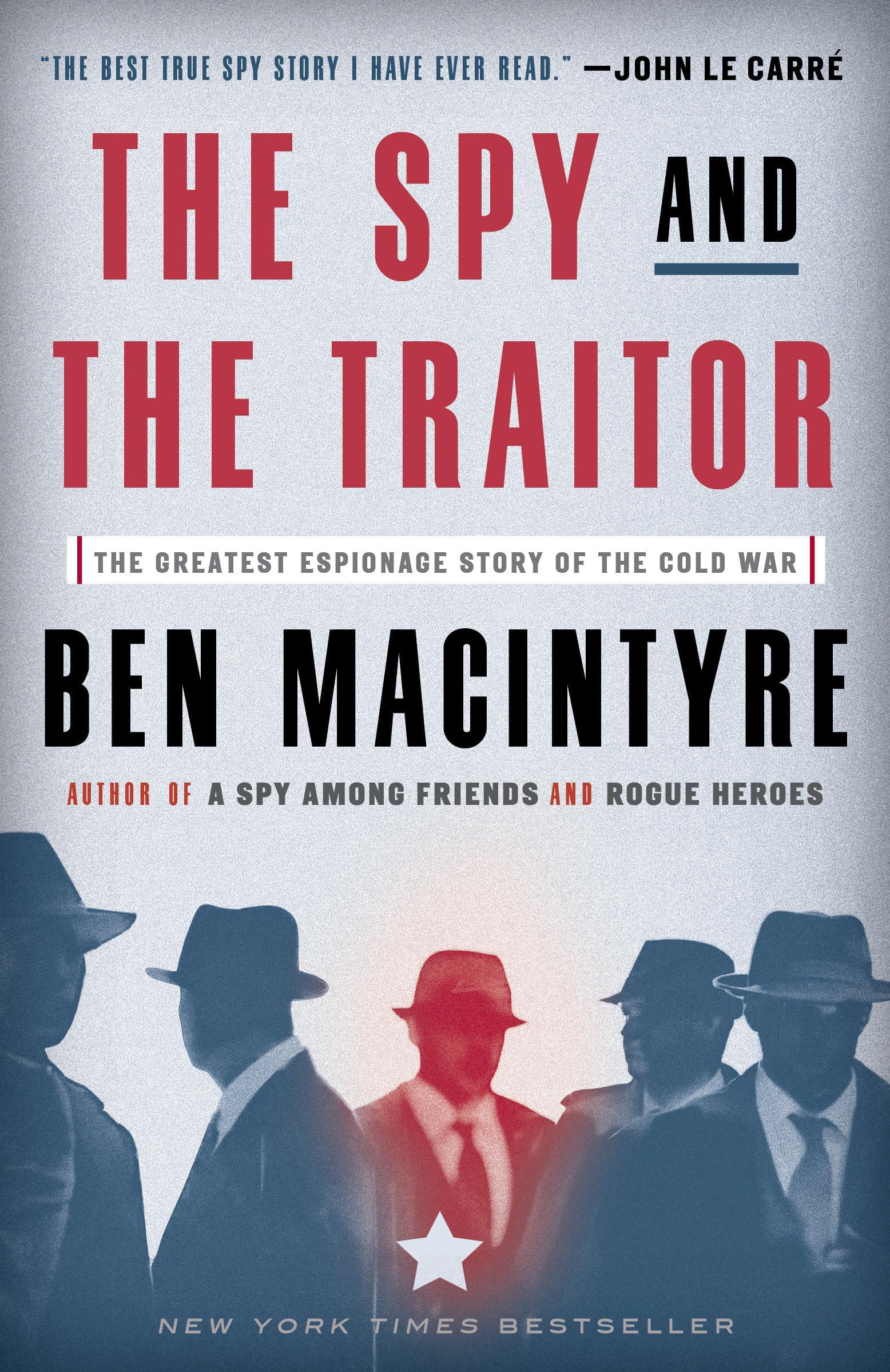
The Spy and the Traitor: The Greatest Espionage Story of the Cold War
Product ID: 157989992
Buy anything from 5,000+ international stores. One checkout price. No surprise fees. Join 2M+ shoppers on Desertcart.
Desertcart purchases this item on your behalf and handles shipping, customs, and support to Vietnam.
NEW YORK TIMES BESTSELLER • From the celebrated author of Operation Mincement and The Siege comes the thrilling Americans -era tale of Oleg Gordievsky, the Russian whose secret work helped hasten the end of the Cold War. “The best true spy story I have ever read.”—JOHN LE CARRÉ Named a Best Book of the Year by The Economist • Shortlisted for the Bailie Giffords Prize in Nonfiction If anyone could be considered a Russian counterpart to the infamous British double-agent Kim Philby, it was Oleg Gordievsky. The son of two KGB agents and the product of the best Soviet institutions, the savvy, sophisticated Gordievsky grew to see his nation’s communism as both criminal and philistine. He took his first posting for Russian intelligence in 1968 and eventually became the Soviet Union’s top man in London, but from 1973 on he was secretly working for MI6. For nearly a decade, as the Cold War reached its twilight, Gordievsky helped the West turn the tables on the KGB, exposing Russian spies and helping to foil countless intelligence plots, as the Soviet leadership grew increasingly paranoid at the United States’s nuclear first-strike capabilities and brought the world closer to the brink of war. Desperate to keep the circle of trust close, MI6 never revealed Gordievsky’s name to its counterparts in the CIA, which in turn grew obsessed with figuring out the identity of Britain’s obviously top-level source. Their obsession ultimately doomed Gordievsky: the CIA officer assigned to identify him was none other than Aldrich Ames, the man who would become infamous for secretly spying for the Soviets. Unfolding the delicious three-way gamesmanship between America, Britain, and the Soviet Union, and culminating in the gripping cinematic beat-by-beat of Gordievsky’s nail-biting escape from Moscow in 1985, Ben Macintyre has crafted an electrifying account of an international hero. Like the greatest novels of John le Carré, The Spy and the Traitor brings readers deep into a world of treachery and betrayal, where the lines bleed between the personal and the professional, and one man’s hatred of communism had the power to change the future of nations. Review: Splendid history & a gripping read - The Spy and The Traitor is touted in its subhead as "the greatest espionage story ever told." That isn't just publisher hype. The real events and the story of Oleg Gordievsky, KGB officer and diplomat reads like something from a John LeCarre or Robert Ludlum story...except it's true and marvelously documented. Raised by a father and older brother who both served devotedly and unquestioningly in the KGB (dad worked through Stalin's purges and survived in the KGB's precursor agency). Loyalty to the service then would seem to be a given--betraying the agency and its million members (you read that right) would be like sabotaging the family's business. Yet events and history continue to flummox human expectations. First the invasion of Hungary, then the erection of the Berlin Wall (which Gordievsky was present to see) and finally the brutal crushing of the Prague Spring in Czechoslovakia all drove this KGB officer further and further away from the party. Exposure to the West in Copenhagen and later in London provided a first hand taste of liberty and freedom. It served as the final push into the eager and eternally grateful arms of his M16 handlers. The double agent provided them with not merely a trove of concrete information but invaluable insight into the workings of the KGB and planning of the Soviet Leadership. It is no exaggeration to say Gordievsky was our Kim Philby. The details of these meetings, contacts, "drops", etc. and how spies operated from the end WWII until the dissolution of the Soviet empire is fascinating and novelistic in the telling. Gordievsky's escape or "exfiltration" from the USSR by M16 is nothing short of breathtaking--a Bourne Identity moment. Best of all though is the historical and moral context that gives readers a perspective of events' meanings. Ben McIntyre is a masterful storyteller and detailed chronicler. He thoroughly but concisely points out the import and value of Grodievsky's insights--particularly warning the Brits and thereby the Americans that the Soviet leader Yuri Andropov genuinely believed the West was intent upon a first nuclear strike. Appreciating that paranoia can be as perilous as animus, first Thatcher and then Reagan worked to assuage Soviet fears. It was Gordievsky who prepped both sides for successful summits in the 80s and it was he who counseled wisely to neither disband nor include the USSR in the SDI or Star Wars initiative. Rather, ratchet up the pressure and they would go bankrupt trying to keep up, which is precisely what happened. Gordievsky certainly didn't single handedly end the cold war--there were dozens of events and officials who played a significant role. But Oleg Gordievsky was surely in the first rank of those who made a valuable contribution earning the appreciation of Reagan, Thatcher, the CIA, M16 and yes, QEII (the monarch, not the ocean liner). Best of all, McIntryre doesn't put a patriotic gloss on his subject's behavior. What Gordievsky did was of enormous benefit to democracy and the West but it destroyed his marriage, implicated his wife and children as well as family and friends who all paid some price for his defection. In short, his actions both saved and ruined lives and the choices he made can be rightfully regarded as both morally defensible and appalling or enraging to those who knew him. Unsurprisingly, his marriage failed and most Russian friends regard him with disdain and disgust. In the western intelligence community he is a hero. This is terrific, important history and a wonderfully well-told tale. Enjoy! Review: A thriller, even if you know the ending! - An excellent read on several levels: a dramatic spy story, a real thriller; very informative about the history and methods of cold-war spying; an intensely personal study in the psychology of a competitive, perhaps adrenaline-addicted, patriotic Russian spy who becomes disillusioned with the socio-political system in which he grew up. Two things I want to note in particular. First, MacIntyre does an excellent job of helping us to understand what the psychological toll can be on the psyche of a double agent: long, mundane weeks of waiting between "information drops" and other spy business while carrying on in a seemingly "normal" day job with family, and then days of sustained tension and real (or often imagined!) danger: you never know in this clandestine business whose side your associates and supposed allies are really on. You trust no one and you spend a lot of time thinking about your level of exposure: who is watching or listening and tailing you, and why and when; and what will likely happen to you if you get caught (and it is never good, especially for the Soviet double-crosser). Even though you are a good guy, you have to be ready to lie to everybody, including family, and be really good at it. The spy business and marriage with children don't really go together, but they are often an unofficial prerequisite to rising in the ranks of spydom: there was no fairy-tale ending to this dramatic story. The second point is the stark difference I saw between the methods, motivations and imagination of the British vs. the Soviet spy services. The Soviets had, by far, the largest espionage network in the world, but the British had the best. The Soviets tortured their own spies if they suspected them of duplicity. The Brits, predictably, were much more civil, even with their own traitors. The British were indeed alert for and would relentlessly pursue the identity of a suspected mole in their midst, but they did not engender the widespread, ongoing paranoia that infected Stalin's secret police and the later KGB, who routinely tortured and murdered their own traitors. Cooperation and trust we're hard to come by among the "comrades" in the Soviet service. There was more genuine subsidiarity among the British spy units: inventive solutions to problem could be worked out at a more local level and thus there were more creative and effective responses, with more "team playing." Finally, the British were more subtle and "invisible" when tailing suspects than were the Soviet "thugs," who were easy to spot by the trained eye. I think most of the differences I've mentioned are attributable to the philosophical and moral differences between the free, Western, socio-political ideology and the totalitarian, communistic, amoral system of economic determinism. What we believe about human freedom and dignity determines how we behave. The author doesn't necessarily lay out, or even intend, all these observations as explicitly as I have, but he clearly "roots for the right side" in his narrative. At the finish, I was proud to be "on the right side of history."


| Best Sellers Rank | #1,991 in Books ( See Top 100 in Books ) #1 in Espionage True Accounts #2 in Intelligence & Espionage History #3 in Political Intelligence |
| Customer Reviews | 4.7 out of 5 stars 36,065 Reviews |
L**N
Splendid history & a gripping read
The Spy and The Traitor is touted in its subhead as "the greatest espionage story ever told." That isn't just publisher hype. The real events and the story of Oleg Gordievsky, KGB officer and diplomat reads like something from a John LeCarre or Robert Ludlum story...except it's true and marvelously documented. Raised by a father and older brother who both served devotedly and unquestioningly in the KGB (dad worked through Stalin's purges and survived in the KGB's precursor agency). Loyalty to the service then would seem to be a given--betraying the agency and its million members (you read that right) would be like sabotaging the family's business. Yet events and history continue to flummox human expectations. First the invasion of Hungary, then the erection of the Berlin Wall (which Gordievsky was present to see) and finally the brutal crushing of the Prague Spring in Czechoslovakia all drove this KGB officer further and further away from the party. Exposure to the West in Copenhagen and later in London provided a first hand taste of liberty and freedom. It served as the final push into the eager and eternally grateful arms of his M16 handlers. The double agent provided them with not merely a trove of concrete information but invaluable insight into the workings of the KGB and planning of the Soviet Leadership. It is no exaggeration to say Gordievsky was our Kim Philby. The details of these meetings, contacts, "drops", etc. and how spies operated from the end WWII until the dissolution of the Soviet empire is fascinating and novelistic in the telling. Gordievsky's escape or "exfiltration" from the USSR by M16 is nothing short of breathtaking--a Bourne Identity moment. Best of all though is the historical and moral context that gives readers a perspective of events' meanings. Ben McIntyre is a masterful storyteller and detailed chronicler. He thoroughly but concisely points out the import and value of Grodievsky's insights--particularly warning the Brits and thereby the Americans that the Soviet leader Yuri Andropov genuinely believed the West was intent upon a first nuclear strike. Appreciating that paranoia can be as perilous as animus, first Thatcher and then Reagan worked to assuage Soviet fears. It was Gordievsky who prepped both sides for successful summits in the 80s and it was he who counseled wisely to neither disband nor include the USSR in the SDI or Star Wars initiative. Rather, ratchet up the pressure and they would go bankrupt trying to keep up, which is precisely what happened. Gordievsky certainly didn't single handedly end the cold war--there were dozens of events and officials who played a significant role. But Oleg Gordievsky was surely in the first rank of those who made a valuable contribution earning the appreciation of Reagan, Thatcher, the CIA, M16 and yes, QEII (the monarch, not the ocean liner). Best of all, McIntryre doesn't put a patriotic gloss on his subject's behavior. What Gordievsky did was of enormous benefit to democracy and the West but it destroyed his marriage, implicated his wife and children as well as family and friends who all paid some price for his defection. In short, his actions both saved and ruined lives and the choices he made can be rightfully regarded as both morally defensible and appalling or enraging to those who knew him. Unsurprisingly, his marriage failed and most Russian friends regard him with disdain and disgust. In the western intelligence community he is a hero. This is terrific, important history and a wonderfully well-told tale. Enjoy!
T**R
A thriller, even if you know the ending!
An excellent read on several levels: a dramatic spy story, a real thriller; very informative about the history and methods of cold-war spying; an intensely personal study in the psychology of a competitive, perhaps adrenaline-addicted, patriotic Russian spy who becomes disillusioned with the socio-political system in which he grew up. Two things I want to note in particular. First, MacIntyre does an excellent job of helping us to understand what the psychological toll can be on the psyche of a double agent: long, mundane weeks of waiting between "information drops" and other spy business while carrying on in a seemingly "normal" day job with family, and then days of sustained tension and real (or often imagined!) danger: you never know in this clandestine business whose side your associates and supposed allies are really on. You trust no one and you spend a lot of time thinking about your level of exposure: who is watching or listening and tailing you, and why and when; and what will likely happen to you if you get caught (and it is never good, especially for the Soviet double-crosser). Even though you are a good guy, you have to be ready to lie to everybody, including family, and be really good at it. The spy business and marriage with children don't really go together, but they are often an unofficial prerequisite to rising in the ranks of spydom: there was no fairy-tale ending to this dramatic story. The second point is the stark difference I saw between the methods, motivations and imagination of the British vs. the Soviet spy services. The Soviets had, by far, the largest espionage network in the world, but the British had the best. The Soviets tortured their own spies if they suspected them of duplicity. The Brits, predictably, were much more civil, even with their own traitors. The British were indeed alert for and would relentlessly pursue the identity of a suspected mole in their midst, but they did not engender the widespread, ongoing paranoia that infected Stalin's secret police and the later KGB, who routinely tortured and murdered their own traitors. Cooperation and trust we're hard to come by among the "comrades" in the Soviet service. There was more genuine subsidiarity among the British spy units: inventive solutions to problem could be worked out at a more local level and thus there were more creative and effective responses, with more "team playing." Finally, the British were more subtle and "invisible" when tailing suspects than were the Soviet "thugs," who were easy to spot by the trained eye. I think most of the differences I've mentioned are attributable to the philosophical and moral differences between the free, Western, socio-political ideology and the totalitarian, communistic, amoral system of economic determinism. What we believe about human freedom and dignity determines how we behave. The author doesn't necessarily lay out, or even intend, all these observations as explicitly as I have, but he clearly "roots for the right side" in his narrative. At the finish, I was proud to be "on the right side of history."
E**C
Second time reading
And it's even better this time. The spy story is amazing, as always with Ben Macintyre and the personal cost is nearly impossible to imagine. That's why I only used 4 stars. I wanted more on the deep personal cost here. Much like Kim Philby who was revered in the USSR, drinking and completely alone, but always a hero, I felt a lot of pain about where our great hero landed, and they seem very similar. Aldrich Ames gets uncritical "master spy" status here, when he was mostly just an amazing example of the CIA's ineptitude. There is no discussion at all about Robert Hanssen over at the USSR section of the FBI, also selling people out to the exact same Soviet spy master at the exact same time. Thankfully the Brits do a better job than my own country on this front. In any event, the more I read of this period, the more amazing that anyone made it through alive. The Soviets had a virtual library of spies in the US on whom to call, and the UK did right to not tell the US. Only CIA hubris caused the massive loss found here, not some super talented Rick Ames. (Read A Spy in Plain sight for a quick gloss on the huge number of Soviet and Russian spies in the US IC at this time. It is terrifying.) And after rereading this history, I find the idea of Ames as superior in any way more infuriating. Ames was lucky, and Oleg Gordievsky was .... not lucky, that the many US intelligence services apparently couldn't figure out who was an obvious problem, despite Ames basically showing the evidence in every way possible. Sorry, after reading this true story, I find the lack of humanity and pure greed of Ames especially galling. I may never get over it. However this book is a good example of how, at least in this case, the Brits did a textbook job of caring for their Joe, and how US hubris nearly killed him anyway. Read it, anything written by Ben Macintyre is always worth reading, sometimes more than once!
A**N
Amazing story of Oleg Gordievsky
I was somehow referred to this book on Amazon while looking into Aldrich Ames literature. Am certainly glad i was, The Spy and the Traitor is the story of Oleg Gordievsky and his career in the KGB and his defection. His story I guess is relatively untold compared to the infamous Aldrich Ames but his importance was extremely high. Ben Macintyre tells the exciting story of Oleg and keeps the reader on the edge of their seat throughout the book. Without the reader knowing what happened the book reads like a true spy novel, yet is entirely based on fact. Oleg Gordievsky was a family KGB man, his father and brother were both in the KGB and he too followed the family tradition despite a streak of ideological doubt. He married into the KGB literally with his wife as a fellow operative and the loveless life created the conditions for his dissatisfaction to boil into anti-establishment when he went on his foreign assignment to Denmark. Oleg realized while he was abroad the richness of other cultures and vibrancy of environment and began to deeply question the model of Soviet rule after exposure to life in a foreign country. He eventually managed to get posted in the UK through his creation of a strong relationships with his English counterparts and there started one of the most fruitful spy relationships of the Cold War. Oleg became the UK government's eye into the inner workings of the KGB and Soviet apparatchik and gave natural insight when others would have been at a loss of interpretation. The book is very personal and describes Oleg's marriage, divorce and remarriage. It takes the reader through the conditions that formed his core beliefs as well as the environment that led to his extreme and critical introversion about the double life he was living. The book is exciting to read, when it becomes clear to the KGB that they have a mole, the escape plan of Oleg is put into place and the reader is taken on a remarkable journey. I don't want to get into the details as the book must be read to get the appropriate immersion but its truly the substance of a must make movie. The book was hard to put down and the last third was impossible. After reading the book i immediately went to Wikipedia to look into all of the details and it was astounding that i knew as little as I did about this character. Definitely worth reading as it is illuminating as to the workings of the KGB, historically significant in the context of the Cold War and as exciting as a spy novel could be, amazing.
W**H
One of the Most Enjoyable Books I Have Read
This is a great story in the hands of a master story-teller. Oleg Gordievsky was a Cold War KGB officer who let his humanity, clear vision of what the Soviet system represented and a personal fearlessness lead him to turn coat and become a British agent reporting from inside the KGB apparatus. This fascinating story is true and is as tense and dramatic as any Ian Flemming work (ok, without the sex, car chases and gun play). The book - based on over 100 hours of interviews with Gordievesky and countless other hours with British spy handlers, former KGB colleagues and Russian friends and his ex-wife detail the real life world of a master spy and excellent practitioner of spy craft. Gordievesky would have in all likelihood remained on station beyond 1985 had another famous spy not turned him out. The CIA's Aldrich Ames figured out who MI6's most productive source was and told his KGB handlers (though their was possibly another source of exposure as well). Called back to Moscow, Gordievsky activated a years-old exfiltration plan that saw him lose his surveillance and rendezvous with a British team mobilized to meet him near the Finnish border and whisk him to freedom. The spy training and craft, operational methods, recruitment of assets and interactions with his British handlers are all here. Also, the book provides an excellent insight into a part of the KGB that reveals it to be a slothful (though still deadly) bureaucracy where petty turf wars and jealousy had dulled the teeth of a once effective and ruthless organization. The recall to Moscow, interrogations, suspicions and eventual escape are tense and nerve wracking as the author has done a brilliant job of pacing in detailing a get-away fraught with danger. Gordievesky is a hero to our side; still a target of the Russians headed by ex-KGBer Vladimir Putin. This man's information and insights helped with political planning and understanding of Russian thinking at the height of the Cold War. His work possibly enabled the British to blunt American and NATO enthusiasm for the Abel-Archer military exercise which a tottering Soviet leadership feared might be cover for a western first strike against the Soviets. He also provided advice on how to deal with Russian reaction to the Strategic Defense Initiative and according to the author was extremely prescient on how it would play out. A fascinating and gripping account of a heroic man. Highly recommended.
K**Y
Well written
Real events that read as well-written suspense spy novel that you’ll read in one breath. Great insight into psyche and personalities of characters in this historical account of some Cold War events. Well presented moral dilemmas, great description of secret agencies’ procedures, and chilling documentary of some real life former KGB’s operations and treatment of citizens.
J**S
Strict criticism .
A text book for intelligence services’ employees.
H**R
amazingly well researched
I bought this for my husband & he couldn't put it down. Then I read it too. It's based on intense documentary research as well as in-depth interviews with the Russian diplomat who spied for the British. Overall, it's well written and the facts revealed are amazing, in and of themselves. But the author also skillfully identifies & analyzes the often intense emotional relationships that develop between a "spy" and his/her handlers. Perhaps the saddest aspect of this book is the inevitable devastating toll such spying takes on the spy and his family. The most infuriating aspect of this story is the sheer incompetence of American intelligence professionals -- especially when compared to their British counterparts -- when it comes to rooting out their own high level mole, Aldrich Ames, who poses such a lethal threat not only to this Russian but also to American agents in Russian. (Oddly, Margaret Thatcher actually comes across as a relatively sympathetic figure, comparatively speaking..) If you want to find out about contemporary security issues, consult the new expose of the U.S. Secret Service, "Zero Fail. " It's repetitive & not particularly well-written, but it paints a devastating picture of an agency that has been chronically starved for financial resources in recent decades while drowning in excess testosterone & self-protective male bonding. The result is an agency that discriminates against Black and female agents & has repeatedly failed to effectively protect Presidents & their families, from JFK through Trump, when it comes to garden variety crazies like the repeated White House fence jumpers. Despite the bravery & commitment of many agents in the trenches, the agency has been awash in booze, prostitutes, adultery, and cover-ups. Even worse, the chapters on the Trump presidency reveal that some agents & supervisors brought their MAGA hats to work &others openly supported Trump on social media (instead of remaining "apolitical"). While the SS culture remains fatally flawed by cronyism, racism and sexism, most of the higher-ups devote their time to promoting & protecting each others' careers (& future pensions). Decade after decade, the result has been a series of humiliating security failures, massive burn-out by agents in the trenches, & chronic difficulty recruiting new agents.
M**0
Great book for all interested about Cold War
What is incredible about this true-life spy story is that you can read it like a classic novel, as it never slows its pace. This captivating espionage tale is a real page-turner. What struck me most in this book is how likeable the main character really is.
S**E
Great book
Great book, highly engaging narrative
C**U
Great read, good story/history for anyone
This is a great book that I have found myself thinking of even after I'm done reading it. In fact, I remember it as if I was watching a TV series It was a great story and history lesson. It is well written so you don't have to know any of the history, context or entities to enjoy it. Highly recommend There really isn't anything in this book that parents need to be concerned about. But here are a couple brief mentionings of more adult nature: -there is brief historical mention that Russia would torture and kill traitor spies -there is brief mention of main character buying pornography from a store (for plot purposes) Book was in great shape when it arrived with no damage
M**H
Excellent spy thriller.
A fascinating and gripping read from cover to cover, all the more so because it is a true story that reads like fiction. A must read for anyone interested in the spy genre.
V**.
Meglio di tutti i romanzi di spionaggio, tranne di quelli di Le Carré
Un ottimo libro, scritto come fosse un romanzo di genere anche se è cronaca, e un po’ storia.
Trustpilot
2 weeks ago
1 month ago