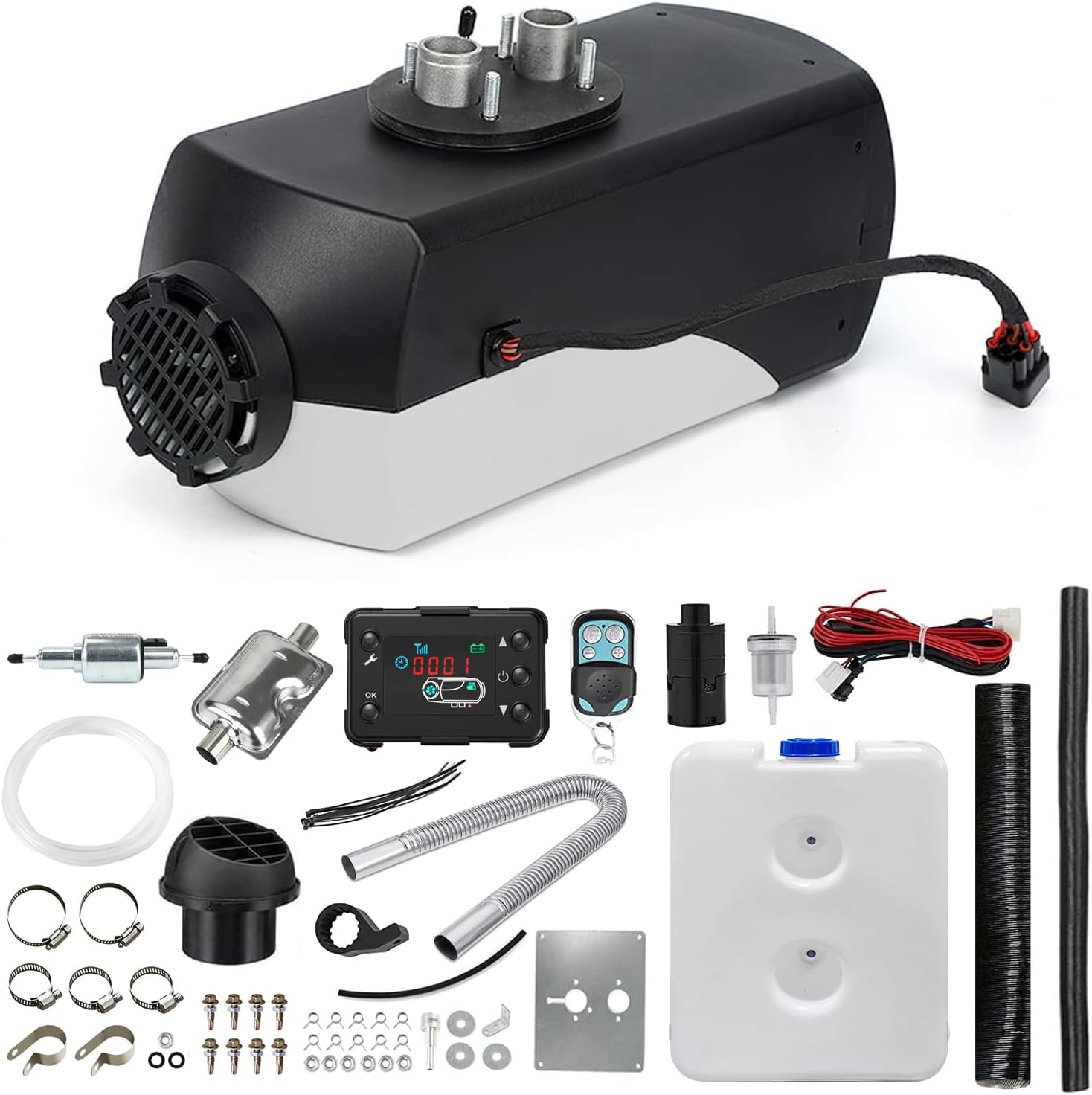





Triclicks Diesel Air Heater 12V 5KW-8KW All In One Fast Heating Parking Night Diesel Heater with LCD Display Remote Control For Campervan Car Truck Boat RV (Color D, Regular)
Product ID: 157893286
Buy anything from 5,000+ international stores. One checkout price. No surprise fees. Join 2M+ shoppers on Desertcart.
Desertcart purchases this item on your behalf and handles shipping, customs, and support to Vietnam.
Product Description Optional Inflatable Gymnastics Mat Inflatable Air Roller Incline Gymnastics Mat Vibration Plate Kids Play Tent Review: Much better than I thought, really happy with the heater! - So there are loads of these heaters around on the internet and I thought I'd do some research before purchasing. I bought the Triclicks as it seemed to be just a little bit better that the others that were offered with the remote control key-fob and the better heater housing. I'll start with the bit of info that you want to know; this heater is brilliant - works very well indeed with plenty of heat produced with minimal usage of fuel. It warms up quickly and has a protective cool down cycle to keep the heat exchanger cool when switching the unit off. (good for longevity) If you want to use your main fuel tank to supply this thing then firstly buy a fuel tank pickup straw kit, this includes a tank adapter connector and a pickup straw – essential and not expensive from desertcart or the van manufacturer service counter. If you want to use the included tank then ignore the bit about fitting the fuel pickup pipe below. Everything else you need is included in the supplied kit that comes with the heater. Right, so what is it like to fit? I bought this to heat the load area of my transit van, I’m a site fitter so have to work out in fields in all weathers whereby my clothes and tools get wet and muddy – so a decent heater was essential so help dry my workwear between jobs. Firstly I found the place I wanted to fit the heater, for me it was just in-front of the drivers side rear wheel arch as this happens to be right in between a major load bearing crossmember and the sill underneath the van. I drilled a 4 inch diameter hole right through the floor using a hole saw – very well measured and marked off first so as not to land in a stressed member. Drill a pilot hole from underneath (where you can see the chassis etc) then the big hole from above to keep things tidy. Assemble the heater inlet, exhaust, fuel pipe, fuel pump wire and included carrier plate and put plenty of high temperature silicon down on the van floor so form a seal – you don’t want carbon monoxide poisoning do you! (or ingress of water). Plonk the lot through the hole and secure the mounting/carrier plate to the van floor using bolts or even just tec-screws will be fine (use silicon underneath to make sure everything is sealed up against the weather and give a good bead around the holes for best protection. So now there is a heater in the van with a load of tubes sticking out underneath. Lets fit the fuel pipe. Fuel pickup pipe: This is the pain part – support and unbolt the fuel tank (make sure to have about ¼ to 1/8 of a tank of fuel – having no more fuel than this in the tank is absolutely essential), pull the wiring off from the connector and unbolt the fuel filler tube bracket, this will just slide out of the bit where you fill the van with fuel when you lower the tank – lower the fuel tank, you need to get it down by about 8” (200mm) or more to enable you to get the fuel pickup onto the tank. The van fuel tank is already fitted with an aux fuel take-off union on the top at the rear – newer fords have two, one located at the fuel pickup end and one at the opposite end of the tank on its own (RH top drivers side). Use a sharp knife and cut the very end of the aux take-off pipe off – this will form an open tube into the tank. Fit the pickup straw that I mentioned at the beginning of this review as it saves a lot of pain! Put the pickup tube into the hole you’ve cut and pull it back out, cut the tube off to shorten it just below the point that you see the fuel on the tube – you are doing this so that you can’t run the heater so much as to completely drain your tank of fuel – you should always be left with ¼ to 1/8 of a tank for driving etc. So once your done this, fit the take-off tube and the included elbow connector along with the included small bore fuel pipe. From here I ran all the fuel pipe back to the heater inside spiral wrap tubing to essentially give a tube inside a tube for extra protection. Re-fit the fuel tank and fuel filler bolt, ensure its very secure and located correctly. Route the fuel pipe across the underside of the van using clips to secure where you can. Find a suitable place to fit the fuel filter and bolt this to the chassis – ensure it points mostly upwards to allow air to escape, continue routing the pipe until you reach a point that the fuel pump wire will reach, at this point fit the fuel pump in the same way to point upwards towards the flow (again for air removal), continue routing the pipe all the way to the heater pickup tube that you previously fitted through the floor. I routed my pump wire in with the small bore fuel pipe spiral wrapping to give it as much protection as possible. The exhaust is a bendable stainless corrugated tube, unfortunately for me it exists the heater from at the front rather than the rear (as my heater faces intake to the rear, heat output to the front – the exhaust is at the front of the heater). I mounted mine really high up between the chassis crossmember and the load area crossmember in front of the wheel arch – aim it downwards to ensure that water can’t gather in the tube and secure using a riv-nut or tec-screw into the crossmember. Do the same with the intake but route it well away from the exhaust and remember to aim to downwards to ensure no water can gather in the tubing. Make sure to seal everything underneath, especially around the 4” hole in the floor that you’ve cut – it’ll stop your van from rotting and also ensure you don’t poison yourself with exhaust fumes. Right, now the easy bit. The Wiring and Controller: Fitting the wiring is easy, you ‘ve probably already worked out that the supplied fittings are different shapes so that you can only connect the fuel pump to the …. Fuel pump and the controller to the … controller etc. At this stage you’ve already connected the pump so that is out of the way. Connect the controller to the triangle connector and locate it away from the heater outlet – this contains the thermostat so locate it mid height in the van and at a easy to view location. Next connect the live and neutral wires – I cut off the included the inline fuse on the live wire as my van is fitted with a fuseboard near my aux battery, but however you connect this be it to an aux battery or a primary battery – fit a 30amp fuse somewhere to protect the heater and battery. The heater only uses 30 amps on immediate start-up and quickly reduces to next to nothing – it is the heater plug using power to initially ignite the fuel but once it is lit then …yeah… it self-ignites using next to no power except what the fan draws (which isn’t a lot at all) Fit the hot air tube with jubilee clips to a location in the van that you like and bob is your uncle, nearly done. Here is where I slipped up, the included instructions are not correct: You first have to prime the pump, go and fill your fuel tank first. Press and hold the settings button (the spanner button on the controller) and then press the down arrow button – you should see a setting appear on the controller screen of 020 or similar – set this to 050 or 060 (this is 50 or 60 seconds) and press ok - you will hear the fuel pump clicking very rapidly until it starts pumping fuel where it will slow down. Other models to prime you have to hold the ‘ok’ and down buttons or settings and up button. (yes this isn't clear in the instructions and they contradict the information). This is done only once, once primed press the power (middle) button and glorious heat will soon start to flow from the vent. Press and hold the up and down arrows to cycle between auto mode (set the temperature on the screen) and pump/manual mode (set the pump frequency on the screen). I usually use manual mode on P01 for just ticking over in the middle of a field somewhere which gives a nice warm background heat at maximum efficiency – if I want more then hole up and down arrows and set it to 16 degrees which is my personal comfortable level (or more if you like). CONCLUSION: Loads of heat at minimal cost. Installation is not difficult as you can fit it as well as you are capable – either use the included external tank (easiest way) or plumb it into your van main tank, gives great heat output and I honestly have not noticed any draw/use of fuel using my van fuel gauge between filling the van up. It’ll run all day with little to no impact on fuel from the van tank – run it for three or four days on the trot and it’ll show – but it is really efficient and consumption is not to be worried about too much. The remote control is basic with just on, off, heat up and down – but does the job. I would certainly recommend one of these heaters, the cost of purchase is minimal and the heat output is just lovely. The inlet and exhaust ports will rot off in the end and you will have to replace the whole unit – but it’ll last three years or so in UK wet weather. Given the cost it’s a bargain – just get one! Review: Incredible value, works perfectly. - Excellent quality heater, easy to install, started first time and runs faultlessly. Easily controllable, either thermostatically or by fixed output. The remote control fob is useful for turning the heater on and off and controlling the output without having to leave your bed on a cold morning. The heater uses approximately 1/10 of a litre per hour per kW of output, so at full output of 5kW, it uses about 0.5 litres per hour. Incredible value for money!


| Manufacturer | triclicks |
| Brand | Triclicks |
| Model | Diesel Heater |
| Item Weight | 14.22 pounds |
| Package Dimensions | 18 x 13.75 x 11 inches |
| Item model number | AIR HEARTER 01 |
| Batteries | 1 AA batteries required. |
| Exterior | Metallic Finish |
| Manufacturer Part Number | AIR HEARTER 01CF |
M**S
Much better than I thought, really happy with the heater!
So there are loads of these heaters around on the internet and I thought I'd do some research before purchasing. I bought the Triclicks as it seemed to be just a little bit better that the others that were offered with the remote control key-fob and the better heater housing. I'll start with the bit of info that you want to know; this heater is brilliant - works very well indeed with plenty of heat produced with minimal usage of fuel. It warms up quickly and has a protective cool down cycle to keep the heat exchanger cool when switching the unit off. (good for longevity) If you want to use your main fuel tank to supply this thing then firstly buy a fuel tank pickup straw kit, this includes a tank adapter connector and a pickup straw – essential and not expensive from amazon or the van manufacturer service counter. If you want to use the included tank then ignore the bit about fitting the fuel pickup pipe below. Everything else you need is included in the supplied kit that comes with the heater. Right, so what is it like to fit? I bought this to heat the load area of my transit van, I’m a site fitter so have to work out in fields in all weathers whereby my clothes and tools get wet and muddy – so a decent heater was essential so help dry my workwear between jobs. Firstly I found the place I wanted to fit the heater, for me it was just in-front of the drivers side rear wheel arch as this happens to be right in between a major load bearing crossmember and the sill underneath the van. I drilled a 4 inch diameter hole right through the floor using a hole saw – very well measured and marked off first so as not to land in a stressed member. Drill a pilot hole from underneath (where you can see the chassis etc) then the big hole from above to keep things tidy. Assemble the heater inlet, exhaust, fuel pipe, fuel pump wire and included carrier plate and put plenty of high temperature silicon down on the van floor so form a seal – you don’t want carbon monoxide poisoning do you! (or ingress of water). Plonk the lot through the hole and secure the mounting/carrier plate to the van floor using bolts or even just tec-screws will be fine (use silicon underneath to make sure everything is sealed up against the weather and give a good bead around the holes for best protection. So now there is a heater in the van with a load of tubes sticking out underneath. Lets fit the fuel pipe. Fuel pickup pipe: This is the pain part – support and unbolt the fuel tank (make sure to have about ¼ to 1/8 of a tank of fuel – having no more fuel than this in the tank is absolutely essential), pull the wiring off from the connector and unbolt the fuel filler tube bracket, this will just slide out of the bit where you fill the van with fuel when you lower the tank – lower the fuel tank, you need to get it down by about 8” (200mm) or more to enable you to get the fuel pickup onto the tank. The van fuel tank is already fitted with an aux fuel take-off union on the top at the rear – newer fords have two, one located at the fuel pickup end and one at the opposite end of the tank on its own (RH top drivers side). Use a sharp knife and cut the very end of the aux take-off pipe off – this will form an open tube into the tank. Fit the pickup straw that I mentioned at the beginning of this review as it saves a lot of pain! Put the pickup tube into the hole you’ve cut and pull it back out, cut the tube off to shorten it just below the point that you see the fuel on the tube – you are doing this so that you can’t run the heater so much as to completely drain your tank of fuel – you should always be left with ¼ to 1/8 of a tank for driving etc. So once your done this, fit the take-off tube and the included elbow connector along with the included small bore fuel pipe. From here I ran all the fuel pipe back to the heater inside spiral wrap tubing to essentially give a tube inside a tube for extra protection. Re-fit the fuel tank and fuel filler bolt, ensure its very secure and located correctly. Route the fuel pipe across the underside of the van using clips to secure where you can. Find a suitable place to fit the fuel filter and bolt this to the chassis – ensure it points mostly upwards to allow air to escape, continue routing the pipe until you reach a point that the fuel pump wire will reach, at this point fit the fuel pump in the same way to point upwards towards the flow (again for air removal), continue routing the pipe all the way to the heater pickup tube that you previously fitted through the floor. I routed my pump wire in with the small bore fuel pipe spiral wrapping to give it as much protection as possible. The exhaust is a bendable stainless corrugated tube, unfortunately for me it exists the heater from at the front rather than the rear (as my heater faces intake to the rear, heat output to the front – the exhaust is at the front of the heater). I mounted mine really high up between the chassis crossmember and the load area crossmember in front of the wheel arch – aim it downwards to ensure that water can’t gather in the tube and secure using a riv-nut or tec-screw into the crossmember. Do the same with the intake but route it well away from the exhaust and remember to aim to downwards to ensure no water can gather in the tubing. Make sure to seal everything underneath, especially around the 4” hole in the floor that you’ve cut – it’ll stop your van from rotting and also ensure you don’t poison yourself with exhaust fumes. Right, now the easy bit. The Wiring and Controller: Fitting the wiring is easy, you ‘ve probably already worked out that the supplied fittings are different shapes so that you can only connect the fuel pump to the …. Fuel pump and the controller to the … controller etc. At this stage you’ve already connected the pump so that is out of the way. Connect the controller to the triangle connector and locate it away from the heater outlet – this contains the thermostat so locate it mid height in the van and at a easy to view location. Next connect the live and neutral wires – I cut off the included the inline fuse on the live wire as my van is fitted with a fuseboard near my aux battery, but however you connect this be it to an aux battery or a primary battery – fit a 30amp fuse somewhere to protect the heater and battery. The heater only uses 30 amps on immediate start-up and quickly reduces to next to nothing – it is the heater plug using power to initially ignite the fuel but once it is lit then …yeah… it self-ignites using next to no power except what the fan draws (which isn’t a lot at all) Fit the hot air tube with jubilee clips to a location in the van that you like and bob is your uncle, nearly done. Here is where I slipped up, the included instructions are not correct: You first have to prime the pump, go and fill your fuel tank first. Press and hold the settings button (the spanner button on the controller) and then press the down arrow button – you should see a setting appear on the controller screen of 020 or similar – set this to 050 or 060 (this is 50 or 60 seconds) and press ok - you will hear the fuel pump clicking very rapidly until it starts pumping fuel where it will slow down. Other models to prime you have to hold the ‘ok’ and down buttons or settings and up button. (yes this isn't clear in the instructions and they contradict the information). This is done only once, once primed press the power (middle) button and glorious heat will soon start to flow from the vent. Press and hold the up and down arrows to cycle between auto mode (set the temperature on the screen) and pump/manual mode (set the pump frequency on the screen). I usually use manual mode on P01 for just ticking over in the middle of a field somewhere which gives a nice warm background heat at maximum efficiency – if I want more then hole up and down arrows and set it to 16 degrees which is my personal comfortable level (or more if you like). CONCLUSION: Loads of heat at minimal cost. Installation is not difficult as you can fit it as well as you are capable – either use the included external tank (easiest way) or plumb it into your van main tank, gives great heat output and I honestly have not noticed any draw/use of fuel using my van fuel gauge between filling the van up. It’ll run all day with little to no impact on fuel from the van tank – run it for three or four days on the trot and it’ll show – but it is really efficient and consumption is not to be worried about too much. The remote control is basic with just on, off, heat up and down – but does the job. I would certainly recommend one of these heaters, the cost of purchase is minimal and the heat output is just lovely. The inlet and exhaust ports will rot off in the end and you will have to replace the whole unit – but it’ll last three years or so in UK wet weather. Given the cost it’s a bargain – just get one!
J**.
Incredible value, works perfectly.
Excellent quality heater, easy to install, started first time and runs faultlessly. Easily controllable, either thermostatically or by fixed output. The remote control fob is useful for turning the heater on and off and controlling the output without having to leave your bed on a cold morning. The heater uses approximately 1/10 of a litre per hour per kW of output, so at full output of 5kW, it uses about 0.5 litres per hour. Incredible value for money!
A**R
Buy with a degree of hopefulness
I bought this after reading reviews and watching YouTube. The instructions are so poorly translated as to be albut useless. I was expecting this but, honestly, if you're exporting for a forgien market and can't be bothered to translate your instructions properly, there's no hope for you. Once carefully installed the pump refused to work (although it worked when removed from the loom and externally powered) and the actual heater emitted a loud, continuous clicking which it's not supposed to do - probably an internal fault so poor quality control as well. Desperately disappointing. Hopelessly optimistic I bought a second one intending to make one good one out of two duffers. The new one worked well and is efficient but it's longevity will be the deciding factor.
G**4
Great value, good functionality and seems reliable
I purchased this after a previous diesel heater's ECU failed on me. I could have tried to fix that, or guarantee a fix by purchasing this. This is a typical diesel heater and comes with all of the accessories that you might expect. The fuel line supplied is nylon, which is better than the cheap plastic green fuel line. The accessories make installation easy and you won't need anything else - besides perhaps some crimps to connect to a fuse box or battery. Installation is very straightforward, although I would highly recommend purchasing a 'turret mount' to make your life easier still. Once you find a suitable spot, drill your holes and connect everything together, follow the instructions to prime the pump and you're good to go. The digital controller has many functions and is easy to use. The previous heater's display was supposedly the same, but appeared to be more limited in function and harder to use. This display has timing functions, the ability to change between power, temperature, voltage, etc. Instructions refer to a timer function although I've yet to try this yet. Pairing the remote control was simple and works without difficulty. This heater takes a while to power on fully, however once it gets going, it pumps out very warm air. I re-used my previous heater's exhaust and this has changed colour from the heat generated by this heater, so I will probably swap it to the new exhaust soon. It shows how much heat this generates. This will heat my XLWB high top camper van from 10c to 20c in around 45 minutes. It has its usual cool down function for a few minutes of blowing air through. The fuel pump is very quiet, again, much quieter than my last one. I have mounted this internally with the supplied rubber mount, hanging on zip-ties for vibration reduction. When inside a cabinet and the heater is running, you can barely hear it clicking away unless you really listen for it, which is a big plus. My only criticism would be that on heat up and cool down, a high pitch electrical noise can be heard, however this isn't a problem as you can't hear it when the heater is in operation. Overall, highly recommend. I know some people really have a downer on cheap heaters and they can be a nightmare. However, I have confidence in this and ultimately, I could buy 3-4 of these cheap heaters before I am worse off (money wise) than buying an expensive branded heater.
R**S
Utterly rubbish
I purchased this product earlier this year, about 6 months ago and fitted it 3 weeks ago. It has always had a horrid smell about it when being used, I thought this might be a smell associated with it being new. It’s fitted under my van in a box. The smell never burnt off. I had sealed all exhaust connections with exhaust gasket paste and confidant there’s no smell coming from the exhaust system. Then I had a had a failure with the fuel pump not pumping, turned out to be a fault with the mother board on the heater, changed that and all working again but still with the smell which was bad enough not to want to use the heater for any thing longer than 30 minutes and now it is smoking so badly it is rendered useless. It used to start with a rocket like noise blasting out, but it is barely heard and billowing out smoke. Not a happy. Now this product is past its return and the cost of spare to try and repair will soon add up to its purchase value… so I’ll probably buy something else and send this to the rubbish tip where it belongs, unfortunately. I can not say this is a worthy product and money would be best spent elsewhere
L**.
Works well.
Good price,works well.
J**S
Excellent heater
Easy to install if you watch a YouTube video. Fitted into our Citreon relay van no problems. Bought a 60mm turret to make whole installation easier. Fuel pump isn't loud - just a rhythmic tick. Fuel line fine. Fuel tank not great I've replaced ours with a 25l one. Priming took about 90 seconds - but depends on your fuel line length. Fired up right away. Biggest issue with these Chinese heater - poor wiring. Use 4mm² cable and ensure you have solid power. It's likely to fail with error code if you done have solid connections and voltage. Blows warm arm within about 2 mins. Great value.
T**I
Good machine but very bad controller - disappointed!
Good product but there is no manuals how to operate the controller. Mashing works great but if you don’t know how to set it up it’s not that good. So far I can start it but it does not stop itself when reach the demand temperature, what’s the point to sell good machine if the operating system is crap?
M**R
Trés bon prix pour la qualité.
Chauffage pour usage quotidien pour bateau, donc très sollicité. Semble faire le travail.
A**.
Da error siendo nueva
Hemos montado infinidad de este tipo de calefacciones. Son sencillas y no se comportan mal para el precio que tienen. Pero en esta ocasion, la pantalla arroja un error e03 que es la bujia de incandescencia que no funciona. El resto esta instalado y colocado y hemos solicitado al vendedor una unidad quemadora que si que funcione,pues la primera opcion de enviarnos una bujia y que probaramos si funciona no me convence. Hemos pagado por una calefaccion nueva,si no funciona no quiero repararla yo,quiero que me den una que funcione
A**E
Top Teil ....alles dabei
Super Teil. Habe es in meinem w211T in die Randmulde montiert. 5kw ist definitv zu groß.Aber Egal, da man Drehzahl und Leistung separat steuern kann. Sehr zu empfehlen. Läuft bei mir 10 min. ... Auto ca.25 Grad. Bin auf die Lebensdauer gespannt.Auch ideal für Garagen usw
S**E
Riscaldatore ottimo
Ottimo riscaldatore. Facile installazione. Unica difficoltà è la programmazione di un timer. Per ovviare questo problema ho domotizzato tramite un BroadLink pro. Da questo e tramite l'app IHC ho potuto creare delle scene da integrare con Google home, o con Alexa per creare dei timer di accensione e spegnimento. In più, grazie a ifttt ho potuto creare delle scene per accedere e spegnere in cinebasto in base alla temperatura rilevata da un termostato. Insomma il riscaldatore è perfetto, poi con questi accessori è top, nulla da invidiare del fratello tedesco!
M**Y
100% would recommend
This thing works! I've had it installed in my enclosed trailer that I work out of and can attest that it will put out the heat. Sips diesel and does what I need it to. Actually, the first time I used it the day after I got it installed before I had my trailer set up for my business, I took it out for a camping trip in February and we got dumped on and it was freezing cold. I fell asleep with the heater on high and woke up a couple hours later sweating. If I were doing a similar setup again I would absolutely buy this setup. I did need some additional components to properly run my exhaust and all that kind of stuff but this system itself was well worth the money
Trustpilot
1 week ago
2 weeks ago