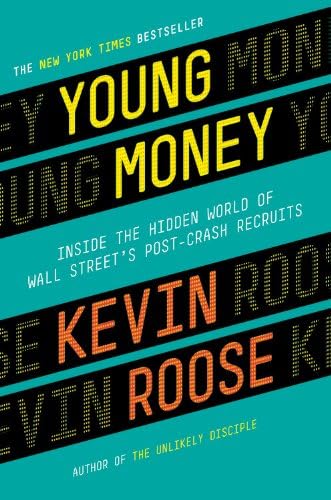

Young Money: Inside the Hidden World of Wall Street's Post-Crash Recruits Hardcover – February 18, 2014
Product ID: 1545601
Buy anything from 5,000+ international stores. One checkout price. No surprise fees. Join 2M+ shoppers on Desertcart.
Desertcart purchases this item on your behalf and handles shipping, customs, and support to Vietnam.
Full description not available
P**C
Well written from a skewed perspective; but re-visiting familiar ground
Young Money is erratic , with some strengths in describing the mass hiring of young analysts by large investment banking firms and their experiences during their two to three year stints. The book has noteworthy flaws largely stemming from the author's disdain for finance as an occupation and obvious animus towards "Wall Street" as an amorphous entity. Roose's project suffers from his interactions falling through the prism of that hostility. At times he is able to suppress his biases enough to come up with some interesting insights on the people, the institutions, their work and how they are , or might be , drawn into , or affected by their experiences. The book falls squarely into the genre of " Youthful talented idealist goes into finance at a top tier institution in search of fame and fortune , is disillusioned / seduced and abandoned and suitably chastened pursues more meaningful pursuits". I am sure people were writing novels on this theme during the Gilded Age ; but the first , and one of the best, Selling Money by S.C. Gwynne , came out in 1986 , and the best known Liar's Poker was published in 1989. Every so often , usually after busts , they appear : Riding the Bull, Monkey Business, Why I left Goldman Sachs and now Young Money. There isn't much new or startling . The book does a reasonable job of minimizing salacious detail, which some of the others have used to spice up subject matter usually of limited interest to a general audience. Roose, whose cover jacket photo gives him an unfortunate resemblance to Pajama Boy dressed up for a job interview, has covered finance for the New York Times and New York Magazine, and falls into an interesting and familiar persona , the Ivy League graduate (Brown) with creative ambitions , who with more than a touch of envy ( Roose's studio apartment contrasted with bulge bracket pay) covers an industry he dislikes full of people he loathes. Roose keeps harping on "power" , which almost no one in the financial community has in any particularly meaningful sense and wealth, which sizable numbers do attain. Highly competitive areas with great rewards for a number of winners seem to generate a lot of unpleasant, and even abusive behavior. Colleges and pro teams chew up athletes and coaching staff. The movie business occasionally produces similar memoirs. Fashion is reputedly brutal and was memorably depicted in The Devil Wears Prada. Journalism and writing seem full of embittered types , feuding with or lording over each other with apparently remarkable rates of dysfunction and substance abuse. And let's not even start on music and entertainment, which have now been the staples of tabloid fodder and tell-all memoirs for 80 years. If you are interested in a certain type of junior investment banking experience in a certain time and place , Young Money is an interesting , uneven pastiche. The mass hiring of undergraduates for their spread sheet and pitch book construction skills looks to be waning. The mass grunt work is becoming increasingly easy to farm out to well-trained spread sheet jockeys in Asia , with the added advantage that the time differences facilitate overnight turnaround. This leaves the firms with an easier hand , hiring graduates who are genuinely interested in corporate finance and securities analysis , which can avoid some of the acute alienation problems firms can have in winnowing bright graduates who are often insecure, may have inflated views of themselves and/or who are conflicted by "progressive" values Roose finds especially attractive . So the book is OK, especially if you don't like investment bankers and investment banks . It reads well. Wall Street junkies may find a few new nuggets . It will be hyped by the "progressive" media because of its perspective ; but objectively, it is flawed.
M**E
Easy and interesting read
Having worked for a summer as a backroom intern some years ago at one of the big Wall St. firms, I was interested to see how this book would handle the front end analysts who some often felt disconnected from the vast majority of people at major financial institutions. I was a bit older than the average analyst profiled here and was not directly involved in the client pitches and the insane hours, but it still rings true that there was a subset of young analysts who seemed to only be there because they hadn't thought to try anything else before applying. The money was obviously enticing, but as was noted throughout the book what drew many of the young people was the effortless means by which you can wind up an analyst if you attend an elite school; drop a resume off, go to a couple of informational meetings, and you'll have a couple of interviews lined up in a week. And the author didn't shy away from the reality that many of these kids simply didn't have a passion for the field as much as they were driven and not prone to admit defeat or distaste, creating a feedback loop that led some to morph into "banker types" and others to flee.My only gripe was more with the framing of "tech jobs" as the great escape, of relaxed working environments and untapped potential. As a software developer, I can attest that the "laid back" work environment is a bit of a myth; you still have pressures and responsibilities, only you can wear jeans and listen to music while you deal with them. And having worked at a number of start-ups as well as large institutions, I often found these young business types to be far more impressed with their own intellect than the realities of the business they were in. You'd hear their pitch about some amazing idea, and then you'd ask if they had considered how to implement it and they mumbled something about knowing "a guy" who used to work at Google who could totally do it with them. It became almost comical to hear them talk about the scope of a project they didn't even have a model of, let alone a prototype. This is a bit of a rant, but reading a couple of the subjects talk about starting their own companies and "making a difference" drove me crazy because, more times than not, they failed to grasp that any industry is demanding, and just because you worked at Goldman Sachs and read Wired doesn't mean you have one iota of insights on how to handle DB sharding as your user base expands or how to effectively log all user interactions effectively and with room to grow organically.Overall, a good book and a very easy read, but we've heard some of these stories before and, while still compelling, can feel a bit dated.
A**A
Easy read but lacks critical thinking
Would be five stars as this book is written very well - quick easy insightful read.Minus two stars because the conclusions and perspectives are completely one sided- what a shame.Essentially the author's views were tainted by those youngsters who failed to succeed on Wall Street and therefore backward rationalises their failures post hoc.It entirely suited the author (who, remember, chose a career as a journalist!) to accept his subjects views at face value and therefore confirm his pre-formed conclusions instead of considering the alternative perspective i.e. despite these candidates being of the highest intellectual calibre, the majority lacked the commerciality, cool headedness, self awareness, sense of humour and strength of character required to succeed at a top investment bank.
L**L
First half is good, but second half becomes cynical
I enjoyed the first half of the book; it was interesting following the lives of young analysts as they begin their journey on Wall Street.However, the second half of the book becomes very cynical and negative. The author's personal dislike of Wall Street comes across very strongly, and he makes disparaging comments about the people who choose to progress their careers in the world of finance.
M**N
Utterly brilliant
I read this book in 2 days as I was so completely enthralled by it. As a student about to choose a career this book is really powerful in not only detailing experiences of those on Wall Street but going into more depth about the kinds of moral choices and questions that come up.If you've even so much as thought about going into IB, buy this book! It is utterly brilliant and even if it doesn't change your views it certainly is a good read.
D**R
Young money review by a parent
Essential reading when your children are bright and asking for advice about their career. Reminds me of life as a junior doctor and the murderous routine with the promise of a better life but of course morally much more palatable.
A**R
Three Stars
Interesting, but would have benefitted from tighter editing.
Trustpilot
1 day ago
2 weeks ago