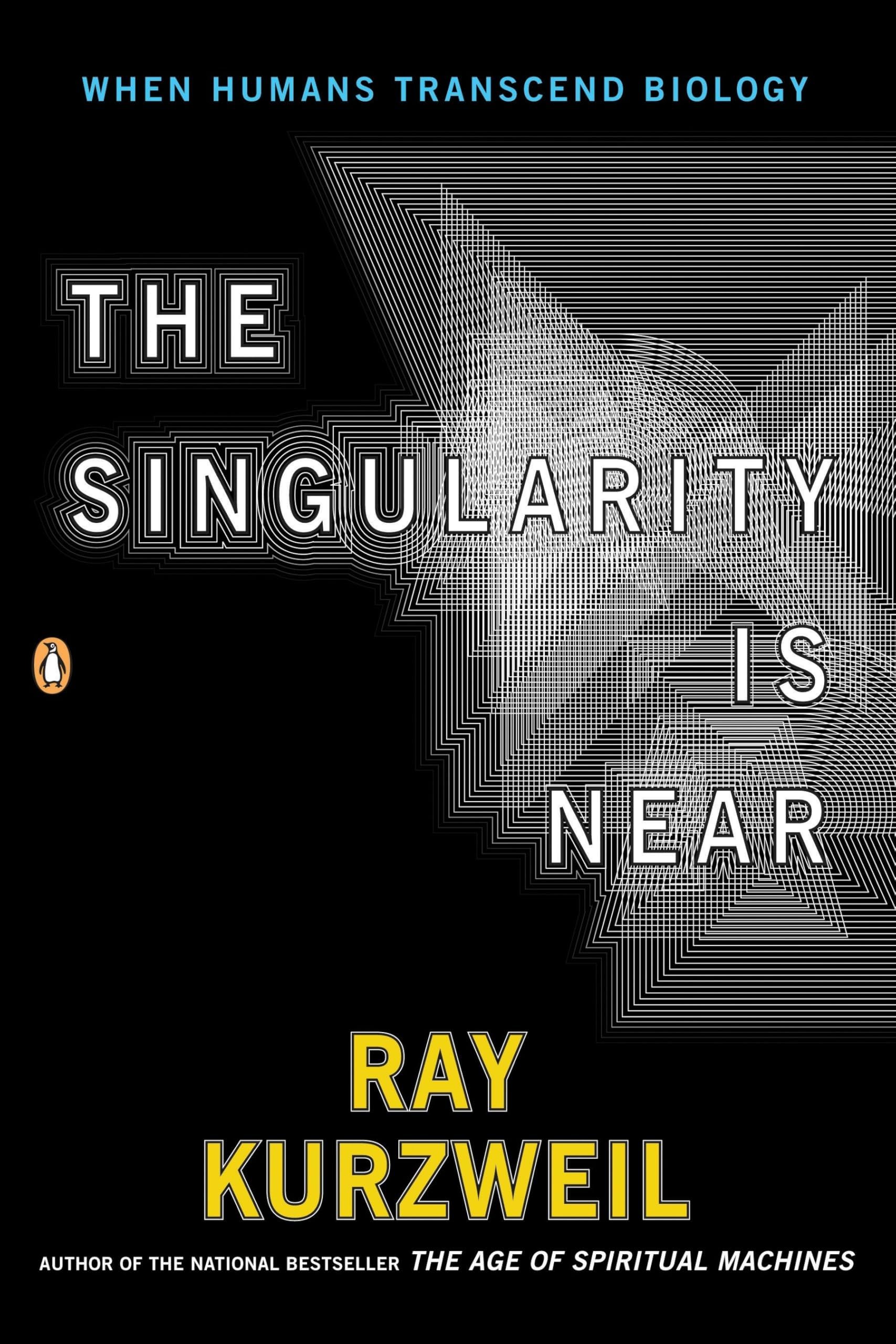
The Singularity Is Near: When Humans Transcend Biology
Product ID: 1525473
Buy anything from 5,000+ international stores. One checkout price. No surprise fees. Join 2M+ shoppers on Desertcart.
Desertcart purchases this item on your behalf and handles shipping, customs, and support to Vietnam.
The Singularity Is Near: When Humans Transcend Biology [Kurzweil, Ray] on desertcart.com. *FREE* shipping on qualifying offers. The Singularity Is Near: When Humans Transcend Biology Review: The Willful and Deliberate Extinction of Mankind - This review is for the Kindle version and Audible This book could be the basis for a taut psychological thriller or a science fiction horror story. It describes, in quite explicit detail, the willful and deliberate extinction of mankind. Let me say right here in the beginning that the author does not consider what he describes as the extinction of mankind because he believes that everything that makes us human resides in our brain and that will inevitably be understood, mapped and duplicated in an AI neural network, consciousness included. Therefore he considers the resulting Superintelligent AI, albeit non-biological, as completely human and therefore mankind simply transformed from biological to non-biological. He even uses the theory of evolution to describe the transformation of mankind from biological to biotechnical and finally to completely non-biological. I disagree with him that such a change in mankind has anything to do with evolution because evolution is considered to be a process inherently void of any external or internal construction, direction, or influenced by an intelligent agent. His stretch of the term evolution inserts into the normal process of evolution the development and final transformation of mankind from biological to non-biological, which is constructed, directed, and influenced by an external intelligent agent, man. The author seems quite comfortable with the process he describes in his book to the point that he has drastically modified his diet to try and ensure that he is alive when the early miraculous stage arrives so he may be technologically modified that he might live much longer than normal, and be cured of any biological deficiencies e.g., diabetes. He meticulously details how this process began, because it already has, but also how it will be supported and progressed and accepted by industry, the sciences, philosophies, and the majority of mankind, which is probably why the book is more than 500 pages or over 20 hours of narration. He has thought this out very extensively to the point of not just presenting his ideas but also addressing the critics of either part of his plan or the entire plan. Furthermore, he has not neglected to study and also detail the many societal institutions that are necessary to move this plan along. He notes that they already have thrown their support and money towards the current narrow forms of AI that will lead to the next acceptable stage and so on until it becomes too late to stop or take control of the process. There is an irony that pops up very late in the book of which I cannot tell if the author himself is fully aware. For the large majority of the book it is implied that incredible technological advances in the very near future will allow mankind to end many biological problems and diseases that will lead to an almost utopian existence. I want to impress upon you that I am heavily stressing the word "almost" in the previous sentence. The author never even comes close to explicitly expressing a utopian concept. However, and this is where the irony enters, he does stress the phenomenal benefit that this incredible soft AI will have on mankind in all areas philosophical, intellectual, medical, etc. areas of human existence. With the elimination of disease, via Nano-bot technology, various levels of biotechnical humans i.e., trans-humans or "enhanced humans," will continue the march towards a Superintelligent AI, that is, an AI that has not only equaled the intelligence of man but far surpasses the intelligence of man. This Superintelligent AI will be the point of no return, the same as crossing the event horizon of a black hole, which is why the word "singularity" is in the title. It will be fully autonomous able to replicate itself and to improve itself. This leads to the extinction of mankind in that only fully conscious technological AI far smarter than a man can ever be will be in existence. However, are you ready for the irony, what his idea ultimately leads to is first the huge benefits to mankind in all areas, then to enhanced humans, and finally to completely technological Super intelligent machines, is a completely new set of problems and diseases, albeit technological diseases, also come into existence. These technological problems/diseases will also be autonomous and self-replicating which will force the new "machinekind" to create technology to fight these threats e.g., Nano-bot autoimmune systems, along with many other technological "medical" and "environmental" protection systems. All the author's idea accomplishes is removing all threats to biological humanity through extinction and replacing it with a completely technological entity with very similar, although completely technological, problems and technological diseases akin to that which it has replaced. This book, regardless the very detailed explanations, held my interest all the way to the end. It never became stale, static, repetitious, or dull and never even approached boring. The previous statement is true even though I do not support his so-called "transformation" of man from biological to a Super intelligent non-biological entity. Once again the narration was superb and no doubt added to hold my interest in this lengthy material. Review: Is this Reality? And is it good for us? - Among technological optimists in the world, the "singularitarians", led by Ray Kurzweil, are perhaps the most extravagant, extrapolating from the growth in information technologies of the past century. This book provides a good review of the ideas behind this optimism, and its likely consequences over the next century or so. It also raises and partly addresses a few central questions: do these extrapolations faithfully represent reality? Do they really extend beyond information technology to our control of the material world around us? And how can Kurzweil be so sure the predicted doubly exponential progress will be good for us? Kurzweil's fundamental basis for optimism is his "Law of Accelerating Returns" for information technology, which claims that the components of our information systems naturally grow in capability at an exponential rate, and that as each reaches limits, it is superceded by new technology with ever-faster exponential growth rates. Not only is the growth exponential, but the rate of growth is itself growing exponentially. Kurzweil even justifies this "law" with a mathematical appendix that suggests the exponent should grow roughly at the same rate as world GDP; he does not mention that the actual rate he finds is a little under half that (1.2% vs 2.8% annually for the 20th century). As I argue elsewhere, if one discounts the putative computation rates per thousand dollars of the early years of the twentieth century (before 1920), the numbers seem to just as easily fit a non-growing exponential rate (0% instead of 1.2%), so it seems hard to saw Kurzweil's "law" is at all proven. The next decade or so will be the real test, as integrated circuits are replaced by whatever the next technological leap coming along is. The idea that this acceleration applies beyond information technologies has also been criticized by people like physicist Jonathan Huebner, who argues that we are, far from entering an era of exponentially greater growth in capabilities, actually approaching a new dark age. Huebner claims the rate of technological innovation per person per year reached a peak a century ago, and the decline now, despite high R&D and education funding, is because developing new technology beyond what's already been done has become more and more difficult. Kurzweil has his own list of innovations to refute this, but he does not manage to make a convincing case that his "law of accelerating returns" is in any way a necessary consequence of the way the world works. In comparing linear and exponential behavior in the first chapter, Kurzweil notes that "people tend to overestimate what can be achieved in the short term (because we leave out necessary details)". There are many details Kurzweil has necessarily skipped over, but no indication that he thinks he might himself be overestimating. So we may have accelerating returns, continued exponential growth, or much slower growth or even decline, depending on your view of the world. At least with either of the growing curves, Kurzweil's other projections still apply, but under plain exponential growth would be simply delayed a bit. Kurzweil estimates a "human-level" computer would require between 10^16 and 10^19 cycles per second. With accelerating returns, that computer would be under $1000 at some point between 2020 and 2030. If the growth continues only on a simple exponential, we have to wait until after 2050 for human-scale personal computing. Kurzweil fully intends to be alive when his brain can be scanned and uploaded to a simulation of immortality, a motive that perhaps overly encourages him to argue for the earlier date. Kurzweil sets 2045 as the date for the Singularity itself, the point when all this computer power really transforms our capabilities. If the plain exponential law is true instead, the date for comparable computational capabilities is pushed back to the first decade of the 22nd century. Continued doubly exponential growth in computational power would reach the ultimate computational capacity of our solar system, between 10^70 and 10^80 calculations per second, before 2120, within the natural life-span of some alive today. Growth along the ordinary exponential would not reach such astronomical scales until the 25th century. Depending on whether such vastly enhanced intelligence can find a way around the speed-of-light restriction or not, Kurzweil sees a universe filled with computation possible less than 200 years from today. This vast growth in computational power is the central element on which much of the remaining speculation of the book rests; it's an awe-inspiring story, and even if slower growth pushes back some of the these dates a century or three, it is still worth understanding where augmenting human intelligence with machines may take us. Kurzweil's arguments for the development of real artificial intelligence in the relatively near future, given computational capabilities, seem sound enough. His commentary on the issue of subjectivity (if I get uploaded, which one is "me"?) is one of the most lucid I have ever seen. But he wastes far too much time on Searle's Chinese Room argument against AI; just a simple statement that the scale of complexity invalidates the comparison should have been enough. Kurzweil identifes three related revolutions underway: in genetics, nanotechnology, and robotics (strong AI). These enable the information technology revolution to be extended to the living, material and mental worlds; many wonders are to be expected. In particular, his outline for "brain uploading" depends on nanomachines capable of penetrating the brain and recording patterns there, a rather invasive (but believable) approach. At times, Kurzweil's book veers into millenial apocalypsism, at one point describing "Singularitarianism" as an almost religious belief in the ability to be uploaded and live forever, and listing several articles of faith. Kurzweil acknowledges the religious element but asserts that this is different: traditional religion is primarily a rationalization of death, while the Singularity makes death a thing of the past. How will existing religions respond to such notions? One very serious question is the possibility of threats from these new technologies - every individual will have vast power, beyond anything even nations have today. There is the "gray goo" threat from nanotechnology, as Bill Joy has articulated. Kurzweil acknowledges, yes there are dangers, in fact he agrees with Joy in many respects. Unfortunately we will have to keep several steps ahead, with "immune systems" deployed against the threats, before they wreak havoc. The most worrisome threat is from Strong AI itself - once they supercede human intelligence, what will prevent them from overcoming any bounds we may have set against harming us? Kurzweil's main response to this threat is that "they" will be "us", uploaded and greatly enhanced, so it doesn't much matter what happens to the old biological world. This is, to say the least, a little unsettling... In addition to the copious graphical illustrations, Kurzweil adds to the text some imaginary conversations with historical, present, and future persons, including Eric Drexler, Bill Gates, Darwin, and Freud. He seems to have obtained permission from the living for this; sometimes these conversations enlighten, but they seem oddly contrived. Kurzweil does have a fascinating view of our potential future. Whether near or far, this book is a useful guide to how the world will change at that point where humans transcend biology.


| Best Sellers Rank | #26,629 in Books ( See Top 100 in Books ) #5 in Biotechnology (Books) #44 in Artificial Intelligence & Semantics #63 in History & Philosophy of Science (Books) |
| Customer Reviews | 4.4 4.4 out of 5 stars (2,084) |
| Dimensions | 1.4 x 6 x 9.1 inches |
| ISBN-10 | 0143037889 |
| ISBN-13 | 978-0143037880 |
| Item Weight | 1.38 pounds |
| Language | English |
| Part of series | The Singularity is Near |
| Print length | 672 pages |
| Publication date | September 26, 2006 |
| Publisher | Penguin Books |
D**E
The Willful and Deliberate Extinction of Mankind
This review is for the Kindle version and Audible This book could be the basis for a taut psychological thriller or a science fiction horror story. It describes, in quite explicit detail, the willful and deliberate extinction of mankind. Let me say right here in the beginning that the author does not consider what he describes as the extinction of mankind because he believes that everything that makes us human resides in our brain and that will inevitably be understood, mapped and duplicated in an AI neural network, consciousness included. Therefore he considers the resulting Superintelligent AI, albeit non-biological, as completely human and therefore mankind simply transformed from biological to non-biological. He even uses the theory of evolution to describe the transformation of mankind from biological to biotechnical and finally to completely non-biological. I disagree with him that such a change in mankind has anything to do with evolution because evolution is considered to be a process inherently void of any external or internal construction, direction, or influenced by an intelligent agent. His stretch of the term evolution inserts into the normal process of evolution the development and final transformation of mankind from biological to non-biological, which is constructed, directed, and influenced by an external intelligent agent, man. The author seems quite comfortable with the process he describes in his book to the point that he has drastically modified his diet to try and ensure that he is alive when the early miraculous stage arrives so he may be technologically modified that he might live much longer than normal, and be cured of any biological deficiencies e.g., diabetes. He meticulously details how this process began, because it already has, but also how it will be supported and progressed and accepted by industry, the sciences, philosophies, and the majority of mankind, which is probably why the book is more than 500 pages or over 20 hours of narration. He has thought this out very extensively to the point of not just presenting his ideas but also addressing the critics of either part of his plan or the entire plan. Furthermore, he has not neglected to study and also detail the many societal institutions that are necessary to move this plan along. He notes that they already have thrown their support and money towards the current narrow forms of AI that will lead to the next acceptable stage and so on until it becomes too late to stop or take control of the process. There is an irony that pops up very late in the book of which I cannot tell if the author himself is fully aware. For the large majority of the book it is implied that incredible technological advances in the very near future will allow mankind to end many biological problems and diseases that will lead to an almost utopian existence. I want to impress upon you that I am heavily stressing the word "almost" in the previous sentence. The author never even comes close to explicitly expressing a utopian concept. However, and this is where the irony enters, he does stress the phenomenal benefit that this incredible soft AI will have on mankind in all areas philosophical, intellectual, medical, etc. areas of human existence. With the elimination of disease, via Nano-bot technology, various levels of biotechnical humans i.e., trans-humans or "enhanced humans," will continue the march towards a Superintelligent AI, that is, an AI that has not only equaled the intelligence of man but far surpasses the intelligence of man. This Superintelligent AI will be the point of no return, the same as crossing the event horizon of a black hole, which is why the word "singularity" is in the title. It will be fully autonomous able to replicate itself and to improve itself. This leads to the extinction of mankind in that only fully conscious technological AI far smarter than a man can ever be will be in existence. However, are you ready for the irony, what his idea ultimately leads to is first the huge benefits to mankind in all areas, then to enhanced humans, and finally to completely technological Super intelligent machines, is a completely new set of problems and diseases, albeit technological diseases, also come into existence. These technological problems/diseases will also be autonomous and self-replicating which will force the new "machinekind" to create technology to fight these threats e.g., Nano-bot autoimmune systems, along with many other technological "medical" and "environmental" protection systems. All the author's idea accomplishes is removing all threats to biological humanity through extinction and replacing it with a completely technological entity with very similar, although completely technological, problems and technological diseases akin to that which it has replaced. This book, regardless the very detailed explanations, held my interest all the way to the end. It never became stale, static, repetitious, or dull and never even approached boring. The previous statement is true even though I do not support his so-called "transformation" of man from biological to a Super intelligent non-biological entity. Once again the narration was superb and no doubt added to hold my interest in this lengthy material.
A**H
Is this Reality? And is it good for us?
Among technological optimists in the world, the "singularitarians", led by Ray Kurzweil, are perhaps the most extravagant, extrapolating from the growth in information technologies of the past century. This book provides a good review of the ideas behind this optimism, and its likely consequences over the next century or so. It also raises and partly addresses a few central questions: do these extrapolations faithfully represent reality? Do they really extend beyond information technology to our control of the material world around us? And how can Kurzweil be so sure the predicted doubly exponential progress will be good for us? Kurzweil's fundamental basis for optimism is his "Law of Accelerating Returns" for information technology, which claims that the components of our information systems naturally grow in capability at an exponential rate, and that as each reaches limits, it is superceded by new technology with ever-faster exponential growth rates. Not only is the growth exponential, but the rate of growth is itself growing exponentially. Kurzweil even justifies this "law" with a mathematical appendix that suggests the exponent should grow roughly at the same rate as world GDP; he does not mention that the actual rate he finds is a little under half that (1.2% vs 2.8% annually for the 20th century). As I argue elsewhere, if one discounts the putative computation rates per thousand dollars of the early years of the twentieth century (before 1920), the numbers seem to just as easily fit a non-growing exponential rate (0% instead of 1.2%), so it seems hard to saw Kurzweil's "law" is at all proven. The next decade or so will be the real test, as integrated circuits are replaced by whatever the next technological leap coming along is. The idea that this acceleration applies beyond information technologies has also been criticized by people like physicist Jonathan Huebner, who argues that we are, far from entering an era of exponentially greater growth in capabilities, actually approaching a new dark age. Huebner claims the rate of technological innovation per person per year reached a peak a century ago, and the decline now, despite high R&D and education funding, is because developing new technology beyond what's already been done has become more and more difficult. Kurzweil has his own list of innovations to refute this, but he does not manage to make a convincing case that his "law of accelerating returns" is in any way a necessary consequence of the way the world works. In comparing linear and exponential behavior in the first chapter, Kurzweil notes that "people tend to overestimate what can be achieved in the short term (because we leave out necessary details)". There are many details Kurzweil has necessarily skipped over, but no indication that he thinks he might himself be overestimating. So we may have accelerating returns, continued exponential growth, or much slower growth or even decline, depending on your view of the world. At least with either of the growing curves, Kurzweil's other projections still apply, but under plain exponential growth would be simply delayed a bit. Kurzweil estimates a "human-level" computer would require between 10^16 and 10^19 cycles per second. With accelerating returns, that computer would be under $1000 at some point between 2020 and 2030. If the growth continues only on a simple exponential, we have to wait until after 2050 for human-scale personal computing. Kurzweil fully intends to be alive when his brain can be scanned and uploaded to a simulation of immortality, a motive that perhaps overly encourages him to argue for the earlier date. Kurzweil sets 2045 as the date for the Singularity itself, the point when all this computer power really transforms our capabilities. If the plain exponential law is true instead, the date for comparable computational capabilities is pushed back to the first decade of the 22nd century. Continued doubly exponential growth in computational power would reach the ultimate computational capacity of our solar system, between 10^70 and 10^80 calculations per second, before 2120, within the natural life-span of some alive today. Growth along the ordinary exponential would not reach such astronomical scales until the 25th century. Depending on whether such vastly enhanced intelligence can find a way around the speed-of-light restriction or not, Kurzweil sees a universe filled with computation possible less than 200 years from today. This vast growth in computational power is the central element on which much of the remaining speculation of the book rests; it's an awe-inspiring story, and even if slower growth pushes back some of the these dates a century or three, it is still worth understanding where augmenting human intelligence with machines may take us. Kurzweil's arguments for the development of real artificial intelligence in the relatively near future, given computational capabilities, seem sound enough. His commentary on the issue of subjectivity (if I get uploaded, which one is "me"?) is one of the most lucid I have ever seen. But he wastes far too much time on Searle's Chinese Room argument against AI; just a simple statement that the scale of complexity invalidates the comparison should have been enough. Kurzweil identifes three related revolutions underway: in genetics, nanotechnology, and robotics (strong AI). These enable the information technology revolution to be extended to the living, material and mental worlds; many wonders are to be expected. In particular, his outline for "brain uploading" depends on nanomachines capable of penetrating the brain and recording patterns there, a rather invasive (but believable) approach. At times, Kurzweil's book veers into millenial apocalypsism, at one point describing "Singularitarianism" as an almost religious belief in the ability to be uploaded and live forever, and listing several articles of faith. Kurzweil acknowledges the religious element but asserts that this is different: traditional religion is primarily a rationalization of death, while the Singularity makes death a thing of the past. How will existing religions respond to such notions? One very serious question is the possibility of threats from these new technologies - every individual will have vast power, beyond anything even nations have today. There is the "gray goo" threat from nanotechnology, as Bill Joy has articulated. Kurzweil acknowledges, yes there are dangers, in fact he agrees with Joy in many respects. Unfortunately we will have to keep several steps ahead, with "immune systems" deployed against the threats, before they wreak havoc. The most worrisome threat is from Strong AI itself - once they supercede human intelligence, what will prevent them from overcoming any bounds we may have set against harming us? Kurzweil's main response to this threat is that "they" will be "us", uploaded and greatly enhanced, so it doesn't much matter what happens to the old biological world. This is, to say the least, a little unsettling... In addition to the copious graphical illustrations, Kurzweil adds to the text some imaginary conversations with historical, present, and future persons, including Eric Drexler, Bill Gates, Darwin, and Freud. He seems to have obtained permission from the living for this; sometimes these conversations enlighten, but they seem oddly contrived. Kurzweil does have a fascinating view of our potential future. Whether near or far, this book is a useful guide to how the world will change at that point where humans transcend biology.
E**O
Muy interesante, el autor conoce de muchos temas.
P**R
Work of art. Except for the sections on Neuroscience and the chapters detailing the present day innovations of 2005. This book is a classic and will be revered in the coming decades.
P**Y
Fabulous
F**O
Ray Kurzweil magari non è sempre moderato e cauto come altri pensatori, ma traccia una prospettiva a tinte forti, di grande ispirazione
M**E
Produto de acordo com as especificações.
Trustpilot
2 weeks ago
1 month ago