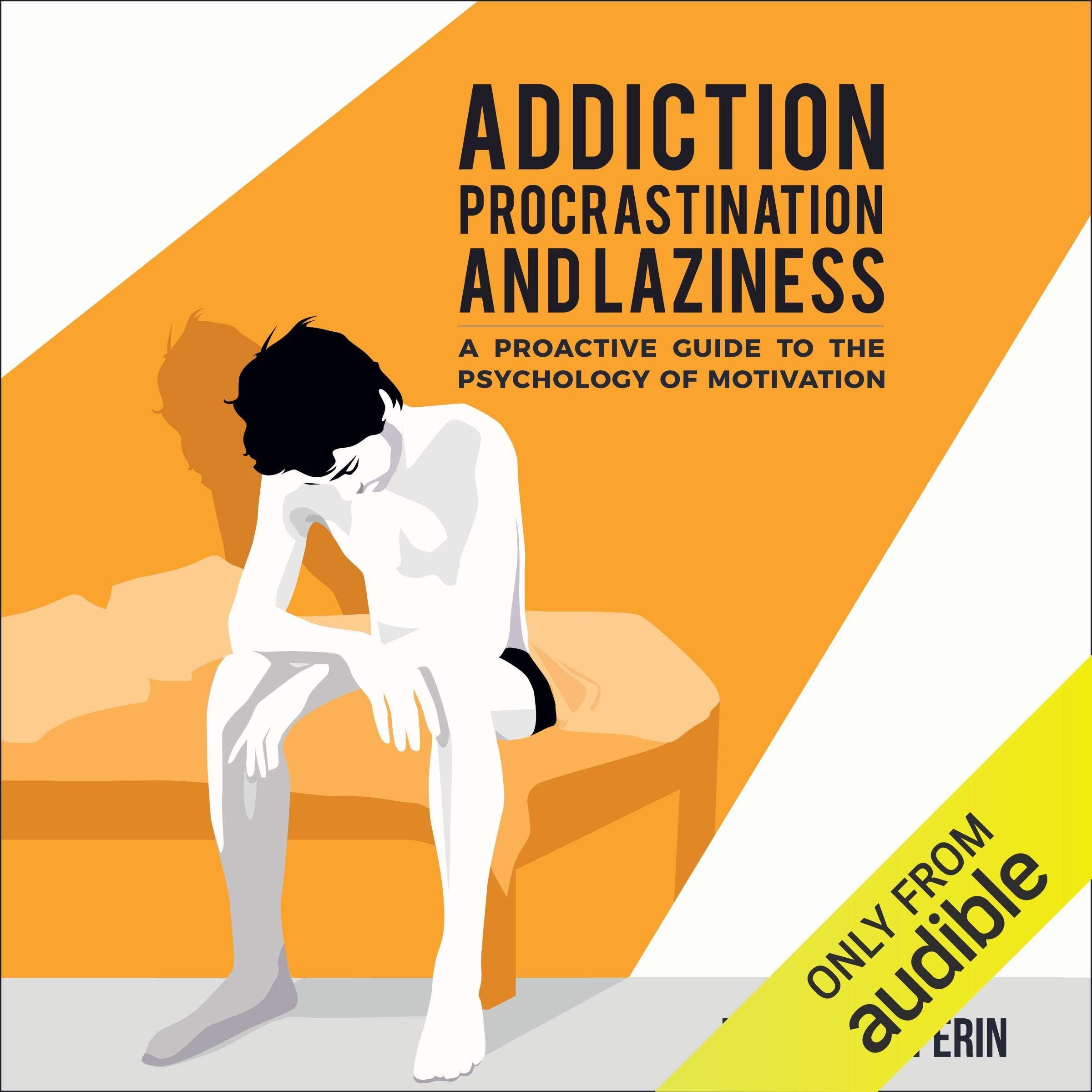
Addiction, Procrastination, and Laziness: A Proactive Guide to the Psychology of Motivation
Product ID: 146888173
Buy anything from 5,000+ international stores. One checkout price. No surprise fees. Join 2M+ shoppers on Desertcart.
Desertcart purchases this item on your behalf and handles shipping, customs, and support to Vietnam.
desertcart.com: Addiction, Procrastination, and Laziness: A Proactive Guide to the Psychology of Motivation (Audible Audio Edition): Roman Gelperin, Paul Brion, Roman Gelperin: Books Review: Great for Understanding the First Principles of Motivation - Excellent book and concepts. This is wayyy better than the many books I've read on habit-forming and such. It is also concise with no fluff or unnecessary language. I think a better job could be done at organizing the points made in the book. For example, as I was writing my notes in a separate doc I realized that the methods for consequence motivation are actually quite early on and the methods for lowering activation energy are scattered throughout the book. Additionally, more detail into how to leverage discomfort or pleasure in certain situations would be helpful. For example, when I brush my teeth and floss, a previously unpleasurable task, I like to pause and really become more aware of how great my breath and teeth feel. That way I have a pleasurable moment to think about the next time I need to accomplish that task. You don't delve too much into turning pleasurable tasks into less pleasurable ones and unpleasurable tasks into more pleasurable ones but I think that is the hidden strength in this book. My favorite example he used was the leveraging any small discomforts while lying in bed to motivate you out of it. Very powerful. More examples like that would be great!! Amazing job on this book! Review: Still Working On It, But This Helps - I liked the book, and although I am not entirely sure yet that it will work for me, it gave me some insight as to what goes on with addiction, procrastination and laziness. I was addicted to cigarettes for 13 years and gave them up 40 years ago. On the third try, I was finally successful using a similar program to this with a slow reduction of nicotine. Going 'cold turkey' has never worked for me, but slow change has. Today, I battle with overweight and lack of motivation from too many years of diet failure. I have some other bad habits, like staying up late, and knowing that it is bad just doesn't help me stop doing it. I have a lot of interests in life and I feel the pull of them distracting me from my goals all of the time. What this book did for me was that it helped me to see how the pleasurable things I enjoy were pulling me away from those goals, and the unpleasant things required for accomplishing my goals were so unpleasant in my mind that they were keeping me from doing them. So, I made a list of my goals and a list of the 14 psychological weapons and strategies in this book, and I applied each one to the 4 goals I listed. While I'm finding that I am making progress on the 1st goal, the last 3 haven't gone so well yet, and that being because my goals and life, in general, are very time consuming. I thought I would divide my time up each day into 4 time slots for the 4 goals, but it never seems to work out. However, being able to look over each of the 14 strategies before I start working on one of the goals seems to be helpful. I thought that maybe I'll have to work on only one goal until I've mastered it or formed a new habit. When I quit smoking, I was entirely focused on that one problem, how much I hated it, and had to get rid of it. The problem with diet and exercise is that it takes up even more of my time to focus on and is complicated by arthritis, now that I'm older. I also run out of gas sooner than I did when I was young. Focusing on just one thing makes everything else in my life (like my housework) fall apart, so the problem now becomes a matter of balance. Now, I've given myself a 5th goal, that of having balance in my life. Yeah, I really needed this book. I just hope I have enough years left to make it work.
A**N
Great for Understanding the First Principles of Motivation
Excellent book and concepts. This is wayyy better than the many books I've read on habit-forming and such. It is also concise with no fluff or unnecessary language. I think a better job could be done at organizing the points made in the book. For example, as I was writing my notes in a separate doc I realized that the methods for consequence motivation are actually quite early on and the methods for lowering activation energy are scattered throughout the book. Additionally, more detail into how to leverage discomfort or pleasure in certain situations would be helpful. For example, when I brush my teeth and floss, a previously unpleasurable task, I like to pause and really become more aware of how great my breath and teeth feel. That way I have a pleasurable moment to think about the next time I need to accomplish that task. You don't delve too much into turning pleasurable tasks into less pleasurable ones and unpleasurable tasks into more pleasurable ones but I think that is the hidden strength in this book. My favorite example he used was the leveraging any small discomforts while lying in bed to motivate you out of it. Very powerful. More examples like that would be great!! Amazing job on this book!
L**.
Still Working On It, But This Helps
I liked the book, and although I am not entirely sure yet that it will work for me, it gave me some insight as to what goes on with addiction, procrastination and laziness. I was addicted to cigarettes for 13 years and gave them up 40 years ago. On the third try, I was finally successful using a similar program to this with a slow reduction of nicotine. Going 'cold turkey' has never worked for me, but slow change has. Today, I battle with overweight and lack of motivation from too many years of diet failure. I have some other bad habits, like staying up late, and knowing that it is bad just doesn't help me stop doing it. I have a lot of interests in life and I feel the pull of them distracting me from my goals all of the time. What this book did for me was that it helped me to see how the pleasurable things I enjoy were pulling me away from those goals, and the unpleasant things required for accomplishing my goals were so unpleasant in my mind that they were keeping me from doing them. So, I made a list of my goals and a list of the 14 psychological weapons and strategies in this book, and I applied each one to the 4 goals I listed. While I'm finding that I am making progress on the 1st goal, the last 3 haven't gone so well yet, and that being because my goals and life, in general, are very time consuming. I thought I would divide my time up each day into 4 time slots for the 4 goals, but it never seems to work out. However, being able to look over each of the 14 strategies before I start working on one of the goals seems to be helpful. I thought that maybe I'll have to work on only one goal until I've mastered it or formed a new habit. When I quit smoking, I was entirely focused on that one problem, how much I hated it, and had to get rid of it. The problem with diet and exercise is that it takes up even more of my time to focus on and is complicated by arthritis, now that I'm older. I also run out of gas sooner than I did when I was young. Focusing on just one thing makes everything else in my life (like my housework) fall apart, so the problem now becomes a matter of balance. Now, I've given myself a 5th goal, that of having balance in my life. Yeah, I really needed this book. I just hope I have enough years left to make it work.
C**T
He is on to something here
Enjoyable read...I immediately wanted to find out more about this guy after a few pages. You can tell this guy is a thinker...and seems to know by experience what it feels like to own and live with these human qualities of addiction, procrastination and laziness. No shaming or blaming here. I am not into gaming at all, but have close observation of some guys who are, and it gave me a kind insight the why and the draw of what their obsession with them...and explained in a way that makes the obsessee chuckle and say..."yes, that is it exactly, that's me". It is not a typical self help book...it is a sharing of experience and observation , spelled out in a step by step matter of this theory of his on why we do what we do. and once understood, change is possible if one wants it. He is smart and quick and sharp...and reduces the "why" of what we do to a couple of basic simple concepts that can easily be used as tools. The book builds this then this then this...so I suggest reading chapters a couple of times before going on to the next. He is on to a bottom line explanation so simple , makes you wonder why it is not talked about more.
A**N
Not the best... Not the worst...
If I could only read one self help book, this one would NOT be it. It's not bad per se, there are just better books. If you need a short, easy, read then maybe this book is for you. Easy read. Nothing a good Goal Setting or Self Improvement book wouldn't already tell you. Make the activity as enjoyable as possible by making it easy to start (or make if more difficult if you're trying to quit) through distractions like music, reminders like post it notes, and social pressures like telling or inviting a friend to help with a goal. In the end you can't circumvent freedom of choice, so if all the tricks and tips don't work there's nothing else to be done... I disagree that anger is alleviate by revenge, which he emphasizes multiple times. I also don't believe that most religious people are motivated our of a fear/anxiety of a vengeful god that will send them to an eternity of damnation and hell. Maybe some, but I don't believe as many as he implies. This is what drove it from 4 stars down to 3 stars for me.
M**D
Breaking down the mechanics of the actions we make.
I read the book, Addiction, Procrastination and Laziness with great interest. This is due to wanting to combat these three things in my own life. The perspective that he brings to the issues are, I believe unique among self-help books, and yet shouldn't be as the psychology behind it is old and well established. By focusing on the subject of motivation, and what ultimately motivates us to or demotivates us from a certain action is really breaking it down to the very essence..the quantum of our behavior. It's refreshing to see. The conclusions seem familiar, that is, the techniques for motivation are familiar, such as making it harder to do the things you don't want to do. It's been well-known advice for example, that if you want to give up eating sweets, it is advised to get rid of all the sweets in the house, and not to bring anymore in. Likewise, in the advice to find a friend or buddy to work on your goals with. But by framing it in the context of motivations, it seems to allow for a more insightful and fruitful analysis and in the long run, a more effective use of the tools given.
A**R
Forget the title, this book should be called "Habits and Behavior: The Simple Truth of How We Choose to Act"
The title of this book sounds super dour and likely puts many people off. The book's cover makes me want to put a gun in my mouth. Fortunately I read some reviews and looked past that as I found it to be a fascinating accounting of behavior and habit formation. I don't agree with everything the author says, and it isn't necessarily the perfectly executed book, but the reasoning is sound and enlightening. It really all comes down to what flips the binary from 0 to 1, 1 to 0! Everything we do is because our subconscious (sometimes with the assistance of our conscious) mind decides that it is the most *rewarding* choice. When we make the myopic choice the reasons are clear enough, but when we make a seemingly high-minded or selfless choice, that too is due to the presently-felt perception of those future consequences. We can't act in the past or the future, "there is only now", so this is self-evident. Yet this is not how we think that we think, and a clearer understanding can help us shape our choices.
J**K
A long slog with a too-small pay off and a manipulative twist
First, the positives. The author lays out step-by-step his understanding of the psychology of motivation, and illustrates how those keys, all centered around minimizing the displeasure of a task, or of alternative activities, or increasing the pleasure associated with an activity can be used to leverage motivation in initiating and completing necessary actions. The principles though not new, are presented well with how they could apply to five different common scenarios. Now, the negatives. The book, though small, is a slog! It is written as though it were a university thesis paper. The style is so old-fashioned and professorial, it was almost charming at first, but that charm wore off *very* quickly. There are virtually no metaphors, imagery, parables or anything to relieve the monotonous abstract declaration of mind-numbing psychological assertions. It's littered with footnotes, but the notes are usually to slightly longer assertions, never to actual research! The author doesn't even share a single personal anecdote until the final chapter where he shows how his ideas might be applied. I initially thought he must be a very old person, as very few books targeted to the general public since the 70's have been so oblivious to the need to communicate with the reader; I was shocked to see by his picture he is a young man, and likely still a student. Furthermore, neuroscience and brain chemistry are completely ignored; the pleasure principle is the theme of the book, and ADHD sufferers will not find help here unless they get other help first. (Yes, I'm one of them; yes, I am biased.) There is even a test at the end, and no, it's not helpful. Think "when did the pleasure unconscious arise in human evolution" rather than "write down three ways to use these ideas to help you accomplish a task." Finally, the author cleverly manipulated the ratings here, through a bait-and-switch. There is a link at the end of the book which opens a web app in which he asks the reader to give HIM feedback about the book. Then he suggests using the app to select that text and post that message as a review on Amazon! Many of the short positive ratings were really written FOR THE AUTHOR'S EYES, and then posted as a reviews. Yes, he understands that people are motivated to take the simplest course, but that manipulation does not make this a good book! Yes, tweaking the pleasure principle through manipulating the environment is a Swiss Army knife in the life-hacking toolkit, and it can help in many circumstances, but many other have written far better about it.
E**E
A book about addiction
An OK book.
Trustpilot
4 days ago
1 day ago