We remain fully operational. Our teams are working around the clock to ensure your deliveries continue safely.

DOWNLOAD THE APP


Copyright © 2025 Desertcart Holdings Limited
DOWNLOAD THE APP
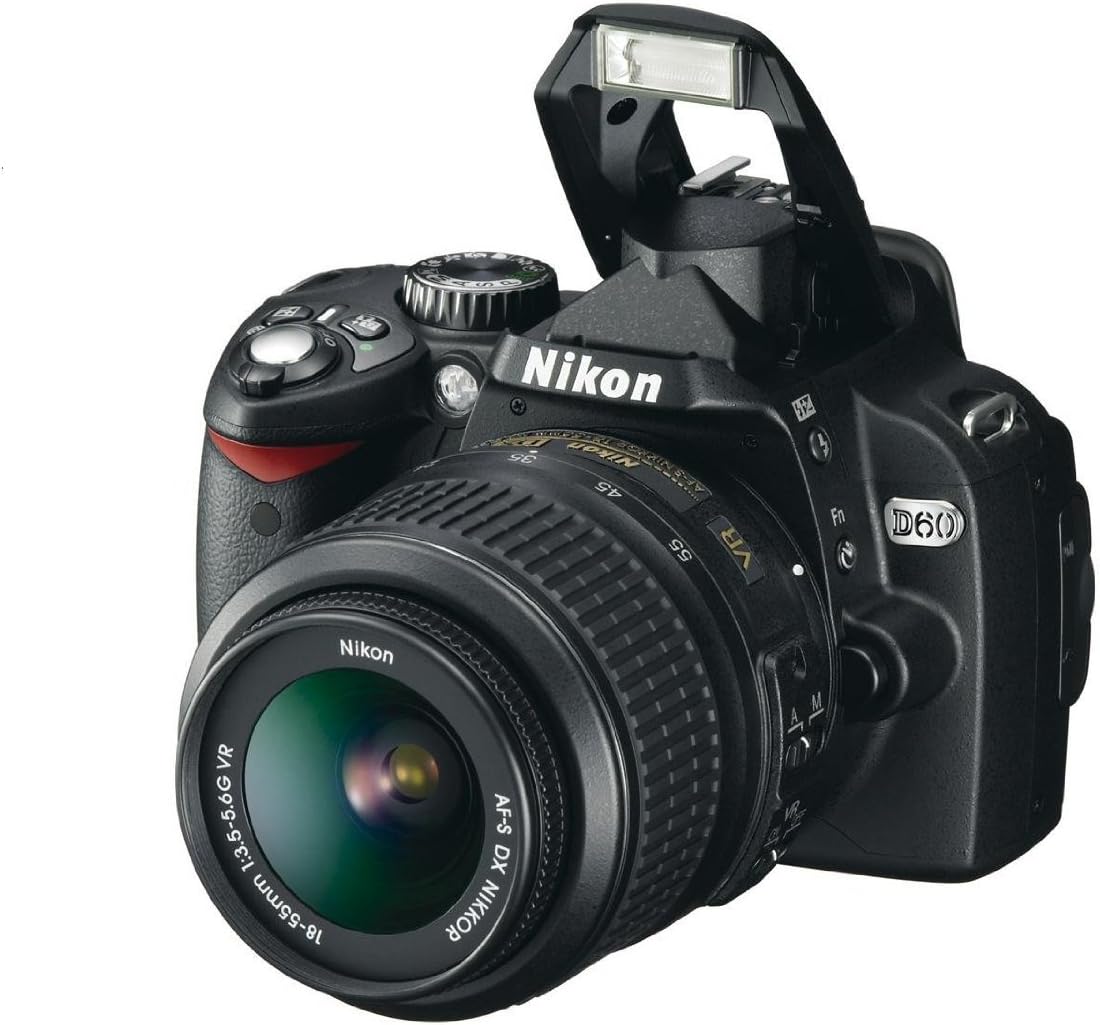


📷 Elevate your photography game—capture brilliance, speed, and clarity in one sleek package!
The Nikon D60 DSLR combines a 10.2-megapixel APS-C sensor with a fast 3 fps continuous shooting rate and an advanced Active Dust Reduction System, delivering professional-grade image quality in a compact, ergonomic body. Paired with the AF-S DX Nikkor 18-55mm f/3.5-5.6G VR lens, it offers versatile zoom and vibration reduction for sharp, steady shots. Ideal for millennials stepping up from point-and-shoots, the D60 balances creative control with intuitive operation, making it a must-have for capturing life’s moments with clarity and style.
| ASIN | B0012OGF6Q |
| Age Range Description | Adult |
| Aperture modes | F3.5–F5.6 |
| Are Batteries Included | Yes |
| Aspect Ratio | 1.60:1 |
| Auto Focus Technology | Contrast Detection |
| Autofocus | Yes |
| Autofocus Points | 3 |
| Best Sellers Rank | #84,850 in Electronics ( See Top 100 in Electronics ) #102 in DSLR Cameras |
| Bit Depth | 12 Bit |
| Brand | Nikon |
| Built-In Media | Camera Body & Lens |
| Camera Flash | Built-In |
| Camera Lens | AF-S DX Zoom-Nikkor VR (vibration reduction) lens with 3.05x zoom |
| Color | black |
| Compatible Devices | Computers, smartphones, tablets with SD/SDHC card reader or USB port |
| Compatible Flash Memory Type | SD, SDHC |
| Compatible Mountings | Nikon F |
| Connectivity Technology | USB |
| Continuous Shooting | 3 |
| Customer Reviews | 4.2 4.2 out of 5 stars (279) |
| Digital Scene Transition | zoom |
| Digital Zoom | 3.00 |
| Digital-Still | Yes |
| Display Fixture Type | Articulating |
| Display Resolution Maximum | Approximately 230000 |
| Display Type | LCD |
| Dots Per Screen | high |
| Effective Still Resolution | 10.75 MP |
| Expanded ISO Maximum | 1600 |
| Expanded ISO Minimum | 100 |
| Exposure Control | Automatic, Manual, aperture-priority, shutter-speed-priority |
| File Format | JPEG (Exif 2.21), NEF (RAW), NEF (RAW) + JPEG |
| Flash Memory Bus Interface Type | SD |
| Flash Memory Speed Class | 10 |
| Flash Memory Supported Size Maximum | 16 GB |
| Flash Memory Type | SD;SDHC |
| Flash Sync Speed | 1/200_sec |
| Focus Features | Active |
| Focus Mode | Single-Servo AF (AF-S) |
| Focus Type | Automatic with Manual |
| Form Factor | DSLR |
| Hardware Interface | AV Port |
| Has Color Screen | Yes |
| Image Capture Type | Stills |
| Image stabilization | Optical |
| Item Weight | 1.6 Pounds |
| JPEG Quality Level | Basic, Fine, Normal |
| Lens Type | zoom |
| Manufacturer | Nikon |
| Manufacturer Part Number | B0012OGF6Q |
| Maximum Aperture | 3.5 f |
| Maximum Focal Length | 55 Millimeters |
| Maximum Image Size | 10.2 MP |
| Maximum Shutter Speed | 30 seconds |
| Metering Methods | Evaluative |
| Minimum Focal Length | 18 Millimeters |
| Minimum Shutter Speed | 1 Seconds |
| Model Name | D60 |
| Model Number | B0012OGF6Q |
| Model Series | D60 |
| Movie Mode | No |
| Night vision | No |
| Optical Zoom | 3 x |
| Photo Sensor Resolution | 10.2 MP |
| Photo Sensor Size | APS-C |
| Real Angle Of View | 63.4 Degrees |
| Remote Included | No |
| Screen Size | 2.5 Inches |
| Self Timer | 10 Seconds |
| Sensor Type | CCD |
| Series Number | 60 |
| Shooting Modes | Digital Vari-program (Auto, Auto [fl ash off], Portrait, Landscape, Child, Sports, Closeup, Night portrait), Programmed auto (P) with fl exible program, Shutter-priority auto (S),Aperture-priority auto (A), Manual (M) |
| Skill Level | Professional |
| Special Feature | TFT-LCD monitor with 230K pixels and brightness adjustment |
| Supported Image Format | JPEG (Exif 2.21), NEF (RAW), NEF (RAW) + JPEG |
| Total Still Resolution | 10.2 MP |
| Total USB 2.0 Ports | 1 |
| Total USB Ports | 1 |
| UPC | 018208254385 |
| Video Capture Format | MP4 |
| Video Output | HDMI |
| Video Resolution | 1080p |
| Viewfinder | hybrid* |
| Viewfinder Magnification | Optical |
| White Balance Settings | Auto |
| Wireless Technology | Yes |
| Zoom | Optical |
L**S
Nikon D60, Great Budget Camera
Review for the Nikon D60 with 18-55mm VR Nikkor lens Cons: -No live preview (fine if you were a film SLR user like I was, but not so fine for point and shoot step-ups) -Lens must be AF-S to autofocus (Lens must have inner moter to autofocus) -Autofocus is considerably slow -Alot of grain present at 1600 ISO -Only 3 Autofocus points -Uses unique .NEF raw format (so not many programs can edit it) -Included lens it not that high end, (it does not smoothly blend out the BG at times) Pros: -Very well priced on behalf of Amazon -Excellent VR system -Sensor Cleaning -Ergonomic Design -Ease of use ++ -Lightweight -Sharp pictures -In-camera Retouch -Vibrant colors -Simple GUI (Graphic User Interface) -Its a NIKON!!! I did my homework comparing this camera to its predecessor, the Nikon D40. I took about 2 weeks going to local photo shops, comparing various cameras side by side, as well as quality, and for the price, the D60 took the gold I heard alot of reviews recommending the D40 over the D60, but I decided to go against the flow and purchase the D60. Purchased it from Amazon for a staggering $517 (~125 $$ cheaper than a local photography store), very prompt shipping on their part FEDEX :)/USPS :(. I got this camera today, and I am pleased to say this is an awesome camera for its price. First of all, you are going to get a quality product from Nikon, (in my opinion, one of the best camera brands), along with an excellent 18-55mm VR Nikkor lens. You also get the nice camera neck strap (which was an extra back in the '70s :)). This camera takes amazing pictures! I went outside to my garden and shot a couple of flower test shots, very satisfying! The quality is very sharp, even at a 100%. The colors are also very vibrant and lively. The camera is also relatively light, as compared to the Nikon FM-2 we already own. It is also nice to know that this camera comes with the VR lens, allowing you to take pictures with 3X slower shutter speed, as claimed by Nikon. Another plus of this camera is the fact that it has the sensor cleaning, which if you own 4 lens like I do, comes in very handy, to keep your pictures "dust free". It is also nice to know, it cleans the sensor everytime you turn it on and off. It also features an orientation sensative LCD screen, which if you rotate the camera, the screen rotates as well. However, Nikon could have made more autofocus points (9 + would have been fine). They also could have added the shaft to the lens mount, to autofocus AF lenses. I would definately recommend this camera to others for its simplicity of use. It has intuitive LCD menus, easy to navigate through, and perfect for the beginning DSLR user! *Please do not base your purchase off of this sole review, as some of the above info may be slightly off. :)
J**G
Very un-digital digital camera
I should preface this with a little history, this is my third digital camera but my first digital SLR. I have and still own several quality 35mm SLR but fell for the instant gratification and cost of digital several years ago. I was almost to the point of going back to film due to the drawbacks (slow shutter, quality of enlargements, limited versatility etc.) of my past digital cameras. I then read a review of the new Nikon D60 and for just a little more than I paid for my last 35mm SLR (inflation adjusted) thought I would give it a try. I have finally gotten thru the manual of my new Nikon D60 camera, it really has more in common with a 35mm SLR than any digital camera I have ever used. Except for the fact that that I can take 2K pictures at max resolution on the 8 gig SD card I bought. It also has more options than any single person can ever use, I assume this is to appeal to varied users who have different priorities. I have decided to use it much like my old auto 35mm SLRs in Shutter Priority mode most of the time. I now should know enough to take some decent pics if something important comes up, say a wedding or something. It will be some time before I feel I am using all this camera has to offer. The shutter is super quick, again just like a 35mm film camera, no delay. I need to try some action shots now to verify this but at 3 frames a second it should be great. As much as I like it this camera is not for everybody, sure you can put it in auto and use it like a point and shoot but if that is all you want save a few hundred and buy a point and shoot. It is also missing two features that some people would like. The 2.5" screen shows you the picture after you take it but can not be used to take pictures, you have to use the viewfinder. I assume this is to save battery power, or maybe they figure real photographers would use the viewfinder anyway. With an SLR you do get exactly what you see in the viewfinder on the picture, plus there is all the other info you would need there, shutter speed, aperture, focus point etc etc. The other feature casual picture takers would miss is the capability to take movies. You can use the continuous mode at 3 frames per second and then you can stitch them together into a MPEG right on the camera. But again this camera is aimed at the serious photographer and if you are serious about movies you would use a video camera anyway. Bottom line for me anyway, this camera has everything I loved about my 35mm SLRs, without any of the drawbacks, it is way lighter, cheap to use, (no film), fully adjustable for every exposure criteria, (f-stop, shutter speed, lighting color, white balance, etc. etc), plus I get the instant gratification of digital photography. I can't wait to take some great photos and blow them up as I used to with film. I highly recommend to anyone who wants a good quality, reasonably priced camera. Now I need to pick-up the 70 to 200 zoom lens and remote control, there's this humming bird on the feeder that I would love to capture of "film".
T**N
It didn’t work
Purchased for my granddaughter but it didn’t work. Seller immediately provided a refund.
B**V
Great Entry-Level DSLR Camera!
If you are used to a compact point-and-shoot and want to overcome the shortcomings of these cameras, then consider the Nikon D60. This camera is designed for newcomers to DSLRs and Nikon wants you to feel at home with this camera. The size and weight is just slightly more than a deluxe point-and-shoot with lots more options for those who want to take photography more seriously. Among the major reasons for buying this camera is its sharp pictures due to Nikon's lens technology which now includes a vibration reduction lens to keep your photos steady. The sensor cleaner is a big plus to keep those images clear. You have the option of using the camera on automatic or trying out many of Nikon's built-in options for editing your shots. There are very few negatives. If you are used to the pricing with a point-and-shoot, a DSLR camera looks like sticker shock. But when you realize all the benefits you are getting, it makes sense. Only other negative is that with more and more cameras raising the bar with mega-pixels, one wonders why Nikon couldn't have gone to a 12MP resolution in the D60. But for most of us, 10MP should be fine. All-in-all this is one great camera value. You get the lightweight small configuration of a point-and-shoot in a DSLR with all the benefits that the D60 offers.
Trustpilot
2 weeks ago
2 weeks ago