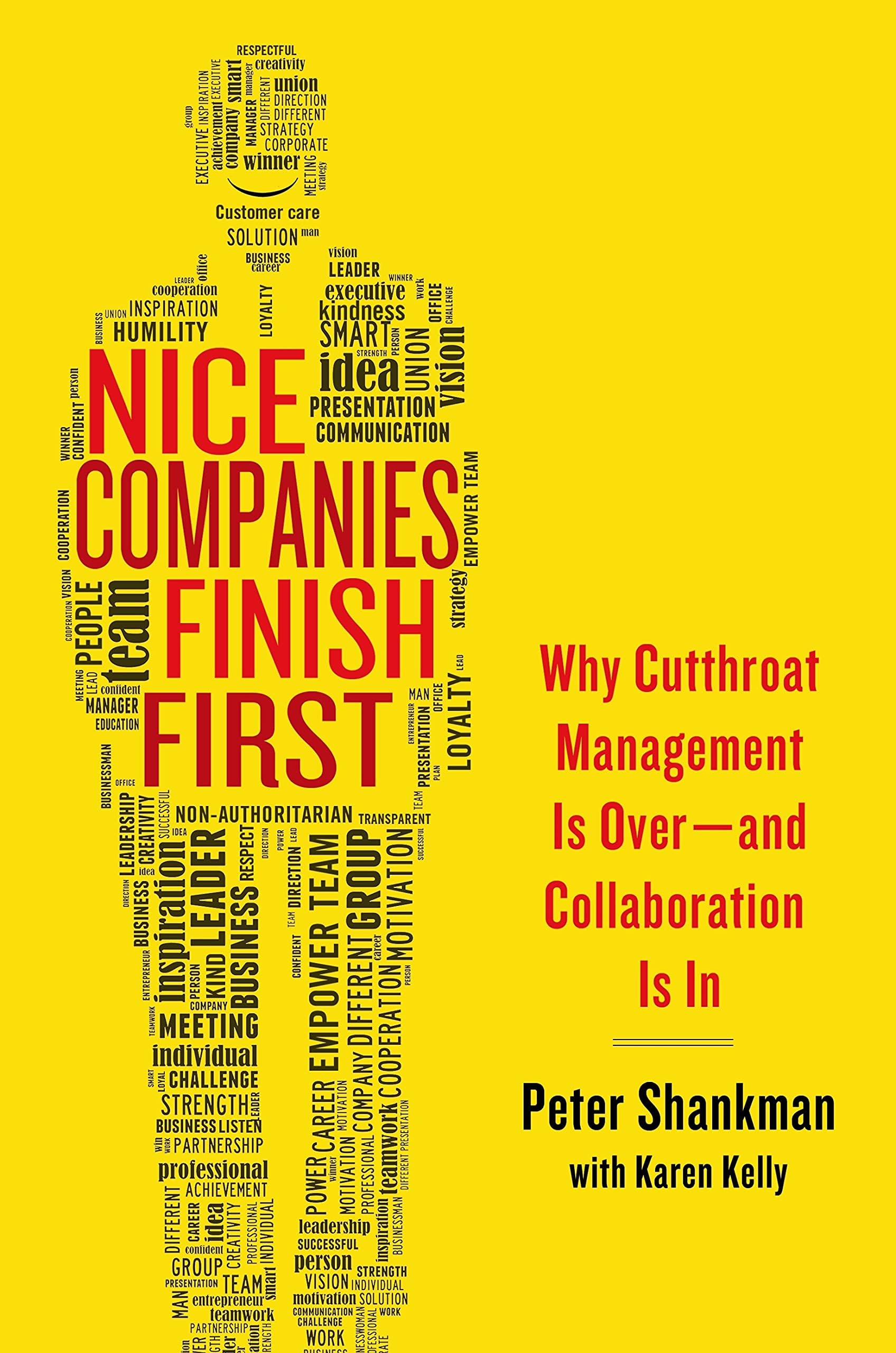
Nice Companies Finish First: Why Cutthroat Management Is Over--and Collaboration Is In
Product ID: 13966701
Buy anything from 5,000+ international stores. One checkout price. No surprise fees. Join 2M+ shoppers on Desertcart.
Desertcart purchases this item on your behalf and handles shipping, customs, and support to Vietnam.
The era of authoritarian cowboy CEOs like Jack Welch and Lee Iacocca is over. In an age of increasing transparency and access, it just doesn't pay to be a jerk―to employees, customers, competitors, or anyone else. In Nice Companies Finish First , Shankman, a pioneer in modern PR, marketing, advertising, social media, and customer service, profiles the famously nice executives, entrepreneurs, and companies that are setting the standard for success in this new collaborative world. He explores the new hallmarks of effective leadership, including loyalty, optimism, humility, and a reverence for customer service, and shows how leaders like Jet Blue's Dave Needleman, Tony Hsieh of Zappos, Steve Jobs of Apple, Ken Chenault of Amex, Indra Nooyi of Pepsi, and the team behind Patagonia harness these traits to build productive, open, and happy workplaces for the benefit of their employees, themselves, and the bottom line. Review: Great book with a big caveat (UPDATED) - UPDATE: Peter responded (crazy right?) to my review in the comments. Safe to say my faith in him has been restored and I would be happy to recommend this book to anyone. Just for the sake of continuity (and I stand behind my word on the internet), I'll let my response below stand so you can follow the story. Changed my rating from 4 to 5 stars as well. --- I was pretty stoked to hear this book was coming out. Based on the title, I was really looking for a "fresh start" with stuff I've heard from Peter (more on that in a second). The book was top notch- great example, wonderful points, and writing that flowed well. Really agreed with most of the points he stated. The biggest problem I had with the book...was the author. (bear with me here) (UPDATE: Read below, then read the comment from Peter) I've followed Peter on various SM platforms over the last couple of years. From his times with HARO and Vocus, to skydiving and weight loss, to the announcement (and eventual birth) of his first kid. He has usually been nice to other companies and (from what I've noticed) makes an effort to talk to others of his level on SM. Me? I've RT'ed/shared/reblogged/forwarded/liked his stuff dozens and dozens of times. How many times has he acknowledged/thanked me? 0. So, you are probably thinking at this point that I'm some stuck up, generation Y brat. I'm not. I've had authors with *double* the following Peter has thank me for something as trivial as a RT. It's just a "best practice" to do stuff like that- when a book writer says to do it (but doesn't do it personally), what should I think? The reason I bring this up is it sadly shaped the prism I viewed the book through. To me, it was much more "Do as I say, not as I do" than I would have preferred (and ironically enough not what he suggests in the book). Frankly, I get it. I'm a small fry customer. But yeah, I'll be a little more hesitant to recommend this book to anyone as I frankly feel uncertain that he walks the way he talks (disclaimer: never met the guy and seems legit from things I see on the internet. YMMV). Review: One of the best books I have read - Peter sums up my thoughts and beliefs on leadership in business in Nice Companies Finish First. He keeps his information relevant and at the forefront while writing in an engaging and entertaining manner. I think he is spot on in his traits for good leadership and how forward thinking companies engaging activities presented in the book will continue to grow and profit from "being nice". His style is so engaging as well that I quickly read the book because I didn't want to stop reading it. I would suggest it for any business or anyone interested in forward thinking management concepts that don't cost a great deal to implement. After all, as Peter points out throughout the book, it usually is just simply a matter of being nice.
| Best Sellers Rank | #5,788,162 in Books ( See Top 100 in Books ) #2,601 in Customer Relations (Books) #3,365 in Management Science #6,669 in Workplace Culture (Books) |
| Customer Reviews | 4.8 out of 5 stars 28 Reviews |
J**E
Great book with a big caveat (UPDATED)
UPDATE: Peter responded (crazy right?) to my review in the comments. Safe to say my faith in him has been restored and I would be happy to recommend this book to anyone. Just for the sake of continuity (and I stand behind my word on the internet), I'll let my response below stand so you can follow the story. Changed my rating from 4 to 5 stars as well. --- I was pretty stoked to hear this book was coming out. Based on the title, I was really looking for a "fresh start" with stuff I've heard from Peter (more on that in a second). The book was top notch- great example, wonderful points, and writing that flowed well. Really agreed with most of the points he stated. The biggest problem I had with the book...was the author. (bear with me here) (UPDATE: Read below, then read the comment from Peter) I've followed Peter on various SM platforms over the last couple of years. From his times with HARO and Vocus, to skydiving and weight loss, to the announcement (and eventual birth) of his first kid. He has usually been nice to other companies and (from what I've noticed) makes an effort to talk to others of his level on SM. Me? I've RT'ed/shared/reblogged/forwarded/liked his stuff dozens and dozens of times. How many times has he acknowledged/thanked me? 0. So, you are probably thinking at this point that I'm some stuck up, generation Y brat. I'm not. I've had authors with *double* the following Peter has thank me for something as trivial as a RT. It's just a "best practice" to do stuff like that- when a book writer says to do it (but doesn't do it personally), what should I think? The reason I bring this up is it sadly shaped the prism I viewed the book through. To me, it was much more "Do as I say, not as I do" than I would have preferred (and ironically enough not what he suggests in the book). Frankly, I get it. I'm a small fry customer. But yeah, I'll be a little more hesitant to recommend this book to anyone as I frankly feel uncertain that he walks the way he talks (disclaimer: never met the guy and seems legit from things I see on the internet. YMMV).
B**S
One of the best books I have read
Peter sums up my thoughts and beliefs on leadership in business in Nice Companies Finish First. He keeps his information relevant and at the forefront while writing in an engaging and entertaining manner. I think he is spot on in his traits for good leadership and how forward thinking companies engaging activities presented in the book will continue to grow and profit from "being nice". His style is so engaging as well that I quickly read the book because I didn't want to stop reading it. I would suggest it for any business or anyone interested in forward thinking management concepts that don't cost a great deal to implement. After all, as Peter points out throughout the book, it usually is just simply a matter of being nice.
A**H
Now I know I'm not crazy
I'm only halfway through this book but I have to say I'm going to get whiplash from the number of times I've nodded my head in agreement or shaken my head in disbelief. It's been a great, quick read with lots of great advice that I'm increasingly realizing my bosses never took which is why I'm now once again my own boss in solo PR practice. I took the book with me to the doctor's office and knew that the wait would fly by as I read the pages. I was there for an hour before I was seen so it's a good thing! The copy is easy to read and the real-world examples, warts and all, add proof points to the words on the page, so that they become more than hollow lessons or recommendations but rather validation that life doesn't have to be status quo.
I**N
Good leaders know this and act accordingly
I have spent consider time over the last month working on the strategy of the African division on a multinational. The courtesy and refinement of the CEO was nothing short of impressive. This was in sharp contrast to a day I had spent with a cross section of staff of a large organization. Here, many had been hurt by their managers; people they desperately wanted to trust. The unfortunate truth is the pervasiveness of unpleasant work places, despite considerable evidence confirming that “nice companies” do finish first. Professor Hochwarter of Florida State University interviewed more than 700 people from a variety of industries about the treatment they received from their managers. 31% reported that their supervisor gave them the “silent treatment” during the year. 37% said that their supervisor failed to give credit when due. 27% reported that they had discovered that their supervisor made negative comments about them to other employees or managers. 23% indicated that their supervisor blamed others to cover up mistakes or to minimize embarrassment. There is a significant difference between being “nice” and exploitation. Good leaders know this and act accordingly. “I am happy to answer a question you might have, but don’t ask me to write your marketing plan for you.” Shankman’s axiom is that the Human Resource Department cannot make a company “nice” through some clever programme. The conduct of the senior leadership determines whether the company is “nice” or toxic. If you examine successful companies, Shankman claims, you will find that the people are working together in an atmosphere that is civil and pleasant. Unsurprisingly, there is a growing body of research indicating that bad managers hamper productivity, dent profits and lose business. University of Florida researchers found that people who work for abusive managers are more likely to arrive late, do less work, and are absent more often. In this book, Shankman identifies nine “nice” traits based on his experience with dozens of CEOs, entrepreneurs, and other leaders, and anecdotal evidence. The trait that underpins all other “nice” traits is “Enlightened Self-interest.” This is the act of doing what benefits you while benefiting others. Adam Smith noted the benefits of enlightened self-interest as early as 1776 in his classic, Wealth of Nations. Smith’s well-known example is the local butcher who does not sell quality meat because he is altruistic. Rather, sells quality meat because he makes a better profit and ensures your return. Enlightened self-interest is the ultimate combination of the acknowledgement of human nature and strategic thinking. Michael Tompkins, president and general manager of Miraval, a top-rated high-end resort, puts the method for achieving enlightened self-interest succinctly. “When I make a big decision, I think, how is this going to impact the guest experience first, how will the staff be affected, and finally, what’s it going to do to me?” Under his management, Miraval received more awards from readers of travel magazines and websites than at any time in its 16-year history. Another trait Shankman identifies is “The Accessibility Factor.” A friend of his was in an elevator to the 42nd floor with the president and CEO of his company. When he tried to make pleasant conversation, the CEO nodded, gave a thin smile, and continued to gaze straight ahead. A few years later, the company’s share price had fallen, the board was unhappy with the CEO, and he was fired. Clearly he was not fired because he refused to talk to junior staff in the elevator. An inaccessible, aloof CEO can run a successful business for a while, but in the long run he makes a bad leader and destroys the business. Leaders who are inaccessible to all but their peers, communicate a dangerously flawed message. Not everyone’s job is valued as prestigious, and not everyone is important to the bottom line. Shankman identifies “Strategic Listening” as one of the traits of a “nice” company. I asked an audience recently how many of them had taken a public speaking skills course. Many had. Then I asked how many had taken a listening skills course. None had. Rubbermaid’s CEO, Wolfgang Schmitt, was infamous for his refusal to listen to others and for making ill-informed decisions. A former colleague remembers that people would joke, “Wolf knows everything about everything.” Wolf, unfortunately, did not. Under his know-it-all leadership, Rubbermaid went from being Fortune’s most admired company in America in 1993 to an inconsequential company sold to Newell a few years later. Biotech giant Amgen’s CEO Kevin Sharer confesses to dismissing or ignoring what others had to say for many years. His epiphany came at a talk by Sam Palmisano, then president and CEO of IBM, who was asked why his experience working in Japan was so important to his leadership development. “I learned to listen by having only one objective: comprehension. I was only trying to understand what the person was trying to convey to me. I wasn’t listening to critique or object or convince,” he said. “Because as you become a senior leader, it’s a lot less about convincing people and more about benefiting from complex information and getting the best out of the people you work with. Listening for comprehension helps you get that information, of course, but it’s more than that: it’s also the greatest sign of respect you can give someone.” However, listening is only a “threshold skill.” If you do not listen well, you will fail. Success is not guaranteed if you do not act appropriately on what you hearing, or if you are not competent at analysing what is being said and making sense of it. This is “Strategic Listening.” One last story: Shankman was at a meeting with a CEO when a secretary walked in, caught her foot on a piece of rug that had curled up, and tripped. She dropped the 200 collated but not stapled pages that she was carrying. The CEO, in his thousand-dollar suit, jumped up and sat on the floor with the secretary for the next ten minutes, picking up and re-collating the papers. Everyone in the meeting joined in. The result was no harm was done, and no injury to anyone’s pride. That CEO’s company was acquired last year for about $ 600 million. “Not bad for a guy sitting on the floor collating papers,” Shankman notes. We spend one third of our lives at work. Anything we can do to help make it enjoyable is worth it. Readability: Light +---- Serious Insights: High -+--- Low Practical: High ---+- Low * Ian Mann of Gateways consults internationally on leadership and strategy.
J**E
You truly need to read this book!
Absolutely spot on - a fantastic book!!! I read a LOT of business books (100+ a year for 20+ years) and I would put this book in my top 10. This is TRULY the way to run a successful business. The book is full of superb ideas and suggestions - with plenty of examples of how companies have succeed by implementing Peter's recommendations. I sent copies to several of my clients - and told them this is a MUST read leadership book. I highly recommend it!!
A**T
A MUST-READ for Any Business, Organization or Cause
Peter is a networking savant and pioneer in the "context" movement happening right now. He was way out in front with concepts such as: humanizing business, transparency, being helpful with no strings, high-touch customer interactions, learning to communicate well, sending actual "thank you" cards, etc. etc. Today, you won't survive if you DON'T adopt the fundamental framework of these concepts. The power of social media has made this undeniably so. Be at the forefront of this movement and buy this book!
A**E
Hard Nosed Cutthroat Business Practices are finally OUT and Nice People & Companies WIN
I love this book which gives concrete examples and steps for company and individual employee success. 99% of people are really nice, but it is the 1% that are very, very busy and in your face. The easiest and fastest way to get noticed in most industries is to be sincerely nice to your customers and vendors (internal and external) and to keep your word. I would recommend this book.
S**L
Perfect for any business owner and employee
This book lays down the law as to why it pays to be a respectable, nice business that focuses on the proper balance between company compensation and customer service reward. For those out there who lived a life thinking, "You gotta be a jerk to get ahead", I suggest you read this "big picture-focused" book. Well-written and choc' ful of examples! It is great for people who own a business, or employees trying to avoid ending up in a negative work environment!
M**T
Must Read
In all honesty, just the chapter on customer service alone is worth the price of the book. Everything else is just icing on the cake.
S**R
I loved it. I loved writing style
I haven't read this book yet, but i have read the authors other book. I loved it. I loved writing style.
Trustpilot
2 weeks ago
3 weeks ago