
Desertcart purchases this item on your behalf and handles shipping, customs, and support to Vietnam.
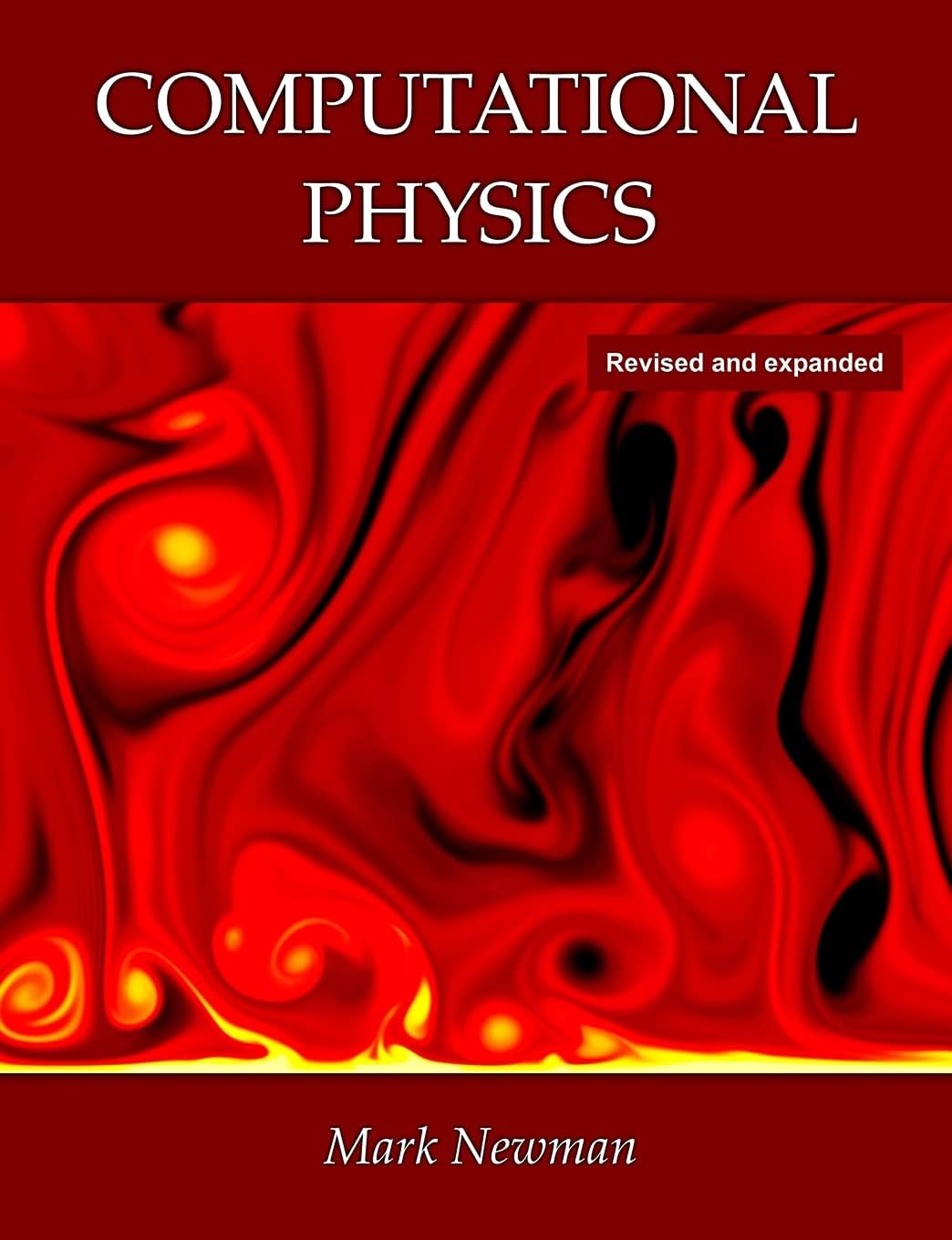
A complete introduction to the field of computational physics, with examples and exercises in the Python programming language. Computers play a central role in virtually every major physics discovery today, from astrophysics and particle physics to biophysics and condensed matter. This book explains the fundamentals of computational physics and describes in simple terms the techniques that every physicist should know, such as finite difference methods, numerical quadrature, and the fast Fourier transform. The book offers a complete introduction to the topic at the undergraduate level, and is also suitable for the advanced student or researcher who wants to learn the foundational elements of this important field.
| Dimensions | 7.44 x 1.27 x 9.69 inches |
| Isbn 10 | 1480145513 |
| Isbn 13 | 978-1480145511 |
| Item Weight | 2.4 pounds |
| Language | English |
| Print Length | 500 pages |
| Publication Date | November 7, 2012 |
| Publisher | CreateSpace Independent Publishing Platform |
User
Great Introduction
I studied computer science and physics at university, and I'm happy to say this is an excellent text if you're interested in learning about one interesting cross-disciplinary intersection between the two. The book uses Python 3, and most of the sample code uses non-deprecated dependencies (most of the expired packages are in matplotlib).I found it guided me along just well enough so that I could complete most exercises without any high level of hand holding (some of the exercises can be done as mild alterations to the examples). While there are plenty of scientific computing packages out there that will do almost all of the behind-the-scenes heavy lifting for you, this book isn't about using them -- instead, it dives deep into the numerical computing methods often used by those same packages.There's plenty of example programs to step you through the exercises. Also, if you have very little programming experience, the first chapter is committed to getting you caught up to speed, but if I'd have to recommend having at least some experience with programming before tackling this (a single introductory uni course, or some time with self-instruction learning python or some other language should be enough).Topics include Visualization, Accuracy and Speed, Integrals and Derivatives, Solving Linear/Non-Linear Equations, Fourier Transforms, ODEs, PDEs, and Monte Carlo/Random Methods.
User
It gives a very good introduction to the Python language and how to apply ...
This is an incredible book for a first timer. It gives a very good introduction to the Python language and how to apply aspects of it to solving Physics problems.There are a few minor issues with the book (Not worth rating it lower than 5 stars). Dr. Newman will introduce libraries and not explain some of them, such as gaussxw. These are usually libraries and functions on the book website. However, there is no reference to it in the book when introduced. Minor oversite. Another issue is that there are parts of the book where it appears he didn't pay attention to which values he was using.These are types of issues that I am sure will be fixed in later editions. Overall this is an incredible book. I picked up this book to see what it had to say. It has taught me things that I did not know. I love that!
User
Good content
Good content, but my book came damaged
User
Good Condition
Good Condition
User
Great Book
This book is very well written and helpful. There are many examples throughout the book, and explanations are complete yet concise. The progression through topics is intuitive. It is very helpful that the author has a set of online supplemental materials available (eg sample code). Concepts are taught so that they can be applied to other programming languages with ease.
User
Just buy it now
I'm a novice Python programmer, but yet I find this book very accessible, well-structured, clearly written, and comprehensive. I am only about halfway through this book but feel that it has really helped me learn both Python programming and solid numerical analysis skills. My only warning is that without a strong physics background the examples and problems may be a bit opaque, but with a strong physics background this book does an excellent job of connecting the physics with computational techniques.
User
Excellent introduction to Python for science
I am a mathematician with some basic programing experience and I was interested in learning Python mostly for mathematical and educational purposes. I consulted many Python books, but I find myself returning over and over again to Chapters 2 and 3 of this book. If you are new to Python and you are interested in scientific applications this is in my view the best place to start.
User
Excellent book!
1. Easy to read. 2. Good examples. 3. Direct to achieve specific results.
User
Recommended
This is an amazing book to learn, from zero, computational physics and python!100% recommended.
User
Very useful, modern introduction to Computational Physics
This is a very clearly written introduction to computational physics. It includes such modern topics as Fourier Analysis and Random Numbers, which are typically absent from computational physics books, without sacrificing the discussion on traditional topics such as linear algebra and differential equations.The tone of the text is that of a friendly teacher. Very often, computational physics textbook get drowned with unnecessary and dry discussion on algorithms and errors. Newman realises that while such discussion is important it can also unnecessarily repel the new student. Unnecessarily, because we now live in an age where Python and Numpy have made computational physics a joy instead of a chore.Newman embraces the Python programming language. He describes each concept with a small Python implementation. He also discusses library functions available in the Python standard library and in Numpy or Scipy. There is useful discussion on how to use Python and how to install it on your computer.There are not many but very useful and elaborate exercise problems.Do not be worried that this book is self-published. I highly recommend it for college students for their self-study. This book and a laptop with Python installed is a perfect set-up for any student to master computational physics. I also used this book recently in a course I gave to PhD students to good effect.
User
Nice Introduction for begginers on this subject
Excellent balance between keeping things understandable for beginners on this specific field and giving enough depths so that a student with some amount of physics, maths and computing background learns with every page . In the same way, the equations and their derivations, are presented in a very understandable way, without unexplained jumps or comments like "its trivial to see". The presented codes were also very readable and comprehensible.
User
N/A
N/A
User
Good option
Very simple to learn with great examples and problems in physics contexts.
Trustpilot
2 months ago
2 months ago