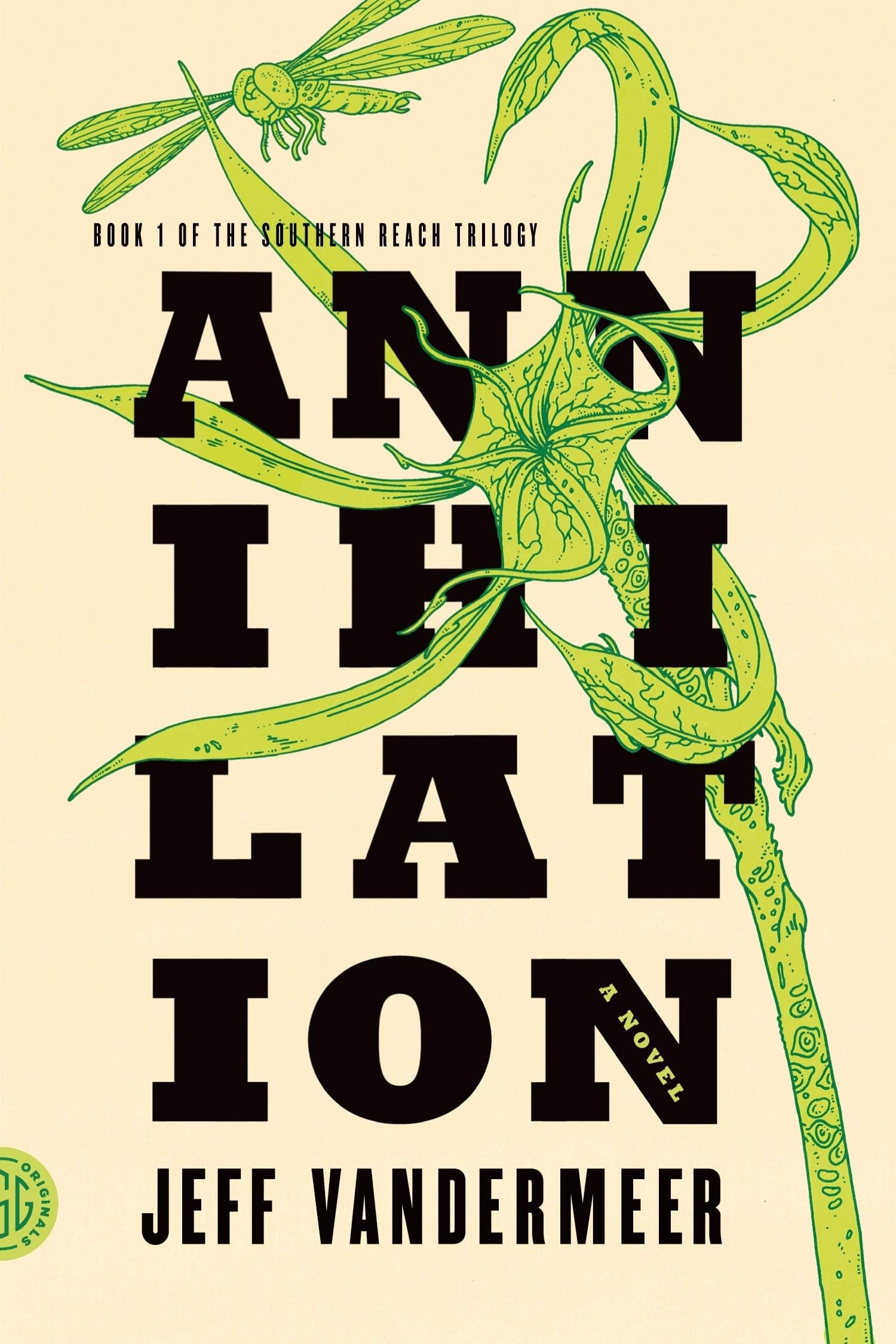

Annihilation: A Novel (The Southern Reach Series, 1)
Product ID: 1357511
Buy anything from 5,000+ international stores. One checkout price. No surprise fees. Join 2M+ shoppers on Desertcart.
Desertcart purchases this item on your behalf and handles shipping, customs, and support to Vietnam.
Annihilation: A Novel (The Southern Reach Series, 1) [VanderMeer, Jeff] on desertcart.com. *FREE* shipping on qualifying offers. Annihilation: A Novel (The Southern Reach Series, 1) Review: A near perfect read - If Loren Eiseley, Charlotte Perking Gilman, Sigmund Freud, and Franz Kafka had a literary baby, it would look something like Annihilation. In Jeff VanderMeer’s Annihilation, an all-women expedition of four is tasked by a secret organization— the Southern Reach—to explore a mysterious region known as Area X, which has been abandoned/cut off from civilization for decades. They are the 12th such expedition, the last one occurring two years earlier, and it’s made clear very early that those earlier ones had some tragic and/or horrific endings. Not long after arriving, they discover a mysterious underground structure (a “tunnel” to everyone save the biologist, who insists on calling it a “tower”) that, unlike the lighthouse and the abandoned village, is not on their map. Her recording of subsequent events is interspersed with flashbacks to her early professional life and to her marriage. And really, even though all that comes out in just the first few pages, this is all I want to mention about the plot, because much of the pleasure—and it really is a pleasure—is the slow reveal of all that ensues, not merely the plot points but the slow reveal of character as well. And equally, or perhaps even more pleasurable, is what is not revealed. Or maybe more precisely, what is not explained. Suffice to say, this is not a novel for those who like clear-cut answers. Or even, you know, just answers, clear or no (though it is possible, this being the first in a trilogy, that some of the mystery will be made more clear by the end of the entire story). Nor is Annihilation a novel for those who do not care much for unreliable narrators, since the biologist is constantly calling into question not only her own conclusions/speculations, but even her own observations. If she can’t trust her eyes, how are we the readers supposed to? Or whatever theories she comes up with based on whatever it is her eyes see? Now, I happen to be a fan, generally, of unreliable narrators. So I’m already predisposed to like what VanderMeer does here with this character. But beyond that, I just really liked this character herself. If one ignores the whole can’t-trust-what-she-sees part, she has a startlingly sharp vision. This is true when she is looking at the world around her, whether that world is the transitional and partially alien landscape of Area X or the more “mundane” worlds of her youthful backyard, or an empty lot near her house, which are allegedly “comprehensible” to us but have their own inexplicable nature, are themselves part of the fantastical (and as old stories tell us, fantasy is not always benign). And so Annihilation is filled with lots of nature imagery, all of which VanderMeer, who is clearly a sharp observer himself, conveys in vividly precise fashion. Beyond the natural world, though, the biologist also has a clarity of vision with regard to herself, say in terms of her love of solitude, or with regard to her relationship with her husband, that is hard not to like and respond to. Besides the descriptive imagery and the sharp characterization, there is a wonderful sense of dread and suspense, of horror, that builds and builds throughout the novel. It’s that great kind of creepiness that feels so good even as you feel the shadow stretching out over you inch by inch and you know you should run like hell. That kind of hurts-but-feels-good pain of picking at a scab. Between the high level of weirdness that I don’t want to say anything much about, the engaging nature of the narrator and the steadily increasing level of suspense, the book is truly compelling. Not quite in the page-turning fashion of a good mystery or action novel (and then what happens? And then what?) but in the way you just can’t help but look at that flash of movement in the darkness you saw in the corner of your eye, you can’t help but go down that hall, then around that corner. Maybe “fascinating” is a better word than “compelling.” I also was captivated by the questions raised in Annihilation, such as how we view nature, what is our place in this world, how do we respond when we encounter the ineffable? Questions of agency, of influence, of what lies beneath the surface, of how or even if one can remain “alone” in a world that constantly presses upon us and also impresses upon us the requirement to share, to interact, to “connect.” And other ones as well. Craft-wise, I think this is one of Vandermeer’s best novels (and I say that as a fan). The pacing is spot on, the prose shifts gears as needed but generally has a great sense of spare rhythm to it, and shifts between flashback and present time are handled smoothly—he seems to know exactly when to interrupt and when not to, as well as when to return. Finally, it’s exactly as long as it should be and no longer. But the whole is larger than the parts here—yes, I like this book for its craft elements—the prose, the characterization, the tone—and yes, I like it because it tells a compelling story about a likable engaging character. But at the core of Annihilation is something ungraspable, and so it’s also nicely appropriate that I can’t quite nail down exactly what it is I love about this book (as opposed to being able to say what I like about it). But boy, did I love it. Despite being the first in a trilogy, the book ends in such a fashion that I’d be quite happy if this were it. That’s not to say I don’t care what comes next, but despite, or perhaps because of, the enigmatic nature of the climax and the many mysteries left hanging, it’s pretty near a perfect ending in my mind. And pretty much a perfect read. Highly recommended. Review: Love it of Hate it, an excellent read - Others have commented that this book, and the entire series, is somewhat 'ambiguous' and unsatisfying. These are reasonable opinions and are true to a greater or lesser degree depending on where in the series you are and consequently whose narrative you are reading. Some are clearer than others. By the end of the series, a reader will know roughly how the events began, and the origin of some of the entities encountered along the way. One will also know what some of the artifacts introduced in the books mean. Someone who prefers their stories to be all-encompassing or wrap up all loose ends, or even most of them, will be frustrated. Someone who prefers their characters both compelling and easily comprehensible will be disappointed. That is not to say the story does not move, or that *all* the characters are poorly drawn - rather, the reader is limited only to the POV characters provided, not all of whom are, to put it bluntly, that competent. I liked the books, despite being incredibly frustrated by them - VanderMeer stayed just the right side of ambiguity for me. For me, the acid test is a single scene in one of the later books, detailed below (marked SPOILER but nothing really critical revealed). If a reader prefers a chapter or two of coverage of the minutiae of every element of the plot, this book will annoy you to near-violence. Fans of the LOTR books, be warned. On the plus side, the writing is wonderful and creepy, the plot is truly strange but consistent, and the reader has a sense of Much Larger Things happening - which are all the creepier for being only sketched out. SPOILERS IN UPDATED REVIEW BELOW EDIT: having read the series a second time through, my initial criticisms do not hold up. While the actual events of the plot are not as clear as some other works that deal with similar themes, it becomes clear what is happening. The ‘how’ is less clear, but this is a strength - instead of hand waving science fictional technobabble (‘warp speed! Wormhole! Fixed point in time!’) Vandermeer shows us what the characters experience and how they experience it, which makes it both creepier and lends depth to the characters. Enough of the mechanics and evidence are presented to explain the ‘what and how’ perfectly well, with the added bonus that the ‘antagonists’ (if you can call them that) are revealed in a manner that is the single best presentation of ‘alien life’ that I have ever read. Aliens are not humans in weird makeup and society that mirrors human civilizations to highlight the human condition - life is messy, violent and strange and life from somewhere very different will be messy, violent and strange in ways humans will have a hard time understanding. The effort may drive them mad, especially as our own human nature make us probe to petty human emotional responses that overwhelm our ability to recon with something alien. It is more comforting to practice office politics than reckon with an alien intelligence you cannot speak to, reason with, understand or stop.
| Best Sellers Rank | #235,023 in Books ( See Top 100 in Books ) #18 in Exploration Science Fiction #56 in Post-Apocalyptic Science Fiction (Books) #271 in Literary Fiction (Books) |
| Book 1 of 5 | Southern Reach |
| Customer Reviews | 4.0 4.0 out of 5 stars (27,413) |
| Dimensions | 5 x 0.55 x 7.45 inches |
| Edition | First Edition |
| ISBN-10 | 0374104093 |
| ISBN-13 | 978-0374104092 |
| Item Weight | 5.6 ounces |
| Language | English |
| Print length | 208 pages |
| Publication date | February 4, 2014 |
| Publisher | FSG Originals |
B**E
A near perfect read
If Loren Eiseley, Charlotte Perking Gilman, Sigmund Freud, and Franz Kafka had a literary baby, it would look something like Annihilation. In Jeff VanderMeer’s Annihilation, an all-women expedition of four is tasked by a secret organization— the Southern Reach—to explore a mysterious region known as Area X, which has been abandoned/cut off from civilization for decades. They are the 12th such expedition, the last one occurring two years earlier, and it’s made clear very early that those earlier ones had some tragic and/or horrific endings. Not long after arriving, they discover a mysterious underground structure (a “tunnel” to everyone save the biologist, who insists on calling it a “tower”) that, unlike the lighthouse and the abandoned village, is not on their map. Her recording of subsequent events is interspersed with flashbacks to her early professional life and to her marriage. And really, even though all that comes out in just the first few pages, this is all I want to mention about the plot, because much of the pleasure—and it really is a pleasure—is the slow reveal of all that ensues, not merely the plot points but the slow reveal of character as well. And equally, or perhaps even more pleasurable, is what is not revealed. Or maybe more precisely, what is not explained. Suffice to say, this is not a novel for those who like clear-cut answers. Or even, you know, just answers, clear or no (though it is possible, this being the first in a trilogy, that some of the mystery will be made more clear by the end of the entire story). Nor is Annihilation a novel for those who do not care much for unreliable narrators, since the biologist is constantly calling into question not only her own conclusions/speculations, but even her own observations. If she can’t trust her eyes, how are we the readers supposed to? Or whatever theories she comes up with based on whatever it is her eyes see? Now, I happen to be a fan, generally, of unreliable narrators. So I’m already predisposed to like what VanderMeer does here with this character. But beyond that, I just really liked this character herself. If one ignores the whole can’t-trust-what-she-sees part, she has a startlingly sharp vision. This is true when she is looking at the world around her, whether that world is the transitional and partially alien landscape of Area X or the more “mundane” worlds of her youthful backyard, or an empty lot near her house, which are allegedly “comprehensible” to us but have their own inexplicable nature, are themselves part of the fantastical (and as old stories tell us, fantasy is not always benign). And so Annihilation is filled with lots of nature imagery, all of which VanderMeer, who is clearly a sharp observer himself, conveys in vividly precise fashion. Beyond the natural world, though, the biologist also has a clarity of vision with regard to herself, say in terms of her love of solitude, or with regard to her relationship with her husband, that is hard not to like and respond to. Besides the descriptive imagery and the sharp characterization, there is a wonderful sense of dread and suspense, of horror, that builds and builds throughout the novel. It’s that great kind of creepiness that feels so good even as you feel the shadow stretching out over you inch by inch and you know you should run like hell. That kind of hurts-but-feels-good pain of picking at a scab. Between the high level of weirdness that I don’t want to say anything much about, the engaging nature of the narrator and the steadily increasing level of suspense, the book is truly compelling. Not quite in the page-turning fashion of a good mystery or action novel (and then what happens? And then what?) but in the way you just can’t help but look at that flash of movement in the darkness you saw in the corner of your eye, you can’t help but go down that hall, then around that corner. Maybe “fascinating” is a better word than “compelling.” I also was captivated by the questions raised in Annihilation, such as how we view nature, what is our place in this world, how do we respond when we encounter the ineffable? Questions of agency, of influence, of what lies beneath the surface, of how or even if one can remain “alone” in a world that constantly presses upon us and also impresses upon us the requirement to share, to interact, to “connect.” And other ones as well. Craft-wise, I think this is one of Vandermeer’s best novels (and I say that as a fan). The pacing is spot on, the prose shifts gears as needed but generally has a great sense of spare rhythm to it, and shifts between flashback and present time are handled smoothly—he seems to know exactly when to interrupt and when not to, as well as when to return. Finally, it’s exactly as long as it should be and no longer. But the whole is larger than the parts here—yes, I like this book for its craft elements—the prose, the characterization, the tone—and yes, I like it because it tells a compelling story about a likable engaging character. But at the core of Annihilation is something ungraspable, and so it’s also nicely appropriate that I can’t quite nail down exactly what it is I love about this book (as opposed to being able to say what I like about it). But boy, did I love it. Despite being the first in a trilogy, the book ends in such a fashion that I’d be quite happy if this were it. That’s not to say I don’t care what comes next, but despite, or perhaps because of, the enigmatic nature of the climax and the many mysteries left hanging, it’s pretty near a perfect ending in my mind. And pretty much a perfect read. Highly recommended.
M**S
Love it of Hate it, an excellent read
Others have commented that this book, and the entire series, is somewhat 'ambiguous' and unsatisfying. These are reasonable opinions and are true to a greater or lesser degree depending on where in the series you are and consequently whose narrative you are reading. Some are clearer than others. By the end of the series, a reader will know roughly how the events began, and the origin of some of the entities encountered along the way. One will also know what some of the artifacts introduced in the books mean. Someone who prefers their stories to be all-encompassing or wrap up all loose ends, or even most of them, will be frustrated. Someone who prefers their characters both compelling and easily comprehensible will be disappointed. That is not to say the story does not move, or that *all* the characters are poorly drawn - rather, the reader is limited only to the POV characters provided, not all of whom are, to put it bluntly, that competent. I liked the books, despite being incredibly frustrated by them - VanderMeer stayed just the right side of ambiguity for me. For me, the acid test is a single scene in one of the later books, detailed below (marked SPOILER but nothing really critical revealed). If a reader prefers a chapter or two of coverage of the minutiae of every element of the plot, this book will annoy you to near-violence. Fans of the LOTR books, be warned. On the plus side, the writing is wonderful and creepy, the plot is truly strange but consistent, and the reader has a sense of Much Larger Things happening - which are all the creepier for being only sketched out. SPOILERS IN UPDATED REVIEW BELOW EDIT: having read the series a second time through, my initial criticisms do not hold up. While the actual events of the plot are not as clear as some other works that deal with similar themes, it becomes clear what is happening. The ‘how’ is less clear, but this is a strength - instead of hand waving science fictional technobabble (‘warp speed! Wormhole! Fixed point in time!’) Vandermeer shows us what the characters experience and how they experience it, which makes it both creepier and lends depth to the characters. Enough of the mechanics and evidence are presented to explain the ‘what and how’ perfectly well, with the added bonus that the ‘antagonists’ (if you can call them that) are revealed in a manner that is the single best presentation of ‘alien life’ that I have ever read. Aliens are not humans in weird makeup and society that mirrors human civilizations to highlight the human condition - life is messy, violent and strange and life from somewhere very different will be messy, violent and strange in ways humans will have a hard time understanding. The effort may drive them mad, especially as our own human nature make us probe to petty human emotional responses that overwhelm our ability to recon with something alien. It is more comforting to practice office politics than reckon with an alien intelligence you cannot speak to, reason with, understand or stop.
K**I
Came fast and in time. Love this book. Got the soft cover book its 195pages. Amazing book you should definitely order it.
L**O
Um excelente livro. As perguntas começam logo cedo e continuam vindo. Mistérios se acumulam e você quer saber mais sobre aquele lugar. Não vejo a hora de ler os próximos livros.
A**R
Very good read...with nice detailings of area x...u can visualise every events...very good n short book...experience the thrill...nice writing after jules verne...
F**F
This is a very different take on what the reader would consider to be an alien invasion. And it's an hypnotic, spiralling descent into hell. Evocative, mysterious, terrifying, it's impossible to put it down. Little spoiler here: ----- the reader doesn't get all the answers, and that's what I loved as well. You fill the gaps with your own imagination and make up the rest. ----- Also, I'll argue that you don't need to embark into reading the trilogy. As weird as it sounds, this book has its own end and it's perfect. This is a very good, almost dreaming little novel.
M**N
When reading 'Annihilation', if you're looking for immediate gratification, you won't find it. This is the sort of book that requires you to dwell on it long after you put it down, teasing out meaning and theme, nurturing their seeds until they blossom. This is weird fiction at its finest. I don't mean "wow, that's a weird book!", I mean the weird fiction genre (if this is your first exposure to it, look it up!). For such a short read it's dense, packed with philosophy, science, horror, you name it. In fact, it's the perfect length, and now that I am nearing the end of book 2, I feel that sequel's larger size makes it feel a bit bloated and meandering. This is a book that demands to be re-read, once, twice, three times, and now that I'm moved onto the sequels, it feels almost a requirement to go back as many things that were only subtly hinted at in this novel are fully revealed or expanded upon in them. A masterful novel for Vandermeer, haunting and memorable. Highly recommended.
Trustpilot
2 weeks ago
3 weeks ago