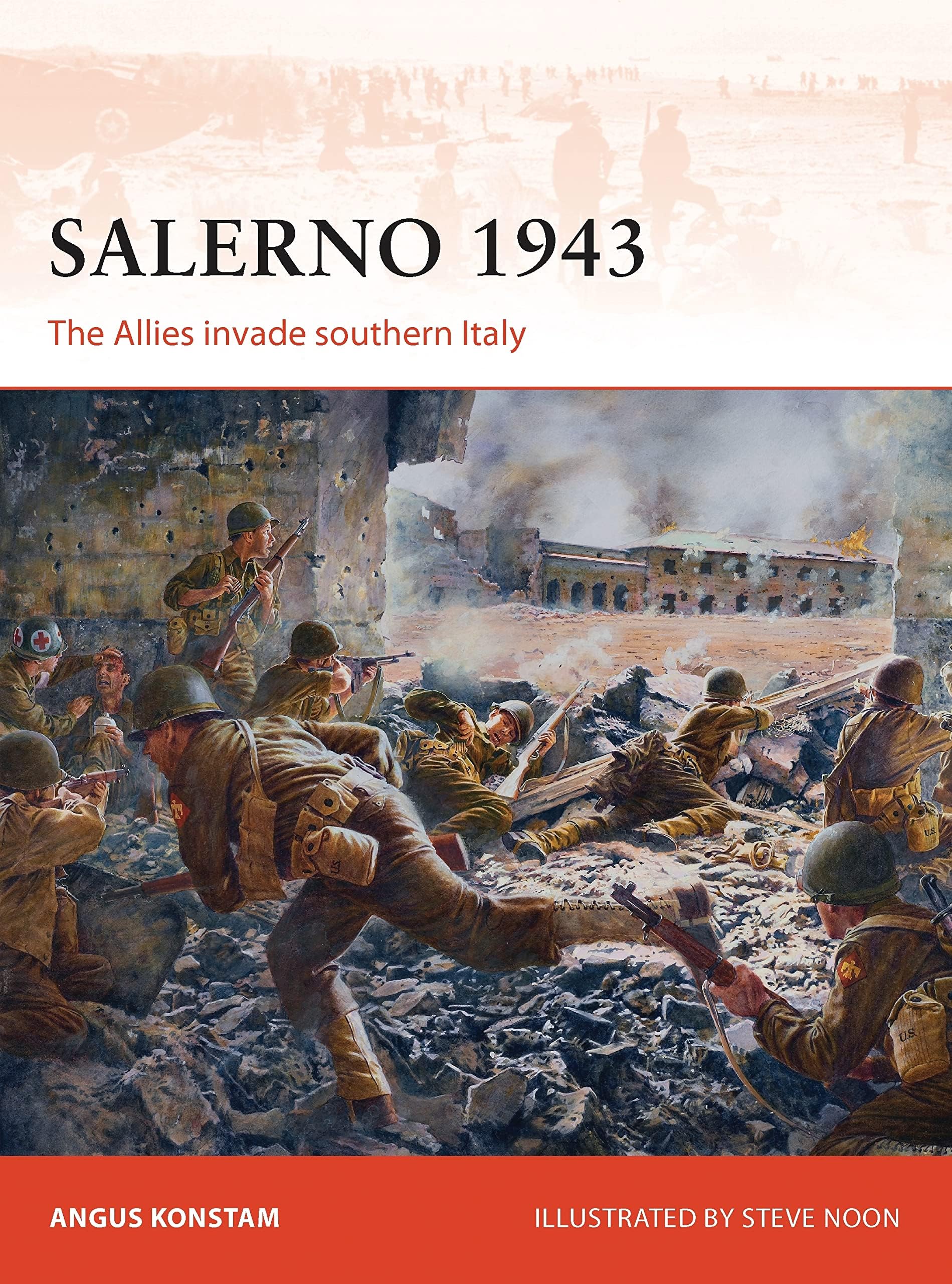
Salerno 1943: The Allies invade southern Italy (Campaign, 257)
Product ID: 13335503
Buy anything from 5,000+ international stores. One checkout price. No surprise fees. Join 2M+ shoppers on Desertcart.
Desertcart purchases this item on your behalf and handles shipping, customs, and support to Vietnam.
In mid-September 1943, as the opening move of the Allied campaign to liberate the mainland of Italy, an Anglo-American invasion force landed on the beaches of the Gulf of Salerno, only a few dozen miles to the south of Naples. Italy had just surrendered, and the soldiers in the landing craft prayed that the invasion would be unopposed. It was not to be. The Germans had seized control of the Italian-built beach defences, and were ready and waiting. What followed was one of the bloodiest battles of the whole Mediterranean campaign - a ten day contest where victory hung in the balance. Over 80,000 British and American soldiers waded ashore at Salerno, and after bitter fighting they managed to establish a narrow and vulnerable bridgehead. The British enclave near Salerno was separated from the American sector around Paestum by a river, and German-held strongpoints. All attempts to link up the two parts of the bridgehead were thwarted by the German defenders, who were being reinforced faster than the Allies. Then the Americans were nearly flung back into the sea by a ferocious German counterattack, as the German commander on the spot used his veteran armour and Panzergrenadiers to deadly effect. Although driven back towards the beach, the Americans rallied and grimly held on, and the crisis passed. The ferocious ten-day battle at Salerno was eventually decided by a combination of Allied reinforcements, and secondary landings in support of the beleaguered Salerno bridgehead. The battle for Salerno changed the course of the campaign - by its end it was clear that wherever possible the Germans were going to fight for every inch of ground in Italy, and the campaign was not going to be the easy victory the Allied commanders had hoped. Using documentary records, memoirs and eyewitness accounts from all sides, Angus Konstam recreates the battle day by day, hour by hour. His methodically researched account offers a fresh perspective on a decisive battle that has largely been neglected by British and American historians in recent years. Review: Salerno - Great overview of the battle! Review: The Hell of Salerno - Although you'll never mistake this account for a novel, the author does a good job of describing the Salerno battle, and its aftermath. Lacking are individual accounts of participants that might have enlivened the retelling. Still, in its workmanlike way, it serves to tell the story of a hard fought battle of an even harder fought campaign...one that the U.S.did not want.

| Best Sellers Rank | #735,505 in Books ( See Top 100 in Books ) #571 in Italian History (Books) #4,580 in World War II History (Books) #15,887 in World History (Books) |
| Customer Reviews | 4.5 out of 5 stars 56 Reviews |
P**Y
Salerno
Great overview of the battle!
S**O
The Hell of Salerno
Although you'll never mistake this account for a novel, the author does a good job of describing the Salerno battle, and its aftermath. Lacking are individual accounts of participants that might have enlivened the retelling. Still, in its workmanlike way, it serves to tell the story of a hard fought battle of an even harder fought campaign...one that the U.S.did not want.
H**E
On to Italy...
The Mediterranean strategy of the Allies took a critical turn in September 1943, when American General Eisenhower was persuaded to commit British and American forces to a campaign in mainland Italy. The key to gaining a foothold was Operation Avalanche, the perilous amphibious landing by the U.S. Fifth Army at Salerno. The U.S. VI Corps and British X Corps crashed ashore side by side, only to find a German Panzer Corps prepared to dispute every step inland. The invasion hung by a thread for days, as both sides struggled to reinforce the fight... "Salerno 1943" is a very good entry in the Osprey Campaign Series, a concise and methodical account of a difficult battle by historian Angus Konstam. The narrative follows the standard Osprey format, with an introduction, surveys of the strategic situation and the opposing forces, and a narrative of the actual fighting. The text is nicely supported by maps, diagrams, illustrations, and period photographs. Recommended to students of the Second World War as a concise introduction to a key battle in what became the Italian campaign.
M**E
Osprey Campaign
Another good campaign book on WW2. Covers the Allied invasion of Sicily where the rift between US Generals and Field Marshall Bernard Montgomery first raised its ugly head to plague General Eisenhower for the rest of the war. It is also the beginning of the invasion of Italy. The second major combined operation incorporating beach assaults and paratrooper landings with naval and air support. Well written. Illustrations good. Maps fair considering large areas they attempt to cover. Good book. Lead in to Salerno.
F**D
I must have WWII library book.
When I do my field set ups for modeling photo mags I like my info right on the mark. Great color scenes and maps
I**E
Weak
This book has a lot of errors in it. The biggest one is this sentence on page 70: "This meant that at a crucial juncture in the battle for the bridgehead, one German battalion had taken on four American battalions and had emerged victorious." Konstam thinks that the Altavilla battle pitted the lone German II/15 battalion against the American 1/142, 2/142, 3/142, and 3/143 battalions. In fact, 2/142 was far to the south. See Map I in Blumenson's Salerno to Cassino. And if you look at the German 10th Army's records and situation maps, you see that the Germans attacked with III/15 and III/71 on September 12, and III/15, II/71, and I/15 on September 13. (III/71 had been pulled back into reserve.) II/15 actually fought to the south of Albanella, I suspect against 2/142. So instead of the Germans fighting at Altavilla outnumbered four to one, they actually had an advantage of four to three! Other errors: Konstam apparently relied on the British official history for his German order of battle because they make similar mistakes. You need to look at the German records to get the true story. There was no II/115/15 PG: it had been broken up to strengthen I and III battalions. (I/115 is correctly omitted because it was guarding the coast west of Naples.) II/1 PG/HG is missing. 15 PG Division had more StuGs than tanks. 129/15 PG had all three battalions. 9/26 Pz had both of its battalions. The omission of I/67/26 Pz is justified because it was the rearguard holding off Eighth Army. 3 PG Division sent II/29 to this battle instead of I/29, and the recon battalion did not participate: it was diverted to Naples. 29 PG Division did not have half-tracks, and the order of battle omits II/15 (which later in the book is misplaced at Altavilla). 71/29 PG had all three battalions. I/3FJ is missing: it fought in Battipaglia. The Americans had the 3rd Ranger battalion, not the 2nd. 645th Tank Destroyer Battalion is missing from the OOB.
B**R
Five Stars
more of a british perspective but ok
F**.
Wonderful Book
Terrific Historic Presentation
B**.
Excellent account of campaign.
Comprehensive account of campaign. Enabled my research into my father's war experiences. Answered some questions.
F**A
Operation Avalanche
This book is fascinating with its interesting background and moving pictures of the Allies' first foothold on the Fascist-controlled mainland of Europe WWII. Hits home personally, as I was born in Paestum. Thank you to all of the brave servicemen who lost their lives for the sake of freedom.
C**N
super
excellent comme d'habitude
N**N
Salerno 1943; the Allies Invade Southern Italy
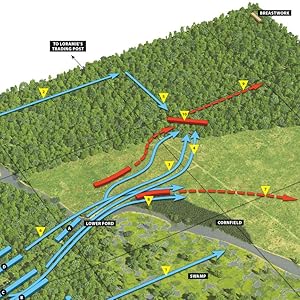
The Allied landings at Salerno in September 1943 remain rather overlooked today compared with the battles for Casino and Anzio and even the early invasion of Sicily. Only the later Italian campaign after the liberation of Rome can be claimed to be lost in even greater obscurity. In fact a quick search of Amazon only brings up this title and another book by the same author from 2007 and running to 227 pages. Why the apparent lack of interest remains a puzzle? It's difficult to ignore these events when writing a history of the Italian campaign or even a general history of WW2. In the World at War TV series from the 1970's the battle for Salerno received a very respectable amount of airtime. The lack of coverage elsewhere meant I approached this title with little detailed knowledge of the campaign, other than the swift and fierce German reaction to the landings and near disaster for the allies saved only by overwhelming airpower. I'm therefore sure that the see-saw battles for the two tobacco factories, hill top villages and river crossings will be new to many readers. I won't attempt to summarise these (go and buy the book) but one is left with respect for the German troops, some of whom, having just retreated from Sicily, were not fully recovered and yet still ran rings around both the British and American forces. In 10 days of fierce fighting the Germans demonstrated qualities of leadership, aggression and tactical skill that could easily have caused the allies to abandon the beachhead. In the end the allies overwhelming firepower from artillery, airpower and especially naval gunfire was able to break-up German offensives. Finally, without reinforcements, and the arrival of Monty's 8th Army from the south, the German called off their counterattacks but were still able to retreat in good order knowing that they had given the allies a bloody nose. The author's narrative is pretty clear and it is reasonably easy to follow the course of the battle day-by-day. The limited time frame of the campaign means it fits nicely within the 96 page limitation of the Osprey format without much glossing over or cutting out any key events. However I feel it would have helped to have had more detailed maps and these could have done with coming down in scale so that the action could be followed easier. For some reason I also struggled to get a feel of the terrain even from the 3D maps which I put down to the use of the general field patchwork overlay which caused many key features to be lost in the background. However full marks for another set of excellent colour plates by Steve Noon. Steve's work is always of the highest standard and here the subject matters chosen are on the mark and used to illustrate key events of the battle not covered by photographs. I hope that Osprey's editors make a note of this point. I have no problem in recommending this title especially as it covers a battle which is so overlooked.
S**E
Salerno
Another good source of information into this little spoke of theatre of WW2
Trustpilot
2 weeks ago
2 days ago