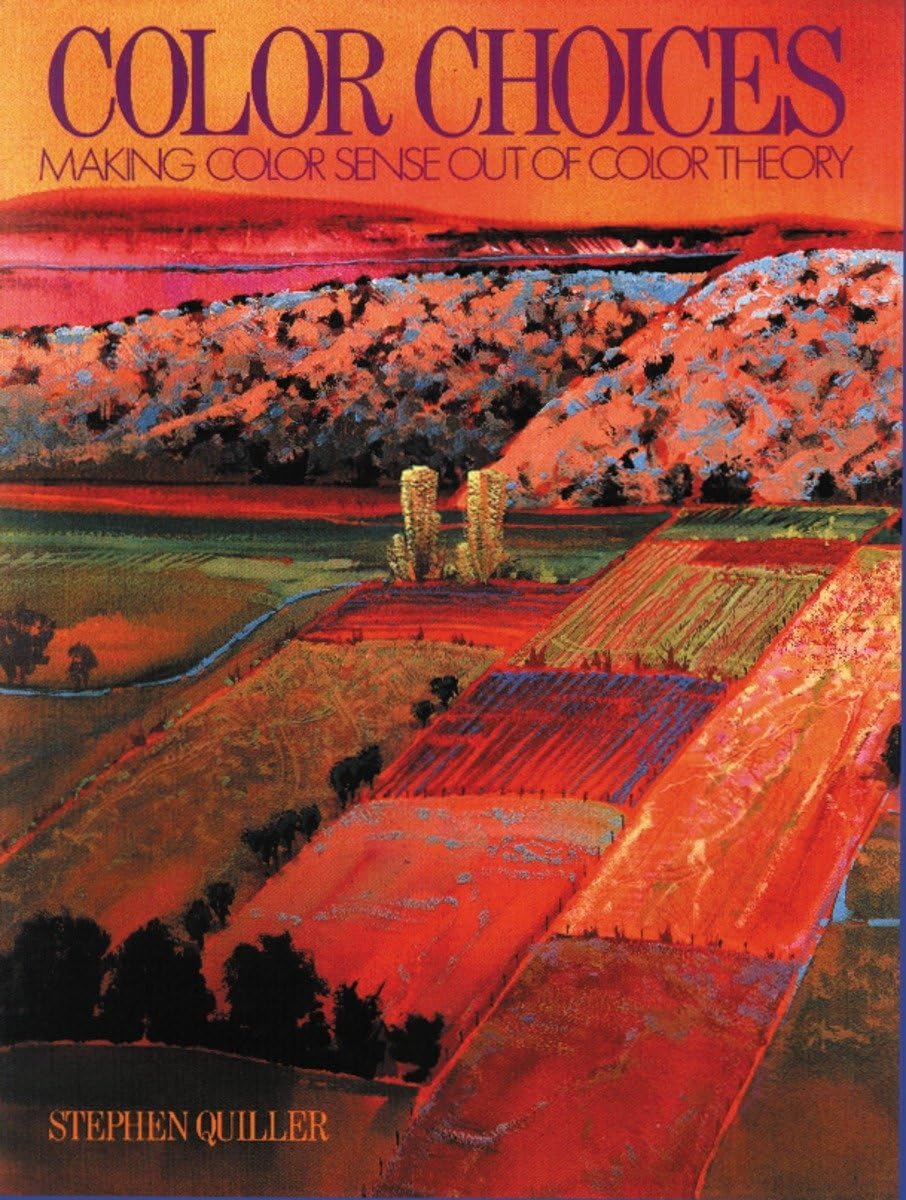
Color Choices: Making Color Sense Out of Color Theory
Product ID: 1273742
Buy anything from 5,000+ international stores. One checkout price. No surprise fees. Join 2M+ shoppers on Desertcart.
Desertcart purchases this item on your behalf and handles shipping, customs, and support to Vietnam.
Color Choices: Making Color Sense Out of Color Theory [Quiller, Stephen] on desertcart.com. *FREE* shipping on qualifying offers. Color Choices: Making Color Sense Out of Color Theory Review: Practical color theory for painters - I’ve been taking deep dives into learning during this quarantine. One of the subjects I decided to go heavy on is color theory. I’ve been using color in painting and interiors since I was a kid and I “know” what colors I need to use instinctively...but not why and I didn’t ever think about the structure behind my choices. I decided it was time to learn all the rules. I’ve read about 4 books on color theory so far, and this is the best yet because it is written for painters. Despite many many years of painting & interiors classes, and a semester of color theory, I had only been taught the usual color theory based on the typical color wheel. As my painting progressed, I began to want to learn about pigments and as any painter can tell you, the regular color wheel doesn’t always apply when it comes to working with color in pigments. This color wheel Quiller developed is seriously brilliant...so practical! And he talks about which companies make which colors- slightly out of date but still helpful. Then he even displays what colors look like when you mix them with different ways of creating neutrals. It’s just a way of breaking down color, value and intensity that makes so much sense, and will save you a lot of time experimenting if you haven’t already done a lot of this. I also love how he breaks down each color scheme. I’m working now I’m laying more attention to what kind of color schemes I’m using along with values. I think the more I memorize what is what, the more time I will save from just intuiting what colors should be mixing up, and how. Definitely worth the read. Review: This is probably the second best book on color that I have read and anyone can understand - While I am a watercolour painter, this book also talk to the acrylic and oil artist. This book has a lot of information about colour and how it works in order to have an outstanding painting with colors helping each other rather than it looking chaotic and somehow out of sync. The only other books that I would recommend on color that I have read so that anyone can understand are below. In addition, I would recommend PANTONEs Guide to Communicating with color by Eiseman. It is a great book to use to understand the psychology behind color and how it is used to communicate a mood or feeling. Let's face it, Marketing does this all the time and it can also be used as a guide when deciding what hues you want to use in your artwork. I love this book and is a great cheat reference for me and also has some surprising color combinations that I would never have thought of. For any Artist: Color Mixing Bible, by Ian Sidaway _________________________ "COLOR WORKS, the Crafters Guide to Color" by Deb Menz FOR ANYONE who wants to know about COLOR THEORY this text breaks it down so that ANYONE can understand this complex subject. I learnt more about color theory in this book than all others put together because I now "Understand" the concept. While this book is for the textile artist, ALL artists should get it and it also has cut outs to use when choosing your colour palette whether it be for Fashion Design or Art.
| Best Sellers Rank | #30,800 in Books ( See Top 100 in Books ) #31 in Graphic Design Color Use #74 in Painting (Books) #492 in Coloring Books for Grown-Ups |
| Customer Reviews | 4.6 4.6 out of 5 stars (946) |
| Dimensions | 8.35 x 0.43 x 10.94 inches |
| Edition | First Edition |
| ISBN-10 | 0823006972 |
| ISBN-13 | 978-0823006977 |
| Item Weight | 1.32 pounds |
| Language | English |
| Print length | 144 pages |
| Publication date | February 1, 2002 |
| Publisher | Watson-Guptill |
M**S
Practical color theory for painters
I’ve been taking deep dives into learning during this quarantine. One of the subjects I decided to go heavy on is color theory. I’ve been using color in painting and interiors since I was a kid and I “know” what colors I need to use instinctively...but not why and I didn’t ever think about the structure behind my choices. I decided it was time to learn all the rules. I’ve read about 4 books on color theory so far, and this is the best yet because it is written for painters. Despite many many years of painting & interiors classes, and a semester of color theory, I had only been taught the usual color theory based on the typical color wheel. As my painting progressed, I began to want to learn about pigments and as any painter can tell you, the regular color wheel doesn’t always apply when it comes to working with color in pigments. This color wheel Quiller developed is seriously brilliant...so practical! And he talks about which companies make which colors- slightly out of date but still helpful. Then he even displays what colors look like when you mix them with different ways of creating neutrals. It’s just a way of breaking down color, value and intensity that makes so much sense, and will save you a lot of time experimenting if you haven’t already done a lot of this. I also love how he breaks down each color scheme. I’m working now I’m laying more attention to what kind of color schemes I’m using along with values. I think the more I memorize what is what, the more time I will save from just intuiting what colors should be mixing up, and how. Definitely worth the read.
M**T
This is probably the second best book on color that I have read and anyone can understand
While I am a watercolour painter, this book also talk to the acrylic and oil artist. This book has a lot of information about colour and how it works in order to have an outstanding painting with colors helping each other rather than it looking chaotic and somehow out of sync. The only other books that I would recommend on color that I have read so that anyone can understand are below. In addition, I would recommend PANTONEs Guide to Communicating with color by Eiseman. It is a great book to use to understand the psychology behind color and how it is used to communicate a mood or feeling. Let's face it, Marketing does this all the time and it can also be used as a guide when deciding what hues you want to use in your artwork. I love this book and is a great cheat reference for me and also has some surprising color combinations that I would never have thought of. For any Artist: Color Mixing Bible, by Ian Sidaway _________________________ "COLOR WORKS, the Crafters Guide to Color" by Deb Menz FOR ANYONE who wants to know about COLOR THEORY this text breaks it down so that ANYONE can understand this complex subject. I learnt more about color theory in this book than all others put together because I now "Understand" the concept. While this book is for the textile artist, ALL artists should get it and it also has cut outs to use when choosing your colour palette whether it be for Fashion Design or Art.
E**T
An Ah-Ha Moment
I've been searching for that perfect book which would deepen my understanding of color and the color wheel so that I can apply it to my quilt-making. Reading Stephen Quiller's 144-page book on color theory provided several ah-ha moments for me. The title says it all, "Color Choices - Making Color Sense Out Of Color Theory". He teaches workshops on color, so this book was extremely informative and simple to understand. I actually found it to be an enjoyable read. My main question around color has always been, "So what? Yes, colors lay next to each other and opposite each other on the color wheel, so what?" It finally connected for me, thanks to Stephen's down-to-earth writing style that, "Color is magic! And what a gift it is to use color in a way that truly expresses what the artist feels." It's difficult to articulate those ah-ha moments in a product review, but here's how one moment worked for me: to assist the reader, Stephen offers sections in the book called, "Six Studies". There are 6 of the same subjects painted differently 6 times using various color schemes and he asks you to, "Notice how each study differs in color emphasis, value, and intensity. Also look at how the various moods have been developed, ranging from calm and serene, to austere, to fantasy-like, to dynamic and powerful." Because of the 6 side-by-side comparisons, my eye traveled differently around each painting and I began to understand the theory of contrast. Or, I would like one painting and despise another connecting to the theories of intensity and color harmony. Wow! I actually get it! Then he explains what the color is doing for you, for example, "The bright orange has been neutralized to create a distinct mood." He's an art instructor, so at the end of each chapter he offers a "Workshop" where he provides exercises for the painter. I continue to find great value in re-reading and experiencing this book and I don't even paint!
C**E
good explanation of how to chose colors for better artwork
This book explains what colors work best together, and how to achieve better combinations in your own work. I am kind of amazed that while I would recommend this book for anyone wishing to improve their use of color, this particular artist's choices of color in his own examples either leave me very cold or actually give me the willies! I would, however recommend this book, which has already improved my own work, and made choosing colors easier for me.
K**D
Colour Theory. Not the easiest topic, but every artist requires some knowledge of it and this author definitely knows his stuff. Not for the faint hearted, but worthwhile dipping into and getting what you need to take your use of colour to the next level. Lots of examples demonstrating the points he is making, some exercises to get you experimenting with colour. The important factor, for me at least, is that what he's talking about can be applied to whatever colour palette you choose. It really does get you thinking about your own colour choices.
R**N
Es un autor al q sigo desde hace tiempo. El libro es muy bueno, muy completo y muy bien explicado. S. Quiller juega muy bien con las paletas de color y aquí te enseña a entender nuevas posibilidades. Recomendable 100%
F**M
I was looking for a book on color theory and color scheme for watercolor and drawing. I am glad to have found this particular one because it relates directly to the world of painting (oils, watercolors, acrylics) not printing/CMYK or digital/RGB. If you already own a color theory book then this one may not provide new information in terms of color schemes, this is not a swatch book. What you'll find: a huge color wheel using a range of paint pigmentation names (not just red, yellow, blue...). Each color scheme type clearly explained with lots of examples and exercises for the reader. Insights from the author who is also a painter going beyond color theory but will also talk of process and techniques specific to painting.
S**A
worth it just for the collection of amazing paintings that u can admire for hours. Definately will lure u to try landscapes and move past wimpy washes. Go bold colors !
A**R
This book is wonderful. The author explains what colour is, in all its shades and forms, how colours work together, how to mix and combine them, what kinds of effects you can get, how to use colour to obtain your desired results... It's all exclusively about colour, in an accessible language (for the reasonably educated) without the extremes of being patronizing or too techinical. Personally, I found it perfect, and it helped me make sense of color theory in a very practical way. There are plenty - it's loaded - of pictures to demonstrate what the author wants to convey, and I found that the great visual elements made it much easier to grasp the concepts taught in the book. Although the medium used here is paint, the lessons taught are for the use of colour in general. I could apply all that I learned (well, still learning) in this book to my drawings in coloured pencils. I am a beginner who did not know much about colour theory until I read this book.
Trustpilot
1 day ago
2 weeks ago