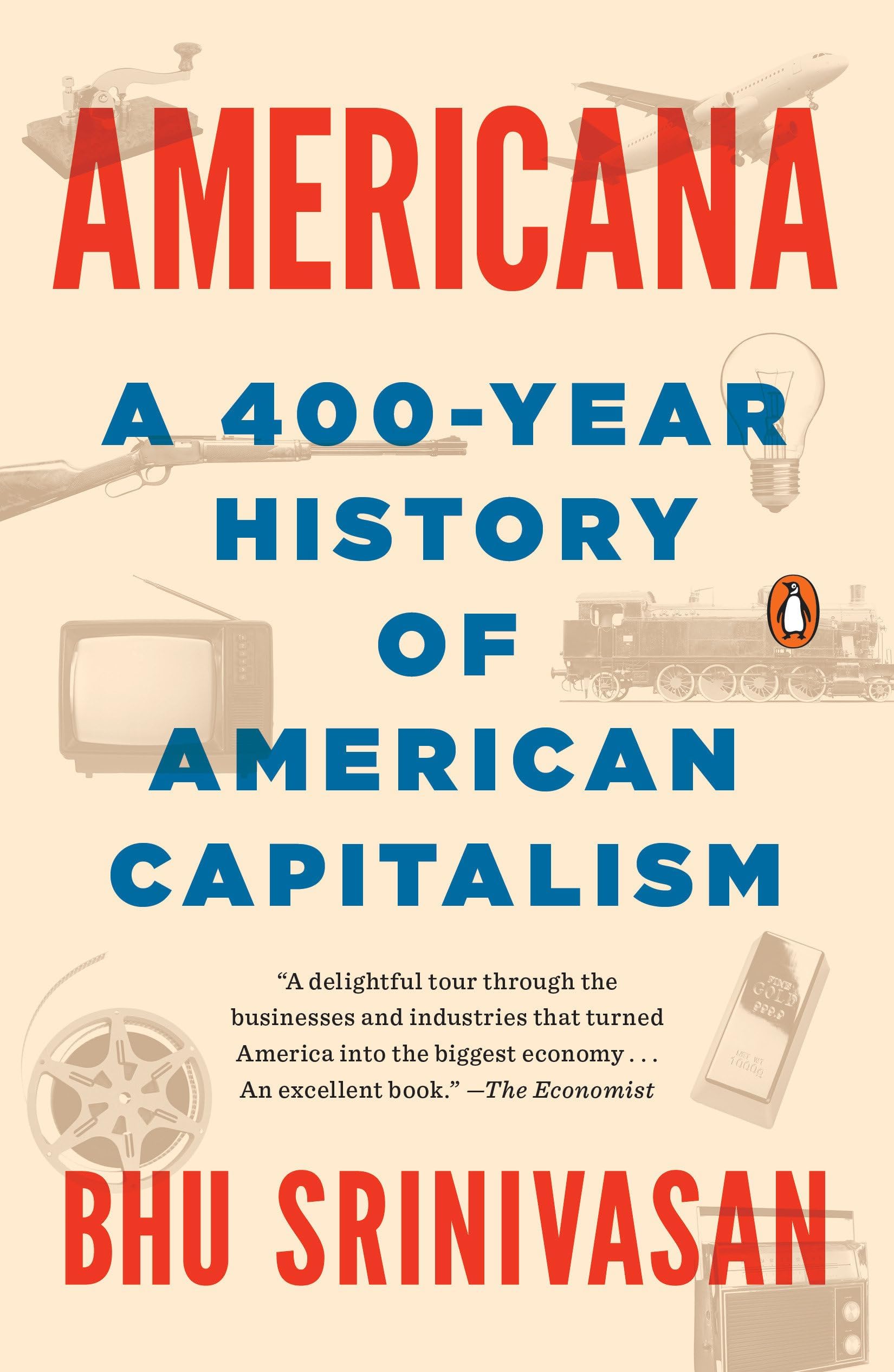
Americana: A 400-Year History of American Capitalism
Product ID: 117255279
Buy anything from 5,000+ international stores. One checkout price. No surprise fees. Join 2M+ shoppers on Desertcart.
Desertcart purchases this item on your behalf and handles shipping, customs, and support to Vietnam.
Named a Best Book of the Year by The Economist “A delightful tour through the businesses and industries that turned America into the biggest economy in the world. Not only is the book written in a light and informative style, it is cleverly constructed . . . An excellent book.” — The Economist An absorbing and original narrative history of American capitalism From the days of the Mayflower and the Virginia Company, America has been a place for people to dream, invent, build, tinker, and bet the farm in pursuit of a better life. Americana takes us on a four-hundred-year journey of this spirit of innovation and ambition through a series of Next Big Things — the inventions, techniques, and industries that drove American history forward: from the telegraph, the railroad, guns, radio, and banking to flight, suburbia, and sneakers, culminating with the Internet and mobile technology at the turn of the twenty-first century. The result is a thrilling alternative history of modern America that reframes events, trends, and people we thought we knew through the prism of the value that, for better or for worse, this nation holds dearest: capitalism. In a winning, accessible style, Bhu Srinivasan boldly takes on four centuries of American enterprise, revealing the unexpected connections that link them. We learn how Andrew Carnegie's early job as a telegraph messenger boy paved the way for his leadership of the steel empire that would make him one of the nation's richest men; how the gunmaker Remington reinvented itself in the postwar years to sell typewriters; how the inner workings of the Mafia mirrored the trend of consolidation and regulation in more traditional business; and how a 1950s infrastructure bill triggered a series of events that produced one of America's most enduring brands: KFC. Reliving the heady early days of Silicon Valley, we are reminded that the start-up is an idea as old as America itself. Entertaining, eye-opening, and sweeping in its reach, Americana is an exhilarating new work of narrative history. Review: Great book! Title and subtitle limit readership. - This book is a fascinating collection of bite-sized chapters that capture the history of America through portrayal of innovations and the development of dozens of American institutions - press, oil, retail, computers, regulation, transportation and many more. An easy read, lots of fun anecdotes that keep it light and lively - even my wife has enjoyed my repeated, "hey, you've gotta hear this!" interruptions - but very informative. Definitely more a history book than a business book. Author refers to it as a "time-lapse view of history" through 4 centuries of innovations, each regarded in its time as "the next big thing." Highly recommended! Review: I loved this book! - I bought this after seeing the author on TV answer his own question: How did the pilgrims - not a wealthy bunch - manage to rent a large sea-going ship, with an experienced crew and plenty of supplies? good question, and I was hooked! I’m an old woman who missed out on a history education because I could never read the textbooks. Srinivasan tells stories, and that’s the way history unfolds, isn’t it? And keeps me reading. If you already know it all, you’re going to be disappointed - but it wasn’t written for you. It was written for me. Sure, it doesn’t cover everything - the title tells you that - but it covers enough, with an important base to ground it, that I feel like I’ve had a worthy education. Thank you, Mr. S, I so enjoyed your wonderful writing, insights, and point of view, colored I think by having one foot in another culture as well as your success in America.
| Best Sellers Rank | #641 in Books ( See Top 100 in Books ) #1 in Economic Conditions (Books) #2 in Economic History (Books) #3 in World History (Books) |
| Customer Reviews | 4.7 out of 5 stars 811 Reviews |
P**I
Great book! Title and subtitle limit readership.
This book is a fascinating collection of bite-sized chapters that capture the history of America through portrayal of innovations and the development of dozens of American institutions - press, oil, retail, computers, regulation, transportation and many more. An easy read, lots of fun anecdotes that keep it light and lively - even my wife has enjoyed my repeated, "hey, you've gotta hear this!" interruptions - but very informative. Definitely more a history book than a business book. Author refers to it as a "time-lapse view of history" through 4 centuries of innovations, each regarded in its time as "the next big thing." Highly recommended!
C**E
I loved this book!
I bought this after seeing the author on TV answer his own question: How did the pilgrims - not a wealthy bunch - manage to rent a large sea-going ship, with an experienced crew and plenty of supplies? good question, and I was hooked! I’m an old woman who missed out on a history education because I could never read the textbooks. Srinivasan tells stories, and that’s the way history unfolds, isn’t it? And keeps me reading. If you already know it all, you’re going to be disappointed - but it wasn’t written for you. It was written for me. Sure, it doesn’t cover everything - the title tells you that - but it covers enough, with an important base to ground it, that I feel like I’ve had a worthy education. Thank you, Mr. S, I so enjoyed your wonderful writing, insights, and point of view, colored I think by having one foot in another culture as well as your success in America.
J**Y
A Fresh Take
I read this book while studying for the FSOT (it has been added to the recommended reading list). It is a great way to tackle economics and history at the same time. This book will take you though American history through an economic lens, from venture capital and the tobacco economy all the way through the internet and smart phones. Dealing with one concept/ focus area per chapter, the reader will see how the American economy has evolved over the past few hundred years, and the country with it.
H**A
The history of the United States described through its industry.
This book describes the industrial development of the United States over the last 400 years, whose favorable outcome has endured and made the country the world's leading power in its most recent history. To do this, Mr. Srinivasan chose 35 outstanding themes that he develops in an equal number of chapters. In each topic he emphasizes the circumstances of its origin and the individuals, who as pioneers, contributed to its success. The chapters are relatively short and do not include all the facts subsequent to those of the initial stage. The result is a pleasant and informative work for readers of various tastes and political tendencies. It is interesting to approach the history of a country from tangible events that since their inception have played so an important role in the lives of its inhabitants. This work is not about discussing political, economic, religious, philosophical or social ideas. The aim is to demonstrate the impact that many industries like radio have played in the capitalist advance of the American Nation. Mr. Srinivasan deserves our recognition for his efforts to present us with an unbiased work based on numerous citations and references, as well as for his impartiality since he does not neglect some Marxist concepts. For a better understanding of the history of the United States, this treatise should be read and reviewed many times.
A**I
Good Stuff
Lots to recommend here. We all know how Columbus paid for his voyages… the Queen of Spain. But how did the Pilgrims pay for their voyage to the new land? In just the first few pages, Bhu Srinivasan brings to light questions heretofore uncontemplated - yet just as poignant. No candy coating of slavery or the mistreatment of our American Indian foredwellers. Well researched and serialed the book is digestible and interesting.
J**N
Original view & easy-to-read,
Original view, easy-to-read, well researched and appropriate for both buff and novice. There have been several books written on the commerce & economic history of the U.S. This book says commerce & economics weren't a part of the history, but caused the history of the U.S. to be as it was. Srinivasan does it cleverly by breaking out different aspects of commerce as singular chapters and then shows how history is the cloth that was woven out of these aspects, rather than the other way around. The author tells this tale in a very readable fashion. This is not an academic treatise, even as the bibliography shows that the research is extensive and well sourced Srinivasan was able to look at old research with new eyes. The author brings to life many facts that have been forgotten, overlooked or ignored over the years and places them in a well conceived and executed framework. I believe one of the reasons for the well-told story is because the author is an immigrant. He looks at America and the American narrative with new eyes and without the baggage some of us carry that slants our interpretation of history. All in all, this is one of the best histories I’ve ever read.
N**E
loved it
Very pragmatic history, inclusive of the paradoxes that permeate the American experiment. Very useful to understand the present everywhere. Very American!
A**R
Really Good Book.
I learned so much from this book - on both a micro and a macro level. Great combination of history of the US and history of business. It's almost too much to put into one book, so at some times it becomes almost too high level. But written very well and I'd recommend it.
J**K
資本主義経済の大河ドラマ
ノーベル文学賞作家カズオ・イシグロ氏同様、幼少のころインドから米国に移民した作者。400年前メイフラワー号で来た清教徒移民のバックにヨーロッパの投資家がいた事実を初めに、米国経済を担ってきた資本主義の変節を毛皮取引、たばこ、蒸気船、密造酒、最後にモバイルと対象を変えながら資本主義とそれを支え、時には欠点を補った民主主義の本質に迫る。カーネギー、フォード、スティーブ・ジョブズ等の資本主義の巨頭が米国民そして世界の生活に与えた影響が興味深い。400年の経済史をミクロ、マクロの両方から記述されている各主題に親しみが持てる。資本主義経済の大河ドラマ。
P**K
Best
Best written book I've ever read. And the subject is interesting too.
G**R
A different view on US History
Usually, american history is told as a sequence of men in the White House. This author takes a different path. He sees US history from trade and innovation. While the pilgrim fathers starved in their first year on american soil, they soon found out that they could buy beaver furs from the natives and sell them with a profit to England. In the beginning, settlers often paid for the passage by working for the party who paid the bill by working for them for seven years. Tabacco, now a sin product, and cotton followed. As far as slavery is mentioned, things changed after California joined the Union. All considered, slave owners in the south had too much of their fortune in slaves. They would not give upthem without a fight. American history is, unlike other nations and Europe, a love affair with technology. This leads us to Silicon Valley. All considered, an entertaining book, worth your time. George Thaller
M**X
Such a good book!
Outstanding!
A**N
Comprehensive & interesting
Americana is a fascinating look into the various capitalistic ventures in America’s history, ranging from tobacco, cotton, and gold to slavery and from various industries to the American way of life. And in all of this, there’s a common thread, first voiced by Adam Smith — despite the risk of total loss, money finds its way to opportunity when the potential rewards are high enough. For a non-American like me, the nuances and origins of many of these were extremely interesting, especially factors such as slavery or anti-completive behaviour, which are clearly to be hated now but have played a role in America’s progress. In all of this, it is interesting to see how history repeats itself. The formation of “trusts” to overcome laws against pricing collusion and the government’s battles against them in the nineteenth century seems to have its echoes even now. The concept of venture or risk capital used to finance the first shipload of passengers to America came back after 350 years to fund technology companies. Or corporate America’s tendency to latch on to investor fads have remained unchanged from the time pointless trusts were formed to the time when existing companies rechristened themselves as “dotcoms” towards the end of the last century. Given the vast number of topics covered, there may be an element of superficiality in their coverage but Srinivasan’s focus is more on making it comprehensive rather than detailed. His writing is pacy and interesting which makes the 500+ page length quite easy to read. He makes an attempt at humour as well, as when he sardonically explains the movie Pretty Woman away by saying that it is entirely plausible that a call girl could serve as the moral compass for a financier! A bonus is the presence of several interesting factoids through the book. For example, slaves formed the single biggest asset class around 1850 with an estimated value of US$2.8 billion at that time. Or the origin of the term, “$300 man” is from the Civil War where rich men could pay that amount for a substitute to take their place. Or that the Remington typewriter is probably what facilitated women into the white-collared working class! Pros: A comprehensive look into nearly all of America’s capitalistic ventures, pacy and interesting Cons: Some superficiality in the coverage of topics
Trustpilot
1 week ago
3 weeks ago