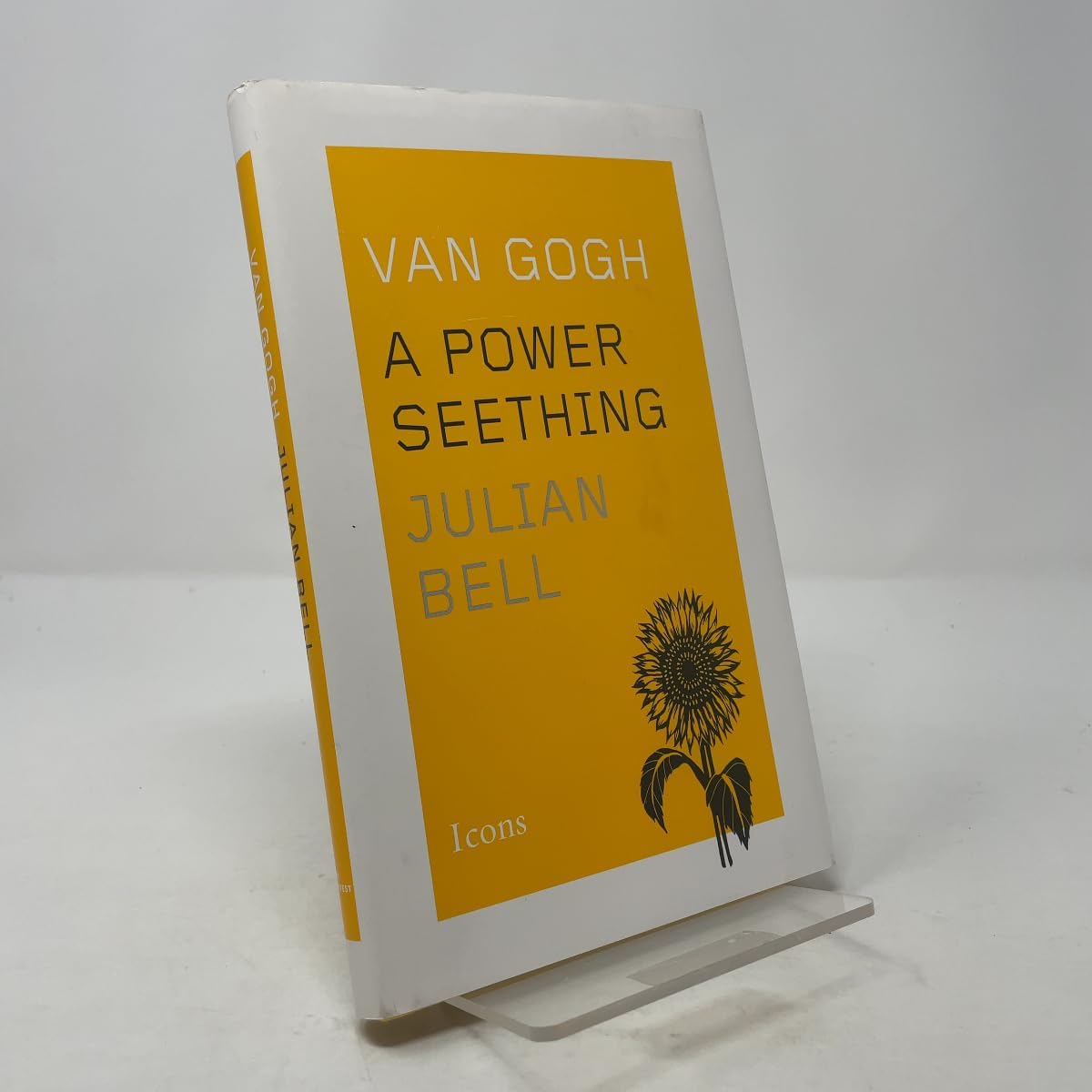



Van Gogh: A Power Seething (Icons)
Product ID: 11625176
Desertcart purchases this item on your behalf and handles shipping, customs, and support to Vietnam.
Van Gogh: A Power Seething (Icons) [Bell, Julian] on desertcart.com. *FREE* shipping on qualifying offers. Van Gogh: A Power Seething (Icons) Review: Beautiful biographical study--though not a monograph. - I loved this book: beautifully written, with great perception and empathy, giving vividly sensitive descriptions of the means by which Van Gogh's paintings convey meaning and artistic ambition, as well as what exactly inspired and influenced him in the work of other artists and in his personal life. The painter's state of mind at every turn in his life is conveyed. Bell has read Vincent's letters with real understanding and quotes from them enough to give a sense of his voice, while retaining objectivity. I loved the book. I could only wish for more illustrations so that I could trace the technical and stylistic changes easily as I read, but images of the paintings he refers to are readily available, so it wasn't too hard to look them up as I read along. Review: Psychological bio - Unlike most biographies, this one doesn't spend much ink compulsively detailing the objective facts. Those are given to the extent necessary for readers unfamiliar with Van Gogh's life, but the main focus is his emotional and psychological state at each turn. Of course, Van Gogh is a perfect subject for such treatment, as he was famously emotional and then famously insane and he wrote thousands of letters pouring his heart out to his brother and others. The author also attempts to apply Van Gogh's psychological state to his artistic decisions with regard to color, draftsmanship and subject matter. A great read for those interested in psychiatry and its interface with art and Nineteenth Century European history.
| Best Sellers Rank | #3,734,455 in Books ( See Top 100 in Books ) #551 in Dutch History #590 in European Art History #1,276 in Art Movements (Books) |
| Customer Reviews | 4.0 4.0 out of 5 stars (286) |
| Dimensions | 5 x 1 x 7 inches |
| ISBN-10 | 0544343735 |
| ISBN-13 | 978-0544343733 |
| Item Weight | 10.4 ounces |
| Language | English |
| Part of series | Icons |
| Print length | 163 pages |
| Publication date | January 1, 2015 |
| Publisher | New Harvest |
R**R
Beautiful biographical study--though not a monograph.
I loved this book: beautifully written, with great perception and empathy, giving vividly sensitive descriptions of the means by which Van Gogh's paintings convey meaning and artistic ambition, as well as what exactly inspired and influenced him in the work of other artists and in his personal life. The painter's state of mind at every turn in his life is conveyed. Bell has read Vincent's letters with real understanding and quotes from them enough to give a sense of his voice, while retaining objectivity. I loved the book. I could only wish for more illustrations so that I could trace the technical and stylistic changes easily as I read, but images of the paintings he refers to are readily available, so it wasn't too hard to look them up as I read along.
C**I
Psychological bio
Unlike most biographies, this one doesn't spend much ink compulsively detailing the objective facts. Those are given to the extent necessary for readers unfamiliar with Van Gogh's life, but the main focus is his emotional and psychological state at each turn. Of course, Van Gogh is a perfect subject for such treatment, as he was famously emotional and then famously insane and he wrote thousands of letters pouring his heart out to his brother and others. The author also attempts to apply Van Gogh's psychological state to his artistic decisions with regard to color, draftsmanship and subject matter. A great read for those interested in psychiatry and its interface with art and Nineteenth Century European history.
M**S
another perspective of the artist
Van Gogh: A Seething Power is a biography of artist Vincent van Gogh (1853-1890) based on the artist’s letters to his brother Theo and others. After Steven Naifeh and Gregory White Smith’s 953-page biography Van Gogh: The Life (2011), what else is there to say? This 176-page book skims through everything. Quickly readers see van Gogh in 1877 in his early 20s, quitting his studies to become a pastor, as he says in a letter: ‘One sometimes gets the feeling, where am I? what am I doing? where am I going? and one starts to grow dizzy.’ Dashing to 1883 ‘the ever-hard-up, ever-fractious edge-of-town loner with the benefactor brother shuttled between various lines of artistic research.’ Decriptions of the artist’s days in Antwerp and Paris provide more of the author’s passion, if not detail, and more interest for readers as van Gogh experiences challenging brotherly ties with Theo, a deep friendship with fellow artist Henri de Toulouse-Lautrec, and tempestuous nights with Paul Gauguin. To 1888 and the solitude of the sea brings about van Gogh’s ‘colourist’ period, but also his troubles, as he cuts off part of his ear. Bell briefly elaborates on the breakdown years. Enter Johanna van Gogh-Bonger, his brother’s wife in 1890, who ‘more than any single person aside from Vincent and Theo themselves, was responsible for the iconic status that van Gogh now possesses.’ And so the biography becomes more interesting. There is still the question: why another Vincent van Gogh book? Julian Bell wrote the book because he loved ‘the letter writer of heart piercing eloquence.’ Bell’s premise is that there were three facets to Vincent van Gogh: the painter, the letter writer, and the social misfit ‘tearing a ragged course through the late nineteenth-century Netherlands and France.’ Bell’s objective is to present an interpretation of why van Gogh’s letters were often ‘at odds’ with what he ‘actually painted and with the record of his actions’ – the gap between the three facets of the man. Given that this biography gets rapidly to the point, it’s a quick read, like a sprint: quick out of the blocks, a period of slow motion, then the most exciting part at the last 10 metres – and it’s all over before you know it. Nevertheless, for van Gogh lovers, this is another perspective in understanding the man and his paintings.
A**K
Valuable introduction to the work of a great artist
Unlike many popular articles about Van Gogh, Julian Bell's book does not give us many stories about the artist's eccentricities but concentrates on his artistic growth. Like most people, I have been aware of Van Gogh's paintings for many years and have enjoyed seeing them in museums here and abroad, but I did not know much about what influenced Van Gogh and why his painting developed in the way that they did. I found this book fascinating. It does not assume that the reader is a scholar or a professional artist, but discusses the paintings in a way that expands the average viewer's appreciation of one of the great modern European painters.
B**R
A Power that Remains
Superb biography that helps better appreciate the exceptionally tortuous life of Vincent Van Gogh. Bell references the letters and the art as he pulls the reader through the path of creativity and eternity. Best to read while looking carefully at the art. It seethe with the passion of a soul possessed.
D**D
This is a critical biography written by an artist who is himself one of our foremost painters. It is based on a close reading of the letters and, although self-published, is a must read for lovers of Van Gogh. It is an intimate reading of the life which gets below the popular accretions which have gathered around the artist over the tears. Bell is certainly one of our best critical writers and his reading of Van Gogh who he clearly loves is persuasive and powerful. A must read.
D**D
As a general reader I found this an interesting account which threw further light on Van Gogh's art. As a doctor I would have liked more discussion of Van Gogh's medical conditions. As a minister I was intrigued by the treatment of Van Gogh's religious experience. I felt the end was too abrupt and would have benefited from summing up and appraisal of legacy.
T**R
A facinating insight into the short life of a frequently insane and creative personality. That his brother Theo kept Vincent's letter made possible our ability to visualise the torment of the "sunflower painter" with his obsession with colour. This book is well written without the usual nonsense which one associates with art critics. I would recommend this to anyone interested in art and life on the continent at the turn of the nineteenth century.
A**A
If you're fascinated by van Gogh, you'll like this in-depth account of how he came across to his family and his contemporaries. And find it all the more surprising that he ended up as a world figure, after such an obscure and painful life.
D**4
This book details Vincent's family life and the conflicts he experienced. Very interesting and an easy read.
Trustpilot
4 days ago
3 days ago