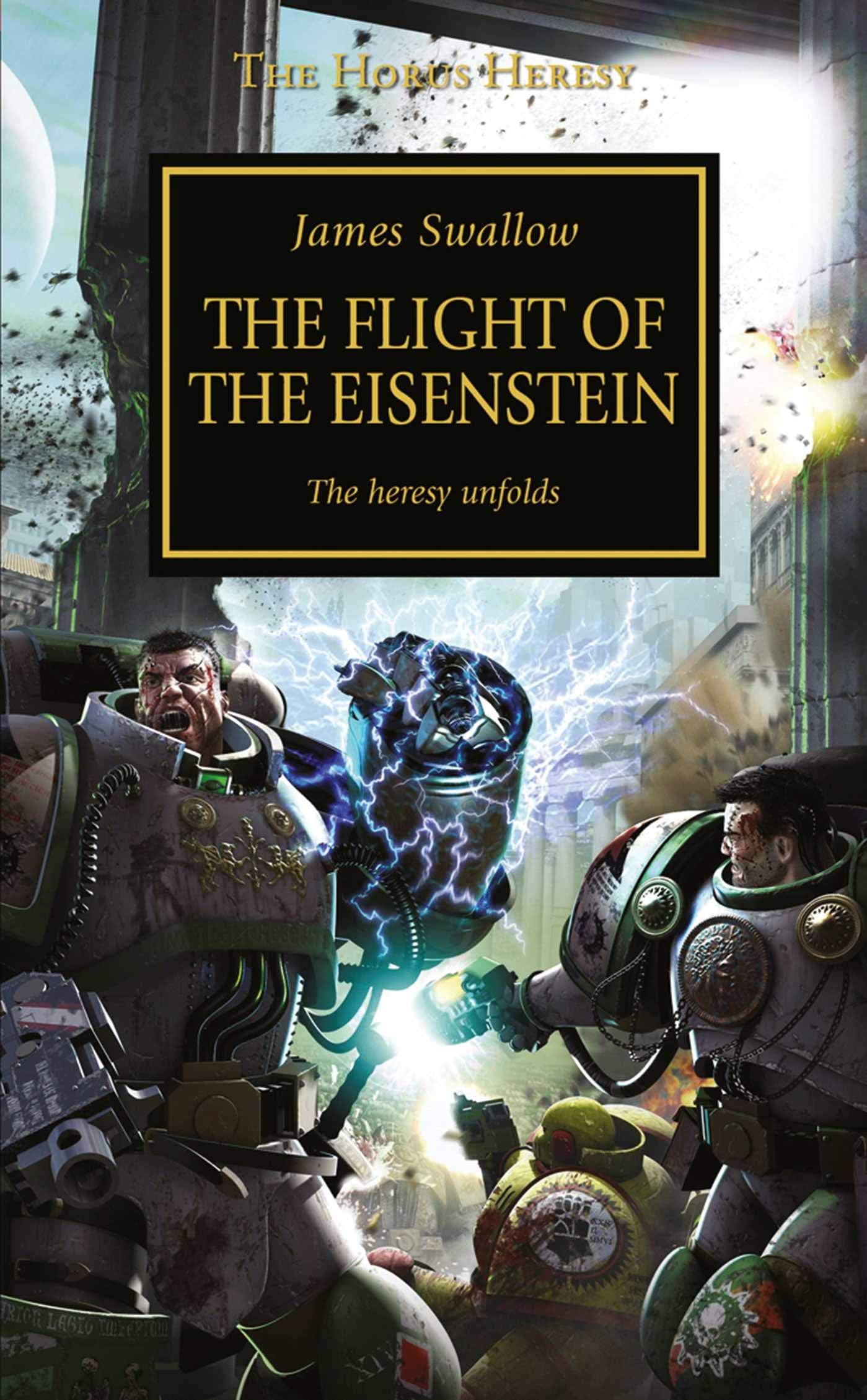
The Flight of the Eisenstein (The Horus Heresy)
Product ID: 115221278
Buy anything from 5,000+ international stores. One checkout price. No surprise fees. Join 2M+ shoppers on Desertcart.
Desertcart purchases this item on your behalf and handles shipping, customs, and support to Vietnam.
Book four in the New York Times bestselling series. This is a reissue of 9781849708128 Having witnessed the events on Istvaan III, Deathguard Captain Garro seizes a ship and heads to Terra to warn the Emperor of Horus' treachery. But the fleeing Eisenstein is damaged by enemy fire, and becomes stranded in the warp. Can Garro and his men survive the depredations of Chaos and get his warning to Terra in time? This is a reissue of 9781849708128. Review: By the Book or Buy the Book - My favorite book in the Horus Heresy series is Ben Counter's "Galaxy in Flames." The reason being that it gripped me and moved me. More often than not I have had a hard time identifying with the space marines. They seemed too god-like, too cold; just heart-less killing machines. Counter made me care about the marines. James Swallow's book "Flight of the Eisenstein" follows Counter's book and moves the plot forward. In many respects I found Swallow's book equal too and sometimes superior (a hard call)to "Galaxy in Flames." Some of the characters from the previous book re-appear and we see events from the earlier books played out from the point-of-view of members of the Death Guard. The protagonist of "Flight of Eisenstein is Battle-Captain of the 7th Company of the Death Guard--Nathaniel Garro. For the most part, we see the action through his pov, although Swallow breaks the unity from time to time to enter the minds of subordinate characters. The book begins with an attack on a Jorgall ship, where we see both the Death Guard and the Oblivion Knight, Amendera Kendel, in action. A psyker's warning of impending doom alerts the reader to treachery ahead and the action begins. The "Flight of the Eisenstein" shows us Horus's strategy becoming visible in the battles of the Isstvan sector. It also develops the rise of the new saint Euphrati Keeler. These plot points are important to the overall development of the series; however, Swallow has presented some interesting touches. The description of the ship's trip through the warp seemed particularly clear and cogent; the hatred of Grulgor was palpable and handled well; the infestation and contamination of Decius was logical and well-developed; the description of the Luna base was brilliant; and the conversion of Garro was believable. In summary, Swallow writes a clear serviceable prose that moves the story along. His fantastic descriptions are quite realistic. I found it a very satisfying novel. Review: The Emperor Protects - When I first read a Warhammer 40,000 story, it was "Cadian Blood" by Aaron Dembski-Bowden, the first story in the Honour Imperialis anthology. The bad guys in it were the XIV Legion, the Death Guard, plague-stricken Space Marines. I'm not much into rot and decay and grotesque things, but I thought the Death Guard were cool bad guys, and after reading the Warhammer 40,000 wikia's overview of the Horus Heresy, I decided I absolutely had to see the XIV as heroes before their fall to the service of the Chaos God Nurgle, Lord of Decay. This novel starts some time before the Horus Heresy kicks off, despite being fourth in that saga. Death Guard Battle-Captain Nathanial Garro, an Earth-born Space Marine of honor and courage, fights the Emperor's Great Crusade, killing aliens and securing space for the Imperium of Man. While doing so, he is given a chilling warning, a prophecy that all he holds dear will be destroyed. Dismissing it, he continues to follow orders until Horus and several Primarchs (super-warrior generals who command the various Legions) betray the Imperium and slaughter many loyalist Marines. Horrified, Garro and his frigate manage to barely escape from the battle, but in doing so they encounter a glimpse of their ultimate enemy, Chaos itself. Desperate to deliver news of Horus's betrayal to the Emperor, the captain and his allies take chance after chance, but the risks grow greater as the stakes rise, and their own fellow warriors may not be ready for the stunning truth Garro carries. If you are unfamiliar with Warhammer/40,000, the novels are lengthy but often well-written. They do not skirt violence, though, and you will often find yourself reading brutal fight scenes, wherein combatants are cut open, torn limb from limb, set ablaze, infested with plague and insects, and more. These are war stories, because as the saying goes, "In the 41st millennium, there is only war." While this novel takes place in the 31st, it is still fairly graphic, though you will find that the scenes depicting such are not outnumbering the more ordinary violence of gunfights or character introspection. The characters are very well done, and you can connect with both the factual and secular Garro, who does not have time for gods or superstition and his servant Kaleb, who believes that the Emperor is a living god and that worshiping him is the right thing to do. By the book's end, you see that there are false gods and real ones, and the consequences of losing faith in the genuine article and the rewards of holding true to your spirit. If you want a novel about space-faring super-soldiers who find out their leaders aren't all they thought they were and that true horror awaits them if they fail to fight the good fight, but who also find themselves stronger in the face of adversity, then this novel is for you.
| Best Sellers Rank | #13,435 in Books ( See Top 100 in Books ) #289 in Military Science Fiction (Books) #302 in Space Operas #551 in Science Fiction Adventures |
| Customer Reviews | 4.7 out of 5 stars 4,429 Reviews |
K**Y
By the Book or Buy the Book
My favorite book in the Horus Heresy series is Ben Counter's "Galaxy in Flames." The reason being that it gripped me and moved me. More often than not I have had a hard time identifying with the space marines. They seemed too god-like, too cold; just heart-less killing machines. Counter made me care about the marines. James Swallow's book "Flight of the Eisenstein" follows Counter's book and moves the plot forward. In many respects I found Swallow's book equal too and sometimes superior (a hard call)to "Galaxy in Flames." Some of the characters from the previous book re-appear and we see events from the earlier books played out from the point-of-view of members of the Death Guard. The protagonist of "Flight of Eisenstein is Battle-Captain of the 7th Company of the Death Guard--Nathaniel Garro. For the most part, we see the action through his pov, although Swallow breaks the unity from time to time to enter the minds of subordinate characters. The book begins with an attack on a Jorgall ship, where we see both the Death Guard and the Oblivion Knight, Amendera Kendel, in action. A psyker's warning of impending doom alerts the reader to treachery ahead and the action begins. The "Flight of the Eisenstein" shows us Horus's strategy becoming visible in the battles of the Isstvan sector. It also develops the rise of the new saint Euphrati Keeler. These plot points are important to the overall development of the series; however, Swallow has presented some interesting touches. The description of the ship's trip through the warp seemed particularly clear and cogent; the hatred of Grulgor was palpable and handled well; the infestation and contamination of Decius was logical and well-developed; the description of the Luna base was brilliant; and the conversion of Garro was believable. In summary, Swallow writes a clear serviceable prose that moves the story along. His fantastic descriptions are quite realistic. I found it a very satisfying novel.
P**H
The Emperor Protects
When I first read a Warhammer 40,000 story, it was "Cadian Blood" by Aaron Dembski-Bowden, the first story in the Honour Imperialis anthology. The bad guys in it were the XIV Legion, the Death Guard, plague-stricken Space Marines. I'm not much into rot and decay and grotesque things, but I thought the Death Guard were cool bad guys, and after reading the Warhammer 40,000 wikia's overview of the Horus Heresy, I decided I absolutely had to see the XIV as heroes before their fall to the service of the Chaos God Nurgle, Lord of Decay. This novel starts some time before the Horus Heresy kicks off, despite being fourth in that saga. Death Guard Battle-Captain Nathanial Garro, an Earth-born Space Marine of honor and courage, fights the Emperor's Great Crusade, killing aliens and securing space for the Imperium of Man. While doing so, he is given a chilling warning, a prophecy that all he holds dear will be destroyed. Dismissing it, he continues to follow orders until Horus and several Primarchs (super-warrior generals who command the various Legions) betray the Imperium and slaughter many loyalist Marines. Horrified, Garro and his frigate manage to barely escape from the battle, but in doing so they encounter a glimpse of their ultimate enemy, Chaos itself. Desperate to deliver news of Horus's betrayal to the Emperor, the captain and his allies take chance after chance, but the risks grow greater as the stakes rise, and their own fellow warriors may not be ready for the stunning truth Garro carries. If you are unfamiliar with Warhammer/40,000, the novels are lengthy but often well-written. They do not skirt violence, though, and you will often find yourself reading brutal fight scenes, wherein combatants are cut open, torn limb from limb, set ablaze, infested with plague and insects, and more. These are war stories, because as the saying goes, "In the 41st millennium, there is only war." While this novel takes place in the 31st, it is still fairly graphic, though you will find that the scenes depicting such are not outnumbering the more ordinary violence of gunfights or character introspection. The characters are very well done, and you can connect with both the factual and secular Garro, who does not have time for gods or superstition and his servant Kaleb, who believes that the Emperor is a living god and that worshiping him is the right thing to do. By the book's end, you see that there are false gods and real ones, and the consequences of losing faith in the genuine article and the rewards of holding true to your spirit. If you want a novel about space-faring super-soldiers who find out their leaders aren't all they thought they were and that true horror awaits them if they fail to fight the good fight, but who also find themselves stronger in the face of adversity, then this novel is for you.
S**R
Rises to the Occasion
James Swallow takes up the fourth novel of the Horus Heresy series, which follows one of the pivotal historical events of Games Workshop's Warhammer 40,000 universe. This novel tells the tale of Battle-Captain Nathaniel Garro of the Death Guard, a minor character in the previous books, and at its core this is a tale of his personal growth and discovery, though action features heavily as well. He is cut of the same cloth as Captain Garviel of the Sons of Horus Legion and main protagonist from the first novels: able, principled, and introspective. Several Primarchs and historical characters make appearances, including: Horus, Rogal Dorn, Mortarion, Captain Typhon (Death Guard), Captain Tarvitz (Emperor's Children), Captain Sigismund (Imperial Fists), and others. I have been a vocal critic of M. Swallow's past works for the Black Library, which have been long on purple prose and dues ex machina, and short on background knowledge and plot, so I picked up this book with no small amount of trepidation. However, I must say that this is easily his best work and is a worthy successor to the other Horus Heresy books. The characters have depth, realistic motivations and reactions, and grow in ways that make sense. Particularly telling is Garro's development as he attempts to come to terms with the betrayal of his own Primarch and that of Horus. Without going into anything that would spoil the plot for others, let's just say that it's well done The action scenes flow well, and convey an excellent sense of urgency. The opponents don't make stupid mistakes for the sake of the plot - a weakness in M. Swallow's prior works. His descriptions of the Primarchs, particularly Mortarion, feel slightly mundane once or twice, but typically have the proper sense of awe. The ending of the book gives a tantalizing hint of things to come without being a tease. In short: a solid addition to the Horus Heresy series and a good read that you'll have trouble putting down.
A**M
great read
Great read, and tied in perfectly to the books before it. Shaping up to be an even better series than anticipated
A**R
Omg
This is the best book so far. I could not put it down until finished. I am now buying the next immediately!!
M**9
Great gift
Gift for my husband who loves war hammer 40k
N**Y
Book 4
This series is the first one in a while that I have to make a conscious to stop reading, or else I'd late for pretty much everything. Flight of the Eisenstein is dope because it shows what the true Astartes are doing while Horus is off being a silly goose, but the 40K version of a silly goose which is in fact genociding entire planets...
L**S
A good story, but it holds up the overall story of the series
Pleasantly surpprised. Nathaniel Garro is a decent character, even if he is a bit of a cookie cutter marine. the pacing is good, compared to later entries. It suffers a bit from the same as the entire heresy series. it is so packed with characters that it get's hard to keep all of it together.
P**N
The Flight of the Eisenstein
Stunningly good read. Powerful and emotional moments abundant. Nathaniel Garro's character will continue to enthrall and excite as his story within the grim dark unfolds.
G**O
FENOMENALE!!!
COME GLI ALTRI TRE LIBRI ASCESA DI HORUS, FALSI DEI E GALASSIA IN FIAMME, PRIMA DI QUESTO, MA QUESTO IN ASSOLUTO, HA AVUTO UN SAPORE SPETTACOLARE!!
S**R
The flight of eisenstein
Nothing to dislike for myself in this book, good action, good pace, some nice illustrations albeit scarce. Great read and great story.
K**S
The flight of the Eisenstein and the birth of Heroes
What a pleasant surprise guys :O I must admit that I had no expectation regarding that book before reading. I had only been hearing miscellaneous reviews here and there : epic, dull, interesting, unnecessary. But my opinion is clear on the matter : the Flight of the Eisenstein is undeniably a high quality book. Admittedly, it's not as epic as the First Heretic, Betrayer or Horus Rising but it's almost every bit as good as them ! James Swallow manages to steer the story in a very compelling way. We discover the great character named Nathaniel Garro. The only beacon of hope who can bring the news of Horus' betrayal to Terra. And most importantly, we learn to like him and to root for him. This book contains so much lore about the Death Guard legion : its customs, its ways, its fighting style, why the legionaries drink poison for breakfast, the internecine oppositions and their fall to chaos. In the face of sheer madness, appalling damnation and certain death stands Garro. Unyielding. Proud. Staunch. Loyal to his oath to mankind. The flight through the void is harsh, costly and exhausting but the reading is highly enjoyable and it will keep you hooked until the very last page ! A legion falls, heroes rise and Primarchs get ready for an all-out conflict. If you wish to know more about the early stage of the Heresy then go get a copy of that book ! Best regards guys :)
R**R
Good Read
The book didn't disappoint. I was sad Loken's story ended with the 3rd book. Here we have Garro as the protagonist. So far i have enjoyed the horus heresy series.
Trustpilot
3 weeks ago
1 month ago