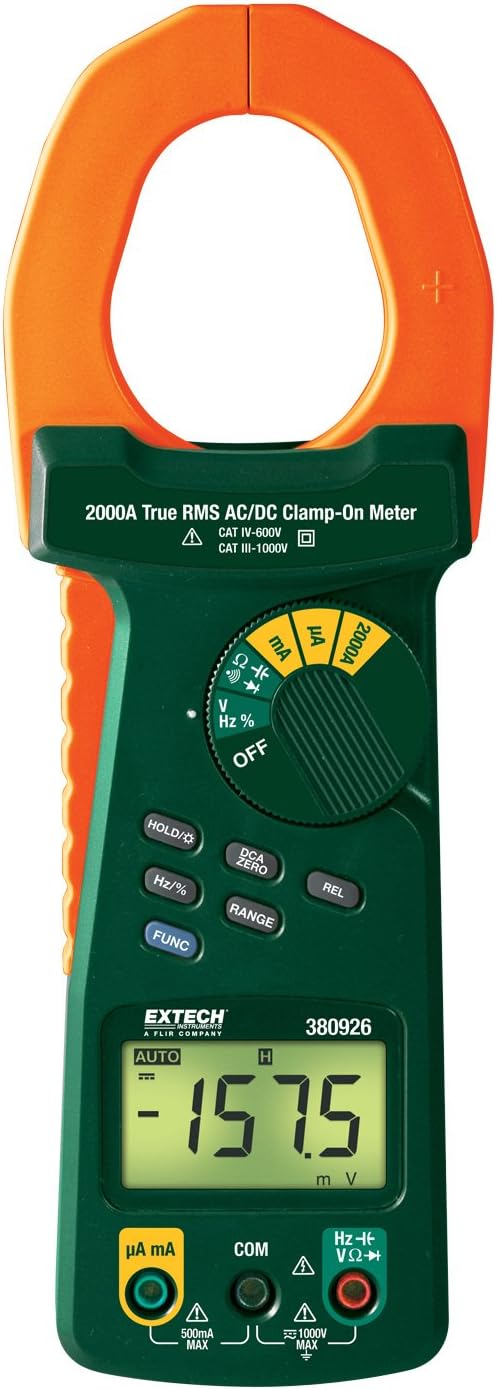
Extech 380926 True RMS 2000A AC/DC Clamp Meter
Product ID: 10170698
⚡2000A AC/DC clamp capacity
🔋Auto power off & battery saver
🌡️Temp range -58°F to 572°F
Buy anything from 5,000+ international stores. One checkout price. No surprise fees. Join 2M+ shoppers on Desertcart.
Desertcart purchases this item on your behalf and handles shipping, customs, and support to Vietnam.
⚡ Clamp it. Measure it. Master it. The ultimate pro’s multitool.
The Extech 380926 True RMS Clamp Meter is a rugged, professional-grade tool designed for precise AC/DC current and voltage measurements up to 2000 amps. Featuring a large backlit display, temperature sensing from -58°F to 572°F, and smart battery-saving functions, it’s engineered for demanding industrial and home diagnostics. Complete with test leads and a 9V battery, this meter delivers reliable, all-in-one performance trusted by technicians and engineers alike.




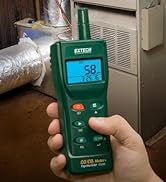


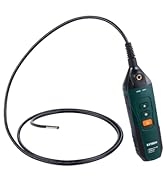
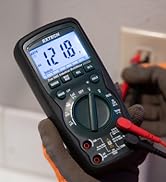


| ASIN | B0000WTZ0Y |
| Best Sellers Rank | #45,832 in Industrial & Scientific ( See Top 100 in Industrial & Scientific ) #53 in Clamp Meters |
| Brand | Extech |
| Brand Name | Extech |
| Color | Multicolor |
| Customer Reviews | 4.3 out of 5 stars 557 Reviews |
| Global Trade Identification Number | 00793950389263 |
| Included Components | Complete with test leads and 9V battery |
| Item Dimensions | 2.9 x 1.5 x 10 inches |
| Item Weight | 0.4 Kilograms |
| Item dimensions L x W x H | 2.9 x 1.5 x 10 inches |
| Manufacturer | Extech |
| Measurement Type | Multimeter |
| Model | 380926 |
| Part Number | 380926 |
| Power Source | Battery Powered |
| Specification Met | CE |
| Style | 380926 |
| Style Name | 380926 |
| UPC | 793950389263 793950389270 |
| Unit Count | 1.0 Count |
| Upper Temperature Rating | 572 Degrees Fahrenheit |
| Warranty Description | 1 year |
P**T
Extech meters are awesome
This is not an especially expensive meter, but it works well for me. I like the clamp jaws as they hold the meter so I can use both hands to probe circuits.
C**)
Very capable meter!
I did not have a clamp meter for home use previously but have used current clamps in the past at work for measuring inrush currents and current draws on power supplies which were done using multi-thousand dollar Tektronix equipment. And while I haven't compared this clamp meter to a reference like that there are videos of others doing similar things on youtube that show how accurate these little meters are. This one is set apart from most others in that it will measure DC current and temperature which not all clamp meters will do and I wanted an all-in-one solution to replace my circa 1980's Micronta true RMS multi-meter. It is nicely built with a solid feel and a good albeit single line display. Ergonomically it has nice graphics with good legend contrast except for one area. The rotary switch. While the action of the switch has great feel with firm detents for each position and a nice knurled and rubberized outer ring it has a position indicator that is a short pointer bar recessed into the top of the green part of the switch. It is very difficult to tell what it is pointing to unless you have good light. I'm sure Extech decided that the tooling and manufacturing cost of having of a double-shot version with a high contrast indicator would be too much for the price point they were shooting for on this meter. As compromises go this is a good one in my view. Functionally the meter has everything one is likely to need and for home use its accuracy is more than adequate. AC voltage and current readings are true RMS with crest factor adjustment percentages listed in the manual for those who want to measure non-sinusoidal waveforms and who care about such things. I had an issue recently with my heat pump. The service technician had a Fluke clamp meter and I though this would be a good opportunity to compare the Extech to the much more expensive Fluke. So we measured the current of the compressor motor and both meters read essentially the same (within a 100mA of each other) on a 12A reading. We did some voltage readings as well and found those to be virtually identical. Not bad! Over the last couple of months since I received the Extech MA445 I've measured precision resistors, film caps, temps, line frequency, diode drops and tried out the NCV function. Everything works accurately and as advertised. Couldn't ask for anything more considering the very reasonable cost.
A**E
Great tool. Many features, and they work!
I bought this to measure current at various locations in my solar electric system. This little unit has all the ability to measure both AC and DC current, but it can also measure frequency, has a data hold function, an LCD backlight, and even a flashlight! One nice bonus feature is a small glowing indicator in the tip that shows "hot" conductors without actually touching them. You can put it next to a plugged in extension cord, and the indicator glows, or near a household socket. This can be really handy for electrical types who want to avoid the bite of an live wire. I discovered it will even show low voltage wires, not just 115V household levels. One last good thing is that it uses standard batteries, and not those little lithium or button cell batteries. All in all, I got a multi-useful tool at what I consider a reasonable price.
C**T
Great general purpose multimeter.
In my opinion, Fluke makes the best electrical test equipment available. Unfortunately, their price is much higher than anything else comparable on the market, and they don't make anything that's anywhere close to as all-encompassing as the EX623. As a stationery engineer, there are many different types of systems that I maintain and test, including electrical and refrigeration. Before the EX623, I used to keep two multimeters with me along with an IR thermometer and a digital thermometer. As you can imagine, I was pretty excited about the 623. I've owned the Extech EX623 for a few months now, and have come to use every one of its functions, though some of which much more than others. Some seem to be impressively accurate, while others are less so, and take several seconds to settle to zero. The AC clamp seems pretty accurate, though I do get a reading of .18 when first turning it on, taking up to ten seconds to settle into .03A, which is more just annoying than actually a problem. The peak current setting is nice and works well for telling the LRA of motors. The DC clamp has a digital zero which is a nice upgrade from meters with a manual dial that I have used in the past. The microAmp feature is nice and seems very accurate, although admittedly this is not a function that I use often myself. Probably the most used feature is also the one I'm least pleased with: the Ohmmeter. There are various ranges for resistance that can be selected, but I typically leave it on auto-range. As a result, most things I check will show up hundredths of Ohms, and for some reason the meter will never settle on anything in that range. It will also take several seconds to read resistance of anything accurately, typically starting out with a higher than actual reading then eventually finding and settling on the correct resistance. I've not owned something that does anything like this, and while it does not affect testing 98% of the time, it is annoying. The EX623 also has a diode test setting, and a continuity setting which emits a beeping when resistance is below 50 Ohms. The voltmeter is also something that has occasionally been a bit of a nuisance for me, more due to personal error than anything else. Like the ohmmeter, when first selected the 623 defaults to auto-ranging. Likely as an effect of just picking up electrical noise, the meter will display a reading of 10-20mV, though when near a power source up to 500mV with nothing connected. This has sometimes led me to believe that a unit is powered even though it is not, especially 208 Volt systems where irony has it the meter will often display 212mV, forcing me to pay extra attention. I've been trying to get in the habit of selecting a higher range to avoid this. My other complaint would be that the EX623 seems to take a bit longer to give a reading, first giving an "OL" then the measurement a second later. My other meters seem to be a bit less delayed. Otherwise the voltmeter is perfect. The capacitance check seems very accurate as well, and has an unusually high range of 40,000mF. I have never needed to test a capacitor that big, but it is a nice feature nonetheless. The duty cycle/frequency feature is something that I can't comment that well on because I only really work with power from a 60Hz source and have not worked with any variable speed motor drives. Even generators have given a steady 59-60Hz reading. What is cool is that the ExTech will also display frequency in smaller text at the bottom of the readout screen in any the the settings other than resistance and temperature. The non-contact voltage detector also works in any setting except temperature and has all but eliminated the need for my standalone NCVD. Like most built-in multimeter NCVs, I've found it to be extremely sensitive, picking up voltages from receptacles and through heavily insulated NM cables, but also picking up voltages several inches away from TVs and fluorescent lights. The IR thermometer with laser pointer is also truly a unique feature on a multimeter and has been much more handy than expected, being used to check surface temperatures of motors and other devices where I would not have normally brought a separate thermometer. The dual K inputs are great for refrigeration work, and the included probes are of decent quality though I plan on eventually replacing them with a heavier one and clamp on types for refrigerant and water lines. There is also a shutter to allow only the test leads or probes to be connected at a time to prevent the probes from being accidentally backfed from a voltage source connected to by the leads. Some other features that are nice are the backlight, though I do not like how it is activated (you need to hold the HOLD button for several seconds and then the light will automatically shut off after a period of time). Like most multimeters the EX623 will shut off to save battery after 30 minutes of inactivity, but this can be disabled which has been great for trying to find startup currents for units that are only intermittently on and difficult to force a startup. I do not like the obnoxious beeping noise emitted when selecting inputs and unfortunately it cannot be disabled. The included carrying bag is also a nice though but it is definitely not a high quality item, being made of thin, scratchy nylon fabric. It has still saved my multimeter and probes from being lost and knocked around in my toolbag and the shoulder strap or belt loop might be good for someone that would carry it around constantly. Overall I am pretty happy with the ExTech EX623 and would definitely recommend it to anyone that troubleshoots and repairs a wide range of equipment. It is a little slower than I am used to and also a bit more sensitive with its readings, but so far has proven to be accurate and dependable. It has replaced many older standalone pieces of test equipment that I used to keep with me daily, including another non-clamp multimeter and a IR thermometer. I would be more satisfied if the measurements were a bit faster and if (even though it's not typical of a clamp meter) there were a built in stand so I didn't have to find something to clamp on to or rest against to see the display. It would have also been nice to have an option to test current in line in the 10 Amp range. Otherwise, The ExTech EX623 is definitely a great tool at an even better price. About the only thing I wouldn't use it for is working strictly in electronics, where I prefer to use a different multimeter with a few different functions and features.
D**D
Does not live up to the other reviews...
I bought this meters because it offers 4-digit accuracy for its measurements. I had a feeling that it was too good to be true, but the reviews here seemed to say otherwise. Well, turns out the accuracy is a farce. Cons: ------------------------------------------------------------- * Every feature seems to have a drift of +/- 20 of the last significant digit. This is in addition to being more than 50 digits off before zeroing in Amps DC mode. Whether I'm measuring something a solid of constant temperature, I tend to have 2.0°C range (which is 4.0°F) within the time span of any two minutes; or if I'm measuring Amps, I tend to have up to +/- 0.20A when no current is running through the meter; or if I'm measuring Volts, .0020 Volts is very good when no current is running. * Consequence: because the meter's always drifting, it thinks it's always being used, and so the auto-off function never kicks in. After measuring the first evening, the measurements were so off that I went to leave this review, forgetting to turn it off. The next morning, the battery was too dead to measure readings -- but, not too dead to keep the meter running. The meter was showing "---.--", further draining the battery; however, even then, the auto-off function didn't kick in -- apparently, the battery didn't provide enough juice for the auto-off function to work. * Another consequence: low current measurements are way off, and are in no way reliable. Just one example: I put the clamp around a circuit with 0mA; the meter is drifting around 200mA. I turn 100 mA current on; within 10 seconds, the average of the meter's drift climbs to about 250mA. After about 30 more seconds, the drift is back to around 210mA. Turning the current off has absolutely NO effect on the center of the drift. Apparently, this is in line with the specs -- my fault for not seeing this before purchasing. Just a side note that, when measuring currents as high as 1.00A, the accuracy of +/- 2.8% + 30 digits means that a reading of 0.67A, or two-thirds of the actual current, is also within specs (meter was showing 0.68-0.69 before the drift). * However, there are enough things about this meter that do not live up to the specs. One example is, voltage readings are very unreliable. When the leads are not touching, the voltage shown drifts beyond .4000 V, sometimes displaying as AC (as easily demonstrated by clicking "MAX" when the leads are not touching). This is off by almost 5000 of the last significant digit. When measuring a 12V AC current, the meter drifts starting around 1.3V to about 2.6V, the whole time insisting that the current is DC. Removing one of the leads makes the current float between 3.2V and 3.6V -- also DC. Funny thing, though -- when measuring the frequency of this current, it shows it's 60 Hz fairly accurately. However, the meter insists the current is DC, and refuses to show the correct reading as AC. This is a true RMS meter; wonder what the shape of the curve is, lol. Also, a side note that, touching the leads one to another *does* display that the voltage is zero (give or take up to 20 digits, as usual). Addendum: before returning the meter, another day I needed to measure ~6A DC current, so I plug in my meter to compare readings to this one. This meter detected the current as AC, with a frequency of 4.0Hz (the frequency is displayed together with the current together on the display). Obviously, the amps were way off. Then the frequency "drifted" to 0.60Hz, then to 0.00Hz. Still showing as AC though, and still readings are off. Removing the meter and attaching it again was able to switch it to DC, and to display the correct current (modulo the above-described offsets). * Temperature measurement is very inconsistent. For example, when the meter was brought in from outside, measuring my 24.5°C room shows drift centered at 42.5°C; I would imagine that out in the sun, it could have been 42.5°C (the leads stayed inside the whole time, though...). Immersing the end into room-temperature water makes the temperature immediately drop to 23.5; but -- get this -- as the water is heated, the drift on average is toward COOLING. So around 40°C, the temperature was showing around 18.5°C; when the water was too hot for me to keep my finger in, the temperature was showing around 14.5°C. Pulling the end out of the water back into the 24.5°C room, and drying it, within about 5 seconds the temperature returns to a drift centered around 42.5°C. p.s., almost no drift when measuring a liquid. * Specs labeling is inconsistent. For example, the description says -100°C to 1000°C; the box says the probe included measures -50°C to 250°C; however, the probe itself says -30°C to 300°C. Measuring down to -30°C is not low enough for my application. Furthermore, considering the above, I'm not sure how accurate the measurements between -30°C and 0°C would be. --------------------------------------------------------------- Pros: * When measuring high voltages through the prongs, the meter is accurate according to specs. Unfortunately the same is not true through the clamp. * If you're willing to accept the huge precision errors, up to a 10-second wait (except when measuring current) to get the meter to float to the correct reading, and the fact that sometimes you need to re-attach the meter a couple times before it will detect the right type of electricity, then this meter will work (other than that 12V AC bug). Not sure if it's worth paying 150 bucks for it, though... Bottom line: if you're getting this accuracy from, e.g. a battery charger which is measuring the current it's producing, I can understand-- they are designed to charge batteries; measuring current is a second. But when an instrument is designed to measure current-- let's just say that I was expecting more from a 40000 count meter. All these bugs already in the first day of using it... so I asked for a return same day I received it. Return was approved, but I have to pay return shipping.
T**L
Not Fluke quality but beats Fluke in price and features
My multimeter is a Fluke but when buying a clamp meter Fluke shoots itself in the foot. When you can buy a good clamp meter with RMS and the ability to go into mega ohm scale plus 10 other features that Fluke doesn’t it a no brainer. Does it feel like the same quality as Fluke? No. Does it preform as good or better than a Fluke? Yes. Fluke limits its ohm scale on some clamp meters to 60k ohms with some only going to 4000 ohms forcing you to carry both a clamp meter and multimeter to cover many high voltage and low voltage jobs. This meter allows you to do everything with one meter. Hope this helps
S**T
This meter works "okay". I use it for checking my solar panels ... but do not consider DC current readings to be accurate.
This meter works great. I use it for checking my solar panels to insure each panel is pushing power to the inverters. Without this, I'd have to have someone watch the current output of the array and then cover each panel with a large piece of cardboard and see if the current drops by one panel's worth. That is easier than unplugging each of them, but just clipping this meter over on of their leads is WAY EASIER than anything. Now the hardest part of this testing is getting up on the roof and finding the wires. It is also a one-man-job now since I don't need anyone in the house at the inverters with a walkie-talkie. I do wish there was a way to turn off the current sensor. It is on 24/7 and flashes anytime the meter is bumped. Clearly this will wear the battery down and if it is not removed when it is dead will corrode the battery terminals and compartment. UPDATE 06/10/2015 REALLY wish the current / voltage presence sensor could be turned off. I need to store the meter in a zip-loc bag with the batteries removed because otherwise it constantly flashes and will kill the batteries which will leak and ruin the meter. That is REALLY ANNOYING! I need to unscrew the back, insert the batteries, screw the back on, use the meter, unscrew the back, remove the batteries, screw the back on, and put the parts back in the zip-loc. This is not very convenient when you want to check something quick. Also, the DC current sensor gives two significantly different values if the meter is clipped on the wire 'forward' (giving a positive reading) or 'backward' (giving a negative reading). This makes me suspicious of the accuracy of the DC current readings. I used it last evening to check the current draw from a battery to an inverter that was running lights on a carnival booth my church was running at a local park. It registered +6.2 amps when clipped on the positive lead one way. It registered -4.8 amps when reversed on the same lead. I moved it around to see if the position of the lead in the clamp mattered or the angle, etc. Nothing seemed to affect the readings significantly and it was reproducible multiple times clipping and reversing. While packing up at the end of the night, the fellow helping me asked, "Why is your bag flashing a red light when I move it?" The meter was in a small nylon tool back and was flashing through the cloth when it was moved even gently. And there was no 'voltage' nearby to sense since I shut down the lights and inverter by that time. I had to explain how the voltage presence sensor on that meter cannot be turned off and I hadn't removed the batteries yet. It still works for the main use I have of being sure my solar panels, which are all connected in parallel, are all connected and pushing power to the charger/inverter. But I do not consider the readings to be accurate for the DC current. Added photo to show how I need to store it so that batteries won't die and leak inside the meter and corrode it all apart.
T**J
highly endorsed ..
Much better in tight places .. I do believe though that the thickness of the distal <far> end of the clamp 'halves' could be made even smaller .. but this is such an improvement over the great majority of 'clamp meters' that I really cant object! Idea: Do get a 'line splitter' to use with it .. ie, a device into which you plug an AC device powercord, and then plug the line-splitter's other end into a wall-socket, eg .. If you 'clamp' any such meter onto the AC powercord of any appliance device, for example, the meter wont work : its the nature of the game. But using a 'line-splitter' will separate each of the double-wire cord's lines to let ya measure current in each individual wire <which should be the same, of course). In this case, I do have a line-splitter but found that the clamp is so DESIREABLY small that it wouldnt properly and fully clamp around the access-points of any typical line-splitter: Solution? i physically pared down the diameter of the line-splitter's access-points so as to allow the clamp of this meter to fully surround the splitter's access points. Tedius, but then, this might give any of you the motivation to take the next step in the 'wire power distribution world' and to redesign the universe of wire-splitters to accomodate great meters such as this. I also build circuits on breadboards .. and the ability to measure such low amperages < on order of milli-amps!> is amazing. ... J.A. , MeEng, M.D.
L**S
Ottimo
Davvero eccellente, è sensibilissimo ed ha tante di quelle funzioni che nemmeno le so tutte; avere pinza amperometrica e multimetro tutto in uno è davvero molto comodo lo consiglio vivamente.
K**R
Great unit for the right price.
Great product. I'm a heavy duty mechanic and use it all the time. This unit does everything that I need when testing equipment. Min max memory feature is nice.
J**Y
Llego repidisimo y todo en buen estado
Los equipos de EXTECH son económicos y de buena calidad
G**N
great value clamp meter!!
does the job perfectly - no need to spend more money on a more expensive brand
P**K
Complet et de qualité
Toutes les fonctions utiles en électrotechnique, plus quelques bonus. La qualité de fabrication de l'ensemble est excellente...on dirait presque un "Fluke"
Trustpilot
2 weeks ago
2 weeks ago